
How Long Does Adductor Strain Recovery Take?
How long a pulled groin takes to heal depends on injury grade and rehab quality, not the calendar. This grade-by-grade timeline shows typical adductor strain recovery windows plus the home-testable pain and strength milestones that mark when you can safely return to running and training.
- Equipment tier required
- none
- Duration
- varies min
- Difficulty
- beginner
- Target area
- adductors
If you are counting days since a pulled groin and wondering whether you are “behind,” the honest answer is: maybe not. Mild-to-moderate adductor strains often calm down in a roughly two-to-four-week window when rehab is structured, but the calendar is only the loosest part of the answer. Grade, diagnosis, symptom behavior, strength, and the quality of loading matter more than how many mornings you have crossed off.
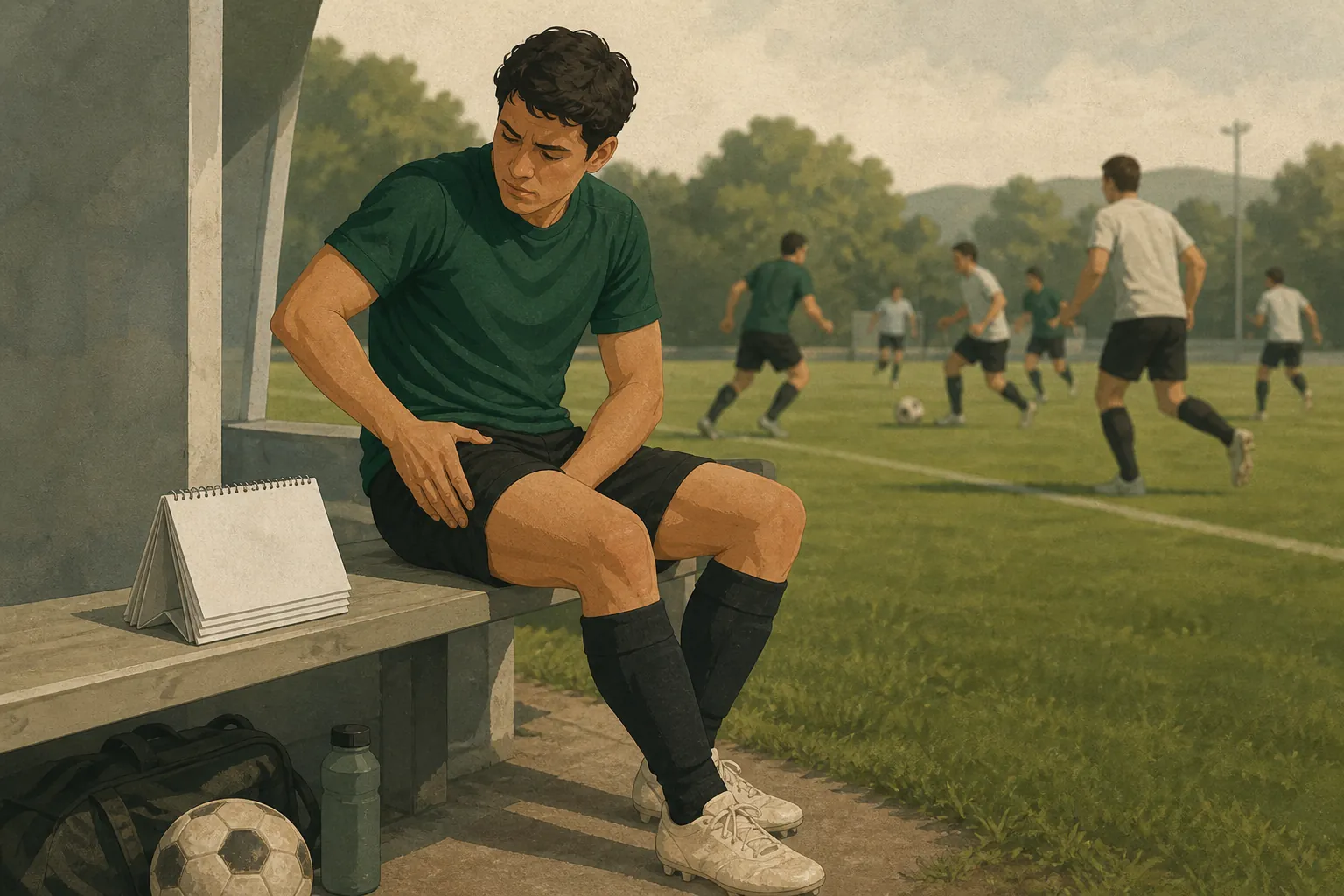
That matters most for the person who feels almost fine. You can walk. You can maybe jog. It only grabs when you open your stride, push off, cut, shoot, sprint, or try a heavier lower-body session. That is the dangerous middle: too good to feel injured, not yet good enough to trust.
| Likely injury category | Typical recovery expectation | What this means in practice |
|---|---|---|
| Mild strain / grade 1 | Often around 2–4 weeks in public-facing rehab ranges | Walking usually settles first; running, sprinting, cutting, and heavy adduction still need pain-free progression. |
| Moderate strain / grade 2 | Often around 4–8 weeks in some grade-based ranges | Symptoms may improve before strength and sport-specific tolerance are back. |
| Severe strain / grade 3 or suspected rupture | Often months, not weeks; some sources place severe cases around 3–4 months or longer | This belongs with diagnosis and supervised rehab, not a home-only timeline. |
Before any home plan: severe pain, major bruising, a popping sensation with sudden loss of function, visible deformity, inability to walk normally, suspected rupture, numbness, testicular pain, or symptoms that are not improving should move you out of self-management and into a clinical exam. A home exerciser cannot confidently grade a tear from vibes, soreness maps, or how brave the first jog felt.
The best timeline data is really a set of gates
The most useful recovery study for this question followed athletes with acute adductor injuries through a criteria-based rehab process. In that prospective cohort, athletes with MRI grade 0–2 injuries were pain-free at a median of 13 days and returned to full team training at a median of 18 days. Athletes with grade 3 injuries took much longer: a median of 55 days to become pain-free and 78 days to return to full team training.[1]
Those numbers are tempting. Thirteen days sounds like permission. Eighteen days sounds like a plan. But the study was not “wait two and a half weeks, then play.” The athletes were male, supervised, diagnosed, and progressed through explicit criteria. That is why the timeline is useful, and also why it should not be treated like a promise for someone doing random stretches in a living room.
The return benchmarks in that cohort were concrete: pain-free adductor palpation, pain-free maximal passive adductor stretch, pain-free 10-repetition-maximum resisted adduction, and pain-free Copenhagen adduction performance for 10 repetitions.[1] In plain language, the athlete had to tolerate touch, stretch, hard contraction, and a demanding adduction task without pain before being treated as ready for the next level.

That changes the question. “It has been 16 days” is less helpful than “Can I squeeze, stretch, resist, jog, accelerate, and change direction without the groin answering back?” The person who only uses the date will often find the last painful corner of the injury during the first hard session back.
What you can check at home without pretending to be your own MRI
Home checks are not a diagnosis. They are a way to stop lying to yourself. If a test produces sharp pain, guarding, or a familiar “that’s the spot” response, the answer is not to push harder to see what happens. The answer is that the current level is not yet boring enough.
| Milestone | A practical home version | What you are looking for |
|---|---|---|
| Pain with touch | Gently press along the tender inner-thigh/adductor area and compare side to side. | No sharp local tenderness and no protective flinch. |
| Pain with stretch | Use a controlled, gentle adductor stretch position rather than forcing range. | No pain during the stretch and no symptom increase afterward. |
| Pain with contraction | Start with an easy ball or pillow squeeze, then progress only if it stays pain-free. | Both sides feel controlled; no groin pain during or after. |
| Strength under load | Progress toward stronger resisted adduction and, much later, Copenhagen-style variations. | No pain and no obvious side-to-side collapse or compensation. |
| Running and sport exposure | Walk, jog, stride, accelerate, decelerate, and change direction in separate steps. | No pain during the session and no next-day flare. |
This is where adductor strain recovery exercises at home fit in: not as a heroic workout, but as the exercise plan behind these milestones. Early work should usually feel controlled and almost underwhelming. Heavy Copenhagen work may be excellent later in rehab or prevention contexts, but it does not belong in the first few painful days of an acute strain.
A simple rule helps: progress the type of stress before you progress the drama. Walking before jogging. Jogging before strides. Straight-line running before cutting. Light squeezes before hard resisted adduction. Short lever Copenhagen-style work before long lever versions, and only after easier adduction is quiet.
For the first few days, the useful work may be less about “strengthening” and more about protecting the area while keeping the rest of life moving. If you need a broader acute-injury frame, the soft-tissue injury recovery guide is a better place for that early PEACE & LOVE style thinking than trying to turn day two into a strength test.
Why “I can jog” is not the same as “I can play”
A groin strain often lets you negotiate. It may allow a normal walk, then a short jog, then a little faster running. The bill arrives when the task asks for adduction strength under speed: cutting, planting, skating strides, lunging for a pickleball, opening up for a sprint, or striking a ball.
That is why return-to-training should be staged by task, not by confidence. A runner who can jog for 20 minutes may still be unready for intervals. A soccer player who can run laps may still be unready to cut. A lifter who can bodyweight squat may still be unready for wide-stance heavy work or lateral lunges. The tissue is not only being asked, “Can you move?” It is being asked, “Can you produce and tolerate force in the direction that hurt you?”
The sibling lesson shows up across strain rehab: useful timelines are grade-based at the start and criteria-based at the end. That same calendar-versus-criteria logic is why a hamstring strain recovery plan or even an ankle sprain recovery timeline can look familiar without being interchangeable. Different tissue, same mistake: using time served as proof of readiness.
The reinjury number that should change your decision
The reason to wait for pain-free criteria is not politeness. In the Serner cohort, the overall one-year reinjury rate was 8%, but athletes who met the pain-free criteria before return had a 5% reinjury rate compared with 21% in those who did not meet the criteria.[1]
That contrast is the part to keep in your head when the groin feels “basically fine.” Returning before the gates are met was associated with about four times the one-year reinjury rate. It does not prove that every early return causes a re-tear, and it does not tell you exactly what will happen in your body. It does make one thing hard to ignore: pain-free testing is not cosmetic.
The broader groin-pain literature points the same direction. Thorborg and colleagues describe that about 90% of adductor longus injuries resolve within 1–3 weeks, but long-standing adductor-related groin pain lasting more than 6 weeks can take 6–9 months. They also report seasonal groin problem prevalence of 20–60% and reinjury rates of 15–30% in athletic populations, and they highlight active exercise rehab as much better supported than passive treatment.[2]
That does not mean massage, heat, rest, or hands-on care are useless for symptoms. It means they should not be the whole plan. The groin eventually has to prove it can handle the job you want to give it.

A practical return progression
Once daily walking is normal and basic squeeze or adduction work is pain-free, progression can become more specific. Not all of these steps need a full week. Some may take days. Some may take longer. The rule is that the next step should not create pain during the session or a meaningful symptom increase later that day or the next morning.
- Normal walking and stairs without guarding.
- Gentle adductor isometrics, such as light squeezes, without pain.
- Progressive resisted adduction with control and no symptom rebound.
- Easy straight-line jogging.
- Faster running exposures, still straight-line.
- Acceleration and deceleration.
- Controlled lateral movement and cutting.
- Practice or training with limits before full competitive intensity.
For a home exerciser, the trap is usually skipping from step 2 to step 8 because the day feels good. For a field athlete, it is mistaking straight-line jogging for return-to-play. For a lifter, it is reintroducing heavy lower-body work before resisted adduction feels symmetrical and boring.
If you need the exercises laid out phase by phase, use the companion groin injury recovery routine as the practical map. This article is the timeline and decision filter; the routine is where the day-to-day loading belongs.
When the timeline stops looking normal
Progress does not have to be perfectly linear. A mildly irritated day after adding a new movement is not automatically a disaster. But the general direction should be clear: less tenderness, better walking, easier squeezing, more range, and more confidence under controlled load.
Get help if the injury is not improving, if pain stays sharp with simple adduction, if bruising or weakness is substantial, if you cannot progress beyond walking or light jogging, or if symptoms are still behaving like an active groin problem after several weeks. Long-standing adductor-related groin pain is a different category from a straightforward acute strain, and the literature describes recovery in months rather than days once symptoms persist beyond 6 weeks.[2]
This is also where a clinician can do what a home checklist cannot: confirm the likely tissue involved, screen for other causes of groin pain, estimate severity, and supervise loading if strength is clearly asymmetric. If your main question has become “why does this keep coming back?” a general home injury rehab primer can help organize the bigger process, but recurrent groin pain deserves more than another week of guessing.
So, when can you train again?
If this is a mild-to-moderate adductor strain, symptoms are steadily improving, walking is normal, palpation and stretch are pain-free, resisted adduction is pain-free, and running progressions do not cause a same-day or next-day flare, then a gradual return toward training can be considered. That may land near the two-to-four-week range for many uncomplicated cases, especially with structured rehab, but the date is not the clearance.
If pain persists, strength is obviously different side to side, cutting or sprinting still reproduces the injury, or the original injury was severe or unclear, the next step is diagnosis and supervised rehab rather than another attempt to outrun the calendar.
References
- Return to Sport After Criteria-Based Rehabilitation of Acute Adductor Injuries in Male Athletes: A Prospective Cohort Study, PMC, 2020
- Clinical and Practical Concepts for Acute and Long-Standing Adductor-Related Groin Pain in Athletes, PMC, 2023
- Physical Therapy for Hip Adductor Strain, The Game Plan PT
- Groin Strain Exercises, Healthline
- Adductor Strain Rehab, E3 Rehab
- Groin Strain, Physiopedia
What a small equipment investment adds
We don't have a build tagged to this exact tier yet. Browse all builds.
How often should you repeat this?
See our recovery and rest reference for citation-anchored rest-interval guidance.
Spot something off?
Tell us if a movement, tier assumption, or duration didn't match your experience.