Most people searching for alan ritchson fitness training regimen are not really looking for a celebrity split. They are trying to answer a smaller, more useful question: if you have a floor, a doorway pullup bar, maybe a park nearby, what can you do now that actually prepares you for harder training later?
That is where Alan Ritchson's training story is more useful than the usual transformation headline. Based on multiple interview accounts, his path has three clear tiers: bodyweight park work, weighted calisthenics, and then a fuller home gym setup with machines and free weights. The order matters. The Smith machine and cable station are the later chapter, not the entry fee.
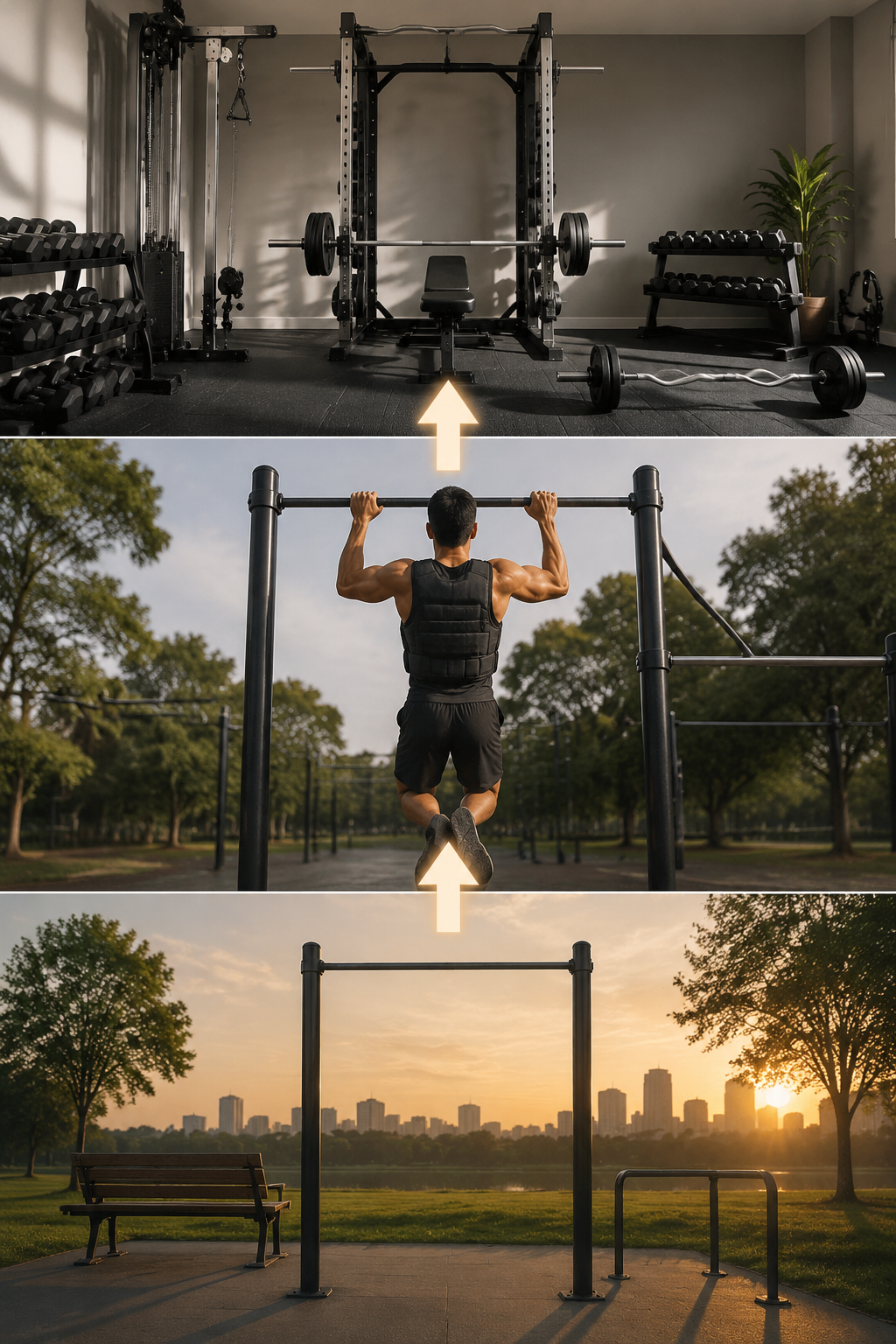
Ritchson has said his earlier routine was blunt: run to a park, do 100 pushups, 100 pullups, 100 dips, and 100 situps, then run home. On cardio days, he described running 5 to 7 miles, with longer runs up to 13 miles when he wanted distance work.[1] That is not a beginner workout prescription. It is a snapshot of a high-volume calisthenics base built over time.
The better lesson is the ladder underneath it. First, repeat simple movement patterns until they stop feeling like a novelty. Then add load only when bodyweight work has stopped giving you enough challenge. Then buy equipment because it solves a training problem you have actually earned, not because a famous actor owns it.
If you want a broader template for building training around equipment tiers, a home gym workout plan that grows with your equipment maps neatly onto this same idea: start with what you can repeat, then expand when your current tools become the limiting factor.
The Three-Tier Path, Without the Celebrity Fog
| Tier | What it uses | What it teaches | When it makes sense to move on |
|---|---|---|---|
| 1. Bodyweight park work | Running, pushups, pullups, dips, situps | Repeatable movement patterns, work capacity, honest strength-to-bodyweight control | You can perform clean reps consistently and need harder loading or better progression |
| 2. Weighted calisthenics | Weighted vest added to pullups, pushups, squats, and similar movements | Progressive overload without buying a full gym | The vest no longer gives enough variety, comfort, or loading options |
| 3. Home gym split | Smith machine, cable machine, EZ bar, dumbbells, weighted vest | More angles, more stable loading, easier isolation work, and higher exercise variety | This is the advanced equipment stage, not the starting point |
The table looks clean. Training does not. You may spend months in the first tier, years in the second, or skip some equipment because your joints do not like it. Ritchson himself is a useful example here because the visible end point was not built by skipping the boring parts.
Tier 1: The Park Circuit Is a Direction, Not a Dare

The original park routine has a useful roughness to it. No app. No cable attachment. No debate over whether the bench angle is optimal. Run there, do the work, run back. The movements are basic enough to remember and hard enough to expose exactly where you are weak.
The mistake is seeing the 100-rep targets and trying to copy them on Monday. One hundred pullups is not the same training stress as 100 situps, and for many beginners, even 20 total pullups across a session is not available yet. The target is better treated as a long-range structure: four movements, accumulated volume, clean reps, and enough rest that the later sets still look like training instead of panic.
A scalable version keeps the same bones while lowering the dose:
- Run, brisk-walk, or bike to the park if the commute itself is part of your conditioning.
- Choose one push movement: pushups, incline pushups, or dips if your shoulders tolerate them.
- Choose one pull movement: pullups, chinups, band-assisted pullups, negatives, or inverted rows.
- Choose one trunk movement: situps, dead bugs, hollow holds, or hanging knee raises.
- Accumulate total reps across sets instead of forcing one perfect set count.
For a beginner, that might mean 25 total pushups, 10 assisted pullups, 20 bench dips or close-grip pushups, and 30 controlled core reps. For an intermediate trainee, it might mean 50 to 75 total reps on the easier movements and a smaller, stricter target on pullups. These are hypothetical examples, not claims about Ritchson's exact programming.
The point is not to worship the park. The point is that Tier 1 makes excuses harder to hide behind. If you cannot repeat pushups, pullups or their regressions, dips or their substitutes, and trunk work for several weeks, a more expensive setup will not fix the real bottleneck. It will just give you more ways to avoid it.
What Tier 1 Should Prove Before You Add Equipment
You are ready to consider the next tier when your reps are repeatable, your joints are not constantly irritated, and you can progress something without needing a motivational event. That might mean more total reps, cleaner tempo, shorter rest, harder variations, or more weekly sessions. None of those require a machine.
This is also where the long background matters. Ritchson reportedly spent about 20 years using bodyweight-focused training before adding more weights for Reacher.[2][1] That does not mean everyone needs two decades of calisthenics before touching a dumbbell. It does mean the physique people notice was not built from a cold start with a cable stack.
Tier 2: The Weighted Vest Is the Bridge
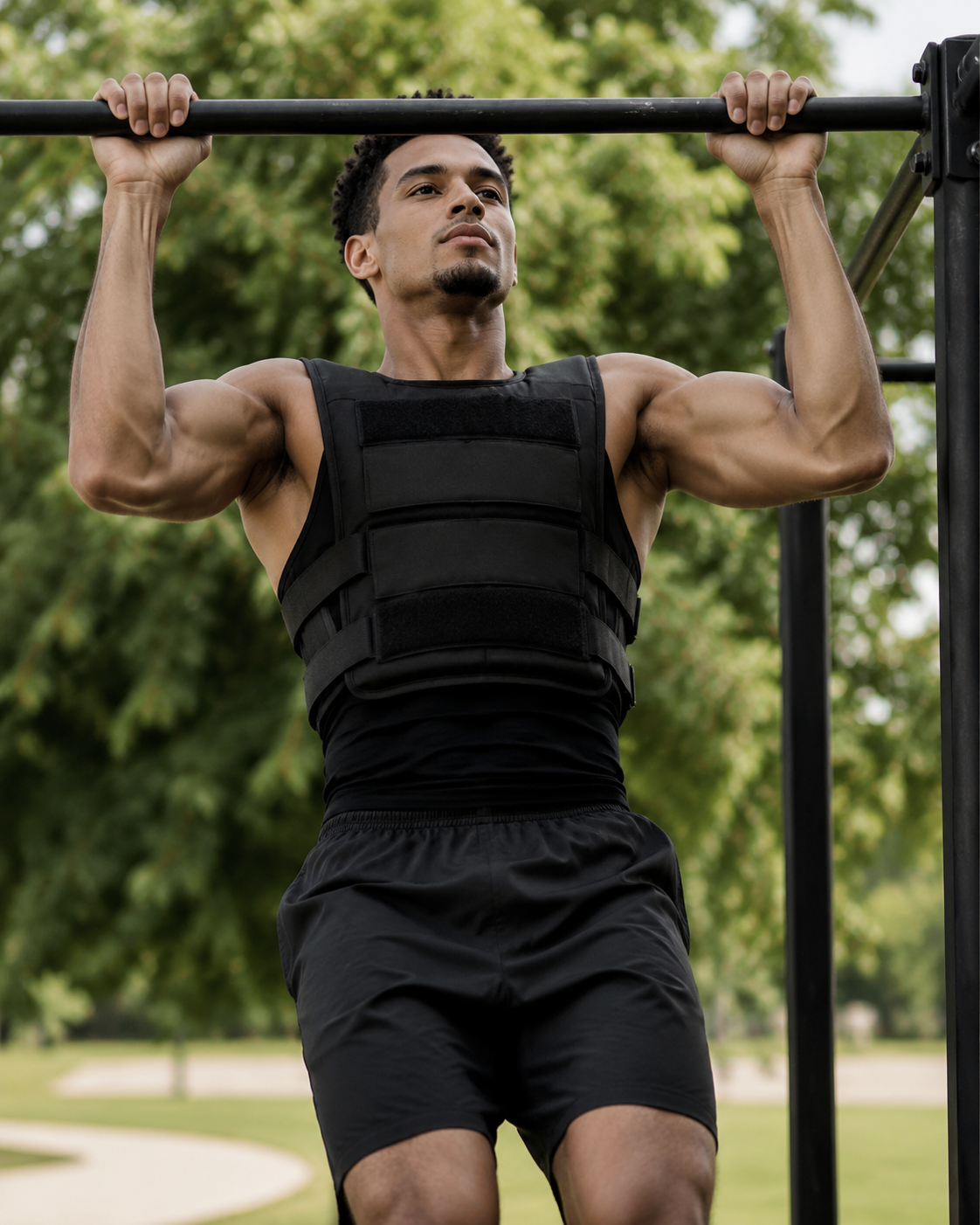
The weighted vest is the most underrated part of the progression because it does not feel glamorous. It is also the cleanest bridge between bodyweight work and a fuller gym. Gravity Fitness describes Ritchson using 10 to 20 kilogram weighted vests to progress movements such as pullups, pushups, and squats before buying gym equipment.[3]
That detail matters. A vest keeps the same movement pattern and changes the load. You already know how your pushup feels. You already know whether your pullup is strict or ugly. When you add a small amount of weight, the feedback is immediate. If your range of motion disappears, the load is too much. If your shoulders complain, the variation may not be right for you. If your reps drop but your form holds, you have found a useful progression.
A vest also slows down the urge to buy around a weakness. If your pullups are stuck because you have never trained them consistently, a cable machine will not magically build the discipline. If your pullups are stuck because bodyweight is now too light for low-rep strength work and too repetitive for hypertrophy work, a vest makes sense.
How to Use the Vest Without Turning Every Set Into a Test
The first job of the vest is not to make the workout look harder. It is to create a smaller step between bodyweight and machine-based loading. Use it on movements you already own. Keep some unweighted work in the week so your joints and tendons are not asked to absorb every session at a higher load.
- Use the vest for one or two main movements per session, not every exercise.
- Start with a load that lets you keep full range of motion and the same rep quality.
- Progress total reps before chasing heavier vest weight.
- Remove the vest for warmups, technique work, and higher-rep back-off sets.
- Treat discomfort in the shoulders, elbows, knees, or low back as information, not as a character test.
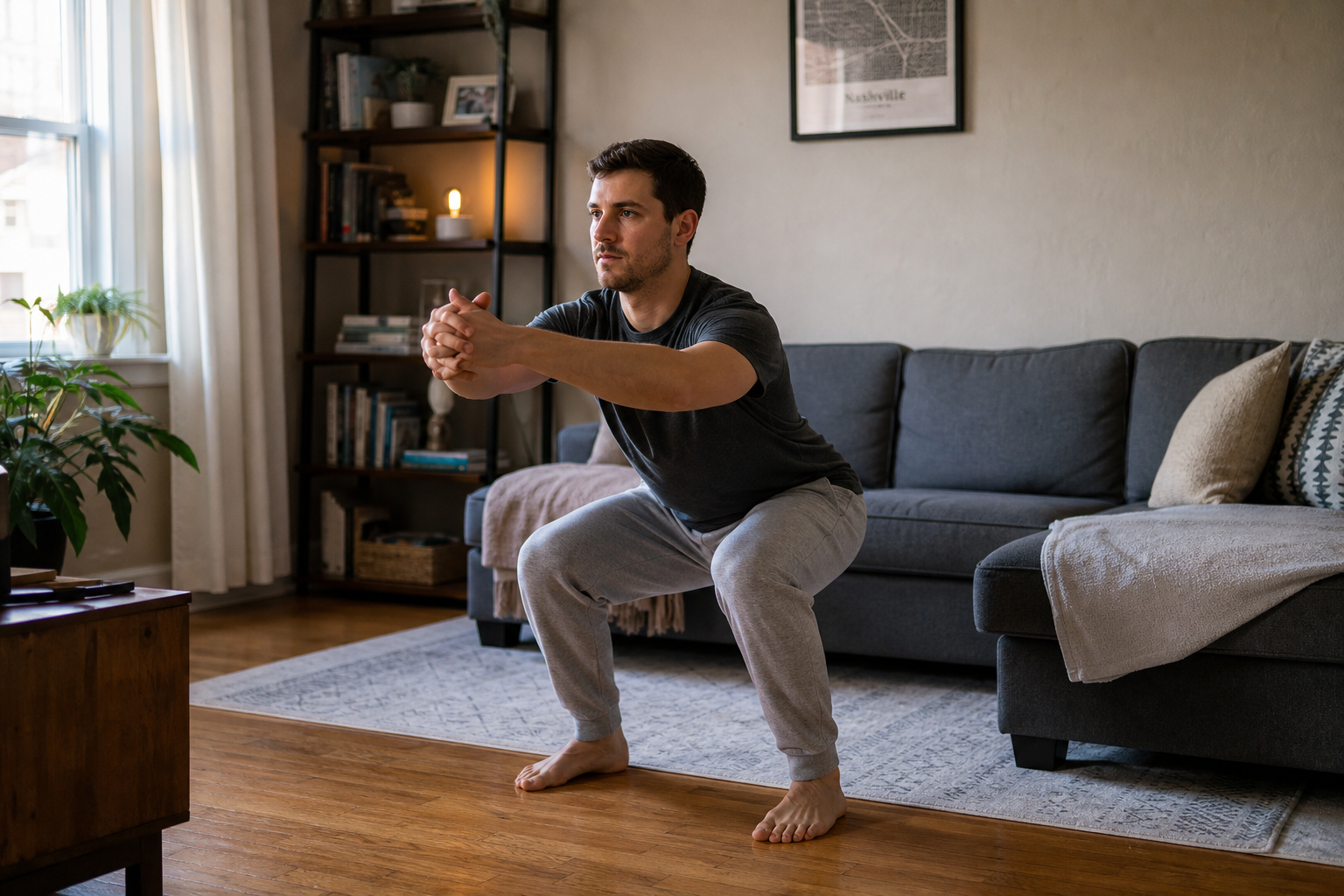
For home trainees, this is often the first purchase that truly changes training. A pullup bar and a vest can carry a lot of work: weighted pullups, weighted pushups, split squats, step-ups, carries, and conditioning circuits. It still does not replace every machine, but it delays the need for one until you know exactly what you are missing.
Tier 3: The Home Gym Adds Options, Not Magic
The advanced version of Ritchson's setup is where the internet usually wants to start. Men's Health showed a home training roster that included a Smith machine, cable machine, EZ bar, dumbbells, and a weighted vest.[1] That is a serious setup, and it gives you things bodyweight work cannot provide as easily: stable pressing, controlled pulling angles, easier isolation work, and more ways to load muscle without depending on one heroic calisthenics variation.
A Smith machine can make certain presses and rows easier to load at home. A cable machine gives smoother resistance for rows, pulldowns, lateral raises, curls, triceps work, and torso training. Dumbbells and an EZ bar fill in pressing, curling, rowing, and arm work without needing a commercial gym. The vest still belongs because loaded calisthenics does not stop being useful just because there is a machine in the room.
This is the stage where buying decisions should become specific. If your limiting factor is vertical pulling, a cable or pulley setup may solve more than another pair of dumbbells. If your limiting factor is lower-body loading and you cannot tolerate certain barbell lifts, a Smith machine, split squat setup, or dumbbell progression may be more useful than forcing the classic squat-and-deadlift script.
That last point is not theoretical. One detailed reconstruction of Ritchson's training notes that he avoids squats and deadlifts, with squats aggravating his lower back.[4] That does not make squats or deadlifts bad exercises. It makes the more practical point: advanced training is not about copying the sacred lift list. It is about loading hard work in ways your body can repeat.
Because Ritchson has not published a single official program, exact set-and-rep reconstructions should be treated carefully. The reliable pattern is broader: he moved from bodyweight volume, to added load through a vest, to a more complete home gym split. That is enough to guide a home trainee without pretending a third-party split is a certified template.
Where the Reacher Transformation Stops Being a Model
The 30-pound headline is where expectations need a hard boundary. Ritchson has described gaining around 30 pounds in eight months for Reacher, training five days per week for the role, and later saying it was probably true that it should not happen that fast. He also described a broken AC joint and hormone depletion connected to that push.[5]
Other coverage has put the transformation in the 30 to 35 pound range over roughly the same eight-month window.[1][2] That is the kind of pace that belongs to a film production context with unusual pressure, not to a normal home trainee with a job, a family, and joints he would like to keep using.
The testosterone piece belongs in the same conversation, not as a whisper at the end. Ritchson has been open about using prescribed testosterone replacement therapy after Season 1, describing it as medically supervised and saying he takes a low clinical dose while training very hard.[6] Healthy Male, writing more generally about TRT in response to public discussion of his case, emphasizes that testosterone treatment is medical care for clinically indicated situations, not a casual performance shortcut.[7]
That distinction matters for trust. TRT does not erase the work. It also does not make the Reacher timeline a sensible target. The ordinary reader should not copy the accelerated bulk, should not treat hormone treatment as a fitness accessory, and should not judge his own progress against an actor preparing for a role under conditions he does not share.
What to Do at Your Current Equipment Level
If you have no equipment, start with the Tier 1 pattern. Pick a push, a pull regression, a dip or triceps-friendly substitute, a trunk movement, and a simple conditioning piece. Track total clean reps. Add volume slowly. Make the same movements show up often enough that your body learns them.
If you have a doorway pullup bar, you already own the most important piece of the first tier. Pair it with pushups, floor core work, split squats, and walking or running. A park gives you more room and better bars, but the principle is the same: repeatable work before exotic equipment.
If bodyweight work is no longer enough, add load before you add complexity. A weighted vest is the cleanest first bridge for many people because it upgrades movements you already know. It is not cheap decoration. It should make your best exercises trainable again.
If you have proven consistency and need more variety, then the home gym tier starts to make sense. Dumbbells usually beat most novelty tools. A cable machine is worth considering when you need adjustable pulling angles and isolation work. A Smith machine can be useful when stable loading matters more than barbell purity. The right purchase is the one that removes the clearest bottleneck in your current training.
The useful version of Alan Ritchson's training progression is not the fastest one. It is the sequential one. Build the bodyweight base. Add a vest when bodyweight is no longer enough. Build toward machines and a fuller home gym only when your training has become consistent enough to need them. His long progression is worth learning from; the accelerated Reacher transformation is not the timeline to chase.
References
- Alan Ritchson Shows His Gym & Fridge, Men's Health
- Alan Ritchson Diet Workout Jack Reacher, GQ
- Alan Ritchson's Reacher Workout: Build a Jacked Physique with Bodyweight Training, Gravity Fitness
- The Alan Ritchson Workout and Diet Plan for Reacher Season 3, Kyle Hunt Fitness
- Alan Ritchson Is Ready for Reacher to Get Darker, Men's Health
- Alan Ritchson Talks Testosterone Therapy, Men's Health
- Alan Ritchson, TRT and testosterone replacement therapy, Healthy Male
Comments
Join the discussion with an anonymous comment.