
“We talkin’ about practice” has become the kind of line people use when they already know they are about to skip something. The shoes are still by the door. The mat is still rolled up. The plan was squats, push-ups, hinges, rows, maybe a short finisher. Then the day gets long, the room feels cramped, the motivation is gone, and somebody reaches for Allen Iverson like he gave us all a permission slip.
That is a lazy way to use a painful clip. Iverson was not standing there as the patron saint of doing nothing. He was at a 2002 press conference, saying “practice” again and again until the word stopped sounding like a basketball term and started sounding like a bruise. The famous count is 22 mentions in a press conference that ran about 31 minutes, and the timing matters: it came days after the murder trial began for the death of his best friend, Rahsaan Langford, while Iverson was also dealing with injuries and the aftermath of another heavy playoff workload.[1][2][3]
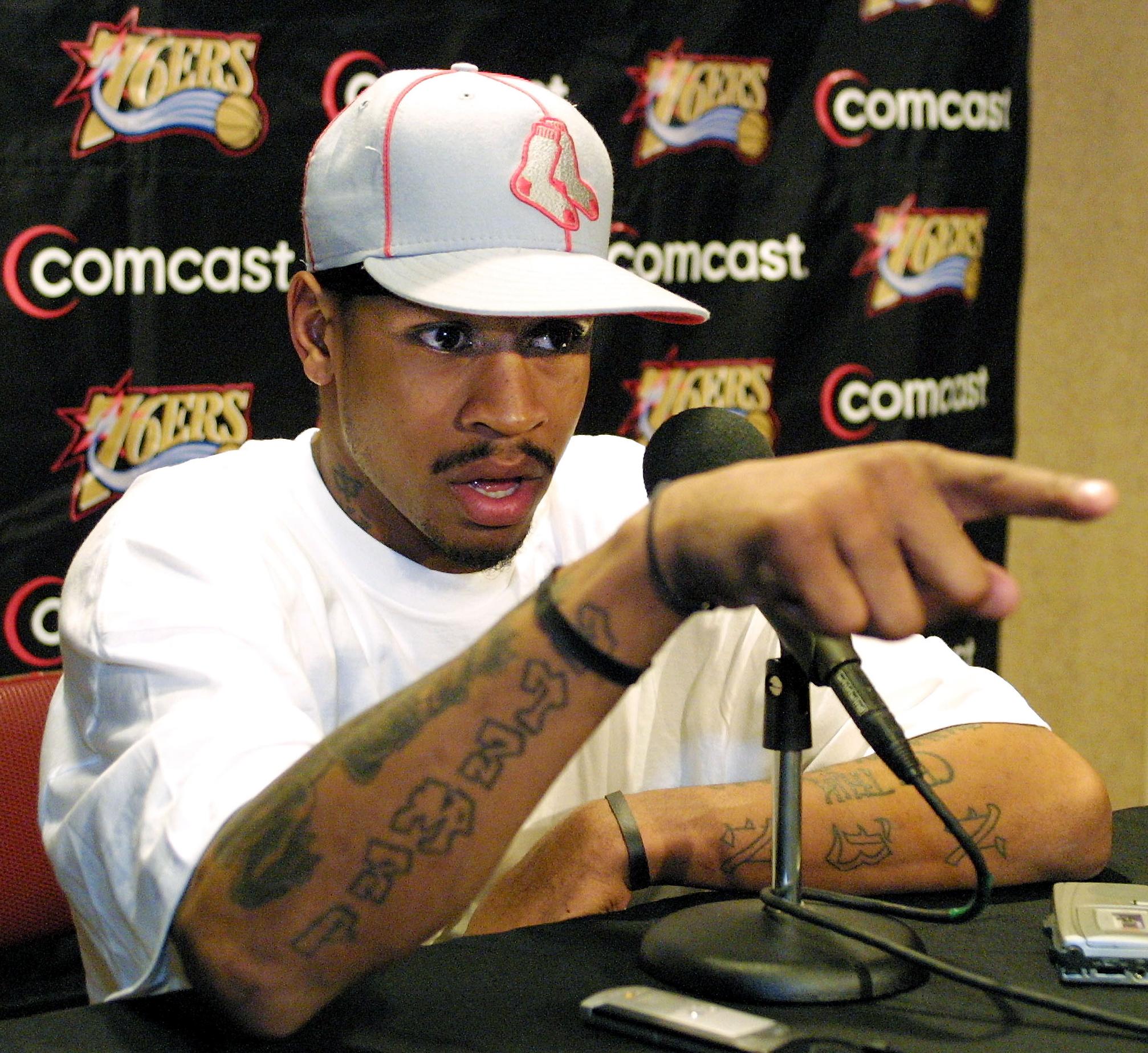
The meme trims away the part that makes the moment hard to judge cleanly. Iverson was not asking why practice ever mattered. He was asking why the room wanted to talk about practice when, in his mind, the games had already answered the question that mattered. In the 2001 playoffs, he averaged more than 41 minutes per game, and the larger Iverson mythology was built partly on the fact that he played through pain and rarely treated game night as optional.[1]
That does not make him right about everything. Coaches and teammates still had to build timing, spacing, trust, and rhythm around him. A superstar can survive on gifts, toughness, and improvisation in ways a whole roster cannot. Practice is where lesser players find their minutes, where defensive habits get boring enough to be useful, where the pass arrives before the cutter has to wave for it. Iverson’s frustration was understandable. It was not a complete training philosophy.
The Part the Meme Leaves Out
The useful lesson from the Allen Iverson practice rant is not “skip the work.” It is that feelings and performance are not the same thing. Iverson could be grieving, irritated, hurt, exhausted, and still be the person expected to carry the ball, absorb contact, take late-clock shots, and play huge minutes when the game started. That separation is not clean or inspirational. It is messy. It also explains why the clip still has more to teach a home exerciser than most polished motivation speeches.
Most people do not need an NBA-level relationship with pain. In fact, copying that would be foolish. A stiff knee, a fever, a health setback, or real exhaustion deserves more respect than the internet usually gives it. But the ordinary failure point in home training is often smaller and more familiar: the mood is bad, so the appointment gets canceled. Not adjusted. Canceled.
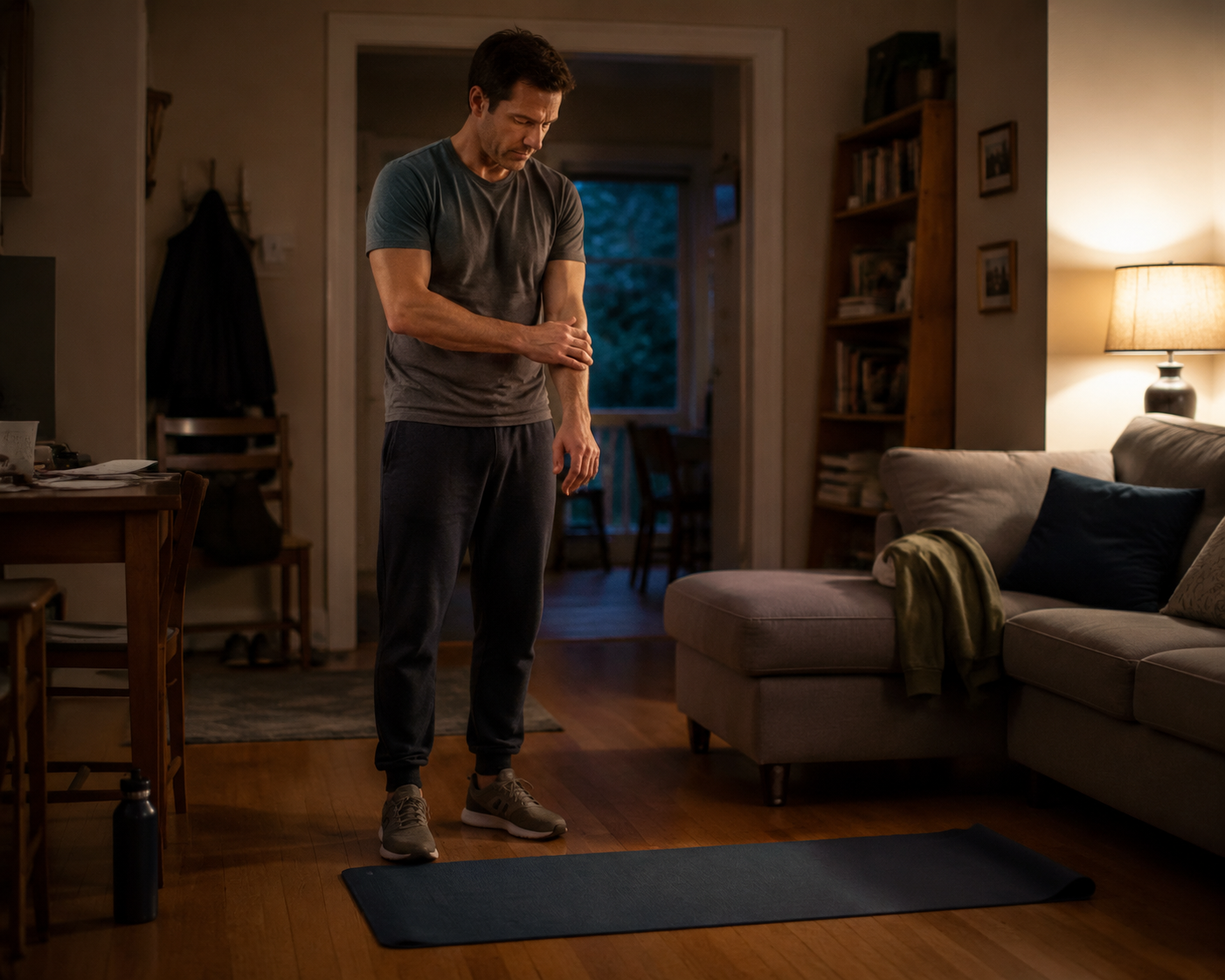
That is where the rant gets misread in a way that matters. Iverson did not feel like giving the room what it wanted that day. He still had a record of showing up when the lights came on. The home version is not heroic. It is standing in the living room at 7:40 p.m. and deciding that the first five minutes still count.
Motivation Is Weather, Not Fuel
A lot of home workout plans are secretly built for the most motivated version of the person who wrote them. They assume clear space, good sleep, full privacy, a predictable evening, and a brain that still wants to negotiate with burpees after dinner. Then a normal day happens.
This is why all-or-nothing thinking wrecks more routines than lack of knowledge. The person already knows a walk is better than the couch, that two sets are better than zero, that a short mobility circuit is better than letting the whole week become a shrug. The problem is not information. The problem is that the “real workout” has become the only workout that counts.
Resolution data points in the same direction. A 2026 training-consistency roundup cites the familiar pattern that roughly 80% of fitness resolutions are abandoned by mid-February, and it describes the Fresh Start Effect as a motivation spike that often fades within three to six weeks when no repeatable structure replaces it.[4] Treat that as a useful summary of the behavior problem, not as a magic law of human failure.
Motivation is allowed to visit. It just should not hold the keys. If a workout only happens when the mood is right, then weather, noise, a missed morning window, or a mildly chaotic room gets a vote. For readers who keep losing sessions to rain, heat, darkness, or lack of space, a plan for bad-weather home workouts is not a backup. It is part of the system.
Shrink the Workout Before You Skip It
The most practical answer to low workout motivation is not to argue with yourself for 25 minutes. By then, the workout has already become a courtroom drama. Shrink the session before it becomes a verdict on your character.
| If the planned workout was | The minimum version can be |
|---|---|
| 45 minutes of full-body strength | Two rounds of squats, push-ups, rows, and glute bridges |
| A run outside | Ten minutes of step-ups, marching, or low-impact intervals indoors |
| A hard conditioning session | A warm-up plus one controlled finisher |
| A mobility routine | Five minutes on hips, upper back, and breathing |
This is not lowering standards. It is protecting continuity. A minimum effective dose keeps the identity of the appointment alive: I said I train on this day, and I did something that belongs to that promise. The body gets a smaller stimulus. The habit gets a full repetition.
For small apartments, shared homes, or late-night sessions, the minimum version also has to be socially realistic. Nobody needs to prove dedication by rattling the floorboards at 9 p.m. A quiet strength session built around controlled reps, pauses, carries, and floor work can keep the streak alive without turning the downstairs neighbor into a training variable. A small-space quiet strength plan fits that job better than another speech about wanting it badly enough.
Make Starting Less Dramatic
Habit research is often flattened into slogans, but one point is worth keeping: repeated behavior in a consistent context tends to become more automatic over time. The Sundried summary cites the commonly repeated 66-day habit-formation figure associated with Lally’s work, which is better understood as an approximate average than a deadline.[4]
The important word is context. A home workout should have fewer moving parts than a playoff possession. Same corner of the room. Same first exercise. Same playlist or timer if that helps. Same rule for what happens after brushing teeth, after closing the laptop, or after the kids go down. This is habit stacking without the cute packaging: attach the workout to something that already happens, then stop reopening the debate.
- Put the shoes, mat, band, or dumbbells where the session begins.
- Use the same warm-up every time, even when the main workout changes.
- Set a floor for success: for example, ten minutes counts on bad days.
- Track completed appointments, not just calories, weight, or personal records.
- Decide the fallback workout before the day goes sideways.
Process goals matter here because they measure the thing you actually control. “Lose 15 pounds” may be meaningful, but tonight it is too far away to guide behavior. “Start the warm-up at 7:40” is close enough to obey.
Broken Streaks Are Not Evidence Against You
The all-or-nothing trap has a second move. First it says a shortened workout does not count. Then, after a missed week, it says the whole routine is dead. That is how one interruption becomes a month.
A better return plan is boring on purpose. Do the first session at a level that feels almost too easy. Keep soreness low. Rebuild the appointment before chasing the old numbers. If the break came from illness, injury, or a life disruption bigger than ordinary busyness, the next move should be more conservative; this return-to-home-fitness guide is the kind of reset that respects that difference.
Iverson’s example should not be stretched into a command to train through everything. Even elite sport is messier than simple maxims about rest and toughness. A 2026 study of NBA players from the 2014-15 through 2022-23 seasons found that games missed for rest or load management were not associated with decreased injury risk, but that finding belongs to a specific professional basketball context, not to someone deciding whether to do lunges beside a couch.[5]
The analogy is modest: performance systems are complicated. More rest is not automatically smarter. More grind is not automatically braver. The useful question is whether today calls for the planned session, the minimum session, or genuine recovery.
A Routine Gives the Mood Less Room to Argue
Once the principle is clear, the structure does not need to be fancy. Three strength days per week is enough for many home trainees to build a real rhythm, especially if the plan repeats often enough to remove guesswork. A program such as a 3-day fighter-style home routine can work because it gives the week a shape: train, recover, train, recover, train, then leave space for walking, mobility, or life.
The details can vary. Bodyweight, dumbbells, bands, stairs, a backpack, a pull-up bar if you have one. The nonnegotiable is not the tool. It is the decision made in advance: on training days, you start. If the full workout is available, take it. If not, take the smaller version before the day closes.
That is the cleaner reading of Iverson for ordinary training. Do not worship his extremes. Do not pretend practice was irrelevant to everyone around him. Do not turn grief into a gym quote. Take the part that still holds up after the meme fades: how you feel can be real without being in charge of whether the appointment happens.
References
- For Allen Iverson, it was never just about "practice" — Andscape
- ‘We talking about practice, man!’: An oral history of Allen Iverson’s epic rant — The Athletic, 2020-05-06
- The origin of Allen Iverson's practice rant — NBC Sports Philadelphia
- Top 10 Strategies to Optimise Your Training Consistency in 2026 — Sundried, 2026
- The Relationship Between Games Missed for Rest or Load Management and Injury in the NBA, 2014-15 Through 2022-23 — Springer Sports Medicine, 2026
Comments
Join the discussion with an anonymous comment.