
The most useful thing about Alan Ritchson's War Machine prep is not that it made him look hard on camera. It is that the work apparently made him tired in the plain, ugly way conditioning makes you tired. Ritchson said War Machine was "the most tired I've ever been," and director Patrick Hughes said the exhaustion seen on screen was real, not performed. Ritchson also described the role as another level harder than the long Reacher Season 3 fight sequence that already had a reputation for being punishing. [1]
That matters because War Machine was not built around a clean gym pump. The available behind-the-scenes material points toward ranger-style work: pull-ups, sprinting across uneven ground, tire flips or drags, and core training. [2] Other coverage of the production emphasizes Grade V rapids, mudslides, and mountain terrain, which is a different problem from adding another inch to an arm measurement. [3] Terrain does not care how good a lat spread looks. It asks whether you can pull, brace, run, recover, and do it again.
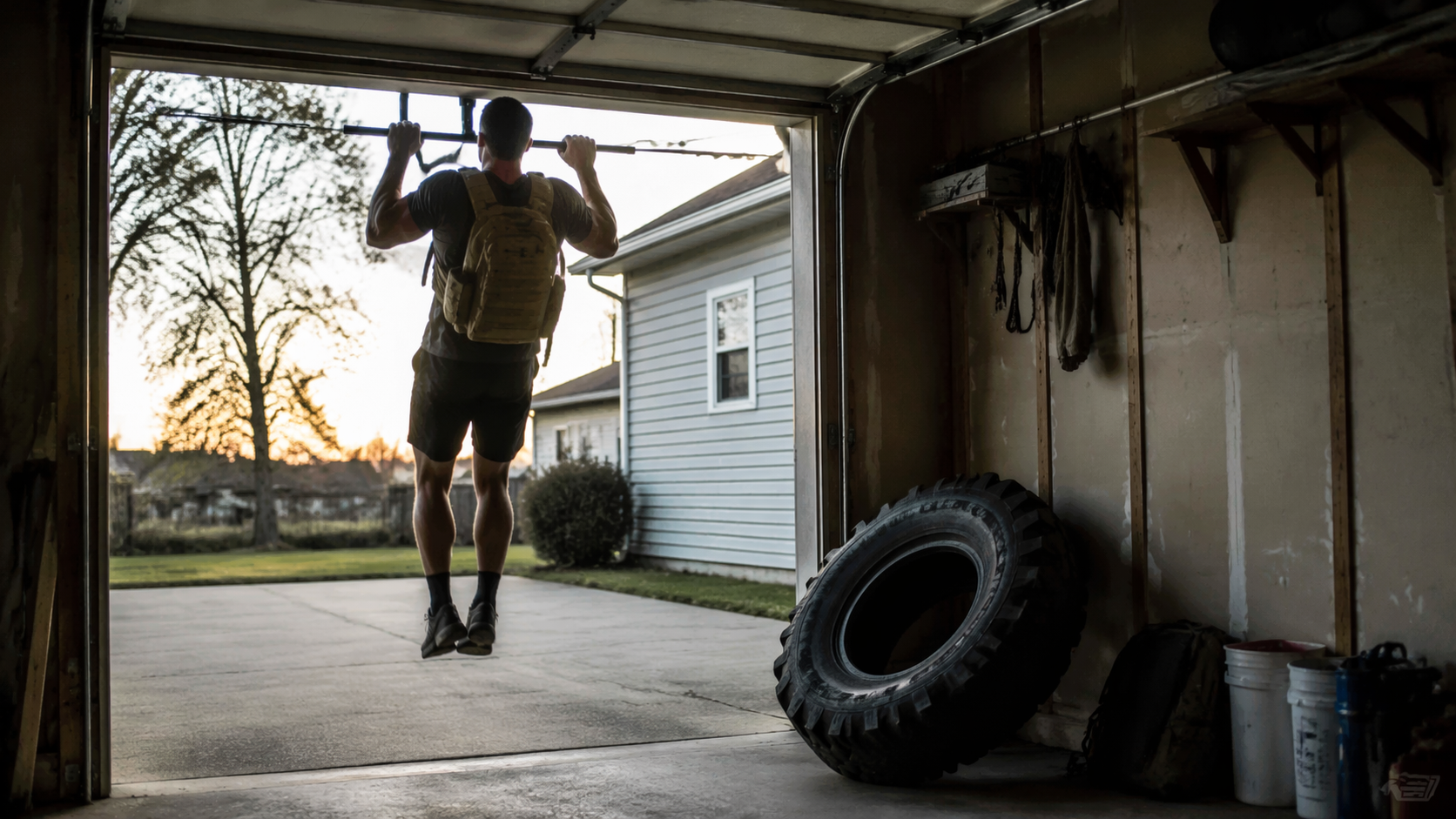
So if you came looking for Alan Ritchson workout secrets for War Machine, the honest answer is narrower and more useful than the usual celebrity-workout headline. No complete official War Machine program has been released. What we do have is a clear movement pattern from clips and interviews, and that pattern adapts well to a home setup if you have a pull-up bar, a loaded backpack, a safe sprint space, and enough training base to handle hard circuits.
This Is Not the Reacher Muscle-Building Plan
Ritchson's Reacher training gets mixed into nearly every search result because it is easier to package: big actor, big arms, big gym work. But War Machine asks a different question. The point is not how to recreate a Hollywood hypertrophy block. The point is how to train for repeated output when the surface, load, and fatigue keep changing.
That distinction keeps the home version from turning silly. The well-circulated 240-rep EZ-bar giant set belongs to Ritchson's Reacher or maintenance-style upper-body training, not to a confirmed War Machine-specific plan. Treating that arm-focused protocol as the War Machine workout blurs the one thing that makes this preparation worth borrowing: it was built around moving hard under bad conditions, not posing fresh under good lighting.
Ritchson did have a long bodyweight base before the bigger gym work became part of his public image. He told Men's Health that for years his basic workout was to run to a park, do 100 reps each of pushups, pullups, dips, and situps, then run home. [4] That old routine is not the same as War Machine prep, but it explains why the War Machine movements make sense for him. Pull, push, brace, run, repeat was already familiar territory.
The Home Version: Pull, Drag, Sprint, Brace, Recover
This session is an evidence-informed adaptation, not Ritchson's private training log. It keeps the documented War Machine ingredients and swaps the movie-set tools for what a regular person can use at home or in a park.
| Phase | Work | Dose | Home setup | Safety cue |
|---|---|---|---|---|
| Warm-up | Easy jog or brisk walk, shoulder circles, hip hinges, dead bugs | 5 minutes | Driveway, hallway, park path, or living room | Finish warm, not tired |
| Pull | Pull-ups or controlled chin-ups | 3 to 6 reps | Doorway bar, wall-mounted bar, or park bar | Stop 1 rep before form breaks |
| Drag or carry | Loaded backpack drag, bear-hug carry, or heavy farmer carry | 30 to 45 seconds | Backpack, duffel, sandbag, or safely loaded bag | Keep ribs down and spine quiet |
| Sprint | Hard run, hill sprint, shuttle, bike burst, or low-impact interval | 15 to 30 seconds | Grass, track, hill, bike, rower, or apartment-friendly march | Use a surface you can control |
| Brace | Plank, side plank, hollow hold, or crawling pattern | 30 to 45 seconds | Floor space or mat | Brace as if carrying load, not as if relaxing |
| Recover | Walk and nasal breathing if possible | 60 to 120 seconds | Any clear space | Start next round only when movement quality returns |
Run 4 to 6 rounds. If you are keeping it close to Ritchson's reported current rhythm of 5 training days per week with 20- to 30-minute sessions, this circuit fits that window without padding. [2] Most people should start with two nonconsecutive days per week, then add a third day only when the last round still looks like training rather than survival.
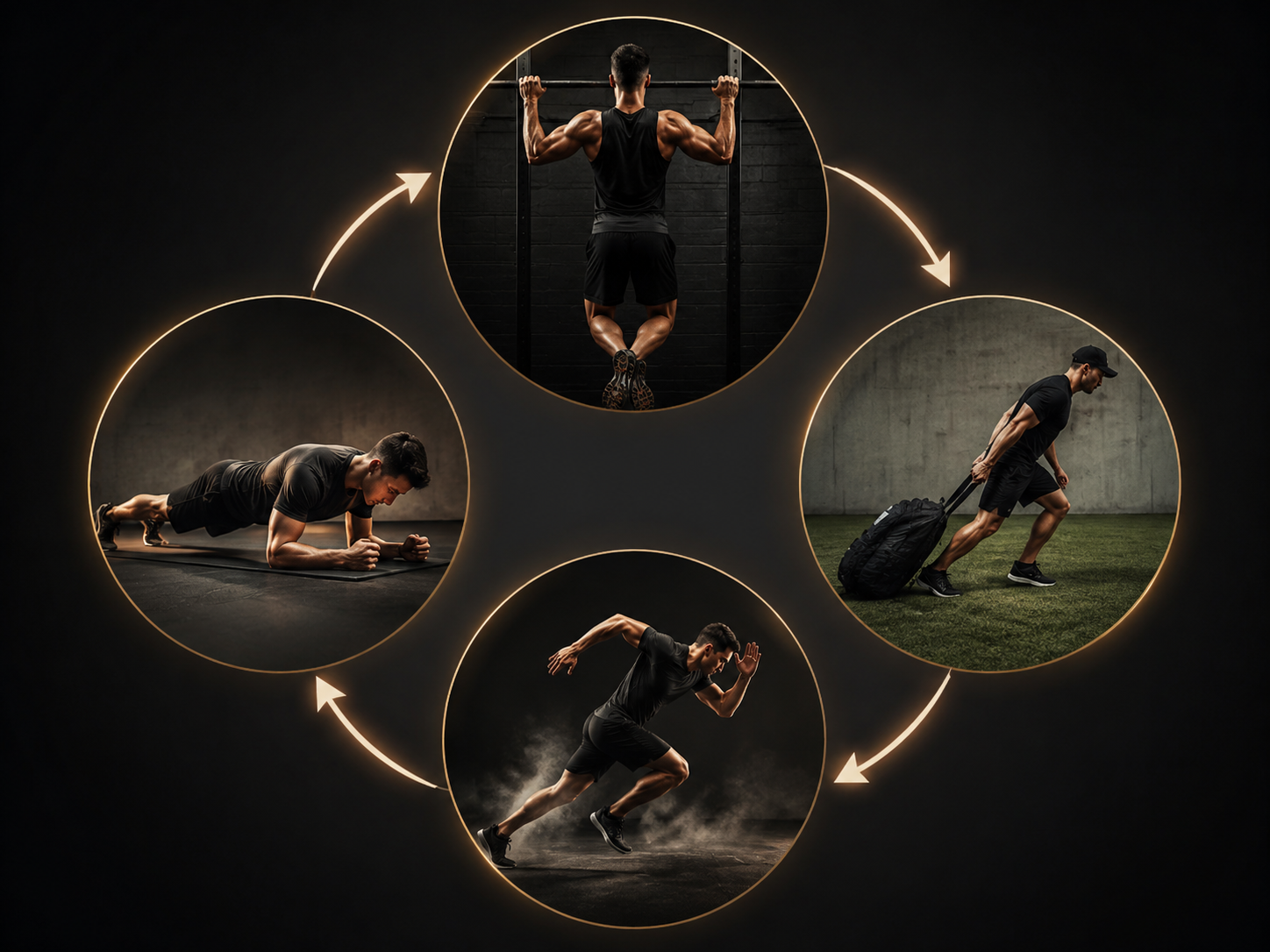
How to Load the Backpack
A tire drag looks better on video, but a backpack is easier to control and easier to scale. Put soft weight inside first: towels around books, water bottles wrapped so they do not shift, or a small sandbag if you have one. For a drag, attach a towel or strap only if it is secure and the floor or grass can handle it. For most homes, a bear-hug carry or suitcase carry is simpler than dragging anything across the ground.
The load should make your breathing change without making your gait collapse. If the bag swings, leaks, cuts into your neck, or forces you to twist every step, it is not more functional. It is just worse equipment.
The Sprint Does Not Have to Be a Movie Sprint
Uneven terrain was part of the War Machine environment, and behind-the-scenes coverage specifically notes sprinting on uneven ground. [2] That does not mean you should go hunting for a root-covered trail and hope your ankles are ready. The transferable piece is the short, hard burst under fatigue. A grass field, a gentle hill, a track straightaway, or a 10- to 20-yard shuttle can all do the job.
Apartment version: replace the sprint with fast step-ups, a stationary bike burst, a loaded marching interval, or a no-jumping conditioning block. If noise is the constraint, use a quieter small-space plan such as Build Muscle Without Making Noise or a no-jumping HIIT workout rather than turning every session into a downstairs-neighbor problem.
Why Pull-Ups Are the Anchor
Of all the War Machine movements, pull-ups deserve the most respect because they expose the gap between looking trained and being able to move your own body. They train grip, lats, upper back, trunk tension, and the habit of producing force while breathing hard. They also punish sloppy pacing. If you sprint first and then attack the bar like you are fresh, the bar will correct you.
For this circuit, clean reps beat heroic sets. Use a full hang if your shoulders tolerate it, pull until your chin clears the bar, and lower with control. If your best set is 8 pull-ups, do sets of 3 to 5 inside the circuit. If your best set is 3, use singles or band assistance. If you cannot yet do pull-ups at all, this is not the right starting point; build the base first with a beginner no-equipment plan and come back when pulling strength is no longer the limiting factor.
A doorway bar can be enough if it is installed and used safely. If you are still choosing equipment, start with the basics in How to Choose a Pull-Up Bar for Your Home. The bar is not decoration in this plan. It is the main strength test.
Core Work Here Means Staying Rigid While Tired
Core work is easy to underload and easy to overcomplicate. In this session, the goal is not a long plank for its own sake. The goal is to keep your ribs, pelvis, and spine organized after pulling, carrying, and sprinting have already pushed your breathing up.
- Use front planks if you lose position during carries.
- Use side planks if your backpack carry makes you lean or rotate.
- Use hollow holds if pull-ups make your legs swing.
- Use slow bear crawls if you want the brace to feel more like movement than a static hold.
Once the brace turns into sagging, shaking, and waiting for the timer, cut the interval. A shorter hold done under control transfers better than a longer hold survived with bad shape.
A 3-Day Week That Fits Real Life
If you are not being paid to recover like an actor, three focused sessions are plenty. Keep the movement pattern, change the emphasis, and leave enough room between days for joints and connective tissue to catch up.
| Day | Focus | Circuit Adjustment |
|---|---|---|
| Day 1 | Pull-up quality | Use easier sprint intensity and keep pull-up reps crisp. |
| Day 2 | Carry or drag endurance | Use moderate pull-up volume and extend carries to the high end of the time range. |
| Day 3 | Conditioning | Keep the load lighter and make the sprint or low-impact interval the hardest piece. |
Progress only one thing at a time: one more round, a slightly heavier bag, one extra pull-up per round, a shorter recovery window, or a harder sprint variation. If you need a simple framework for that, use progressive overload at home rather than trying to make every variable harder in the same week.
A practical progression might look like this: start with 4 rounds and 90 seconds of recovery. When every round stays clean, move to 5 rounds. After that, add a little backpack load. Only after the load feels stable should you reduce rest. The body reads total stress, not your spreadsheet.
What You Can Copy, and What You Cannot
The circuit can be copied. The recovery environment cannot. Ritchson has spoken openly about using testosterone replacement therapy, and Men's Health reported his protocol as 200 milligrams per week, with total testosterone moving from about 700 ng/dL to 1,500 ng/dL. [5] Healthy Male has also discussed the medical context around TRT and the difference between treatment, public perception, and performance expectations. [6]
That is not a moral argument, and it is not a reason to ignore the training. It is expectation-setting. Pull-ups, loaded carries, sprints, and bracing work can build functional endurance for a home trainee. They do not guarantee the same physique, recovery rate, weekly workload, or screen-ready output as a large actor training for a major production with medical support, professional scheduling, and a job built around preparation.
Use the War Machine pattern for what it is good at: rugged conditioning with minimal equipment, not as a promise that 25 minutes in a garage will reproduce a celebrity body under different physiology and different life conditions.
Who Should Run the Full Version
Try the full version if you can already do several clean pull-ups, handle bodyweight circuits without your joints barking afterward, and sprint or perform hard intervals without turning every landing into a gamble. This is moderate-level training. It is not a first month of exercise plan.
- Run the full version if you have a safe bar, a controllable load, and a sprint space with reliable footing.
- Scale it if pull-ups fall apart after the first round, using assisted reps, lower reps, or inverted rows.
- Choose the quiet version if you train above neighbors, have limited space, or need low-impact conditioning.
- Step down to base-building work if you cannot yet pull, brace, and recover without losing control.
If you like this style of celebrity-workout adaptation, the same filter applies elsewhere: take the transferable training stimulus and leave the production fantasy behind. The home version of Terence Crawford's training works for the same reason when it focuses on repeatable movement qualities instead of pretending the reader has an elite athlete's entire support system.
For a home trainee, the useful War Machine session is simple and uncomfortable: pull, carry or drag, sprint, brace, recover. Keep the reps clean. Keep the load honest. Stop before the workout turns into imitation military theater.
References
- Alan Ritchson Says His New Sci-Fi Movie Was a Harder Role Than Reacher, Collider, March 2026
- Alan Ritchson Military Training War Machine, Men's Health UK
- Alan Ritchson's Brutal Real Ranger-Style Workouts Behind Netflix's War Machine, Muscle & Fitness
- Alan Ritchson Diet, Workout, Gym and Fridge, Men's Health
- Alan Ritchson Jack Reacher Testosterone Therapy, Men's Health
- Alan Ritchson, TRT and Testosterone Replacement Therapy, Healthy Male Australia

Comments
Join the discussion with an anonymous comment.