
Aaron Donald being seen training at the Rams facility in July 2026 was enough to restart the comeback chatter, but the better question for anyone searching for the Aaron Donald training camp workout is more practical: what did one of those sessions actually look like, and can a home athlete copy the useful part without pretending to be an NFL defensive tackle? TMZ and Rams Wire both reported the facility sighting on July 10, 2026, which makes the topic current again, but the workout itself became worth studying because of Jared Verse’s description from Rams training camp the year before.[1][2]
Verse’s account is the load-bearing evidence here. He did not describe a clever mobility flow, a secret lift, or some branded “train like Aaron Donald” fantasy. He described a conditioning session that was plain enough to write on a whiteboard and nasty enough that, in his telling, he could not train for 1.5 days afterward.[3]

The Workout Verse Described
The publicly documented version of Donald’s training camp session comes from Verse’s July 2025 account on the Rams’ site, later echoed by Sports Illustrated and Yahoo Sports. It should be treated as a real single session, not as proof that this exact circuit was Donald’s entire training camp program.[3][4][5]
| Phase | Publicly Described Work |
|---|---|
| Main circuit | Versa Climber, bike, walking lunges, core |
| Rounds | 4 full rounds |
| Finisher | 8 arm circuits, 4 sets each |
| Session length | About 90 minutes |
| Rest | No exact rest interval publicly documented; described and reported as minimal |
That table is almost disappointing if you expected wizardry. Versa Climber. Bike. Lunges. Core. Repeat. Then arms. The problem is not exercise complexity; it is density. Four rounds of full-body cardio and locomotion before a high-volume arm finisher means the fatigue does not stay politely in one muscle group. Your lungs, grip, hip flexors, quads, trunk, and shoulders all keep getting called back onto the field.
Verse made the session sound less like a normal offseason lift and more like being dragged into the back end of a game. He said Donald yelled, “Think of the fourth quarter,” and he joked that he told Donald’s wife to “call the police.” The memorable part is not the joke; it is that an elite young player was still wrecked after a session built from movements most gym regulars recognize.[3]
Why This Circuit Hurts More Than It Looks
The Versa Climber matters because it forces opposite-side arm and leg drive while keeping the athlete upright and under constant respiratory pressure. Donald has also publicly been associated with the Versa Climber as one of his key training tools, so it is not just a random machine dropped into the story.[6]
The bike comes next as another low-skill way to pile on output. That matters. When a session is already ugly, the best conditioning tools are often the ones that do not require much technique once fatigue hits. You can push hard without missing a box jump, rounding a deadlift, or turning a sprint into a hamstring bet.
Walking lunges change the flavor. Now the athlete has to move through space, stabilize one leg at a time, and keep posture when the legs are already flooded. For a lineman, that transfer is obvious enough: repeated lower-body drive, bracing, and the ability to keep producing when the easy reps are gone.
Core work at the end of each round is not decorative. It asks the trunk to do its job after the breathing rate is up and the hips are tired. That is very different from opening a workout with fresh planks and calling it “football core.”
Then the arm circuits arrive after the main work, not before it. The reported structure was 8 arm circuits at 4 sets each, after the 4-round conditioning block, inside a session of about 90 minutes.[3] That is the part a lot of home adaptations get wrong. They copy the exercise names, then cut the accumulated fatigue that made the later work mean something.
The “Fourth Quarter” Cue Is a Pacing Rule, Not a Poster
Donald’s “fourth quarter” line lands because it matches the session structure. Anyone can look good in round one. The workout is designed so that the useful test shows up late, when the legs are heavy and the rest periods start feeling too short.
That mentality has older roots in Donald’s training story. Fitness Volt reports that Donald’s father began waking him at 4:30 AM for basement training when Donald was 12 years old.[7] That detail is useful only if it keeps the workout in context. This is not a one-off punishment circuit stapled onto a famous name. It sits inside years of tolerance for early, hard, repeated work.
It is also worth separating this camp-style conditioning session from Donald’s broader offseason training. Fitness sites have documented offseason split-style programming around Donald, but that is not the same thing as the Verse training camp circuit.[7] Mixing the two together makes the article look fuller and the advice worse.
A Home-Gym Version That Keeps the Point
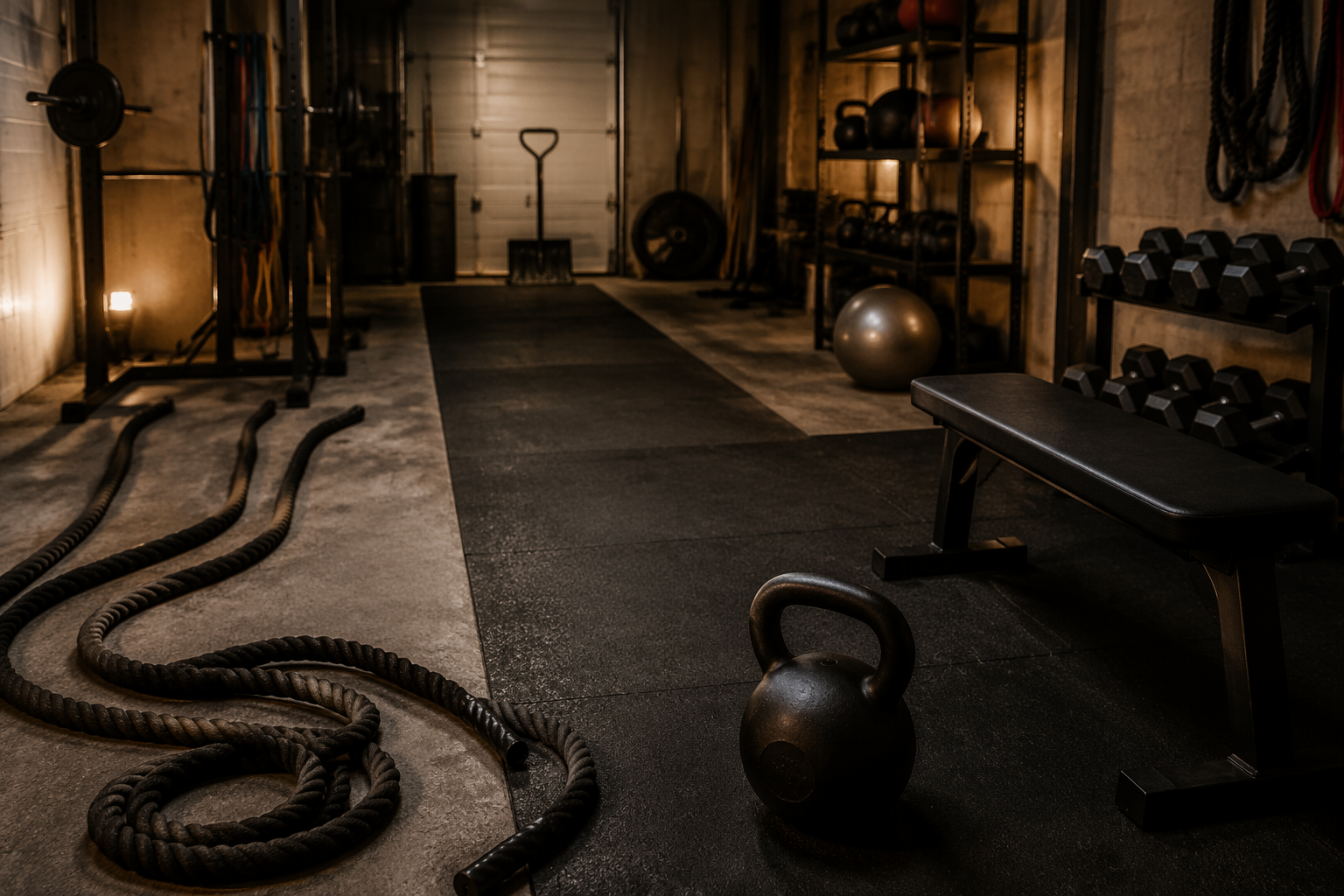
A useful home version should preserve the pressure of the original: full-body cardio, repeated rounds, lunges under fatigue, trunk work when breathing is compromised, and a reduced upper-body finisher. It does not need to preserve the exact machine lineup.
| Original Station | Home Substitute | Working Target |
|---|---|---|
| Versa Climber | Battle ropes, stair climber, high-step intervals, or sled pushes if available | 30 to 45 seconds hard |
| Bike | Assault bike, stationary bike, outdoor run interval, or hill sprint | 45 to 90 seconds hard |
| Walking lunges | Walking lunges, reverse lunges, or split squats if space is limited | 20 to 40 total reps |
| Core | Plank, Russian twist, leg raise, mountain climber, or dead bug | 2 to 4 movements |
| Arm circuits | Dumbbell curls, overhead presses, triceps extensions, push-ups | Reduced volume after conditioning |
The numbers in the home version are not claimed to be Donald’s exact prescriptions. They are practical targets for recreating the training effect with common equipment. If you own a Versa Climber, fine. Use it. If you do not, battle ropes are the cleanest garage-gym substitute because they keep the upper body involved while the heart rate climbs fast.
The 45-Minute Version
- Warm up for 8 to 10 minutes with easy cardio, hip mobility, bodyweight lunges, and light trunk work.
- Do 3 rounds of the main circuit: battle ropes or stair-climber substitute, bike or run interval, walking lunges, then core.
- Rest only long enough to keep movement quality intact; do not turn the workout into separated station workouts.
- Finish with 4 to 6 arm circuits instead of 8.
- Stop the session if lunges become sloppy, sprint mechanics fall apart, or the core work turns into low-back survival.
That is the version most trained home athletes should start with, even if they think they can do more. Three rounds gives you enough repeated exposure to feel the late-round problem without pretending you have Donald’s work capacity or a staff waiting afterward.
Main Circuit Template
| Station | Option A | Option B | Notes |
|---|---|---|---|
| 1 | Battle ropes: 30 seconds hard | High-step intervals: 45 seconds | Keep the arms and legs working together. |
| 2 | Assault bike: 60 seconds hard | Outdoor run: 200 to 400 meters | Choose the option you can repeat without technique falling apart. |
| 3 | Walking lunges: 20 to 40 total reps | Reverse lunges: 20 to 30 total reps | Use bodyweight first; load is optional. |
| 4 | Plank plus leg raises | Mountain climbers plus dead bug | Pick core work you can control while breathing hard. |
The Versa Climber substitute is the most important choice. A treadmill jog does not really replace it because the upper body gets to coast. Battle ropes, a stair climber, high step-ups, or sled pushes all keep more of the body involved. None are perfect matches, but they are honest substitutes.
The bike or running interval should be hard, repeatable, and boring. That last word matters. The less skill required, the better this station works late in the session. If you pick 400-meter outdoor intervals, do not race the first one like it is the whole workout. Donald’s circuit punishes that kind of ego by station three.
Lunges can stay simple. A garage, driveway, turf strip, or sidewalk is enough. If space is tight, reverse lunges are cleaner than turning every few steps. Add dumbbells only after bodyweight reps stay smooth in the final round.
Arm Finisher: Cut It Before It Cuts You
The original account says 8 arm circuits at 4 sets each after the main conditioning work.[3] For a home version, that is the first place to reduce volume. The point is not to prove you can curl after suffering. The point is to do upper-body work while already tired without letting shoulder, elbow, or trunk position turn sloppy.
| Level | Arm Circuit Volume | Example Movements |
|---|---|---|
| First attempt | 4 circuits | Dumbbell curl, push-up, overhead press, triceps extension |
| Built-up version | 6 circuits | Same movements, slightly shorter rest |
| Full challenge attempt | 8 circuits | Only after several successful 4-round sessions |
Use loads you can control after the conditioning block. If you need to cheat every curl, arch every press, and sag through push-ups, the workout has stopped training discipline and started collecting ugly reps.
How to Build From Three Rounds to Four
Do not jump straight from a normal garage workout into a 90-minute professional conditioning session. The smarter progression is to increase one stressor at a time: first rounds, then density, then finisher volume.
| Week Type | Main Circuit | Arm Finisher | Rest Target |
|---|---|---|---|
| Entry version | 3 rounds | 4 circuits | Enough to keep clean reps |
| Density version | 3 rounds | 4 to 6 circuits | Slightly shorter transitions |
| Volume version | 4 rounds | 4 to 6 circuits | Controlled, not leisurely |
| Full home challenge | 4 rounds | 6 to 8 circuits | Minimal rest without form collapse |
That progression is less dramatic than saying “do Donald’s workout,” but it is closer to actual training. The fourth round should be earned by repeatable performance, not added because the original story had 4 rounds.
A simple rule works: if your final round is more than a controlled drop-off, stay where you are. Hard conditioning allows fatigue. It does not require a full technical breakdown.
The Recovery Part Is Not Optional
This is where the professional context matters. Donald’s ability to tolerate big training days was not just mentality. Total Shape describes a diet framework around roughly 5,000 calories per day and notes Rams dietician Joey Blake in connection with his nutrition support.[8] That does not mean every detail of his intake is something to copy. It means the workload and the recovery system belonged to the same athlete.
Most home athletes do not have a team cafeteria, soft-tissue staff, practice schedule monitoring, or someone adjusting food around the training week. If the workout scales up, recovery has to scale up too: more sleep discipline, more food if body weight is dropping unintentionally, easier training the next day, and a real cool-down instead of collapsing next to the bike.
If recovery is the part you usually skip, start with a lower-volume option and use a deliberate post-workout recovery routine at home before trying to compress rest or add the fourth round. For readers building out a setup, a basic equipment plan matters more than chasing a specialty machine; compare options in a home gym equipment systems guide before spending money just to imitate one station.
What to Copy, What to Leave Alone
Copy the structure: repeated full-body conditioning, lunges under fatigue, trunk work late in the round, and an upper-body finisher after the main work. Copy the discipline of keeping the session moving. Copy the idea that the last round is where the workout becomes honest.
Leave alone the myth-making. Reported max lifts and weight-room numbers are not necessary to make this workout useful, and they are not the reason Verse’s account stuck. The evidence that matters is cleaner: an elite teammate described the stations, the rounds, the session length, the fourth-quarter cue, and the recovery cost.[3]
If you want another example of adapting elite-athlete work without copying every professional variable, the same principle applies in this Terence Crawford home workout adaptation: preserve the training effect, scale the support demands, and stop pretending that suffering by itself is programming.
Aaron Donald’s training camp workout can be adapted for a home gym if you copy the density, repeated effort, and late-session discipline. Trying to copy the full 90-minute professional version on day one, without Donald’s conditioning base or recovery support, is not toughness. It is just bad programming dressed up in a Rams jersey.
References
- Aaron Donald Works Out At Rams Facility Amid Comeback Rumors, TMZ, July 10, 2026
- Aaron Donald spotted training at Rams' facility amid comeback rumors, Rams Wire/USA Today, July 10, 2026
- Though Aaron Donald workout was "psychotic," it instilled a valuable mindset in Jared Verse, The Rams, July 2025
- Rams Jared Verse Comments on Workout With Aaron Donald, Sports Illustrated
- Rams LB Jared Verse provides hilarious account, Yahoo Sports
- Aaron Donald's Top 3 Workouts He Swears By, Ready®
- Aaron Donald Workout Routine and Diet Plan, Fitness Volt
- Aaron Donald's Workout Routine, Diet Plan & Supplements, Total Shape
Comments
Join the discussion with an anonymous comment.