
A Proposal, Not a Proof
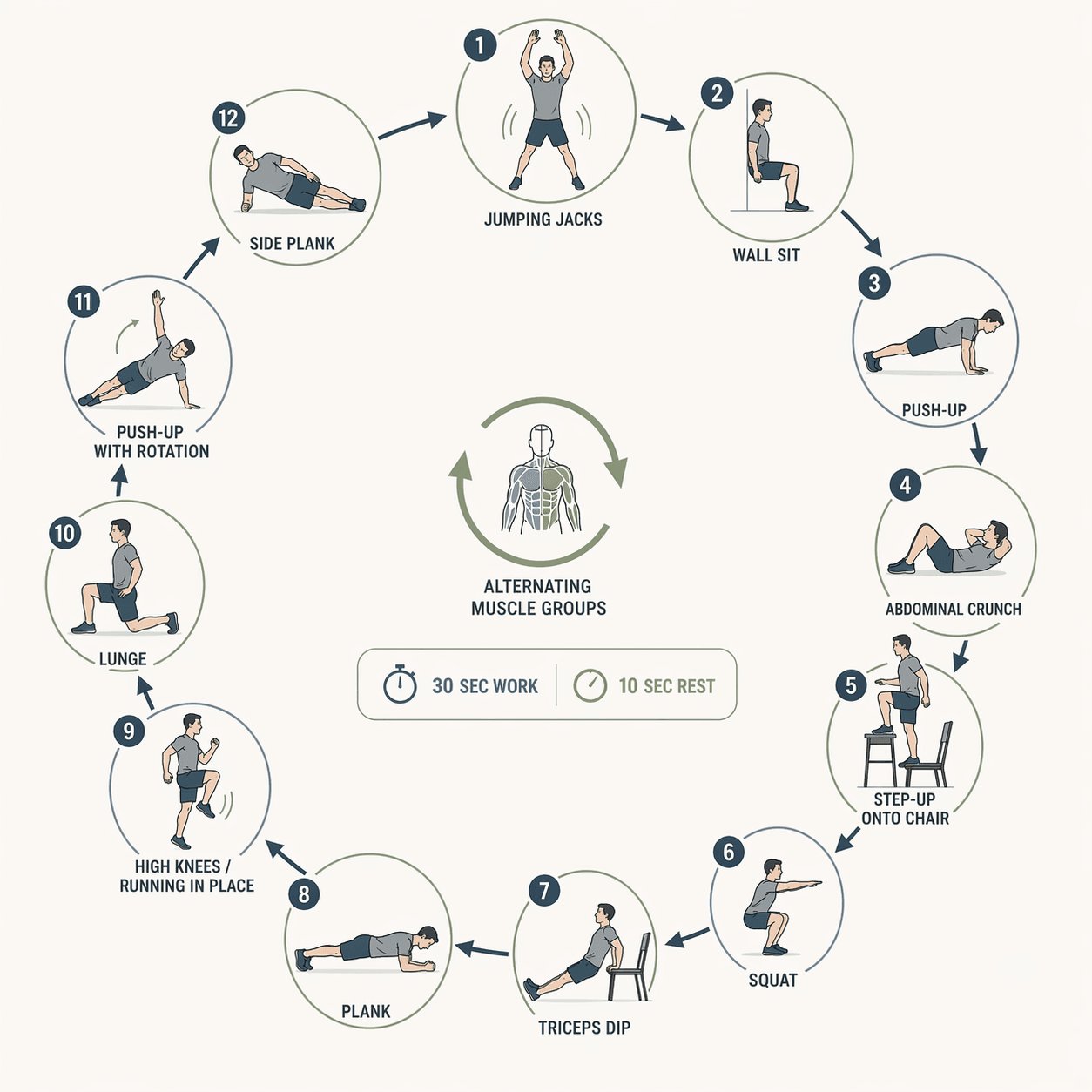
In 2013, Brett Klika and Chris Jordan published a 5-page review in ACSM's Health & Fitness Journal. They synthesized years of HIIT research into a proposal: a 12-exercise bodyweight circuit that could be done anywhere in about 7 minutes. The New York Times wrote it up. The internet did the rest. But here is what most summaries skip: Klika and Jordan's article was a review and a proposal, not an experiment. The specific protocol—jumping jacks, wall sit, push-up, crunch, step-up onto chair, squat, triceps dip, plank, high knees, lunge, push-up with rotation, side plank—had never been put through a controlled trial. The authors were clear about this. They said they were designing a workout from known principles, not reporting results from a study of this exact circuit.
That distinction matters because the viral headline "scientifically proven 7-minute workout" implies direct evidence. I've seen this pattern before: a review gets cited as if it were a controlled trial. The 7-minute workout became a phenomenon based on a synthesis, not a test. The direct evidence came later, and it's less tidy than the marketing suggests.
The Name Says 7 Minutes. The Creators Said 14–21.
The name "7-minute workout" sells a single lap. The creators intended two or three. Here is the protocol exactly: perform each exercise for 30 seconds at a hard intensity (roughly 8 out of 10 on perceived effort), then rest 10 seconds while transitioning to the next. One circuit takes about 7 minutes. But the original article explicitly says the circuit should be repeated 2 to 3 times for a total of 14 to 21 minutes. That recommendation comes straight from standard exercise guidelines: at least 20 minutes of continuous vigorous activity for health benefits.
Multiple sources — Cleveland Clinic, Healthline, the New York Post — all repeat the same point: the 7-minute figure was a convenient shorthand, not the intended dose. Doing one circuit and stopping is like reading the first chapter of a book and claiming you finished it. It's not a scandal, but it changes what you should expect. One circuit is a warm-up or a very short session. Two or three circuits are a genuine HIIT workout.
What the Research Actually Found (and What It Didn't)
Several studies have now tested versions of the 7-minute circuit. The results are modest but real—especially for people who are not already in strong shape. Here's what the evidence shows:
| Study | Participants | Protocol | Key findings |
|---|---|---|---|
| Mattar et al. (2017) | 29 adults, ages 18–30 | Daily 7-min circuit for 6 weeks | ~4 cm waist circumference reduction, decreased fat mass, slight weight loss without dietary changes |
| Schmidt et al. (2016) | 96 healthy adults | 7-min or 14-min circuit, 3x/week for 8 weeks | Significant improvements in push-up endurance; increased muscle strength in men |
| Armas et al. (2020) | 12 healthy young adults (crossover) | Single session: 7-min bodyweight circuit vs. 7-min cycling HIIT | Similar systolic BP, lower diastolic BP, higher post-exercise HR (145 vs 126 bpm avg); no difference in glucose or triglycerides |
| Poon (2023) | Sedentary men and women | Single session: 7-min circuit vs. 30-min moderate cycling vs. 7-min cycling HIIT | Participants reported higher enjoyment and found the circuit 'less boring' |
Look at these findings closely. The waist reduction in Mattar et al. (2017) is about 4 cm over six weeks—meaningful for a beginner, but that result came from a single small study, and the original data is hard to access. The Schmidt study showed push-up endurance improved, but muscle strength gains only appeared in men, which suggests the circuit is better for endurance than hypertrophy. The single-session studies show that the bodyweight circuit raises heart rate higher than cycling HIIT, but that doesn't necessarily mean more cardiovascular benefit—it could just mean the movements are less efficient. For someone starting from zero, this workout is a reliable way to get a sweat on. For someone who already runs or lifts, it's a warm-up.
The 7-minute workout is a good tool. It's not a complete program. The viral name oversold it, but the circuit itself, done as intended—two or three rounds—is a real HIIT session backed by modest evidence. That's worth having. Just don't expect it to replace dedicated training for strength or endurance.
Comments
Join the discussion with an anonymous comment.