
The most useful question is not whether the 7 minute workout is hard. It is which version belongs in front of you today. For one person, seven minutes of jumping jacks, push-ups, and floor transitions is a reasonable middle-of-the-day reset. For another, it is enough impact and wrist loading to end the session in the first two minutes. For someone stronger, the same seven minutes can turn into a warm-up unless the exercises or timing are made denser.
A better way to look at the format is as a ladder: a gentle version for people who need lower impact or chair support, the original 12-exercise circuit as the reference point, and advanced or power variations for people who can complete the original with control and still need more challenge. Chris Jordan, who co-authored the original 2013 ACSM article, later presented gentle and power versions through The Washington Post, which is a useful signal: even the format’s best-known architect treats it as adaptable rather than one fixed test everyone must pass the same way.[1][2]
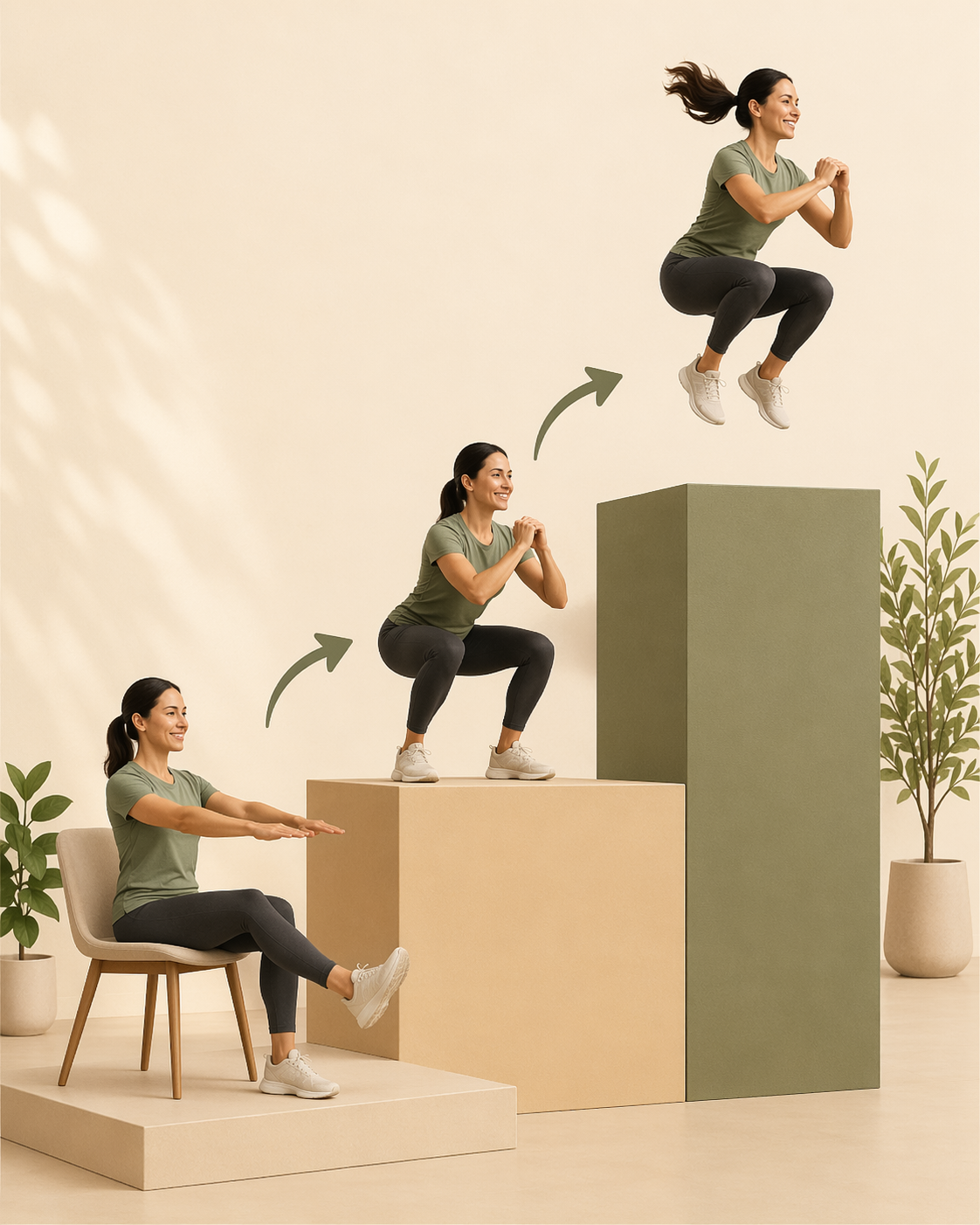
Start by choosing the right rung
Most frustration with this workout comes from starting on the wrong rung. Beginners often meet the original routine through an app or timer, hit the first jumping-jack block too aggressively, then discover that push-ups, planks, and step-ups arrive before they have recovered. Stronger exercisers can make the opposite mistake: they stroll through one casual round, never push the working intervals, and decide the whole format is too easy.
| Level | Best fit | What changes | Move up when |
|---|---|---|---|
| Gentle | New exercisers, returners, people managing impact, balance, or floor transitions | Lower-impact moves, more support, fewer abrupt up-and-down changes | You finish with steady breathing, controlled form, and no joint flare-up |
| Original | People who can handle basic bodyweight moves for short intervals | The classic 12-exercise circuit uses 30 seconds of work and 10 seconds of transition | You can complete the full circuit with honest effort and clean technique |
| Advanced or power | People who have outgrown the original version | Harder compound movements, denser timing, or themed strength emphasis | The original no longer forces focus unless you deliberately increase intensity |
This is not a ranking of character. It is a fit check. The right version is the one that lets you work hard without turning the session into a scramble.
The original circuit is the middle standard
The original 7-minute workout was published in ACSM’s Health & Fitness Journal in 2013 as a high-intensity circuit using body weight, a wall, and a chair. The article laid out 12 exercises performed for 30 seconds each, with about 10 seconds allowed for transition between exercises.[2]
- Jumping jacks
- Wall sit
- Push-up
- Abdominal crunch
- Step-up onto chair
- Squat
- Triceps dip on chair
- Plank
- High knees running in place
- Lunge
- Push-up and rotation
- Side plank
The order matters. The circuit alternates demands across the body so one muscle group can partially recover while another works. Jumping jacks raise the pulse before the wall sit loads the legs; push-ups shift the work to the upper body; step-ups and squats return to the lower body; planks and side planks ask for trunk stability rather than another round of the same leg fatigue.[2]
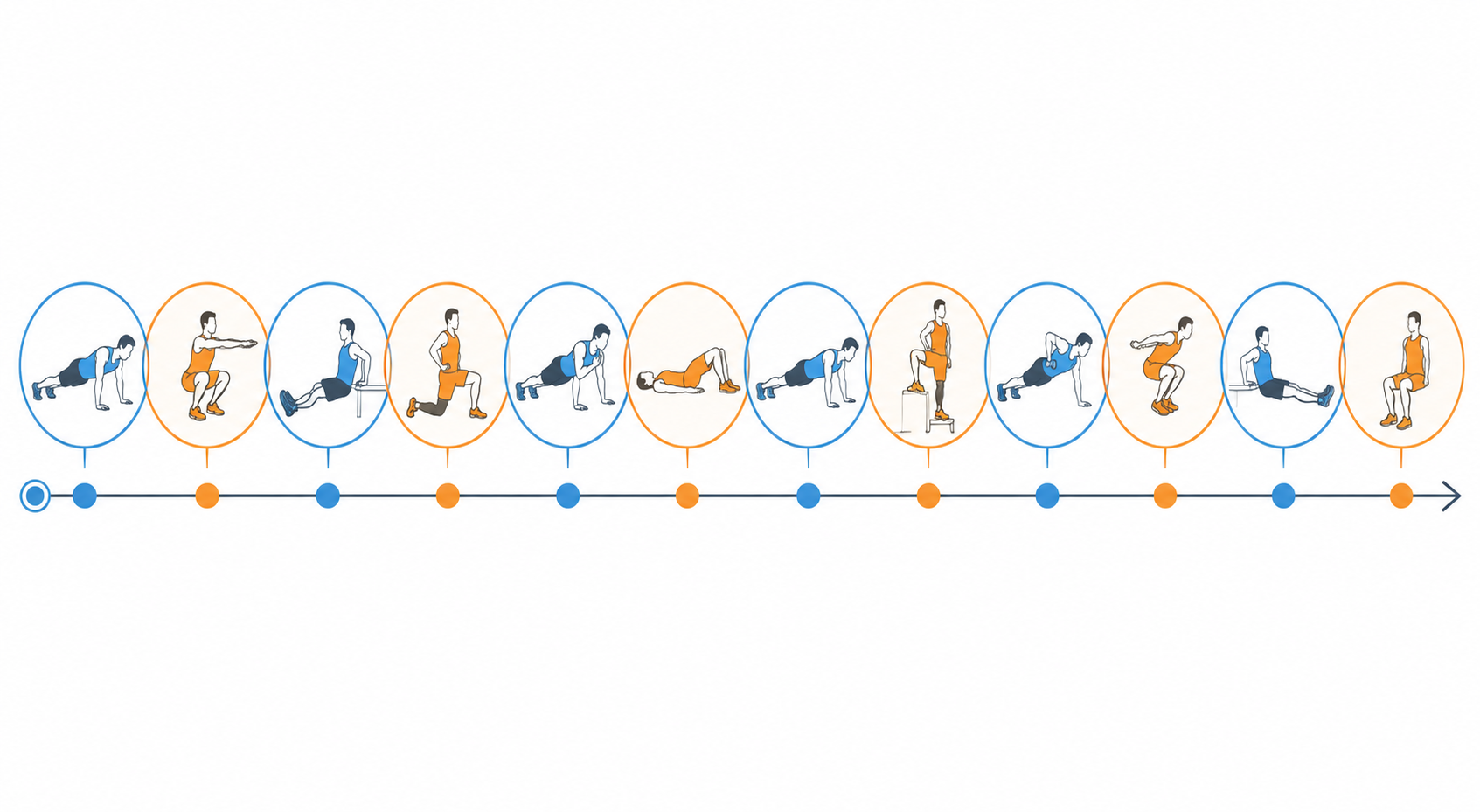
That alternating design is why the original version still works as the reference point. It is compact, but it is not random. If you change every exercise at once, you may still have a seven-minute session, but you no longer know whether you are modifying the same workout or building a different circuit with the same duration.
If you want the evidence discussion behind the original protocol, use a separate science-focused read such as does the 7-minute workout work. For choosing a version today, the main question is simpler: can you do the classic sequence with the intended effort and acceptable form?
Use the gentle version when impact, balance, or transitions are the limiter
A gentle 7-minute workout should not mean waving your arms for seven minutes and calling it training. It should preserve the basic idea of short work intervals while removing the parts that make the original unnecessarily hostile for some bodies: jumping, unsupported single-leg work, fast floor changes, deep wrist extension, and exercises where fatigue quickly turns into sloppy alignment.
The visible Washington Post materials identify Jordan’s gentle workout as a lower-intensity option and his power workout as the higher-intensity counterpart, but the exercise-level details are not fully accessible without the paywalled article. That means it is fair to use those pieces as evidence that the format has official low and high ends, while being careful not to pretend to reproduce the full routines.[1]
In practice, the gentle rung usually changes the stress, not the purpose. Jumping jacks can become step jacks. Push-ups can move to a wall, counter, or sturdy chair. Step-ups can become sit-to-stands or low step taps. Planks can become elevated planks. Lunges can become supported reverse taps or split-stance bends. The person still works; the workout simply stops demanding that impact tolerance and floor mobility arrive before conditioning does.
Stay at the gentle level if you are still losing balance, rushing transitions, holding your breath, or feeling joint irritation that changes how you move. Move toward the original only when the modified moves feel repeatable. The best sign is not that the session feels easy; it is that you can finish with enough control to imagine doing it again later in the week.
For a more detailed modification path, use the 7-minute workout for beginners guide rather than forcing the classic circuit before your joints, balance, or confidence are ready.
Use the original when you can work hard without negotiating every move
The original circuit is a good choice when the exercises are familiar enough that the timer, not confusion, drives the session. You do not need perfect athletic form, but you should know how to squat without collapsing inward, how to step onto a stable chair or platform without launching off the back leg, and how to scale push-ups before your shoulders take over the whole movement.
Thirty seconds is long enough for form to change. In a mixed-level class, the first 10 seconds often look fine, the middle 10 seconds show the real level, and the final 10 seconds decide whether the exercise still belongs in the circuit. If the last third of every interval turns into bouncing, shrugging, or bracing through pain, stay with a modification.
A clean original round should feel concentrated. You should be breathing harder, watching the clock at least once, and needing the 10-second transitions. If you can talk comfortably through most of it, you are probably under-reaching. If you cannot set up the next move safely in the transition window, you may need a gentler layout or a slightly longer reset.
A simple stay-or-progress check
- Stay gentle if impact, balance, pain, or floor transitions are deciding the workout for you.
- Use the original if you can complete the 12 moves with effort, control, and short transitions.
- Repeat the original before progressing if you finish only by cutting range, skipping reps, or rushing setup.
- Move up if the original feels controlled and no longer demands focus unless you intentionally push harder.
Frequency matters here. A seven-minute workout can be short and still intense, especially once you are doing the original or harder versions. If your question is how often to repeat it, use the 7-minute workout frequency guide instead of assuming that short automatically means daily.
Advanced versions change the density, the exercises, or the emphasis
Once the original circuit is no longer enough, the answer is not always to add more minutes. You can make seven minutes harder by choosing more demanding movements, reducing the amount of easy transition time, or focusing the whole session on one quality such as upper-body pushing, legs, or core strength.
Jordan’s Washington Post power version sits at this advanced end of the ladder, but again, the paywall limits how much of the specific routine can be responsibly described from the available material.[1] The safer takeaway is that a power version should earn its name through better loading choices and cleaner intensity, not through random punishment.
Men’s Health also presents themed seven-minute workouts, including push-up power, lower-body blitz, core crush, and booty blitz. These are useful as advanced variety, but they are not identical copies of the original ACSM protocol: the article uses formats such as 20-second work blocks, EMOM-style sessions, and ladder structures rather than only the original 30-seconds-on, 10-seconds-transition setup.[3]
| Advanced variation | How it increases difficulty | Who should use it |
|---|---|---|
| Power-style circuit | Harder compound movements and higher output | Someone who can complete the original without losing form |
| Push-up emphasis | More repeated upper-body pushing volume | Someone whose shoulders, wrists, and trunk tolerate push-up variations well |
| Lower-body emphasis | More squatting, lunging, hinging, or jumping demand | Someone with good knee, hip, and ankle control under fatigue |
| Core emphasis | More sustained trunk work and anti-rotation demand | Someone who can brace without neck, hip-flexor, or low-back compensation |
| EMOM or ladder format | Less passive recovery and more pressure to manage pacing | Someone who understands the exercises well enough to move efficiently |
The trap at this level is confusing complexity with progress. A harder circuit should make the right thing harder. If a lower-body version makes your legs work and your landings stay quiet, good. If it only makes you twist your knees to beat the clock, it is not a better workout; it is a worse match.
How to progress without turning every session into a test
Progression should be boring enough to work. Start with the easiest version that lets you train with attention. Repeat it until the movements are familiar. Then change one variable: make the exercise less supported, increase range of motion, use the original timing, reduce transition hesitation, or choose a harder variation. Changing all of those at once is how a manageable workout becomes chaos.
A beginner might spend several sessions doing step jacks, wall push-ups, supported squats, elevated planks, and chair-based transitions. The next move is not necessarily the full original circuit. It may be one original exercise placed into an otherwise gentle circuit, such as standard squats replacing supported squats, while push-ups stay elevated. That counts. It is often the cleanest way to move up.
For the original circuit, progression can mean doing the same 12 exercises with sharper work intervals before chasing a harder routine. More controlled reps, steadier breathing, cleaner transitions, and less collapse in the final 10 seconds are all real progress. Only after those are in place does an advanced variation make sense.
On days when you want movement without another hard interval session, use the format differently. A low-intensity version can work as a short mobility or circulation break, especially if you treat it as active recovery rather than a personal record attempt.
A practical choice for today
Choose the gentle version if the original has been stopping you at the first few movements, especially because of jumping, push-ups, step-ups, or getting down to the floor. Choose the original if you can handle the basic exercises and want the clean reference circuit. Choose an advanced version if the original is controlled, repeatable, and no longer intense unless you deliberately raise the effort.
The best 7-minute workout is challenging enough that you have to pay attention and controlled enough that you can repeat it consistently. That may be chair-supported today, the original circuit next month, and a power or themed variation later. The useful version is the one that matches the body doing it.

Comments
Join the discussion with an anonymous comment.