
The hard part of buying home gym workout equipment is not deciding whether training at home is convenient. It is deciding which kind of system deserves your money before you start comparing models. A power rack, a cable trainer, a wall-mounted smart gym, an all-in-one machine, and a set of resistance bands can all be called a “home gym,” but they solve different problems and create different ones.
Start with the system type. The bench, ceiling height, plates, subscription, repair path, and future strength ceiling matter more than a showroom photo.
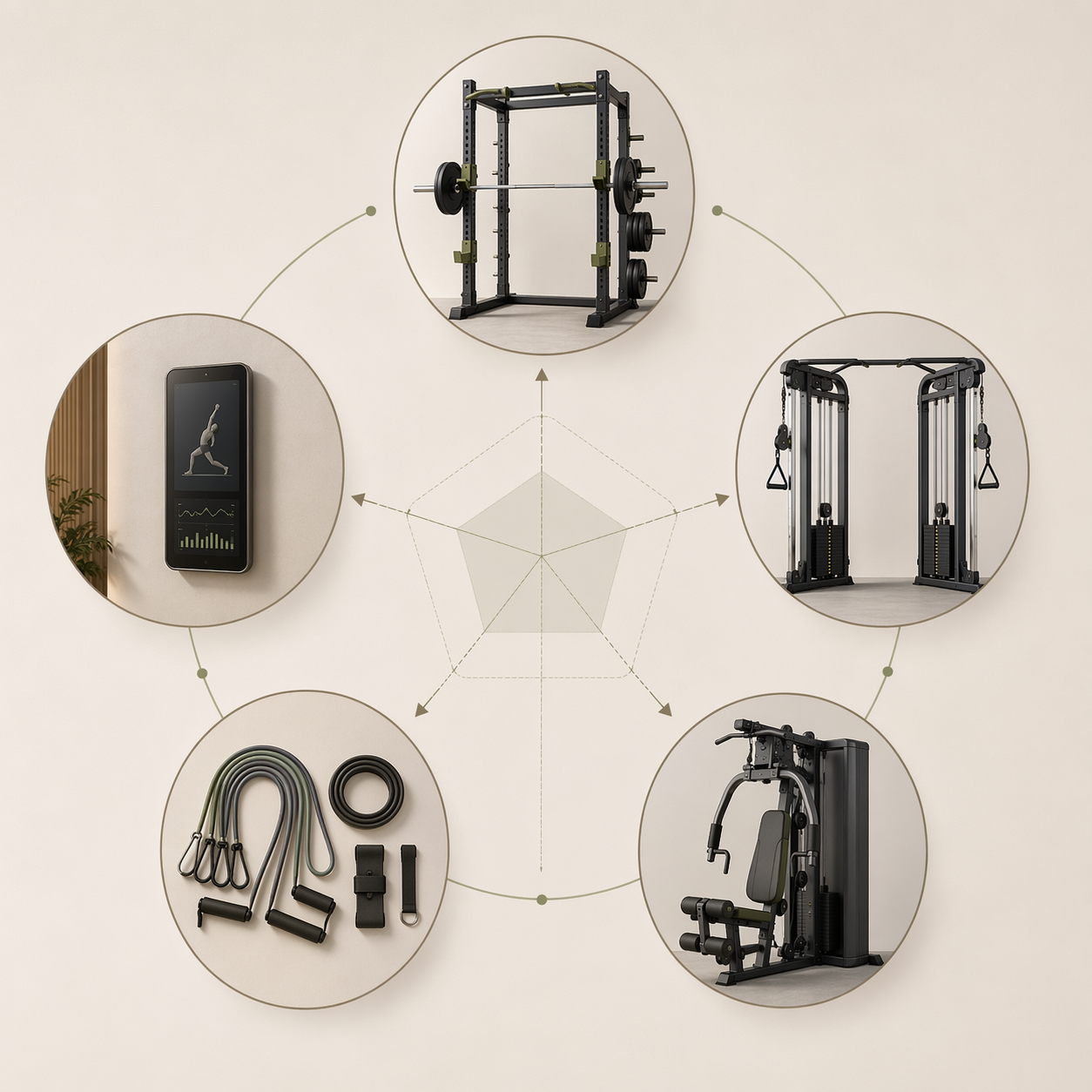
| System type | Footprint reality | Resistance ceiling | Exercise variety | Subscription dependency | Upfront price signal | 3–5 year cost signal |
|---|---|---|---|---|---|---|
| Power rack + barbell | Usually the largest usable footprint once bench, plates, bar path, and storage are included | Highest ceiling per dollar; the REP PR-1100 is listed at 700-lb capacity | Excellent for barbell lifts; accessories expand it | None | Low rack price can be misleading; REP PR-1100 pricing appears around $380–$400 before barbell, plates, bench, collars, and flooring | Often strong if you actually use barbell training and avoid constant add-ons [1][2] |
| Functional trainer | Tall, fixed station; smaller than a full rack zone for many cable movements | Moderate; 200–260-lb stacks often use a 2:1 pulley ratio, so working weight can be half the stack | Very high for cable work, isolation, rehab-style movements, and general strength training | None | Mid-to-high; examples in the research range from about $1,300 to $3,000 | Predictable because there is no required subscription, but limited if you outgrow the stack [3] |
| All-in-one machine | One large dedicated footprint; the Major Fitness B17 example occupies more than 37 sq ft | Can be high on rack components; B17 J-hooks are listed at 1,500-lb capacity | Highest single-station variety when rack, cables, Smith-style work, and attachments are combined | Usually none | High; Major Fitness B17 is cited at $4,200 | Can be good if it replaces several stations, but warranty and component replacement risk matter [2] |
| Smart gym | Best when wall space is easier to give up than floor space; Tonal 2 is cited as 5.25 inches deep when folded | Capped; Tonal 2 is cited at 250 lbs total resistance | High for guided cable-style training and beginners who need programming | Often central to the product; Tonal subscription is cited at $59.95/month | High; Tonal 2 is cited at $4,295 before subscription | Subscription changes the math quickly over three to five years [2][4] |
| Resistance bands | Smallest and easiest to store or travel with | Variable but difficult to compare cleanly with weights | Good for warmups, accessories, travel, and beginner strength work | None | Lowest | Lowest cash cost, but the available source material does not support strong long-term progression or durability claims |
The four trade-offs that decide the category
The average price across tested home gym machines in one 2026 roundup was $1,855, but that average hides the actual decision. The same source set places a budget rack around $400 and Tonal 2 at $4,295 plus a $59.95 monthly subscription, so the spread is not a neat good-better-best ladder. It is a set of compromises around space, resistance, convenience, and ownership cost [2][4].
Footprint is not the listed footprint
A rack may look compact on a product page because the steel frame has clean dimensions. Then the bench needs to slide in and out, plates need a wall or tree, the barbell needs side clearance, and the lifter needs room to fail a rep safely. That is why the cheapest rack can become the most space-demanding system in an ordinary spare room.
Smart gyms flip the problem. Tonal 2’s folded depth is cited at 5.25 inches, which is remarkable if you have a finished room and a clear wall [4]. It does not mean the room has no requirements. You still need open training space in front of the unit, suitable mounting conditions, and enough clearance for arm positions and floor work.
Ceiling height is the quiet dealbreaker. Buying guides for home gym layouts call out ceiling height and movement clearance because overhead pressing, pull-ups, cable towers, and tall racks all become awkward before the product technically “fits” [5]. If your room has a low ceiling, the right answer may be a shorter rack, a wall-mounted unit, bands, dumbbells, or a different room—not the tallest machine you can squeeze through the door.
Resistance ceiling is where categories stop pretending to be equal
For beginners, almost every category can feel hard enough. Six months later, the differences show up. A barbell rack scales by adding plates. A functional trainer may list a 200-lb stack, but with a 2:1 pulley ratio the handle may deliver about 100 lbs of working resistance [3]. A smart gym can make weight selection effortless, but Tonal 2’s cited cap is 250 lbs total resistance [4].
That does not make cable systems weak or smart gyms unserious. It means their ceiling has to match the job. For rows, presses, lateral raises, curls, split squats, and controlled hypertrophy work, moderate cable resistance can stay useful for a long time. For a lifter who expects to squat, deadlift, or press far beyond those limits, a digital or cable cap is not a personality flaw; it is a category boundary.
Upfront price is the easiest number to misread
The rack price is the classic trap. A $380 rack and a $180 barbell look inexpensive against a $1,300 functional trainer or a $4,200 all-in-one machine [1][2][3]. But a rack without plates, bench, collars, flooring, and storage is not a complete training system. The initial cart can still be sensible; it just should not be compared against a complete cable station as if both carts contain the same thing.
Smart gyms have the opposite problem. Their purchase price is already high, and the subscription is not decoration. Tonal’s cited $59.95 monthly fee adds $2,158.20 over three years before any taxes, accessories, installation differences, or price changes [4]. If the guided programming is the feature that makes you train consistently, that may be money well spent. If you only want resistance, it is expensive resistance.
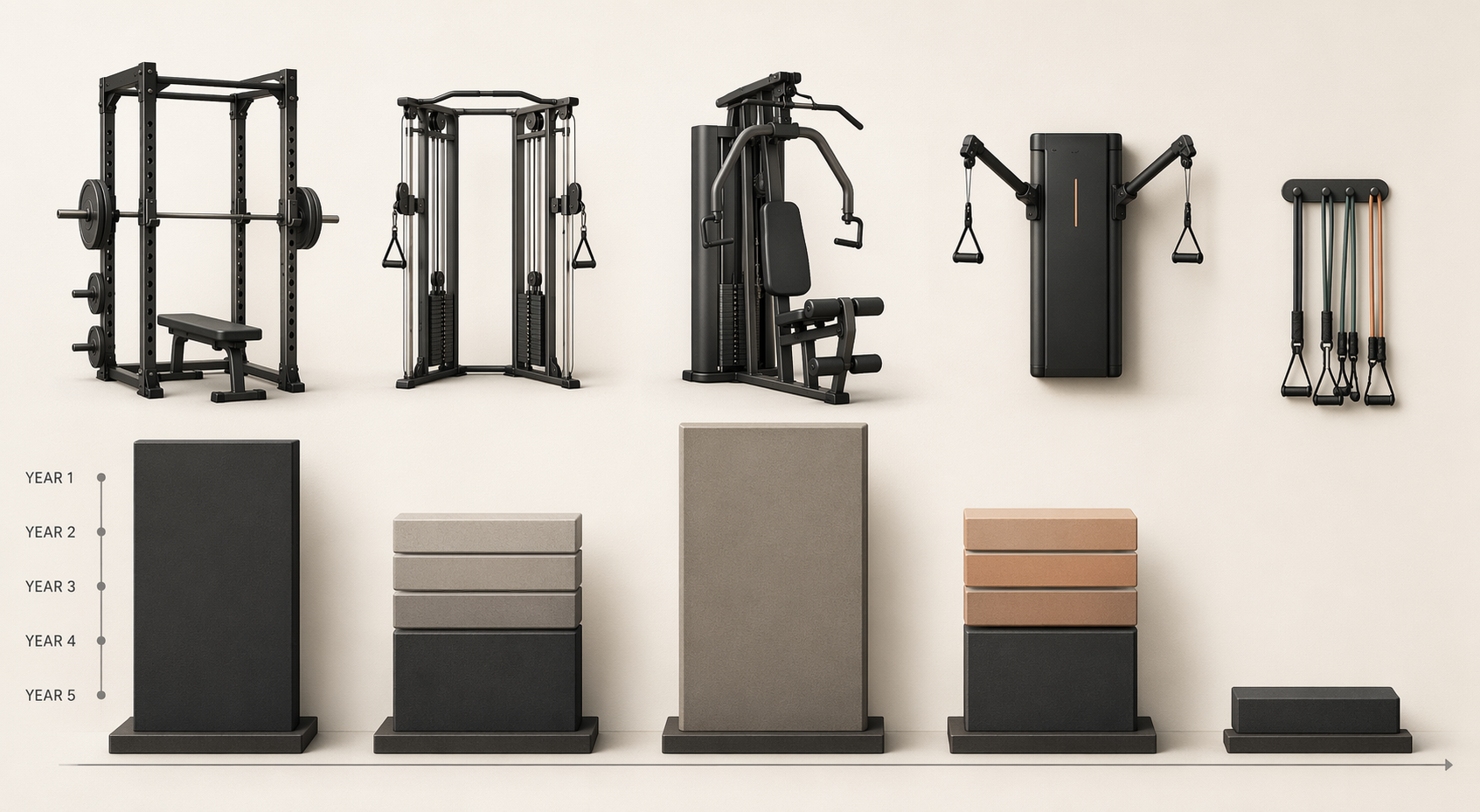
Convenience and upgradability pull in opposite directions
Convenience is real. A smart gym that chooses the workout, adjusts resistance, counts reps, and reduces setup friction can remove enough uncertainty for a beginner or busy adult to train more often. A selectorized functional trainer also keeps setup simple: move the pin, adjust the arms or pulleys, and start.
Upgradability is different. A rack can accept more plates, a better bar, safeties, dip handles, landmine attachments, cable add-ons, and specialty benches. That flexibility is useful if you know what you are building toward. It is annoying if you wanted one clean purchase and now own a half-finished project.
Readers who want a broader category primer can compare weight-stack, smart, and modular systems in the home gym system categories guide. For tighter rooms, the separate guide to compact home gym categories is the better next stop.
Power rack + barbell: best when progression matters more than polish
A power rack is the category to start with if your training revolves around squats, bench press, overhead press, deadlifts, pull-ups, and heavy progressive overload. The REP PR-1100 example is useful because it shows the basic value proposition: roughly $380 for a rack with a cited 700-lb capacity and no subscription [1]. That is hard to beat if you have the room and actually want barbell training.
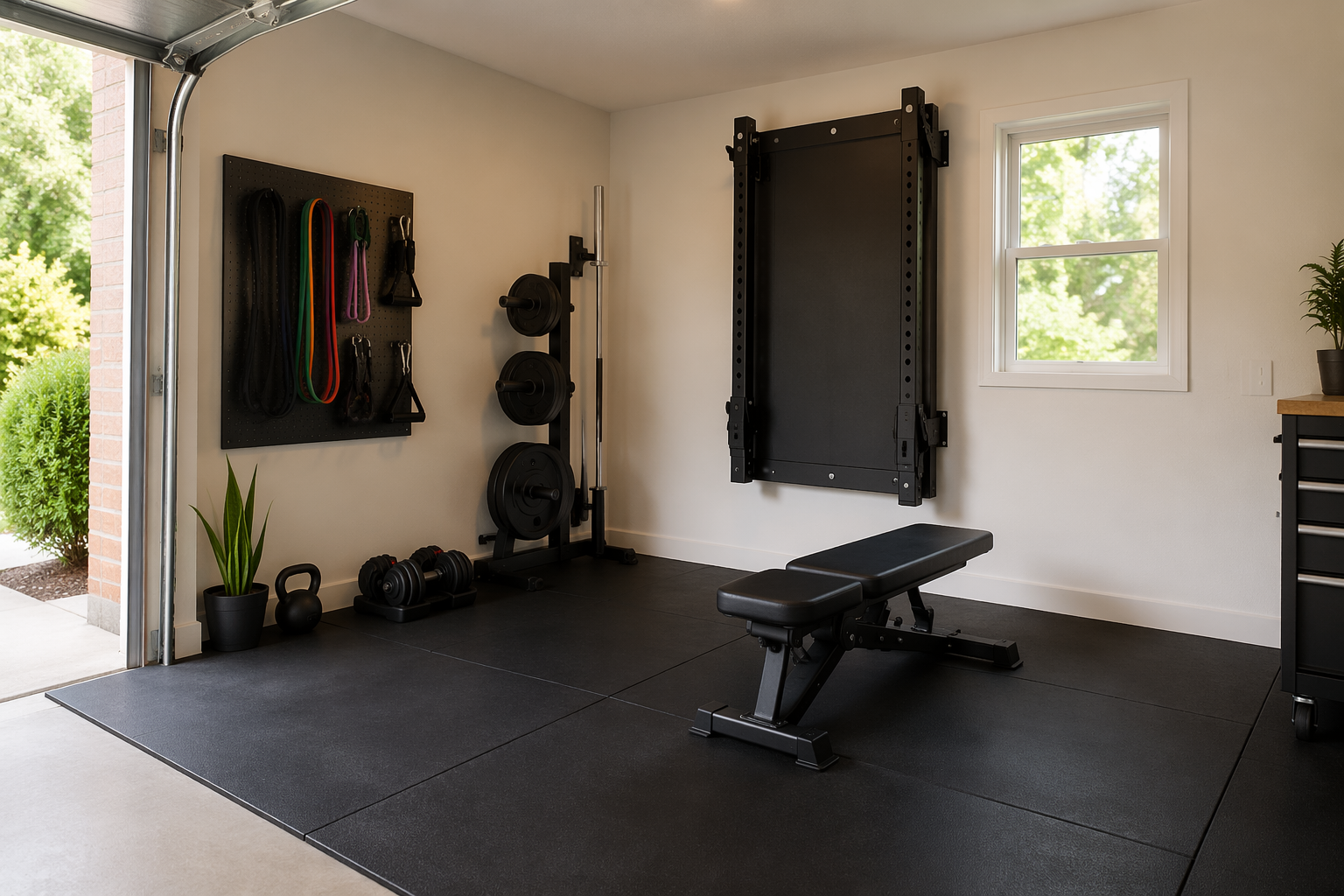
The catch is that a rack is not a home gym by itself. The real setup needs a barbell, plates, bench, collars, floor protection, and a storage plan. A buyer can start lean, but the system becomes honest only after those pieces are priced. The cheap rack stopped being cheap in a lot of garages the moment bumper plates and a decent bench entered the cart.
It disappoints apartment renters, low-ceiling rooms, people who hate setup time, and anyone who wants cable variety without bolting on more hardware. It also asks for more lifting knowledge. Safety arms and J-hooks are helpful, but they do not decide your program, teach bracing, or tell you when to stop adding weight.
- Best fit: strength-focused lifters, garage gyms, basements with clearance, and buyers who want maximum load progression per dollar.
- Poor fit: small apartments, shared living rooms, very low ceilings, and people who want one guided machine with minimal accessories.
Functional trainer: the cleanest middle ground for cable-first training
A functional trainer is often the most sensible “I want one station that does a lot” answer. It handles rows, presses, flyes, pulldowns, curls, triceps work, wood chops, face pulls, split-squat variations, and plenty of accessory work without requiring a pile of plates on the floor. The examples in the research brief span from the Bells of Steel unit around $1,300 to a Titan Fitness option around $3,000 [3].
The thing to check is not just stack weight. Many cable systems use a 2:1 ratio, so a 200-lb stack may feel like roughly 100 lbs at the handle [3]. That is perfectly fine for many cable movements and frustrating for others. If your future self wants heavy lat pulldowns, rows, or loaded lower-body patterns, that ratio matters before purchase, not after delivery.
Functional trainers also work well for households with multiple users. Changing the pin is faster than changing plates, and the exercise menu is friendly to people with different goals. They are less ideal as the only system for someone whose main goal is barbell strength, because the machine’s smoothness and versatility do not erase its working-weight ceiling.
- Best fit: general fitness, hypertrophy accessories, shared households, controlled cable work, and buyers who want variety without a subscription.
- Poor fit: advanced strength athletes who need open-ended loading or buyers who assume stack weight equals working weight.
Smart gym: worth it when guidance is the feature, not the garnish
Smart gyms are easy to underrate if you already know how to train. They are also easy to overrate if you confuse elegance with unlimited progression. Tonal 2 is the clearest example in the available materials: it folds to a cited 5.25 inches deep, offers guided digital resistance training, costs $4,295, carries a $59.95 monthly subscription, and caps total resistance at 250 lbs [4].
For a beginner who is intimidated by programming, that package can be exactly the point. The machine reduces decisions. It tells you what to do, changes resistance quickly, and fits in a room where a rack would dominate the space. For a busy person who will not build spreadsheets or watch technique videos before every session, convenience has training value.
The subscription has to be treated as part of the equipment, not a footnote. Three years of Tonal’s cited monthly fee totals $2,158.20; five years totals $3,597 [4]. That does not make the system bad. It means the buyer is purchasing guided training infrastructure as much as resistance. Muscle-building readers who are choosing between digital resistance and free weights should compare the trade-offs in the smart home gym vs. traditional weights guide before treating the two as interchangeable.
- Best fit: beginners, busy professionals, renters with usable wall space, people who value coaching, and households where low visual clutter matters.
- Poor fit: powerlifters, buyers who hate subscriptions, and anyone who will outgrow a 250-lb total resistance cap.
If the smart-gym category still looks attractive, the next filter is living situation. Wall mounting, lease rules, room sharing, and moving risk deserve their own check; the smart home gym living situation guide is the more practical follow-up than another spec table.
All-in-one machine: impressive when the single footprint is truly useful
All-in-one machines appeal to the buyer who wants the gym to feel complete on day one. The Major Fitness B17 example shows why: it is listed around $4,200, occupies more than 37 square feet, offers broad exercise variety, and cites a 1,500-lb J-hook capacity [2]. In the right room, that can replace several separate stations and reduce the amount of piecing together.
The risk is concentration. If a rack, cable system, Smith-style path, pulleys, and attachments all live in one machine, a failed component can affect more of the gym. The available source material also flags a short one-year warranty for the B17 example, while warranty reporting across similar machines is inconsistent enough that buyers should verify the current manufacturer terms before treating any all-in-one as a decade-long appliance [2].
This category is strongest when the buyer has a dedicated room, likes machine variety, and would otherwise buy a rack plus cables plus attachments anyway. It is weaker when the room is tight, the buyer moves often, or the budget cannot absorb a repair or replacement problem. If this is the category that survives your constraints, use an all-in-one home gym decision framework before comparing specific machines.
- Best fit: dedicated rooms, buyers who want variety in one station, and people who would otherwise assemble several separate pieces.
- Poor fit: renters, tight rooms, cautious buyers worried about serviceability, and anyone who only needs basic barbell training.
Resistance bands: useful, cheap, and easy to overclaim
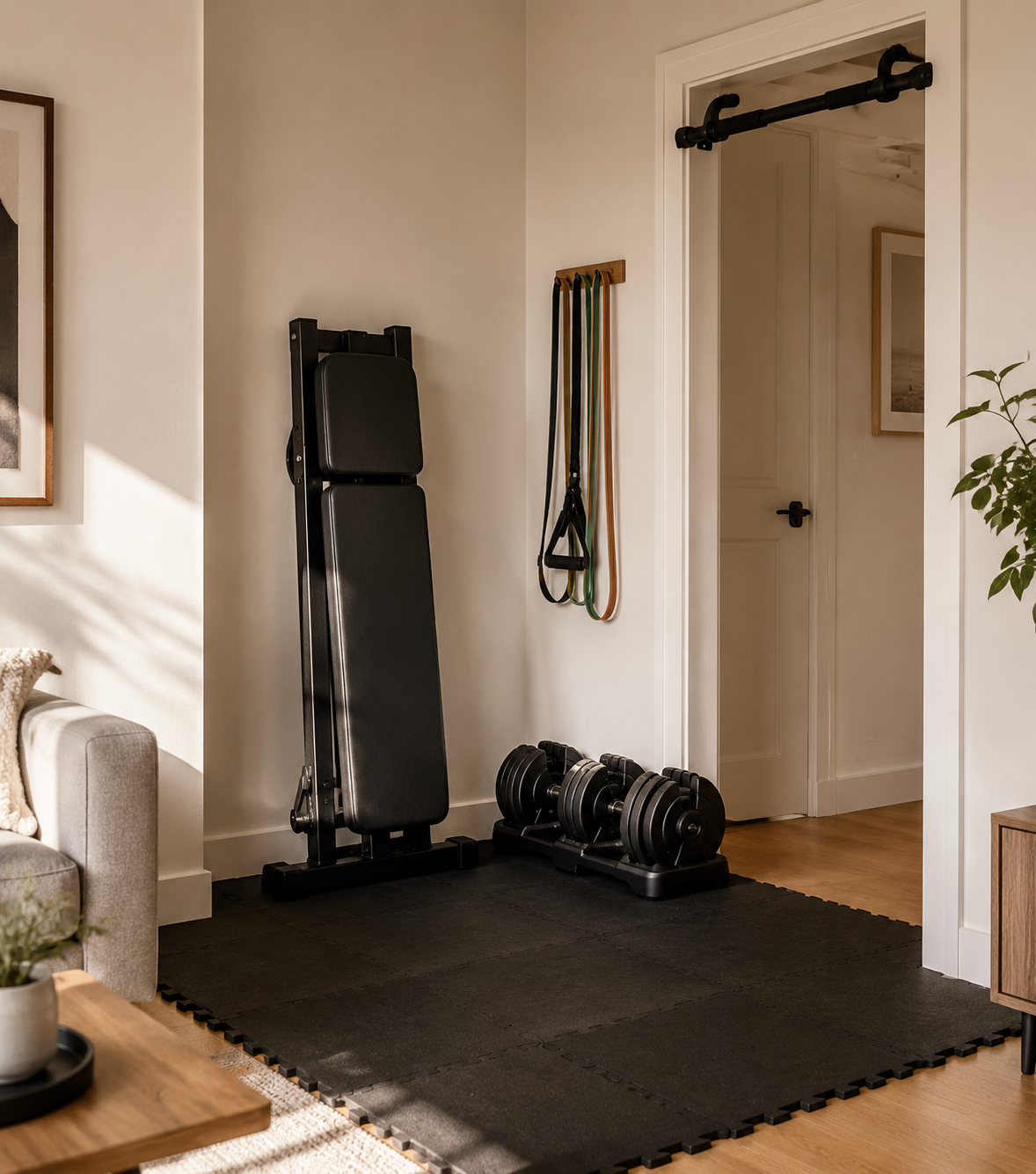
Bands are the easiest system to store, travel with, and buy without rearranging a room. They make sense for warmups, assisted mobility, beginner strength work, accessories, and keeping a routine alive when space or money is tight.
The available source material does not support strong claims about long-term durability or progression compared with racks, cable stacks, or smart resistance systems. So the fair recommendation is narrower: bands are a good starter or supplement, not the safest primary recommendation for an intermediate or advanced lifter who wants measurable, long-term loading.
- Best fit: beginners testing consistency, travelers, warmups, accessories, and people with almost no equipment space.
- Poor fit: lifters who need clear load progression, heavy lower-body training, or a durable primary system with well-documented limits.
What three to five years does to the price
A home gym purchase feels expensive because the cost arrives early. A gym membership feels smaller because it arrives monthly. Garage Gym Reviews cites a $65/month average gym membership from the 2024 U.S. Health & Fitness Consumer Report, which equals $2,340 over three years and $3,900 over five years before initiation fees, travel cost, or price increases [6].
| Setup | Known starting costs from source material | 3-year ownership signal | 5-year ownership signal | What the number leaves out |
|---|---|---|---|---|
| Rack starter path | $380 REP PR-1100 rack + $180 barbell example | Cheaper than a $1,300 functional trainer by year 3 if the buyer keeps additions modest | Still strong if plates, bench, and flooring are bought once and used consistently | Plates, bench, collars, flooring, storage, and future accessories [1] |
| Functional trainer | $1,300 Bells of Steel example; $3,000 Titan example | Predictable if the stack is enough | Still no subscription, but the resistance ceiling does not rise unless the machine supports upgrades | Delivery, assembly, ceiling fit, and 2:1 working-weight limits [3] |
| All-in-one machine | $4,200 Major Fitness B17 example | Higher upfront than most functional trainer examples, but no required subscription in the cited material | Can make sense if it replaces several stations and stays serviceable | Warranty verification, component failure, repair path, and room commitment [2] |
| Smart gym | $4,295 Tonal 2 + $59.95/month subscription | $6,453.20 before other costs after three years of subscription | $7,892 before other costs after five years of subscription | Subscription dependency, installation, accessories, service, and whether guidance remains valuable [4] |
| Resistance bands | Lowest starting cost; no precise long-term durability basis in the provided sources | Lowest cash commitment | Still low if used as a supplement | Replacement frequency and long-term progression are not well supported by the provided research |
The useful comparison is not “home gym versus gym membership” in the abstract. It is whether this specific setup will still be used after the room gets crowded, the buyer gets stronger, and the novelty wears off. A $4,000 machine that makes training happen can be cheaper than a $600 pile of mismatched gear that blocks a closet. A $600 rack path can also beat everything if the buyer knows they want barbell training and has the space to leave it ready.
Category-level recommendation matrix
| If this describes you | Start with this category | Why |
|---|---|---|
| You want heavy strength progression, have a garage or dedicated room, and do not mind buying pieces over time | Power rack + barbell | It gives the highest loading ceiling per dollar and can grow with plates and attachments. |
| You want one versatile station for general fitness, cables, accessories, and multiple users | Functional trainer | It balances variety, usability, and predictable cost better than most categories. |
| You are a beginner or busy person who needs coaching, low clutter, and fast setup more than maximum resistance | Smart gym | The guidance and compact footprint can justify the subscription if they directly increase adherence. |
| You have a dedicated room and want rack, cable, and machine variety in one large purchase | All-in-one machine | It can consolidate several functions, but warranty and serviceability deserve careful checking. |
| You are testing consistency, traveling, warming up, or adding cheap accessory work | Resistance bands | They are the lowest-commitment option, but not the strongest long-term primary system based on the available source material. |
| You are still unsure and need a simpler beginner path | Beginner decision framework | Use the broader beginner guide to choose by budget, space, and goals before entering model comparisons. |
Once the category is clear, model comparison becomes much easier. The next step is not to chase every machine in the market; it is to choose a training plan and equipment tier that match the system you are actually likely to keep using. The home gym workout plan by equipment tier is the practical handoff after this decision, while the beginner home gym equipment decision framework is better if you are still deciding how much space and money to commit.
References
- The Best Budget Home Gym Equipment of 2026, Garage Gym Reviews
- The Best Home Gym Machines in 2026: Tested for Versatility, Durability, and Performance, Garage Gym Reviews
- Best Home Gym Machines of 2026, Approved by Experts, Barbend
- Fitness Expert-Approved Smart Home Gyms Worth Splurging On, CNET
- Summer 2026 Home Gym Buying Guide, The Fitness Outlet
- 2024 U.S. Health & Fitness Consumer Report, cited by Garage Gym Reviews
Comments
Join the discussion with an anonymous comment.