
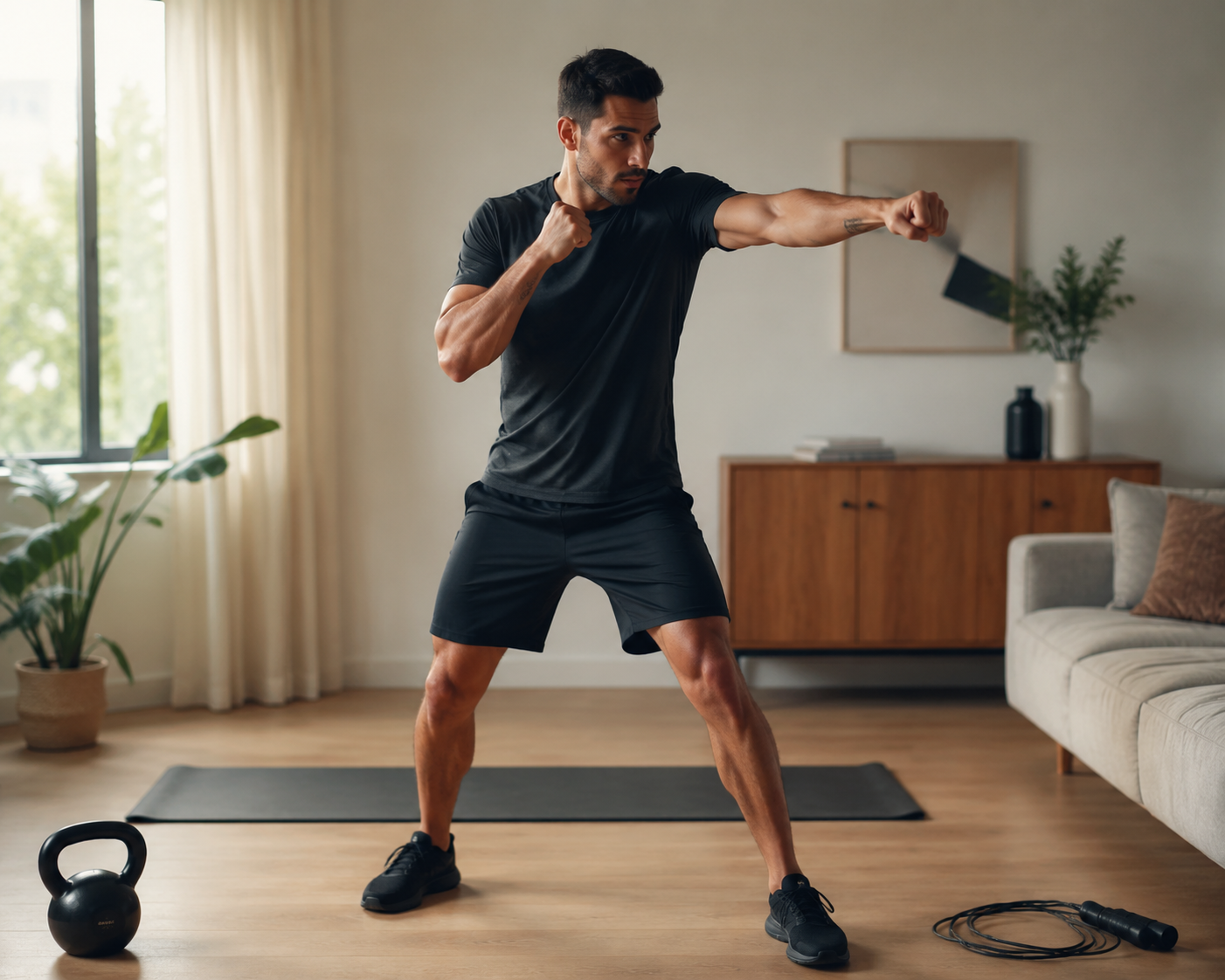
The honest answer is that you cannot run Terence Crawford’s full camp from a living room. You do not have his sparring partners, Jamie Belt watching the week’s load, a pool reserved for conditioning, or the consequences of a championship fight sitting on the calendar. But the useful part of Crawford’s boxing workout and training routine is not the fantasy of copying every drill. It is the structure underneath it: short violent efforts, circuit strength, non-impact conditioning, technical movement, and core work placed where it will not wreck the next hard boxing day.
That structure matters more than whether you own a heavy bag. Crawford’s camp reporting describes a clear shift away from traditional long-distance roadwork toward sprint intervals, because boxing is not one steady pace; it is repeated bursts with recovery between them. The same reporting also notes that strength work is placed on technical or pad days and not on sparring days, which is the kind of detail most “train like a champion” workouts skip even though it decides whether the week holds together.[1]
What Crawford’s Camp Is Actually Built Around
Strip away the champion aura and the routine becomes easier to read. The reported camp spine has five components: sprint-interval roadwork, circuit-style strength and conditioning, swimming or other non-impact conditioning, shadow boxing and pad or technical work, and targeted core conditioning. The most useful progression detail is the strength and conditioning format: circuit rounds begin at 5 minutes and build toward 15 minutes across a 12-week camp, with 1 minute of rest between rounds.[1]
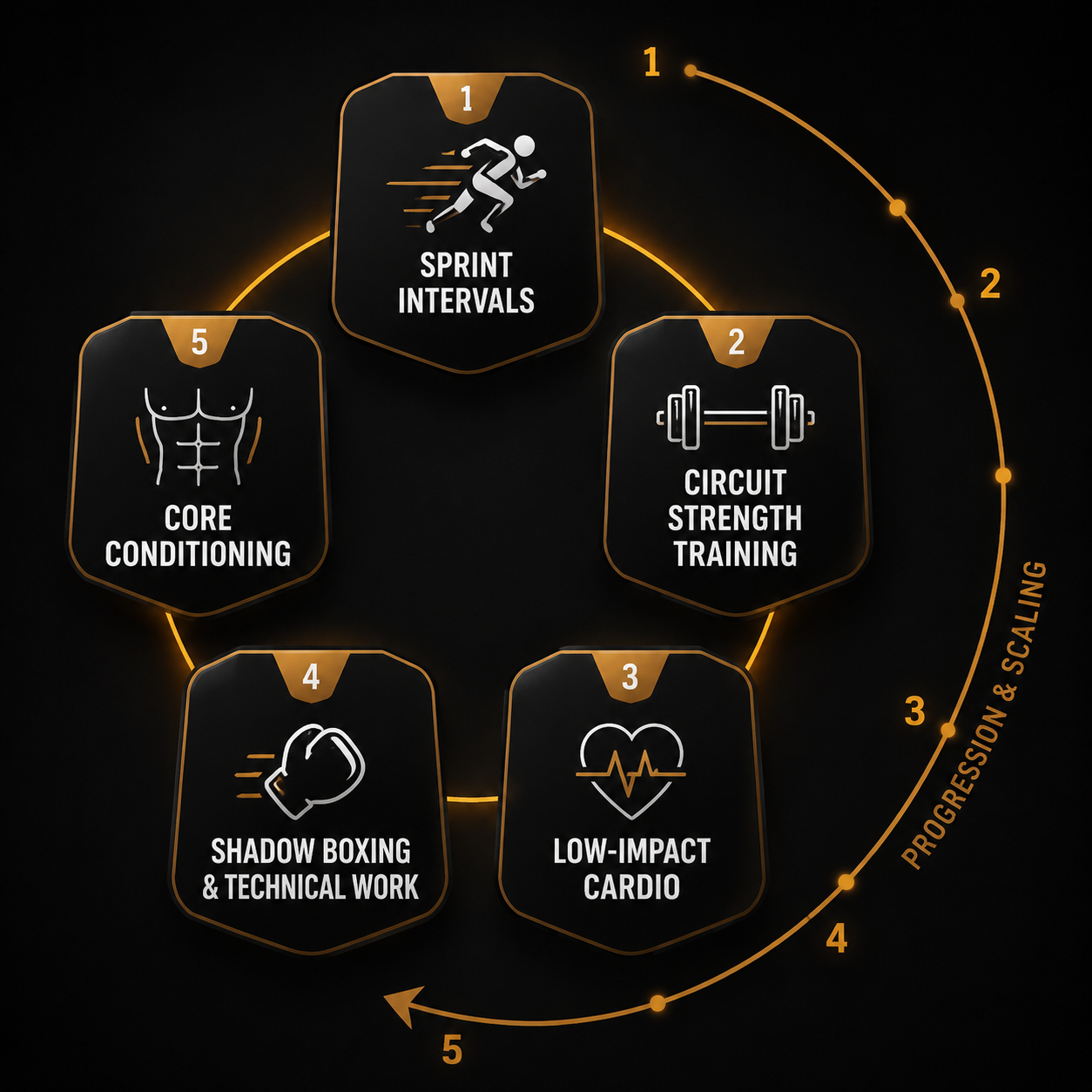
That progression is the part worth protecting at home. A random hard circuit can make you tired once. A boxing camp has to make you better while leaving enough room for skill work the next day. If you are training in an apartment, spare room, garage, or small backyard, the job is to preserve the stimulus, not the scenery.
| Camp component | Training quality | Home substitute |
|---|---|---|
| Sprint-interval roadwork | Burst-and-recover conditioning | Jump rope intervals, stair intervals, shuttle steps, bike sprints, or low-impact intervals |
| Circuit strength training | Work capacity under fatigue | Timed bodyweight, dumbbell, kettlebell, and band circuits |
| Swimming | Non-impact conditioning and breath control | Bike, rower, elliptical, brisk incline walking, or controlled nasal-breathing cardio |
| Shadow boxing and pads | Technical rhythm, stance, defense, and punch selection | Structured shadow boxing rounds, mirror work, slip-line drills, or partner mitts if available |
| Core conditioning | Trunk stiffness, rotation control, and resilience | Planks, dead bugs, hollow holds, anti-rotation presses, med-ball slams, and controlled crunch variations |
Sprint Intervals: Keep the Boxing Rhythm, Not the Roadwork Myth
Crawford’s move from long-distance running to sprint intervals is the first clue that this routine is built for the sport rather than for tradition. Boxing asks you to explode, settle, reposition, and explode again. Long steady running can build general endurance, but it does not match the repeated high-output exchanges of a round as cleanly as interval work does. Belt’s rationale, as reported, was exactly that: sprint intervals better fit boxing’s intermittent high-intensity demands.[1]
At home, the interval does not have to be a track sprint. In fact, many home trainees should not sprint hard on pavement every day. The substitution depends on what you can repeat safely:
- Jump rope: fast singles, high knees, boxer skip surges, or double-under attempts if you already have the skill.
- Stairs: short hard climbs followed by controlled walk-down recovery, if the stairs are safe and not crowded.
- Stationary bike: hard seated or standing bursts without joint impact.
- Floor shuttles: quick in-and-out footwork between two tape marks when space is limited.
- Low-impact shadow bursts: 10 to 20 seconds of fast combinations and defensive exits, then easy movement.
The progression should be boring on paper and hard in practice. Start with short bursts you can keep sharp. Add one more interval, extend the work period slightly, or reduce sloppy recovery movement before you add another layer of intensity. If your punches turn into arm-flailing or your feet cross under fatigue, the interval has stopped being boxing conditioning and become noise.
A simple home version is to run intervals after a warm-up: hard work, easy movement, repeat. The hard phase should feel like a flurry, a fast angle change, or a short chase to close distance. The easy phase should let you regain shape without fully checking out. That rhythm is closer to the useful part of Crawford’s camp than jogging in place for a long block while pretending it is roadwork.
Circuit Strength: Progress the Round, Not Just the Exercise List
The strength work in Crawford’s camp is not just a collection of hard-looking movements. The reported progression is timed like a fight demand: 5-minute circuit rounds building toward 15-minute rounds across 12 weeks, with only 1 minute of rest.[1] That tells you how to adapt it at home. The round length is the overload. The rest period is part of the stress. The exercise selection supports the goal rather than stealing the whole show.
For a home setup, pick movements that cover the main jobs without requiring a rack, sled, or full gym lane: a squat or hinge, a push, a pull if you have equipment, a loaded carry or march, a rotational or anti-rotational core drill, and a footwork or conditioning station. A single dumbbell, kettlebell, resistance band, or backpack can be enough. If you need more minimal-equipment options, a no-equipment upper-body workout can fill the push and trunk portions without turning the session into a bodybuilding split.
| Circuit station | Home options | Boxing purpose |
|---|---|---|
| Lower body | Split squat, reverse lunge, goblet squat, step-up | Leg endurance for stance, level changes, and exits |
| Hinge | Kettlebell deadlift, hip bridge, single-leg RDL | Posterior-chain support for balance and power transfer |
| Push | Push-up, dumbbell floor press, pike push-up | Shoulder and trunk control under fatigue |
| Pull | Band row, towel row setup, dumbbell row | Upper-back balance for guard position and punching volume |
| Rotation control | Side plank, dead bug, Pallof press, suitcase march | Keeping the trunk organized while the limbs move fast |
| Footwork finisher | Line hops, in-and-out steps, shadow-boxing exits | Maintaining stance when breathing gets heavy |
The mistake is making every station maximal. If the circuit is supposed to last several minutes, the exercises must be repeatable. A home trainee who opens with all-out burpees, heavy swings, and push-ups to failure will usually lose boxing posture before the round is over. Better choices let you keep your feet underneath you and your ribs stacked while fatigue builds.
Use the camp progression as a model without pretending you are in camp. Begin with 5-minute rounds if your conditioning is ready for them. Work through stations continuously at a pace that lets you breathe, brace, and move cleanly. Rest 1 minute between rounds. Over the weeks, progress by increasing the working round, improving movement quality at the same time, or adding a round only if recovery is holding.
A Home Circuit Progression
| Training phase | Round length | Rest | Main rule |
|---|---|---|---|
| Early phase | 5-minute circuit rounds | 1 minute | Move cleanly and stop stations before form collapses |
| Middle phase | Longer circuit rounds | 1 minute | Add time only when stance, breathing, and bracing stay organized |
| Later phase | Toward 15-minute circuit rounds | 1 minute | Treat this as advanced conditioning, not a casual add-on |
The important scheduling detail is just as practical: Crawford’s camp places strength work on technical and pad days, not sparring days.[1] A home boxer may not be sparring, but the principle still applies. Do not stack your hardest circuit onto the same day as your hardest interval session and then wonder why your shadow boxing turns sloppy for the next two sessions. The body does not care that the workout looked organized in a notebook.
Swimming Shows the Value of Non-Impact Conditioning
Swimming is not a decorative detail in Crawford’s camp. The reported sessions run 30 to 60 minutes twice per week and include a “3-5-7” breath-control drill. The same report says Crawford’s benchmark was 32 seconds for one 50 m Olympic pool length.[1] The point for a home trainee is not that you must find a pool. It is that his conditioning week includes hard work that does not pound the joints the way repeated running can.
If you have access to a pool and already swim safely, use it. If not, preserve the category: non-impact or lower-impact aerobic work that lets you build volume without turning every session into another leg-beating interval day. A stationary bike, rower, elliptical, brisk incline walk, or easy shadow-boxing flow round can all serve the purpose. Breath control can be trained conservatively through nasal breathing or controlled exhale patterns, not breath-holding contests.
This is one of the places where home training can become smarter than imitation. You do not need to mimic the pool drill to respect the reason it is there. You need a conditioning slot that builds the engine, spares the joints, and does not interfere with the next technical day.
Shadow Boxing Has to Be Technical Work, Not Filler
Pad work is hard to reproduce alone. Shadow boxing is not. The problem is that most home workouts use it as a warm-up blur: throw punches, bounce around, sweat a little, move on. In a Crawford-inspired routine, shadow boxing should carry some of the technical responsibility that pads or coaching would normally handle.
Give each round a job. One round can be stance and balance only. One can focus on the jab, exit, and reset. One can pair a combination with a defensive action: jab-cross-slip, jab to the body-step out, or double jab-pivot. If you are more advanced, add feints, level changes, and southpaw or orthodox switches only when they do not make your feet careless.
- Round for feet: keep stance width, step before punching, and exit without crossing your legs.
- Round for jab: vary height, rhythm, and recovery to guard.
- Round for defense: slip, roll, pull, or step out after every combination.
- Round for pressure: cut off an imaginary opponent without chasing square.
- Round for recovery: move lightly, breathe, and keep technique crisp at lower intensity.
If you have a partner who can hold mitts safely, pad work can replace some of these rounds. If you do not, do not fake mitt work by blasting the air as hard as possible. Shadow boxing gives you a chance to practice decisions: where your head is after the punch, how your lead foot lands, whether your rear hand returns, and whether your breathing changes when the pace rises.
Core Work: Build Resilience Without Copying the Reckless Parts
Crawford’s core work has been described with the kind of drill that gets attention: a coach bouncing a heavy medicine ball off his stomach while he performs crunches.[2] That belongs in a supervised fight camp, not in a living room experiment. The useful lesson is not “take impacts to the abdomen.” It is that a boxer’s trunk has to resist movement, transfer force, and stay organized while breathing under pressure.
A safer home core menu should train three qualities: anti-extension, anti-rotation, and controlled rotation. Anti-extension keeps the ribs and pelvis from flying apart when you punch or fatigue. Anti-rotation helps you absorb force and return to stance. Controlled rotation lets you turn through combinations without yanking through the lower back.
| Core quality | Home drills | Progression |
|---|---|---|
| Anti-extension | Dead bug, hollow hold, plank | Longer holds, slower reps, or harder limb positions |
| Anti-rotation | Side plank, suitcase march, band Pallof press | More time under tension or slower controlled movement |
| Controlled rotation | Standing band rotation, med-ball rotational throw if space and wall are safe | More precise hip turn before more speed |
| Boxing-specific fatigue | Plank shoulder taps, slow mountain climbers, shadow-boxing with tight guard | Add work late in the circuit without losing posture |
Keep the core block close enough to boxing to matter. A few clean sets after intervals or within a circuit beat a long ab finisher that leaves your hip flexors cramped and your next stance session worse. Trunk work should make your boxing shape harder to break, not just make your midsection sore.
A 60-Minute Crawford-Inspired Home Session
POWA Boxing offers a 60-minute Terence Crawford-inspired template built around a 10-minute warm-up, 15 minutes of cardio intervals, 15 minutes of agility or footwork, 15 minutes of strength and core, and a 5-minute cool-down. Treat that as an adaptation framework, not Crawford’s actual program.[3]
| Block | Time | Home execution |
|---|---|---|
| Warm-up | 10 minutes | Easy jump rope or marching, shoulder circles, hip openers, light shadow boxing |
| Cardio intervals | 15 minutes | Jump rope, bike, stair, or shadow-boxing bursts with easy movement between efforts |
| Footwork and technical work | 15 minutes | Tape-line steps, pivots, stance resets, jab exits, defensive movement, structured shadow rounds |
| Strength and core | 15 minutes | Timed circuit using lower-body, push, pull, trunk, and footwork stations |
| Cool-down | 5 minutes | Easy breathing, walking, gentle mobility |
The warm-up does not need to become a second workout. Raise temperature, open the hips and shoulders, then move through light boxing patterns. If you jump rope, keep the first minutes relaxed. If you train in an upstairs apartment, use low-impact marching, step patterns, or easy shadow boxing instead.
The interval block is where the session starts to feel like boxing conditioning. Choose one mode and stay with it for the day. For example, alternate hard rope surges with relaxed bounce steps, or hard bike pushes with easy pedaling. Do not turn the interval block into five unrelated drills. The body adapts better when the stress is clear.
The footwork block should lower the heart rate slightly while raising technical attention. Put tape on the floor if you do not have an agility ladder. Work forward and back without narrowing your stance. Pivot off the lead foot. Step out after combinations. If you use shadow boxing here, make it cleaner than the interval block, not faster.
The strength and core block can follow the circuit logic from Crawford’s camp. In a 60-minute home session, that may mean one longer circuit round or several shorter rounds with brief rest, depending on your level. If you are also doing separate hard interval days during the week, keep this block moderate. If this is your main hard day, it can carry more of the workload.
How to Arrange the Week Without Burying Yourself
The weekly layout matters because fatigue has a memory. Crawford’s camp avoids placing strength work on sparring days.[1] At home, use the same idea even if you are not sparring: separate the sessions that demand the most nervous-system output, joint stress, and concentration.
A practical home week can rotate emphasis instead of trying to make every day championship-hard. One day can center on intervals and technical shadow boxing. Another can use non-impact cardio and core. Another can carry the longer strength circuit. If you need shorter sessions because life is crowded, a home workout plan for busy parents gives a better model than cramming every quality into one exhausted hour.
| Day type | Main work | Keep light |
|---|---|---|
| Hard conditioning day | Sprint-style intervals and sharp shadow boxing | Heavy lower-body circuits |
| Technical day | Footwork, stance, shadow boxing, light pads if available | Max-effort intervals |
| Strength circuit day | Timed circuit progression and core | Long hard jump-rope finishers |
| Non-impact conditioning day | Bike, swim, row, elliptical, or incline walk | High-volume plyometrics |
| Recovery or mobility day | Easy movement, breath work, joint prep | Testing fitness |
Equipment can progress gradually. Start with floor space, tape, and a rope if you can use one. Add a dumbbell or kettlebell when the circuits need loading. Add bands for rows and anti-rotation work. A tiered home gym workout plan by equipment level fits this kind of progression better than buying gear because a champion used something expensive in camp.
Be Careful With the Science-Sounding Claims
Some reporting around Crawford’s preparation includes Victor Conte’s statements about unusual heart-rate recovery and oxygen-mask work, including claims that Crawford’s heart rate came down “one-third slower” than expected and references to a 68% oxygen mask. Those are Conte’s claims from a single boxing media source, and they should be treated as attributed statements rather than independent proof of what a home trainee should copy.[4]
You do not need an oxygen mask, a lab setup, or a dramatic recovery metric to train the useful parts of the routine. You need repeatable intervals, timed circuits, non-impact conditioning, technical rounds, and enough recovery discipline to keep improving. If a detail sounds impressive but does not help you decide what to do safely at home, leave it outside the session.
The Sober Home Version
A home version of Terence Crawford’s boxing workout is not his camp. It does not replace sparring, coaching eyes, pad timing, or the pressure of preparing for a world-level opponent. It also should not borrow unsupported performance claims just because they sound advanced.
What it can preserve is the part that makes the routine useful: sprint-style conditioning for boxing’s burst-and-recover rhythm, circuit rounds that progress over time, non-impact cardio that protects the week, shadow boxing with technical assignments, core work that supports trunk resilience, and scheduling that respects fatigue. That is enough to build a serious intermediate home boxing routine without pretending your living room is a championship camp.
References
- Inside Terence Crawford's training camp, Boxing News Online.
- Boxing Champ Terence Crawford Tips To Be The Best, Muscle & Fitness.
- Terence Crawford's Boxing Training Secrets, POWA Boxing.
- Terence Crawford may be the most scientifically prepared boxer in the history of the sport, BoxingScene.
Comments
Join the discussion with an anonymous comment.