A useful pickleball home workout does not start with a shopping list. It starts with the problem most recreational players actually bring home: the paddle feels fine for five relaxed hits, then the feet get late, the paddle face opens, the dink floats, and the third-shot drop turns into a hopeful shove. Solo paddle drills help. Squats and planks help. But if they live in separate corners of the week, they miss the way pickleball points really feel: touch, pause, move, reset, brace, swing again.
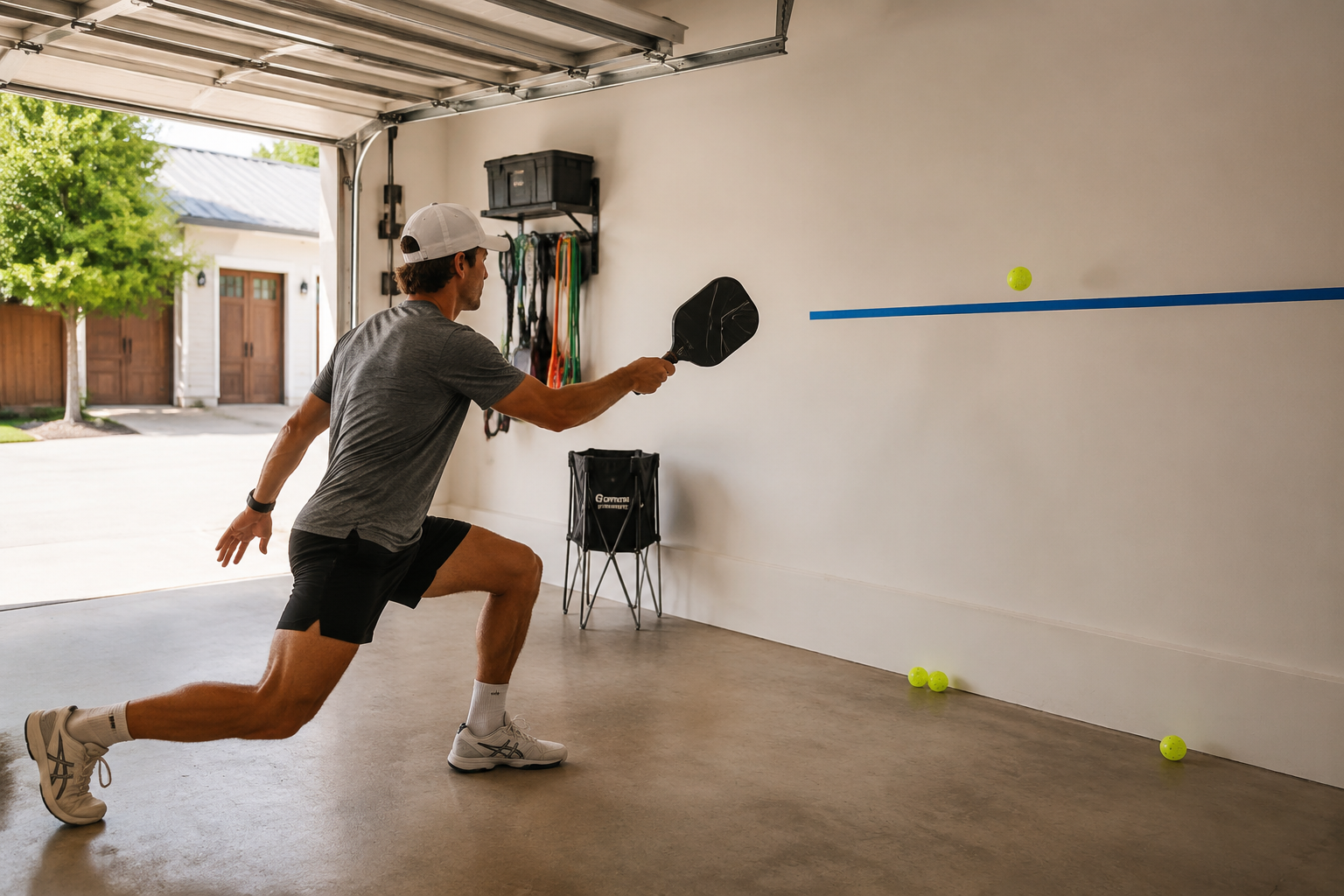
This 30-minute session uses a paddle, three balls, a wall or garage door, and a strip of tape. If you have a driveway, garage, basement, or living-room wall you can safely mark, you have enough to start. It is a blended routine, not a replacement for court reps and not a complete strength program. The point is narrower and more useful: connect pickleball skills with the legs and trunk that have to support them while fatigue is slowly building.
The 30-Minute Pickleball Home Workout
Set a timer before you begin. The timer matters because focused practice loses its edge when it becomes a vague half hour of tapping a ball around. The Dink’s solo-practice guide points to deliberate-practice research from K. Anders Ericsson when arguing that 15 to 30 minutes of focused solo work can beat an hour of unfocused rallying; that is not a guarantee of instant improvement, but it is a good standard for how this session should feel: specific, limited, and repeatable.[1]
| Time | Block | What You Do | Why It Belongs Here |
|---|---|---|---|
| 0:00-4:00 | Warm-up | March, hinge, rotate, ankle bounce, shadow-ready position | Prepares shoulders, hips, ankles, and eyes before ball contact |
| 4:00-12:00 | Skill touch | Wall dinks from 7 feet, then controlled forehand/backhand wall hits | Builds soft hands before conditioning makes touch sloppy |
| 12:00-18:00 | Serve and third-shot mechanics | Serve rhythm reps, drop-feed third-shot drops, shadow resets | Practices the shots that start the point and help you reach the kitchen |
| 18:00-27:00 | Strength and agility circuit | Squats, lunges, planks, lateral shuffles, rotation work | Trains the stop-start legs and trunk control that support the paddle |
| 27:00-30:00 | Cool-down and notes | Breathing, calf/hip/forearm reset, quick tracking note | Lets you repeat the workout without guessing what changed |
The order is deliberate. Skill work comes before the harder conditioning because dinks and drops punish a tired, noisy paddle face. The conditioning comes after because pickleball is not a neat strength test; it asks you to make a controlled shot after a small scramble, a split step, and a recovery.
Set Up the Wall So It Teaches the Right Lesson
Put a horizontal strip of tape on the wall at net height. Then mark a spot on the floor 7 feet from the wall. The Dink uses that 7-foot wall-dinking setup to mimic kitchen-distance exchanges, where the goal is not to win with pace but to keep the ball controlled, low, and repeatable.[1]
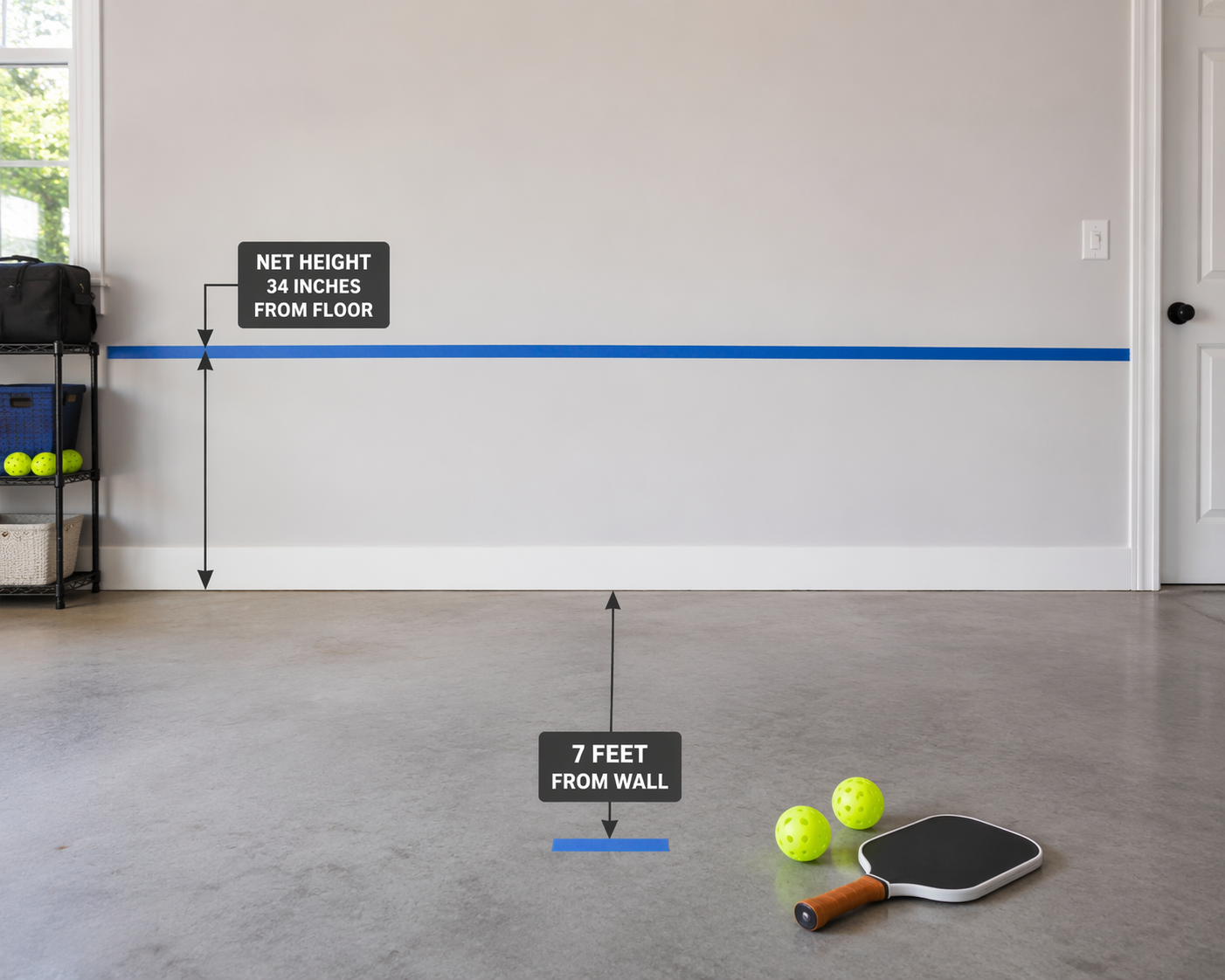
Stand behind the 7-foot marker in an athletic stance: feet under you, knees soft, paddle out front. Your first target is not speed. It is a ball that clears the tape line softly and returns to a height you can handle without reaching. If you have to stab at the next ball, the previous contact was probably too firm.
- Start with 60 seconds of forehand dinks, resting whenever the ball gets away from you.
- Switch to 60 seconds of backhand dinks, keeping the paddle face quiet through contact.
- Do 60 seconds alternating forehand and backhand, using your feet instead of reaching across your body.
- Finish with 60 seconds where every miss has a label: too high, too hard, late feet, or changing paddle face.
That last minute is the difference between practice and ball chasing. A wall will give you plenty of repetitions, but it will not tell you why you missed. You have to make the miss useful. If most misses are too high, soften the hand and reduce the backswing. If most misses are late, reset the feet before the paddle moves.
Add Movement Without Turning the Dink Into a Slap
For the next four minutes, keep the same wall setup but add a small recovery step after every contact. Hit, recover to the marker, split your feet, then hit again. The movement should be almost boring. If you make it dramatic, you will train a late lunge instead of a balanced dink.
Paddletek also includes solo wall work in its partner-free drill recommendations, which is useful mostly because it keeps the practice honest: the ball comes back quickly enough to expose a lazy ready position.[2] At home, that quick return is a feature as long as you do not start swinging harder just to survive the pace.
Serve Rhythm and Third-Shot Drop Practice
The serve portion is short because most home players do not need to turn the driveway into a serving lab. They need a repeatable rhythm they can bring to the court. Stand where you have safe clearance, hold the ball as if you are about to serve, and make 10 slow shadow serves. Say the rhythm quietly if it helps: set, drop, swing, finish. Then hit or simulate 10 serves with the same tempo. No rushing the second half of the swing.
If you can safely hit into a wall or open space, aim for shape rather than a tiny target. If you cannot hit a full serve indoors, shadow it in front of a mirror or phone camera. Paddletek and PB5star both use shadow swinging or visual feedback as a way to work on mechanics without live ball contact, which is exactly the kind of home compromise that still transfers if you take it seriously.[2][3]
The third-shot drop deserves more patience. The Dink describes it as the single biggest separator between 3.5 and 4.0-plus recreational players and includes home practice using a drop feed and wall target.[1] That does not mean a wall drill magically gives you a tournament drop. It means the shot is important enough to rehearse before you are already in a game, tense, and hoping your hand remembers softness.
How to Rehearse the Third-Shot Drop at Home
Use the same tape line if you have a wall. Stand several steps back from it, drop the ball in front of you, and lift it with a smooth, low-to-high motion so it clears the tape softly. Do not jab underneath the ball. Do not rescue a bad feed with a wrist flick. A home drop drill is partly a shot drill and partly an honesty test: can you keep the swing calm when the ball is not perfectly placed?
- Drop-feed 5 forehand attempts and watch whether the ball climbs gently or shoots into the wall.
- Drop-feed 5 backhand attempts, keeping the paddle path simple and the finish balanced.
- Do 10 shadow third-shot drops after a split step, using a mirror or camera if available.
- Finish with 10 alternating attempts: one actual drop feed, one shadow drop, one reset step.
The shadow rep after the ball rep is not filler. It lets you clean up the shape without being bullied by the bounce. If the ball rep was rushed, the shadow rep should look slower. If the ball rep made you lean, the shadow rep should finish with your chest stacked over your hips.
Players who also train for other court sports may recognize this structure: a short skill pattern, then the movement qualities that support it. The same idea shows up in a tennis fitness routine at home, where the workout has to respect the sport instead of becoming generic cardio with a racket nearby.
The Strength and Agility Circuit
Now the session changes. Put the balls aside but keep the paddle nearby. You are not trying to exhaust yourself for the sake of it. You are training the parts that usually break down before the score does: thighs that stop sitting low, hips that stop recovering, and a trunk that lets the arm swing alone.
Strength and conditioning sources for pickleball consistently point toward lower-body strength, core control, lateral movement, and rotation. Men’s Health builds pickleball strength work around exercises such as squats, lunges, hinges, and core training; Peloton’s pickleball exercise list also emphasizes legs, glutes, core, and rotational control.[4][5] Paddletek’s strength guide connects strength training twice per week with court speed, shot power, and injury resistance, while noting that bodyweight versions can still be useful when equipment is not available.[6]
| Move | Work | Home Coaching Cue |
|---|---|---|
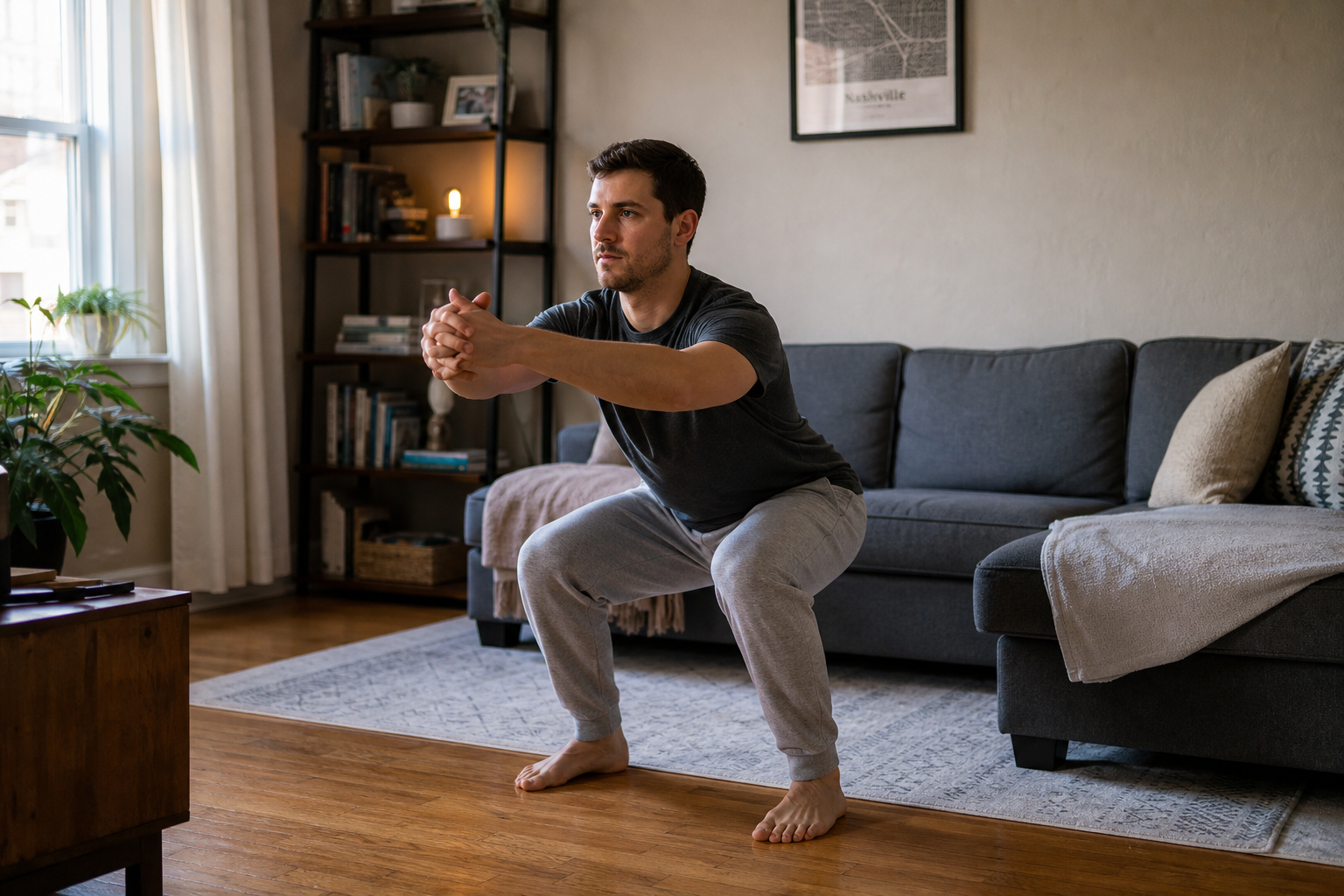
| Bodyweight squat | 40 seconds | Sit low enough to feel the legs, then stand without throwing the chest forward |
| Reverse lunge or split squat | 30 seconds each side | Step back, stay balanced, and imagine contacting the ball before you stand up |
| Forearm plank | 40 seconds | Brace as if someone is about to pull your paddle hand away from center |
| Lateral shuffle | 40 seconds | Two or three steps each way, quiet feet, paddle held in ready position |
| Standing rotation with paddle | 40 seconds | Turn through the ribs and hips without whipping the wrists |
Run the circuit once with 15 to 20 seconds between moves. If you have time left inside the 9-minute block, repeat the squat, shuffle, and rotation moves. Pickleball.com and The Picklr both include conditioning work aimed at speed, endurance, and game-specific movement, and those qualities matter more here than turning the circuit into a breathless burpee contest.[7][8]
Make the Lower-Body Work Look Like a Point
A squat in this workout is not just a squat. It is a chance to practice dropping the hips without dropping the paddle. Hold the paddle in front of your chest for the first half of the set, then extend it into ready position for the second half. If your shoulders climb toward your ears, reset them. Many kitchen errors start as tension before the ball even arrives.
The reverse lunge is where balance matters more than depth. Step back, lower under control, pause for one count, then return. On every third rep, hold the bottom position and make one slow shadow dink. This turns the lunge into something closer to a real pickleball problem: can your legs support a soft shot when your base is challenged?
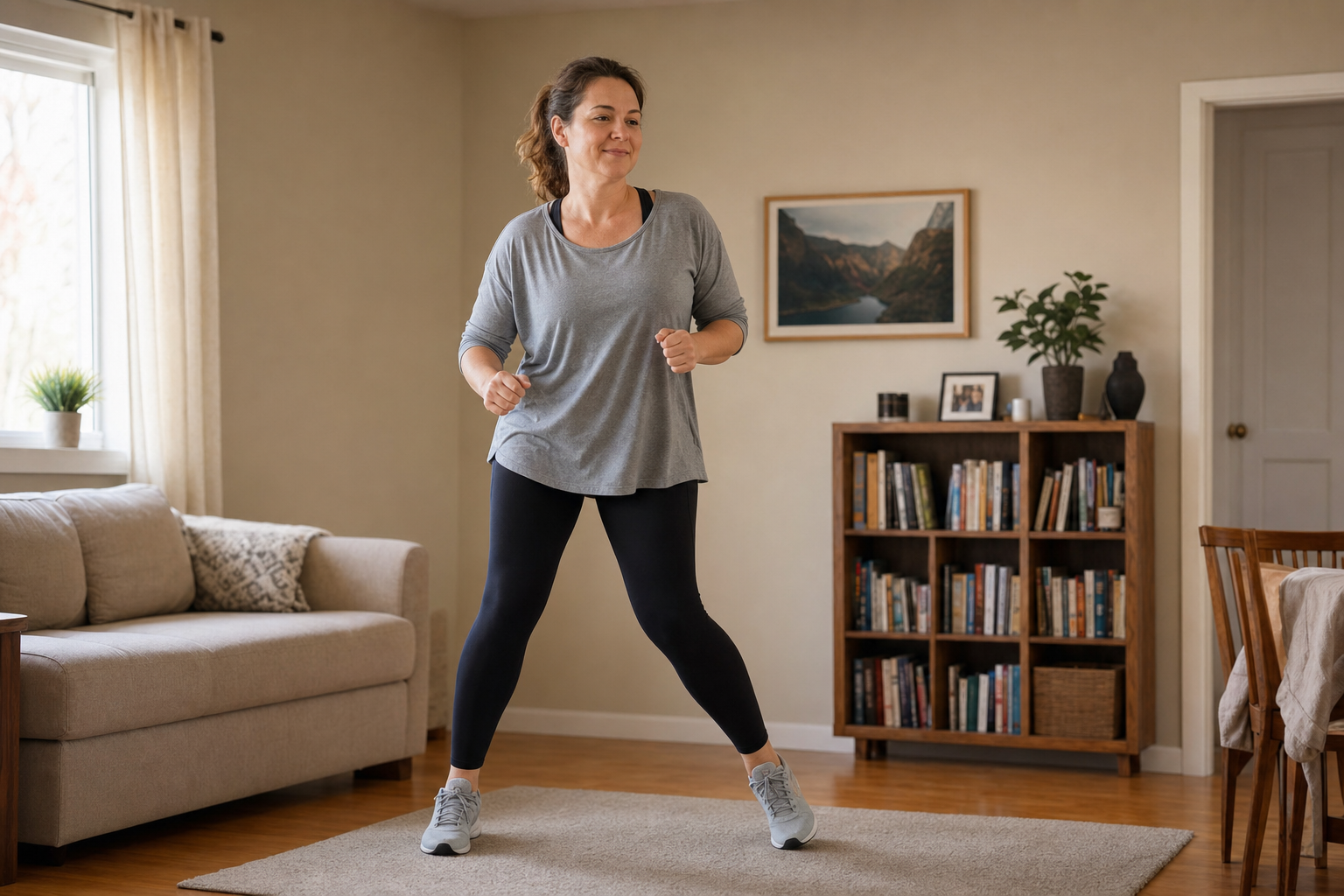
For lateral shuffles, use whatever space you have. A driveway might allow several steps each way. A garage might give you two. A living room may only allow one step and a recovery. That is still worth doing if the feet stay quiet and the torso stays ready. More space is not automatically better if it makes the movement sloppy.
Use Core Work to Control the Paddle, Not Just the Abs
The plank is there because the paddle depends on the middle of the body more than new players expect. If your trunk collapses, the paddle has to invent stability at the last second. Hold the plank with a long neck, steady breathing, and no sagging hips. If 40 seconds makes your form worse, use 20 seconds, rest, then repeat.
For standing rotations, hold the paddle with both hands in front of your chest. Turn to one side as if preparing a controlled groundstroke, return to center, then turn the other way. Keep the feet planted for the first 20 seconds. For the second 20 seconds, let the back foot pivot. The PPA Tour has also emphasized strength training as a way to support pickleball performance and longevity, but in this home session the useful piece is simple: rotation should come from the body, not a panicked arm swing.[9]
If You Have No Wall or Very Little Space
A wall makes this workout cleaner, but it is not the only way to practice. PB5star’s no-wall guidance includes shadow swings and other court-less options, which fit the small-space version of this session.[3] The tradeoff is feedback. A wall tells you immediately when the ball is too hard, too high, or too late. Without it, you need a mirror, phone camera, floor target, or stricter self-checks.
- Replace wall dinks with paddle taps and shadow dinks in front of a mirror.
- Replace third-shot drop feeds with slow shadow drops aimed at a towel or floor marker.
- Replace lateral shuffles with one-step recoveries: step right, reset, step left, reset.
- Keep the strength circuit unchanged unless the floor surface is slippery.
If your training area is closer to a hallway than a garage, borrow the small-space mindset from a small-apartment no-equipment workout: reduce travel, keep intent, and make every rep cleaner instead of larger.
How to Repeat and Progress the Session
Repeat this workout two or three times per week if it fits around your court play and recovery. Keep one skill target and one conditioning target each time. That is enough. Tracking six things usually turns into tracking nothing.
| If This Feels Too Easy | Change This First | Do Not Rush To |
|---|---|---|
| Wall dinks are controlled | Shrink the acceptable target above the tape line | Hit harder |
| Third-shot drops are consistent | Add a split step before the feed | Stand so far back that form falls apart |
| Squats and lunges feel stable | Slow the lowering phase or add a pause | Add weight before balance is reliable |
| Lateral shuffles feel tidy | Reduce rest or add one recovery step after each direction change | Turn the drill into a sprint |
| Planks feel easy | Add shoulder taps or shorten rest | Hold a long plank with sagging hips |
Progression should make the drill more like pickleball before it makes it more complicated. Aim smaller. Recover faster. Pause lower. Rest a little less. If you eventually want to build a broader equipment-based setup, a home gym plan that grows with your equipment is a better next step than buying random gear because one drill felt stale.
For absolute beginners who still need the basics, get a paddle, a few balls, and a safe practice surface before worrying about accessories. A first-time home gym buying framework can help keep that decision boring in the best way.
End each session with one note like this: “Backhand dinks floated when tired” or “Lunges stable, shuffle too loud.” Next time, repeat the same workout and change only the thing the note points to. A 30-minute integrated pickleball home workout is not magic, but it is a better match for the home player’s constraints than pretending skill practice and conditioning have to wait for separate days.
References
- How to Practice Pickleball Alone: 7 Solo Drills – The Dink Pickleball
- 5 Solo Pickleball Drills You Can Practice Without a Partner – Paddletek
- How Can You Practice Pickleball Without a Wall? – PB5star
- The Ultimate Pickleball Workout Plan to Build Strength for the Game – Men's Health
- 10 Strength Exercises That'll Power Up Your Pickleball Game – Peloton
- Strength Training for Pickleball: 5 Essential Exercises – Paddletek
- Pickleball Conditioning: Proven Exercises to Increase Speed and Boost Endurance – Pickleball.com
- Pickleball Workouts: Conditioning Exercises to Improve Your Game – The Picklr
- Boost Your Pickleball Game—and Your Lifespan—With Strength Training – PPA Tour
Comments
Join the discussion with an anonymous comment.