
Quarterfinal morning is where a lot of serious club players start making bad decisions with good intentions. You have won two or three matches, the draw suddenly looks possible, and the instinct is to prove you belong there: another basket of serves, another hour of live-ball patterns, maybe a leg session because the legs feel “flat.” That is usually the wrong adjustment. By this point, the question is no longer how much fitness you can build. It is how little extra work you can do while keeping the first three steps explosive.
The useful contrast is simple. Pros reduce training volume while preserving intensity. Many recreational tournament players increase volume while mistaking fatigue for readiness. Matt’s Point, citing tapering research from Vachon et al., describes an optimal pre-competition training-volume reduction of 41–60%, while also noting that many tennis players do the opposite by increasing court time before matches.[1] That number matters because it turns tapering from a vague “take it easy” suggestion into a workload decision.

The Quarterfinal Problem Is Accumulated Speed Loss
A player rarely feels tournament fatigue as one dramatic collapse. It shows up earlier than that. The split step is a fraction late. The outside leg does not push as cleanly. A wide forehand that was attackable on Saturday morning becomes a floating slice on Sunday afternoon. You may still feel mentally eager, but the court is already getting bigger.
That is why the competitive-fatigue data is more useful than generic advice about “listening to your body.” Matt’s Point cites Murphy et al. 2015, which found that a four-week competitive ITF tour significantly decreased acceleration and speed over 5m, 10m, and 20m in elite junior players.[1] The study window is longer than a club tournament weekend, so it should not be stretched into a claim that every quarterfinal player loses the same amount of speed. But the direction is relevant: repeated competition can measurably degrade the exact qualities that decide whether you arrive balanced or stretched.
For tennis, that is not a small conditioning detail. Five meters is the first emergency move to a wide ball. Ten meters is the recovery-and-reposition pattern after defending. Twenty meters is the longer chase, the drop-shot response, or the scramble after being pulled off the court. When those qualities fade, a player starts making tactical explanations for physical problems: “I got too passive,” “I stopped going for it,” “I made bad choices.” Sometimes the first mistake happened before the decision.
Tapering Is Not Resting; It Is Cutting Volume Without Blunting Intensity
The mistake is treating tapering as if it means becoming soft. A proper late-round taper does not ask you to move slowly, avoid intensity, or drift through a token warm-up. It asks you to remove unnecessary repetitions. The nervous system still needs reminders: push hard, stop sharply, react, brace, rotate, recover. What it does not need is another 90 minutes of proving that you can suffer.
A useful late-round workout has a different objective from a normal training session. A normal session may build strength, aerobic capacity, repeat-sprint tolerance, or technical volume. A quarterfinal-stage activation session tries to keep high-output movement available without creating new soreness, stiffness, or central fatigue. The work should feel crisp, not draining. If the session makes you proud because it was hard, it probably missed the point.
| Training Choice | What It Usually Does Before A Quarterfinal | Better Late-Round Version |
|---|---|---|
| Extra basket of serves | Adds shoulder, trunk, and calf load after match play | Hit a short serving rhythm block, then stop while timing is good |
| Full leg workout | Creates fatigue in the same muscles needed for first-step recovery | Use short jumps, fast step patterns, or low-rep strength reminders |
| Long live-ball hitting | Turns confidence practice into another match-load session | Use brief pattern rehearsal with generous rest |
| No movement prep | Leaves the body under-stimulated and stiff | Use 10–20 minutes of activation matched to the day |
This is where the 41–60% reduction becomes practical. You are not deleting intensity; you are deleting volume. Instead of doing five sets, do two. Instead of a full lifting session, do a few low-rep, fast-tempo movements. Instead of turning a pre-match hit into a second match, touch the ball, check timing, and leave the court with legs still under you.
How The Pro-Style Six-Day Taper Translates To A Home Gym
Tennis Fitness outlines a six-day tournament-week taper used around professional preparation: six days out emphasizes speed drills, five days out strength with low reps and fast tempo, four days out agility, three days out plyometrics, two days out footspeed and reaction, and one day out core and stability only. The same source frames these as short 10–20 minute sessions with long rest between sets.[2] That is the part worth copying. Not the exact facility, not the elite equipment, not the Instagram version of the drill. The structure is the value.
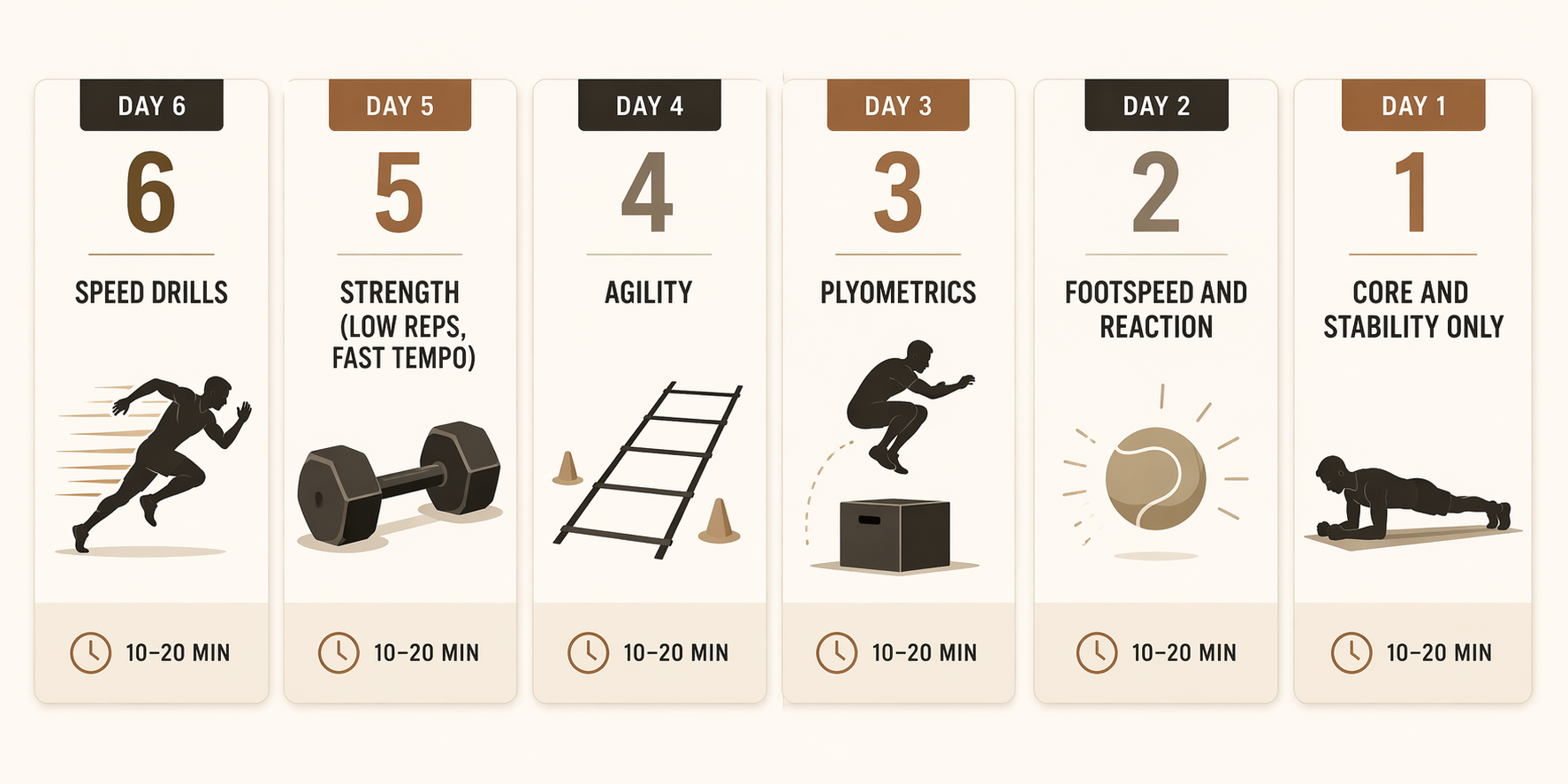
For a club player, the calendar may not be neat. Many local tournaments compress rounds into a weekend. Some events give rest days; many do not. At most Grand Slams and ATP/WTA events, the late rounds are commonly organized in a way that reduces the margin for heavy training between matches, but lower-level formats vary. So use the template as a sliding model: the closer you are to the next match, the less total work you do.
Six Days Out: Speed, Not Conditioning
Six days out is the last point in the week where a speed reminder can still feel like training rather than pure preservation. Keep it short: three to five sets of 5–10 second accelerations with full recovery. A driveway, turf strip, garage gym, or quiet court lane is enough. Use split-step starts, crossover starts, and short resisted starts with a light band if you have one.
The rule is that every rep must look fast. If rep four looks like a tired version of rep one, the set is over. Speed work that turns into conditioning is no longer speed work.
Five Days Out: Strength As A Reminder
This is not the day to chase a personal best. The pro template calls for strength with low reps and fast tempo.[2] At home, that can mean goblet squats, split squats, push-ups, band rows, or medicine-ball throws if those are already familiar. Keep the load moderate, the reps low, and the movement sharp.
- Two sets of three to five goblet squats, fast on the way up
- Two sets of three to five split squats per side, controlled and clean
- Two sets of five push-ups or band rows, stopping well before fatigue
- Optional: two sets of three medicine-ball rotational throws per side
If you do not normally lift during tournament week, do not introduce this now. A taper is not a place to audition new exercises.
Four Days Out: Agility Without The Circus
Agility should still look like tennis. Use short directional changes: split step, shuffle two steps, plant, recover; crossover to a wide cone, recover; forward diagonal sprint, decelerate, backpedal under control. The useful part is the brake-and-repush, not the complexity of the pattern.
Keep the work in small clusters. For example, do four to six 6-second reps, rest generously, then repeat once. If the feet get noisy and heavy, stop. Heavy-footed agility practice is just fatigue practice with cones.
Three Days Out: Plyometrics In Tiny Doses
Plyometrics before a tournament are easy to overdo because the first few jumps feel good. Keep them low-volume and familiar: pogos, lateral bounds, snap-downs, or small split-step rebounds. The goal is stiffness and spring, not soreness. A player who wakes up with heavy calves from “activation” has turned the session into a tax.
A sensible home version is two rounds of 10 seconds of pogos, four lateral bounds per side, and three controlled snap-downs. Rest long enough that the second round is as crisp as the first.
Two Days Out: Footspeed And Reaction
Two days out is where nervous-system sharpness matters more than any feeling of having “worked.” Use reaction starts, fast-feet bursts, and short mirror drills. If you have a partner, have them point left or right after your split step. If you are alone, use a random timer, ball drop, or simple visual cue.
The drill can be almost embarrassingly short: six to eight reactions of 3–5 seconds. That is enough to remind the body what fast feels like without turning the session into conditioning.
One Day Out: Core And Stability Only
The day before a quarterfinal is where discipline looks boring. The Tennis Fitness template moves to core and stability only one day out.[2] At home, that means anti-rotation presses, side planks, dead bugs, bird dogs, and light hip stability. None of this should feel like a challenge workout.
- Dead bug: two sets of five slow reps per side
- Side plank: two short holds per side, stopping before shaking
- Band anti-rotation press: two sets of five reps per side
- Single-leg balance with reach: two sets of three controlled reaches per side
If you want a light hit, keep it as a rhythm check. There is nothing wrong with using the court to calm the mind. The line is crossed when the calming ritual becomes fatigue-producing volume.
What Changes Once You Are Already In The Quarterfinals
Once the quarterfinal is no longer six days away but tomorrow or later today, compress the model. Do not try to “catch up” on the sessions you missed. You are not owed a strength day because the template had one. The only useful question is what your body needs before the next match.
| Time Before Next Match | Training Objective | Home-Gym Version |
|---|---|---|
| 24 hours | Stability, mobility, and very light activation | 10–15 minutes of dead bugs, side planks, band anti-rotation, hip mobility |
| Match morning | Raise temperature and sharpen first step | 5–8 minutes of dynamic movement, then 3–5 short accelerations |
| Between same-day matches | Recover first, then re-prime briefly | Walk, refuel, change clothes, elevate legs if useful, then do a short warm-up before play |
| After a long match | Reduce next-day stiffness and protect sleep | Cool down, eat, hydrate, use your normal recovery tools, and skip extra training |
That last line is often the hard one. After a good win, players want to rehearse the next match immediately. They shadow swing in the parking lot, text tactical notes until midnight, watch clips, stretch again, then decide they should probably serve a little more in the morning. Some of that is nervous energy. Some of it is useful preparation. But the body does not care whether the extra volume came from ambition or anxiety.
Recovery Counts As Training In The Late Rounds
The clearest professional example is not a complicated drill. It is sleep. Tennis Fitness and TennisTraveller both describe Jannik Sinner prioritizing 10 hours of sleep per night during tournaments, including around the 2025 Australian Open, regardless of match finish time.[3][4] That is a concrete behavior, not a motivational quote. A top player protects recovery with the same seriousness that amateurs often reserve for extra hitting.
Sleep is also where club players give away late-round legs. Tournament days stretch out. Matches run late. Dinner becomes whatever is still open. Then the player studies the draw, scrolls results, and calls it preparation. If the next day’s match depends on acceleration, the night before is part of the workout routine.
Post-match recovery does not need to become a second sport. The general framework is simple: cool down, replace fluids, eat, bring the nervous system down, and sleep. For a broader home-fitness structure, this post-workout recovery routine at home covers the basics. During a tournament, the adjustment is urgency: you are recovering for a match that may arrive before you feel ready.
Some tennis fitness coaches recommend specific recovery tactics such as protein soon after play, cold-water exposure, and compression garments, with Tennis Fitness and Aubone Tennis giving practical tournament-recovery suggestions in that direction.[5][6] Treat those as tools, not magic. If ice or compression helps you settle and feel better the next day, use it. If it becomes another hour of fussing when you should be eating and sleeping, it has stopped serving the match.
A Concrete Quarterfinal-Stage Routine
Use this when you have reached the late rounds and the next match is within roughly 24 hours. It assumes you are healthy, already accustomed to basic strength and movement work, and trying to stay sharp rather than get fitter.
After The Previous Match
- Walk for a few minutes instead of sitting down immediately.
- Change out of wet clothes and start rehydrating.
- Eat a proper recovery meal or snack as soon as practical.
- Write down only the tactical notes you genuinely need for the next match.
- Do not add serves, sprints, lifting, or “just a little” conditioning.
Night Before
- Spend 8–12 minutes on easy mobility: hips, ankles, thoracic rotation, gentle hamstring movement.
- If you feel restless, do breathing or a short walk rather than another workout.
- Prepare clothes, grips, food, water, and warm-up gear before bed.
- Protect sleep as the main session of the night.
Match Morning Activation
| Block | Exercise | Dose |
|---|---|---|
| Warm-up | Easy jog, skips, lateral shuffle, arm circles | 3–5 minutes |
| Mobility | Hip openers, ankle rocks, thoracic rotations | 3–4 controlled reps each |
| Stability | Dead bug, side plank, band anti-rotation press | One short set each |
| First-step speed | Split-step to 3-step acceleration left and right | 3–5 total reps |
| Reaction | Partner point, ball drop, or random cue start | 3–5 reps of 3–5 seconds |
| Stop point | End while movement still feels sharp | No fatigue finish |
The whole session should fit inside 10–20 minutes. Rest longer than feels necessary between explosive reps. Tennis already supplies the conditioning test. The activation session only needs to tell the body that high-quality movement is still required.
If You Also Have A Pre-Match Hit
Keep the hit short and purposeful. Start with cooperative rallying, touch volleys and overhead rhythm if needed, a few returns, and a small number of serves. Leave before timing starts to decline. A pre-match hit should lower uncertainty, not become a private fitness test.
The late rounds punish unnecessary work. Once you reach a quarterfinal, the goal is no longer to build fitness during the tournament. It is to preserve speed, keep intensity available, and stop extra volume from stealing the legs you need for the next wide ball.
References
- In-Season Training for Tennis: 3 Strategies, Matt's Point
- How To Train A Week Before A Tennis Tournament, Tennis Fitness
- Preparing For A Tennis Tournament, Tennis Fitness
- Tennis Recovery Guide, TennisTraveller
- Discover A Secret Tennis Training Technique For Recovery, Tennis Fitness
- Tips To Improve Recovery During Tennis Tournaments, Aubone Tennis
Comments
Join the discussion with an anonymous comment.