
Most searches for baseball swing training drills for home run into the same problem: the drill looks useful, but it assumes a cage, a net, a tee, a garage bay, or someone available to toss balls. Then the player tries one awkward full swing in a bedroom, hears a lamp rattle, and the workout is over.
Start with the room, not the drill. A good home swing plan is less about copying the biggest setup online and more about choosing reps that fit the space safely enough to repeat tomorrow.
| Tier | Best fit | Equipment | What to train |
|---|---|---|---|
| Tier 1 | Living room, bedroom, hallway, apartment space | Mirror, towel, PVC pipe, broomstick, or no gear | Posture, coil, sway control, sequencing, follow-through |
| Tier 2 | Garage, driveway, small backyard, open basement | Bat and ball, but no net | Dry swings, bat path, contact-position checkpoints, controlled movement |
| Tier 3 | Dedicated tee-and-net area | Bat, balls, tee, net, optional weighted bats | Tee-location work, stop-at-contact, one-hand swings, bat-speed rounds |
If you are unsure which tier you belong in, choose the lower one. A cramped, repeatable drill beats a bigger drill that makes everyone in the house nervous.
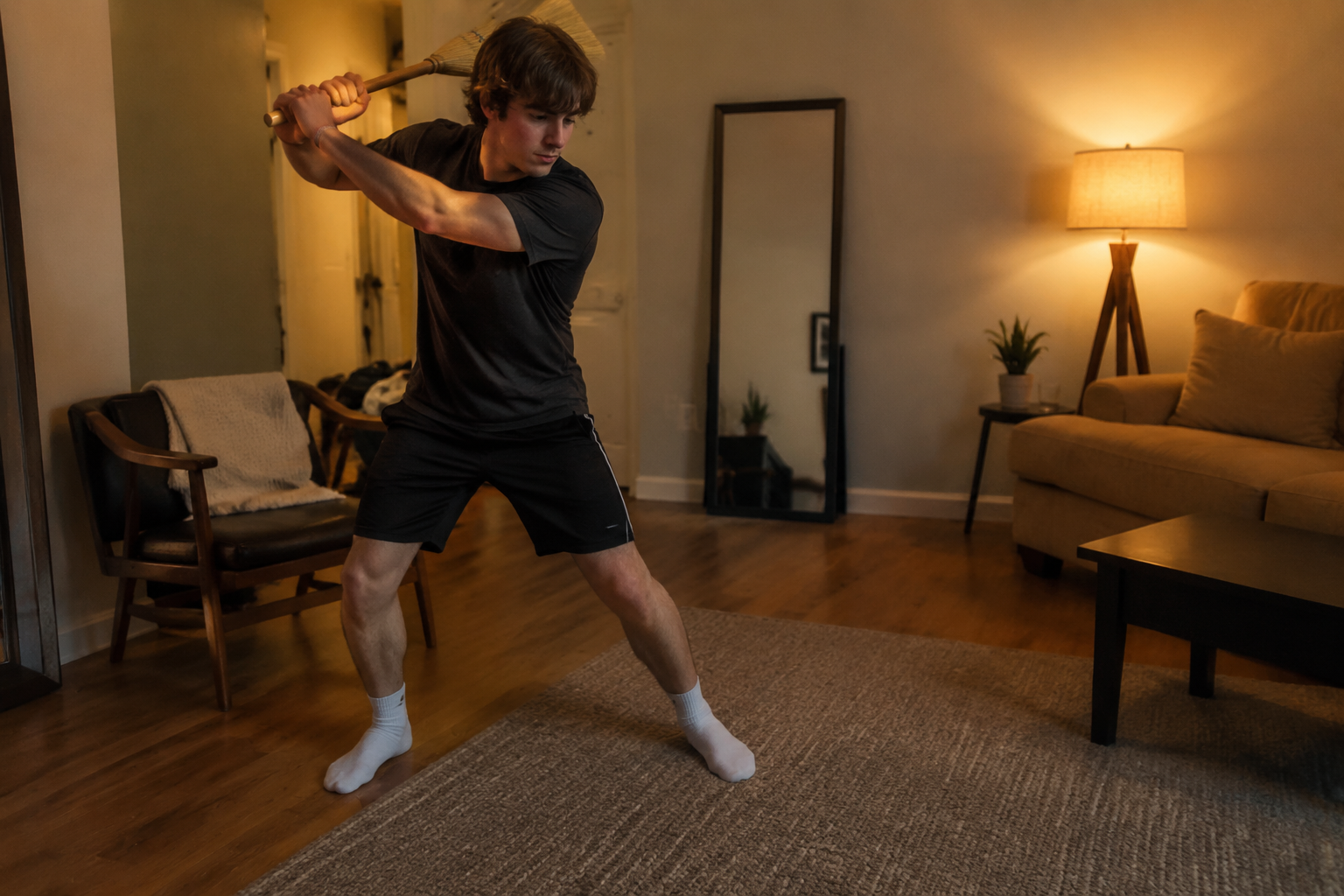
Tier 1: Living Room Drills With No Real Bat Required
Tier 1 is for the player who has almost no margin for error: furniture nearby, low ceiling, no net, maybe a parent who is already watching the light fixture. This is not the place for full-speed bat swings. Use a broomstick, PVC pipe, rolled towel, or even empty hands until the movement is controlled.
That sounds small, but it is not wasted work. Many home swing problems are feedback problems. The player cannot feel sway, collapsing posture, drifting hands, or a cut-off finish until something simple reflects it back.
Mirror Swings: The Cheapest Coach in the Room
Stand in front of a full-length mirror or a phone camera in selfie view. Use a broomstick, PVC pipe, or no bat. Move through the swing at half speed, then freeze at three points: stance, launch, and contact. RGen Sports and WIN Reality both use mirror or video review as a home feedback tool because it lets the hitter see posture and swing shape without needing a coach beside them.[1][3]
- At stance: knees athletic, head centered, shoulders not already tilted out of control.
- At launch: front side controlled, back hip starting to turn, hands not dumping early.
- At contact: head still, chest not flying open, barrel working through the hitting zone.
- At finish: balanced enough to hold the pose for two seconds.
Run 10 slow mirror swings, then record five from the side and five from the front. Watch the video immediately. Do not save it for later; later usually becomes never. The point is to create a quick loop: swing, see, adjust, repeat.
Wall Drill: Find Sway Before It Becomes a Habit
The wall drill is one of the rare home drills that is useful because the room gets in the way on purpose. Set up sideways with the back hip about 2 to 3 inches from a wall, then move through the load and swing slowly. RGen Sports and Bobby Woods Baseball describe the wall as feedback for whether the hitter is swaying into the wall instead of coiling and rotating.[1][2]
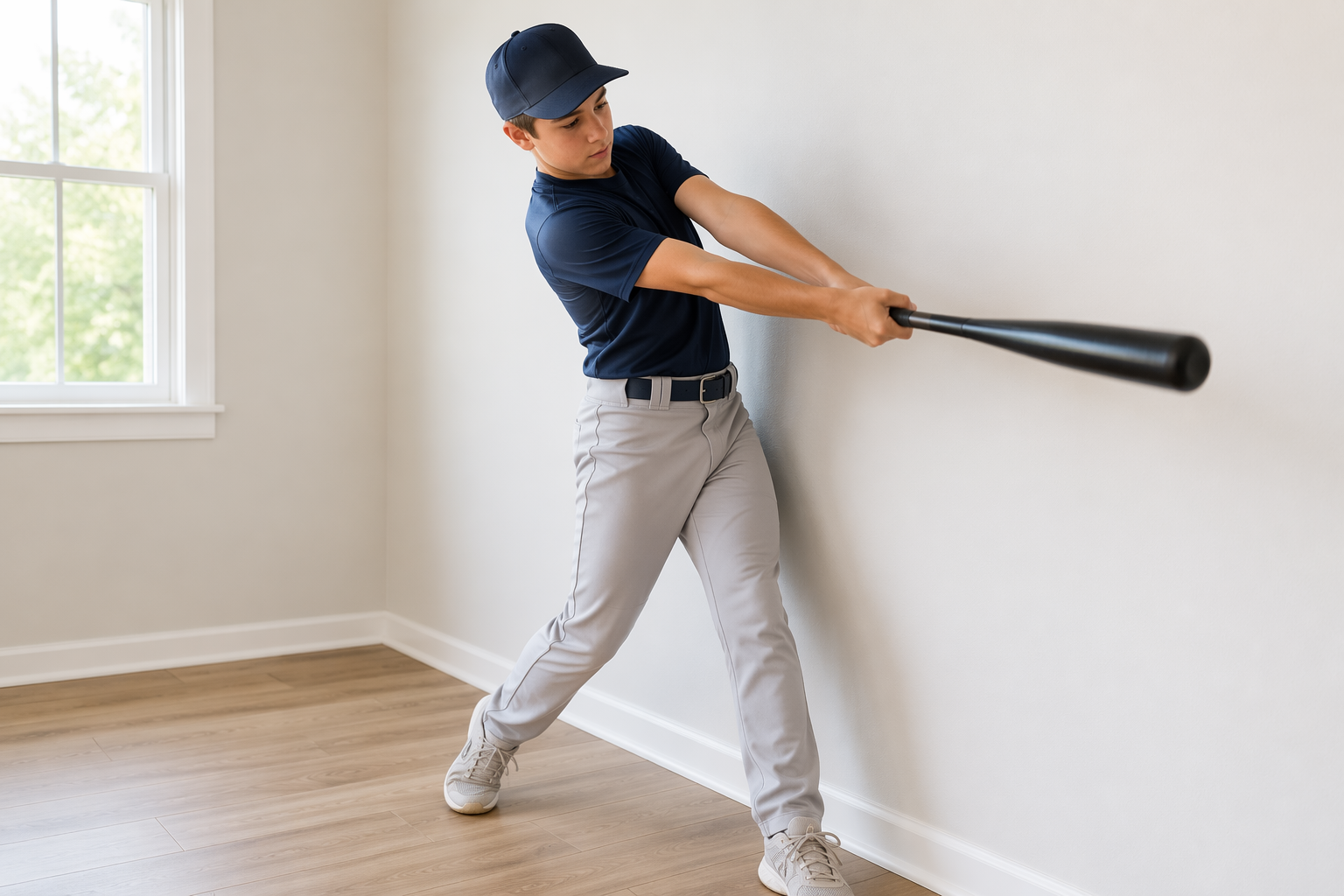
Use a broomstick or empty hands at first. If the back hip bumps the wall during the load, the body is drifting. If the player can coil without crashing into the wall, then rotate through while staying balanced, the movement is cleaner.
A good starting dose is 8 to 12 slow reps, then 5 reps recorded from the open side. The video matters because some hitters avoid the wall by standing tall or cutting the turn short. The goal is not simply to miss the wall; it is to keep an athletic hinge while turning.
PVC or Broomstick Separation Work
A PVC pipe or broomstick can stand in for a bat when ceiling clearance is bad. RGen Sports uses PVC pipe work to train hip-shoulder separation, which is the feeling of the lower body starting the move while the upper body stays controlled for a beat.[1]
Hold the pipe across the shoulders, get into stance, and make a small load. Turn the hips slightly before the shoulders follow. Keep it slow enough that the head does not lunge forward. The feedback is simple: if the whole torso spins as one block, there is no separation; if the shoulders yank first, the swing is starting from the top.
Use this for 2 sets of 8 to 10 controlled turns. It pairs well before mirror swings because the player can feel the sequence, then check whether it survives when the hands come back into the motion.
Towel Drill for Extension Without Smashing Anything
For the towel drill, drape a towel under the lead arm, move through the swing, and let the towel release as the arms extend. RGen Sports presents this as a way to work on follow-through and arm extension at home.[1]
This drill is useful in a small room because the towel gives feedback without needing a ball. If the towel drops immediately, the lead arm may be pulling away too early. If the hitter gets stiff trying to trap the towel forever, the finish becomes artificial. Let the towel stay connected through the turn, then release naturally as the swing extends.
Try 10 slow reps, then 10 reps at a comfortable rhythm. Stop before the hitter starts whipping the towel around the room; at that point the drill has become a household hazard, not a baseball session.
Tier 2: Garage, Driveway, or Backyard Work Without Pretending It Is a Cage
Tier 2 gives you more room, but it also tempts players into bad decisions. A garage with a concrete floor, a driveway near a car, or a backyard with windows nearby is not automatically a batting cage. If there is no net, the safest work is still mostly dry swings and controlled checkpoints.
Before swinging a real bat, check ceiling height, side clearance, footing, pets, siblings, cars, and anything that can ricochet. If the space doubles as a garage gym or storage area, treat it like any other compact training setup: the layout has to match the movement, not the other way around. FitAtHome uses the same constraint-first logic in its home gym equipment decision framework and compact home gym buyer guide. Baseball just makes the clearance mistakes louder.
Controlled Dry Swings With Stop Points
Use a real bat only if the player can swing freely without reaching walls, ceiling, garage rails, or stored equipment. Start with dry swings that stop at contact. The hitter loads, turns, and freezes where contact would happen. Then the player checks the barrel angle, head position, back knee, and balance.
This borrows the same checkpoint idea used in stop-at-contact work, but without a tee or ball. Driveline Baseball discusses stop-at-contact as a way to inspect position at the point of contact rather than letting every flaw disappear into the finish.[4]
A practical round is 5 slow dry swings, 5 stop-at-contact swings, then 5 normal dry swings. Record one set from the open side. If the hitter cannot freeze without falling, the regular swing is probably hiding a balance problem.
Light Ball-Contact Constraints
Without a net, ball contact should be limited and intentional. Use rolled socks, foam balls, or very soft training balls only when the environment is safe. This is not where a player should hit real baseballs into a fence from five feet away and hope the bounce behaves.
The better Tier 2 use is contact awareness: slow swings into a suspended sock ball, gentle top-hand path work with a foam ball, or short bat-control movements that never approach full game effort. If the hitter wants real ball flight, that is the sign to move to a field, cage, or Tier 3 net setup.
Tier 3: Tee-and-Net Drills for a Fuller Home Routine
A tee and net changes what home training can do. Now the hitter can train contact, not just movement. WIN Reality describes a tee-and-net setup in the rough range of $75 to $400 as enough for mechanics and contact work, while also noting that it does not replace pitch recognition or game-speed swing decisions.[3]
That caveat matters. A tee can show whether the swing is organized enough to meet a stationary ball. It cannot teach the hitter to read spin, handle timing, or decide whether to swing at game speed. For home work, that is still a good trade if the player knows what the tool is for.
Tee-Location Work: Front, Inside, Outside
Tee work gets much more useful when the tee moves. WIN Reality recommends front tee, inside tee, and outside tee locations, with 15 to 25 balls at each spot.[3] The point is not to take the same comfortable swing 75 times. The point is to learn where contact belongs.
| Tee location | Contact cue | Common miss to watch |
|---|---|---|
| Front tee | Meet the ball slightly out front | Lunging forward instead of turning |
| Inside tee | Clear the barrel and get to contact earlier | Casting the hands around the ball |
| Outside tee | Let the ball travel deeper | Rolling over or pulling off too soon |
For most home sessions, 15 balls per location is plenty if the player reviews the misses. If the hitter is spraying balls off the side of the net, do not add more reps. Move slower, freeze at contact, and find the contact point again.
Stop-at-Contact Drill
Set the ball on the tee, swing to contact, and freeze before the follow-through. Driveline Baseball uses this drill to examine the hitter’s contact position.[4] It is not exciting, which is part of why it works. The player cannot hide a poor barrel position behind a loud finish.
- Check whether the barrel is behind or through the ball, not chopping straight down.
- Check whether the head stayed near the contact window.
- Check whether the front side opened so early that the barrel dragged.
- Check whether the hitter can hold the position without stumbling.
Use 8 to 12 stop-at-contact reps before tee-location rounds. For a player who rushes everything, this may be the most valuable part of the session.
One-Hand Swings and the Slapshot Drill
One-hand swings can expose whether each arm contributes to extension or whether one side is just along for the ride. RGen Sports and Bobby Woods Baseball both include one-hand or slapshot-style work, with RGen Sports giving a range of 10 to 15 reps per hand using a lightweight bat.[1][2]
Keep these controlled. Use a lighter bat if available, choke up if needed, and hit off a tee into the net. The top hand should help the barrel work through contact. The bottom hand should keep the swing from collapsing across the body. If the hitter starts muscling the bat with the wrist, lower the speed or stop the drill.
Overload and Underload Swings, With the Claims Kept in Bounds
Weighted-bat work belongs in Tier 3 because it needs space, attention, and a hitter who can already make decent swings. WIN Reality suggests 3 to 5 swings with a heavier bat, 3 to 5 with a lighter bat, for 3 rounds, using bats about 10 to 15 percent above and below game bat weight.[5]
The same WIN Reality article describes 3 to 5 percent bat-speed gains as consistent with what coaches see across age groups, but that is a vendor blog statement, not a peer-reviewed result.[5] Treat overload and underload work as a useful advanced option, not a magic bat-speed guarantee.
A reasonable home version is modest: one round of heavy, light, and game-bat swings after the hitter is warm, then stop if the swing gets sloppy. If the heavier bat changes the hitter’s mechanics, it is too heavy for that session.
How to Run a Home Swing Session Without Turning Reps Into Noise
The number that matters at home is not how many swings the player can survive. It is how many swings still have attention attached to them. WIN Reality’s guidance favors 40 to 60 focused reps over 100 mindless swings.[3] That is about right for a home session because the room, the net, and the player’s concentration all have limits.
Here is a simple way to build the session once the tier is clear.
| Session part | Tier 1 example | Tier 2 example | Tier 3 example |
|---|---|---|---|
| Warm-up movement | PVC turns, 8 reps | PVC turns or dry swings, 8 reps | Dry swings, 8 reps |
| Feedback drill | Wall drill, 10 reps | Stop-at-contact dry swings, 10 reps | Stop-at-contact tee swings, 10 reps |
| Main work | Mirror swings, 20 reps | Controlled dry swings, 20 reps | Tee-location work, 30 to 45 balls |
| Optional finisher | Towel drill, 10 reps | Recorded dry swings, 5 reps | One-hand swings or modest weighted-bat round |
| Review | Watch 2 clips | Watch 2 clips | Watch 2 clips |
The review is not decoration. A player training alone needs some kind of witness. A mirror gives instant feedback, and a phone video gives slower feedback. Use both when possible: mirror for the feel, recording for the truth.
Pick one cue for the day. For example: stay balanced, coil without sway, meet the outside pitch deeper, or hold contact. If every swing has five corrections attached to it, the player will usually fix none of them.
A 20-Minute Tier 1 Session
- Clear the space and use a broomstick, PVC pipe, towel, or empty hands.
- Do 8 PVC shoulder turns, watching that the hips start before the shoulders.
- Do 10 wall-drill reps with the back hip 2 to 3 inches from the wall.
- Do 20 mirror swings, freezing at launch and contact.
- Do 10 towel-drill reps for extension.
- Record 5 final swings and review one cue only.
A 25-Minute Tier 3 Session
- Check the tee, net, floor, ceiling, and side clearance.
- Take 8 dry swings, then 8 stop-at-contact tee swings.
- Hit 15 balls from the front tee location.
- Hit 15 balls from the inside tee location.
- Hit 15 balls from the outside tee location.
- Add 10 one-hand swings total, or one modest overload/underload round if mechanics stay clean.
- Review two clips before putting the gear away.
What Home Swing Work Can and Cannot Fix
Home drills can improve movement quality, contact checkpoints, balance, repeatability, and awareness. They are especially good at making a player notice the things that get ignored during a full batting practice round: drifting into the load, losing posture, pulling off the ball, or finishing off balance.
Home drills cannot fully replace facing velocity, reading spin, adjusting timing, or making swing decisions against a live arm. Even a solid tee-and-net station mainly covers mechanics and contact; pitch recognition and game-speed decisions require visual training or live/game-like reps.[3]
That boundary should not discourage home work. It should keep the routine honest. Use the living room for movement. Use the garage or backyard for controlled bat-path work. Use the tee and net for contact. Then use the field, cage, coach, or game-speed visual work for the pieces a house cannot safely provide.
The best baseball swing training drills for home are the ones the player can repeat safely, review clearly, and connect to the next real baseball setting. Bigger is nice when the space supports it. Better is the setup that produces clean reps without pretending the living room is a batting cage.
References
- Innovative Hitting Drills You Can Do at Home, RGen Sports
- At-Home Baseball Training Drills and Exercises to Improve Your Game, Bobby Woods Baseball
- Indoor Baseball Drills, WIN Reality
- Baseball Hitting Drills, Driveline Baseball, 2022
- How to Increase Bat Speed, WIN Reality
Comments
Join the discussion with an anonymous comment.