
Run Caitlin Clark's Pregame Warmup in Your Living Room
Caitlin Clark's pregame warmup works for a reason that has nothing to do with the arena: it's built on continuous movement, ball-handling before shots, balance under contact, and ending on a make. Here's how to rebuild that structure as a 20–30 minute, no-hoop, small-space routine, with noise and floor-protection notes for renters.
- Equipment tier required
- $0-100
- Duration
- 30 min
- Difficulty
- beginner
- Target area
- full body
- Space footprint needed
- 2x2 m
- Noise level
- low noise
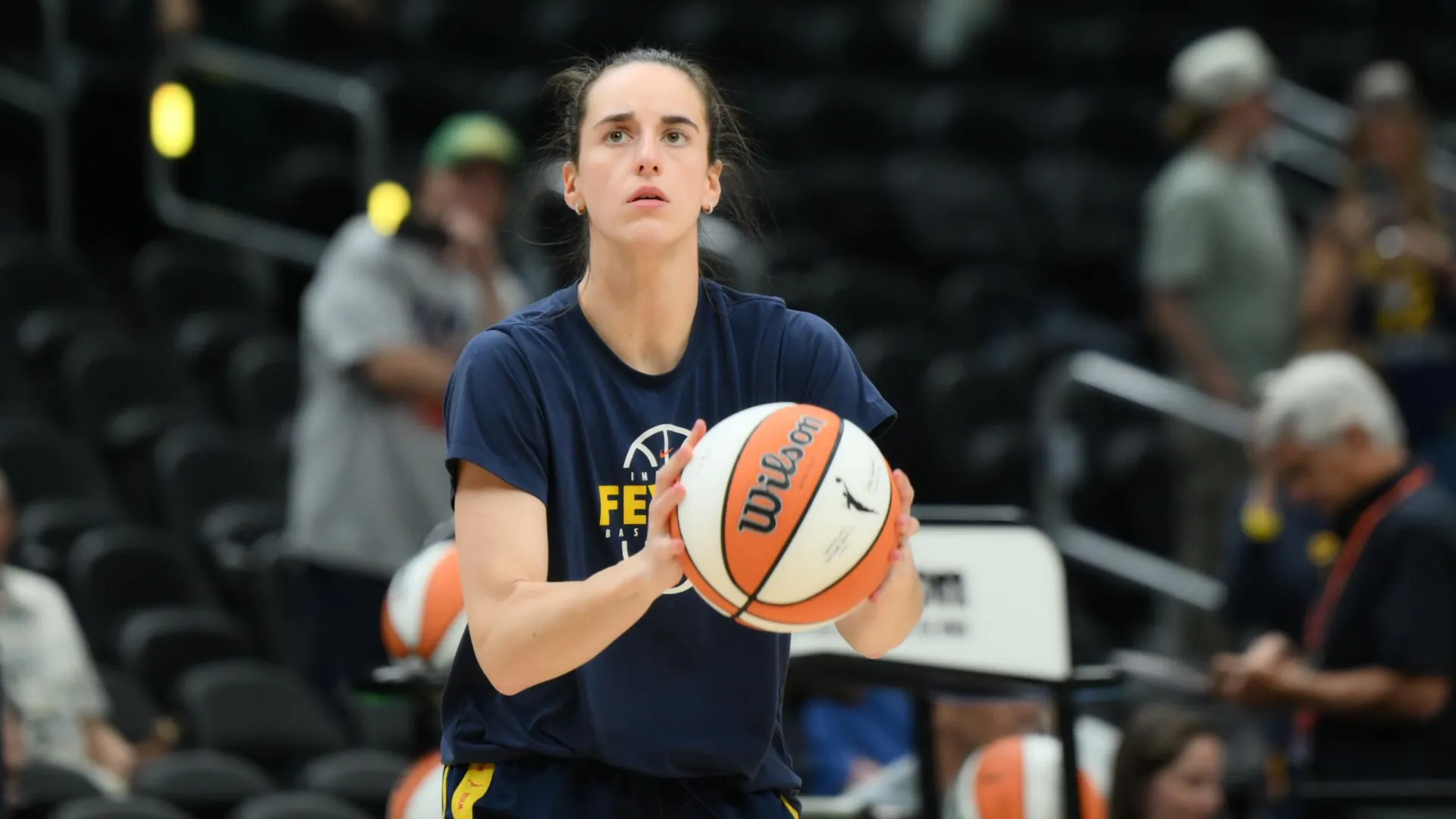
Caitlin Clark’s pregame warmup looks like a show because it happens in front of people. In the documented ESPN feature, she comes out about 75 minutes before tipoff, moves fast without much dead time, shoots, drives, absorbs contact from assistant coach Austin Kelly, and will not let the session end until the ball goes in. The crowd is part of the scene — roughly 1,000 fans watching a warmup — but the useful part is quieter: she is rehearsing basketball that does not stay clean. Clark described the contact piece plainly: “If I don’t get hit, maybe I’m off balance at this point?”[1]
That is the reason a Caitlin Clark pregame warmup routine at home is worth building. Not because a living room can become Gainbridge Fieldhouse. It cannot. The transferable pieces are the order of demands: keep moving, handle before you shoot, challenge balance, make the reps feel game-speed, and finish on one clean success.
What is documented, and what is the at-home adaptation
There is no published, official drill-by-drill home version of Clark’s pregame warmup from Clark or the Fever. The arena material documents the rhythm and priorities: early court arrival, continuous movement, shooting and driving, contact from Kelly to train balance, feeling “activated,” a ritual soundtrack that includes “Applause” by Lady Gaga, and the rule that the warmup ends on a make.[1]
The at-home version below is an adaptation. It borrows the structure, then changes the tools. A hoop becomes a wall target or form finish. A defender becomes a safe lean, a wall brace, or an off-balance catch. Full-court pace becomes continuous work inside roughly 2x2 m. If you want Clark’s broader offseason shooting-volume angle, use FitAtHome’s separate guide to Caitlin Clark’s home workout drills without a full court. This piece stays on pregame activation, balance, and the last-make rule.
| Clark element | At-home translation | Why it stays useful |
|---|---|---|
| Continuous movement before tipoff | A 20–30 minute sequence with short resets, not long rests | You raise readiness without turning the warmup into a separate workout |
| Handles before shots | Low dribbles, wall taps, pickups, and ball transfers before any shooting-form work | The ball feels alive before you ask your shot mechanics to be clean |
| Contact and balance work | Wall-braced leans, one-leg catches, hip turns, and controlled off-balance gathers | You practice recovering shape instead of only moving when perfectly set |
| Game-speed intent | Short bursts where every rep has a target, foot angle, or finish point | The session avoids becoming lazy living-room dribbling |
| End on a make | One clean target hit, clean form rep, or controlled finish | You stop with a concrete success instead of chasing fatigue |
Set the room before you touch the ball
Clear a patch of floor about two big steps by two big steps. Move anything glass, wheeled, sharp-cornered, or sentimental. If you live above someone, put down the thickest stable surface you can use without slipping: a dense exercise mat, rug-plus-mat combination, or court-style tile over padding if you already have it. The point is not to make basketball silent. The point is to remove avoidable thuds.
Use a real basketball only if your floor and neighbors can tolerate controlled dribbling. Otherwise, run the same sequence with a quieter ball, a slightly deflated outdoor ball, or no dribble on the loudest sections. A wall is useful, but it is not a backboard. Pick a sturdy, bare section; avoid framed art, thin interior doors, mirrors, and shared walls late at night.
This warmup also follows the basic warmup logic the NBPA teaches young players: use dynamic work before activity, save longer static stretching for after, and prepare the body for basketball movement rather than parking in passive holds first.[2]
The 20–30 minute living-room version
Clark’s broader at-home and offseason training footage has been described as conditioning first, wall-tap ball-handling, then game-speed shooting, with different outlets highlighting runs, wall taps while switching the ball behind the back, and sharp shooting work rather than casual spot-up reps.[3][4][5] That order matters here. You are not trying to empty the tank. You are trying to arrive at the ball work already warm, then add just enough chaos to make the final rep meaningful.
| Block | Time | Main job |
|---|---|---|
| Dynamic activation | 4–6 minutes | Raise temperature and wake up feet, hips, ankles, and shoulders |
| Handle-first rhythm | 5–7 minutes | Make the ball feel quick before any shot substitute |
| Balance-under-contact substitute | 5–7 minutes | Recover control from leans, bumps, and imperfect catches |
| Game-speed shot or finish substitute | 5–8 minutes | Make every rep intentional even without a hoop |
| Final make | 1–2 minutes | End on one clean, defined success |
1. Dynamic activation: 4–6 minutes
Start without dribbling. In an apartment, the first few minutes are where you get warm without announcing yourself to the building.
- March to quick feet in place: start soft and low, then increase cadence without stomping.
- Hip switches: step one foot back, rotate the hip open, return to an athletic stance.
- Ankle rocks: shift forward and back with heels controlled, not bouncing hard into the floor.
- Lateral step-and-stick: take one quiet side step, freeze for a beat, then come back.
- Arm circles into shooting pockets: circle the shoulders, then bring both hands to a set position as if catching.
The “stick” matters. A lot of small-space basketball work becomes fake because the feet never have to stop. Clark’s warmup includes drives and contact; the home version has to include brakes.
2. Handle-first rhythm: 5–7 minutes
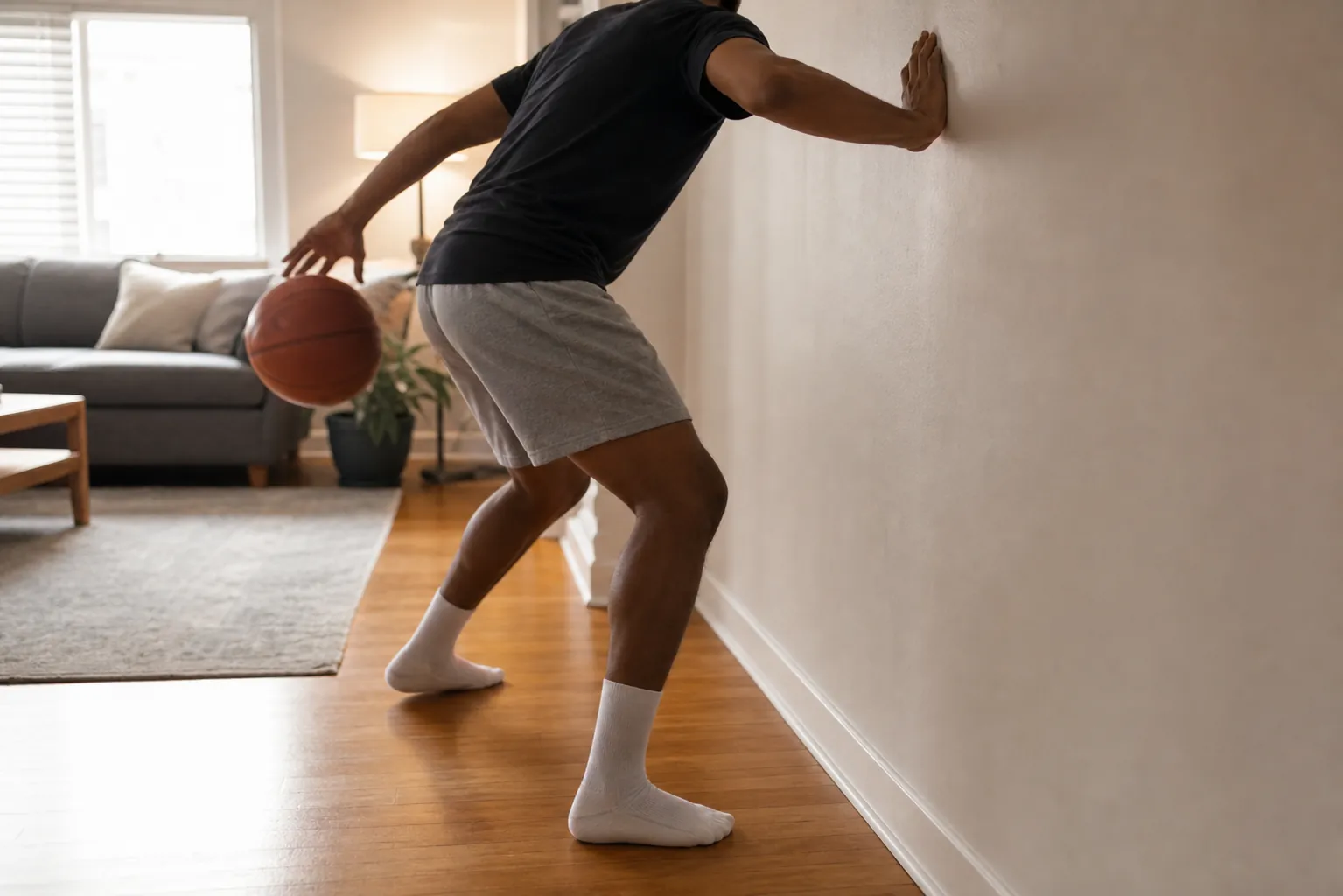
If you can dribble, keep the ball below the knee for most of this block. Low dribbles are quieter, quicker, and harder to fake. If you cannot dribble because of noise, do the same timing with poundless taps: hold the ball, move it hand to hand, and make your feet obey the same rhythm.
- Low right-hand dribble, 20–30 seconds: eyes up, off hand active, feet light.
- Low left-hand dribble, 20–30 seconds: match the height and sound of the right hand.
- Crossover to freeze, 6–10 reps: cross once, land in balance, pause just long enough to prove control.
- Behind-the-back transfer without a bounce, 8–12 reps: move the ball behind you, catch it clean, stay low.
- Wall-tap handling, 30–45 seconds: tap the wall lightly with one hand while the other controls or transfers the ball, then switch sides.
The wall tap is where the at-home version starts to feel less like a compromise. You are forcing the off hand to do something while the ball moves, which is closer to basketball than standing still and dribbling in place for a minute. Keep the tap gentle. If the wall shakes, you are not training toughness; you are testing drywall.
3. Balance-under-contact substitute: 5–7 minutes
This is the heart of the routine. The arena version has Austin Kelly bodying Clark so she can practice being balanced when she is unbalanced.[1] At home, you need the same problem without throwing yourself into furniture.
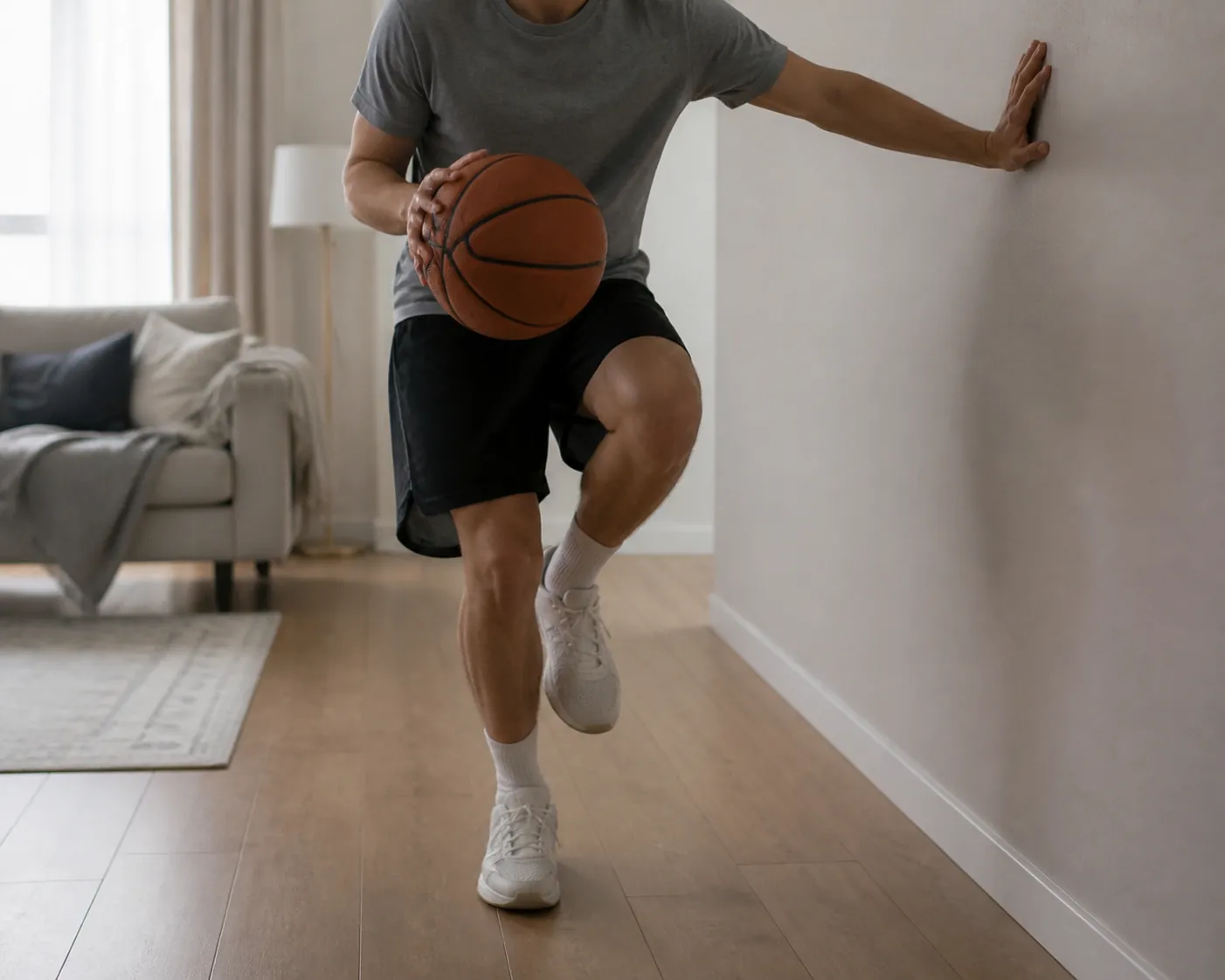
- Wall-lean catches: stand side-on to the wall, lean your shoulder or forearm into it lightly, push away, catch the ball in your shooting pocket, and freeze.
- One-leg pocket holds: lift one foot a few inches, bring the ball from hip to shooting pocket, hold for two quiet counts, then switch.
- Off-balance gather steps: take a short diagonal step, let your body lean slightly, gather the ball, and recover to a square base.
- Bump-and-turn without a partner: press your forearm into the wall, pivot away, bring the ball through tight, and land ready to pass or shoot.
Keep the lean small. The goal is not to simulate a full defender with your apartment wall. The goal is to make your torso, feet, and hands disagree for a moment, then teach them to reorganize. If your knee collapses inward, your foot slaps, or your shoulder jams into the wall, reduce the range.
4. Game-speed shot or finish substitute: 5–8 minutes
Without a hoop, “shooting” has to mean something more exact than flinging the ball at a wall. Pick one of three targets: a tape square on a sturdy wall, a soft target on a door you are certain can take light contact, or an imaginary rim for form reps where the ball never leaves your hand. US Sports Camps’ at-home drill guidance includes no-hoop ball-handling and shooting-form work, which is the right lane for this part: mechanics and targets, not pretending every apartment has a basket.[8]
- No-release form rep: dip, rise, extend, hold your follow-through, and check that your feet did not drift.
- Wall target push shot: from close range, send the ball softly into the target and catch it with quiet hands.
- One-dribble pull-up footwork without a release: one controlled bounce, gather, rise into form, freeze.
- Drive-stop-finish: one hard step, controlled stop, ball to the outside shoulder, hold as if finishing through contact.
- Turn-and-square: start slightly angled away, pivot to target, bring the ball up, and complete either a soft wall hit or a no-release form rep.
Do fewer versions if the room is small. The standard is not variety. The standard is whether the rep has a basketball consequence: bad foot angle, late eyes, loose pickup, or noisy landing. If nothing can go wrong, the drill is probably too easy.
5. The final make: 1–2 minutes
Clark’s insistence on ending with a make is the cleanest part to copy.[1] It gives the warmup a finish line. In a living room, define the make before you start, then honor it.
- No hoop: one clean wall-target hit with balanced feet, or one no-release form rep where the pickup, extension, and landing all feel right.
- Portable hoop: one made shot from your chosen warmup spot, not five extra minutes of “almost.”
- Court access: one make after movement — a catch, one-dribble pull-up, or controlled finish — rather than a lazy standstill toss.
Stop there. The temptation is to keep going because the body finally feels good. That is how a warmup quietly becomes a workout, and then the next session starts with tired legs instead of readiness.
Why this direction makes sense, without overselling it
The science here supports the direction, not every detail of the routine. A 2019 study by Stevanovic and colleagues tested 12 young male basketball players, reported that static stretching reduced vertical jump by about 2.6% and spinal excitability by about 20.6% in that setting, and found that an 8-minute sport-specific warmup restored jump performance by 3.01%. The same paper also cautioned against turning static stretching into a cartoon villain: short static holds of 30 seconds or less per muscle group were described as unlikely to harm performance.[6]
That narrow finding lines up with the practical choice here: move first, handle the ball, rehearse basketball shapes, then save longer stretching for later if you need it. Iowa strength and conditioning coach Lindsay Alexander’s captured quote about Clark — “You’ve got to practice how you play” — fits the same idea.[7] A living-room warmup should still look like the sport, even when the sport has been squeezed into a rug-sized rectangle.
Scaling it for your setup
| Setup | Keep | Change |
|---|---|---|
| No hoop, apartment | Dynamic work, low handles, wall-braced balance, form reps, final clean target or form make | Reduce dribbling volume, use soft wall contact, avoid late-night shared-wall work |
| Portable hoop | Same order: activation, handles, balance, game-speed intent, final make | Move the shot block outside or to the hoop area; keep the living-room portion quieter |
| Court access | Same structure and final-make rule | Let the shot block become real makes after movement, but do not skip the balance work |
If noise is the limiting factor, build the session around pickups, transfers, wall taps, no-release form reps, and short bursts of low dribbling. For more drill options, use FitAtHome’s basketball drills you can do at home without a hoop. For the renter problem specifically — floor protection, timing, and not becoming the upstairs-neighbor villain — see basketball shooting drills at home with no noise complaints and how to practice basketball at home without noise complaints.
Clark’s routine is copyable at home because you can copy the order of demands, not because you can copy the arena. Move continuously. Touch the ball before you “shoot.” Make balance messy on purpose. Give the last rep a definition. Then finish on one clean make and leave it there.
References
- Caitlin Clark and the most exciting warmup routine in sports, TSN, July 31, 2026
- Stretching Tips: Keys to a Proper Warm-Up, NBPA
- Caitlin Clark brutal offseason workout regimen WNBA Indiana Fever, talkSPORT
- Caitlin Clark offseason NCAA basketball, Just Women’s Sports
- Caitlin Clark Fever Training Footage: Here’s What WNBA Star Appears to Be Working On, Sports Illustrated
- The Acute Effects of Static Stretching Exercises and Sport Specific Warm-Up in Basketball Players, 2019
- How Caitlin Clark Builds Her Strength, The New York Times, April 5, 2024
- 11 Basketball Drills You Can Do at Home, US Sports Camps
What a small equipment investment adds
Cable Machine Alternatives That Save Space and Money
Compare the best cable machine alternatives for home gyms – from resistance bands and pulley systems to suspension trainers and compact digital units – and find the right option for your space and budget.
Small Treadmill Buying Guide: 7 Critical Specs to Check Before You Buy
A cross-category spec primer for apartment and small-space dwellers comparing walking pads, ultra-compact folding treadmills, and full-size folding treadmills. Learn the concrete thresholds for motor HP, deck length, noise, warranty, and subscription lock-in so you can compare apples to apples.
How to Practice Basketball at Home Without Noise Complaints
Learn how to run a full basketball workout in a small apartment without noise complaints. This guide covers no-dribble handling drills, wall form shooting, and silent ball options that let you train without disturbing neighbors.
How often should you repeat this?
See our recovery and rest reference for citation-anchored rest-interval guidance.
Spot something off?
Tell us if a movement, tier assumption, or duration didn't match your experience.