
Christopher Schwarzenegger's Home Weight Loss Workout Plan
A no-equipment, start-anywhere plan that follows Christopher Schwarzenegger's documented weight-loss progression: walking first, then bodyweight strength, then harder conditioning, with one food swap instead of a crash diet. It separates the realistic multi-year 100+ pound template from the extreme Lent outlier so beginners can apply it at home on any budget.
- Equipment tier required
- none
- Duration
- 30 min
- Difficulty
- beginner
- Target area
- full body
- Space footprint needed
- one room
- Noise level
- low
The useful version of a Christopher Schwarzenegger weight loss home workout plan starts with a boring answer: walk first, add bodyweight strength later, then make the work harder only after the habit is already alive. That is the part a beginner can copy in a living room, hallway, sidewalk, or apartment parking lot.
The less useful version is the viral shortcut: Christopher reportedly lost 30 pounds in 40 days during Lent 2020 after giving up bread, inside a larger weight-loss journey that began after he was unable to go skydiving in Australia in 2019 and eventually passed 100 pounds over more than five years.[1][2][3] Those facts belong in the same story, but they should not be treated as the same template. The multi-year arc is the plan. The Lent drop is the warning label.
If you are starting overweight, out of shape, and without a gym, the documented habits matter more than the family name. The reliable activity pattern is strength training, hiking, and walking “as much as possible,” not a named celebrity routine or a hidden Schwarzenegger circuit.[3] Before starting any weight-loss routine, especially if weight, joint pain, medication, or past dieting history complicates the picture, it is worth reading how to discuss weight loss before a home workout routine. Then build the plan from what can actually be repeated.
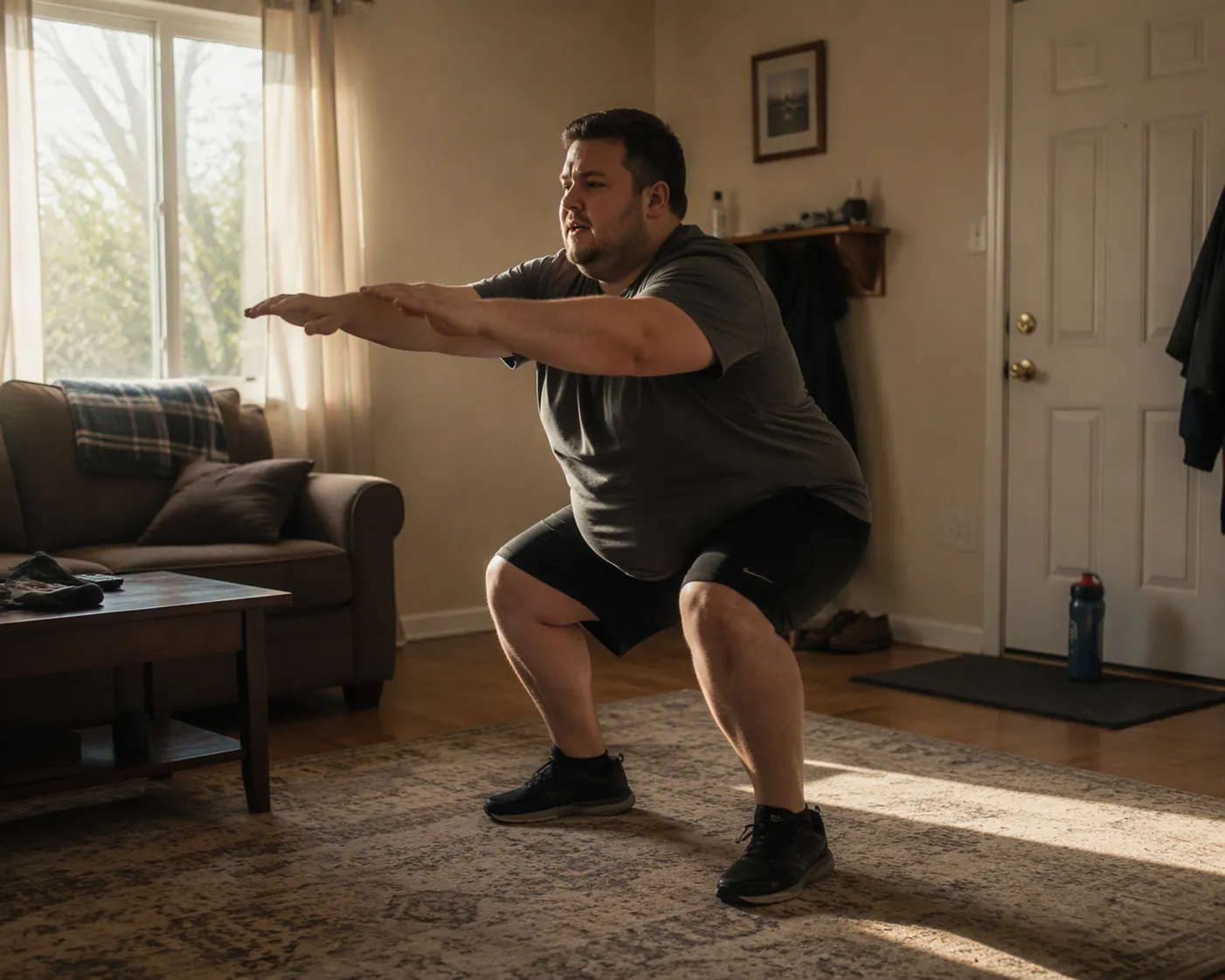
The copyable plan in one view
The plan below is not presented as Christopher’s exact private program. Nobody has published a complete training log from him. It is a home version built from the documented progression: walking, strength work, hiking, and consistency over years.
| Phase | When | Main job | What you do at home |
|---|---|---|---|
| Phase 1 | Weeks 1–4 | Build the walking habit | Walk daily, starting with 10 minutes and building toward 30 brisk minutes |
| Phase 2 | Weeks 5–12 | Add bodyweight strength | Train strength 2–3 days per week with at least 48 hours between sessions |
| Phase 3 | Week 13 and beyond | Progress conditioning | Turn longer walks into hikes, use harder bodyweight variations, and add minimal gear only if useful |
| Diet anchor | All phases | Change one repeat food pattern | Pick one high-calorie staple or snack and swap it for a lower-calorie, higher-volume option |
That is enough. A beginner does not need six training days, a supplement stack, a garage gym, or a heroic first week. Most failed home programs do not fail because the exercises are too simple. They fail because the starting dose is too big for the life it is supposed to fit into.
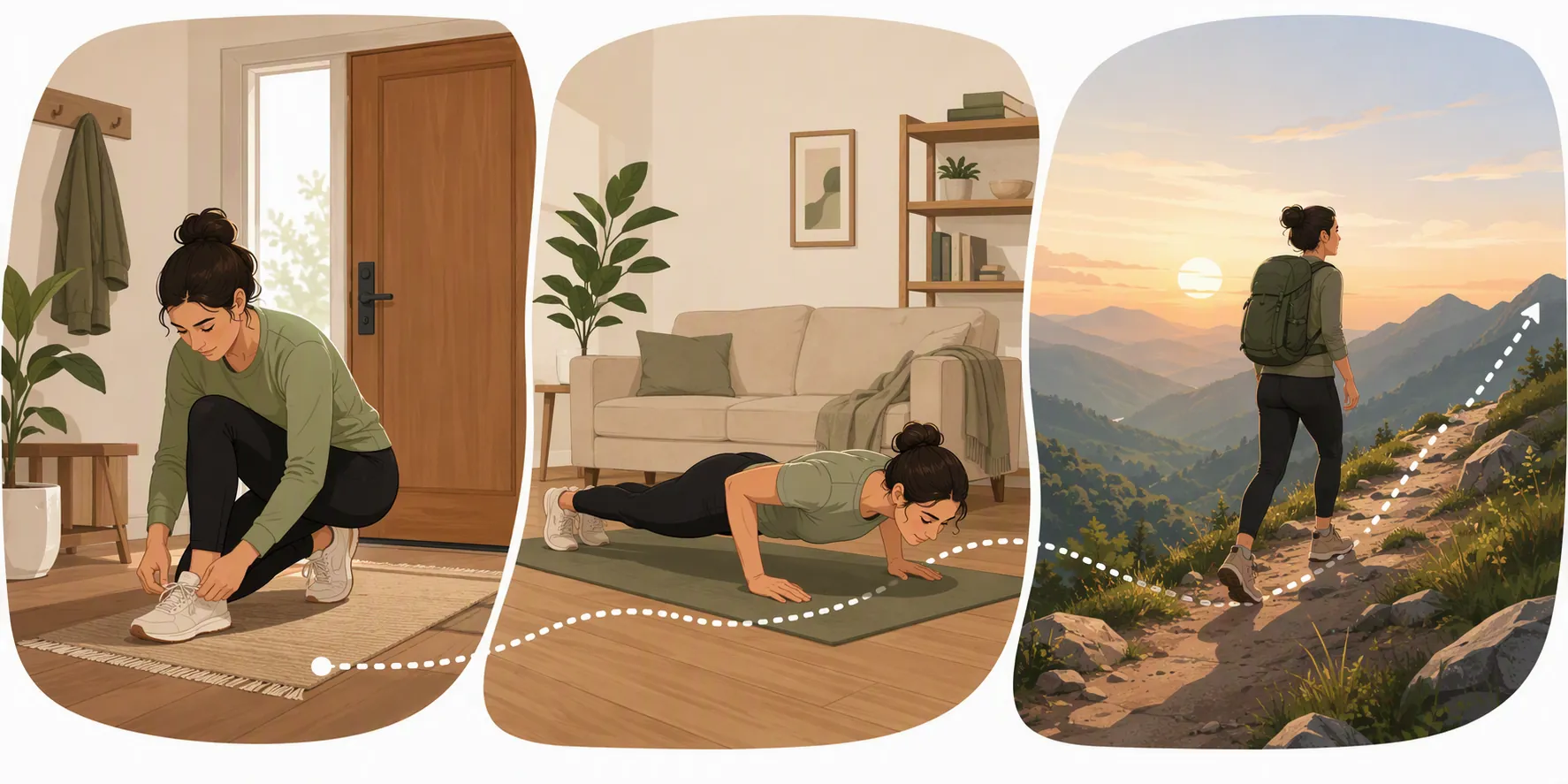
Phase 1: walk every day before you try to train hard
Start with 10 minutes a day. Not 10,000 steps. Not a weighted vest. Not an hour walk that leaves your knees irritated and your calendar wrecked by Wednesday. Ten minutes is small enough that it can happen after dinner, before work, during a lunch break, or in loops around the block.
For the first week, the goal is not calorie burn. The goal is becoming the person who walks today even when the walk is unimpressive. If you are deconditioned, that may mean five minutes out and five minutes back. If weather or safety gets in the way, walk indoors, pace a hallway, or use stairs carefully as short intervals. The surface does not matter nearly as much as the repetition.
| Week | Daily walking target | Effort |
|---|---|---|
| Week 1 | 10 minutes | Easy enough to finish without bargaining with yourself |
| Week 2 | 15–20 minutes | Comfortable, with a slightly quicker pace on good days |
| Week 3 | 20–25 minutes | Steady pace; breathing deeper but still controlled |
| Week 4 | 30 minutes | Brisk walking most days |
The 30-minute target is not random. Mayo Clinic estimates that adding 30 minutes of brisk walking can burn about 150 extra calories per day, depending on body weight, walking speed, terrain, and efficiency.[4] That number should be read correctly: it is helpful, not magical. One snack can erase it. One missed week can stall it. But 30 brisk minutes becomes powerful when it stacks up across months.
This is also where many beginners misunderstand the exercise guidelines. Around 150 minutes per week of moderate activity is a useful health baseline, but weight loss often requires more total movement; the HHS/CDC range commonly cited for weight-loss-oriented moderate activity is 200–300 minutes per week.[5] That does not mean you jump there in week one. It means week four is not the finish line.
A realistic path is to reach 30 minutes most days first, then add time slowly: one longer weekend walk, a 10-minute after-dinner walk on top of a morning walk, or a short errand done on foot. If you need help making that first month feel less like a motivational gamble, use the habit rules in How to Start Working Out at Home before adding more moving parts.
What counts as success in the first month
- You walked on most days, even when the walk was short.
- Your normal pace became easier.
- You found a repeatable time of day for walking.
- You finished the month wanting slightly more, not needing a week off.
That last point matters. The beginner who quits after a punishing first week usually does not need a tougher mindset. He needs a smaller starting dose and a cleaner progression.
Phase 2: add bodyweight strength two or three days per week
Once walking is no longer a debate, add strength work. Two days per week is the practical floor for most beginners; three days can be useful if recovery, sleep, and joints are holding up. Leave about 48 hours between strength sessions so the muscles and connective tissues you just challenged have time to recover.[6]
Do not turn this into a punishment circuit. Strength training in this phase has one job: teach your body to squat, hinge, push, pull, brace, and get up and down from the floor with more control than last month. The fat-loss work is still being carried by the daily walking habit and the food anchor. Strength training protects function, helps preserve lean mass, and gives the body a reason to adapt.
| Movement category | Beginner option | Progression when ready |
|---|---|---|
| Squat | Sit-to-stand from a chair | Bodyweight squat, slower lowering, split squat |
| Push | Wall push-up or counter push-up | Incline push-up, floor push-up, slower tempo |
| Pull | Towel row setup or sturdy-table row if safe | Harder angle, slower reps, more total sets |
| Hinge | Hands-on-hips hip hinge | Single-leg assisted hinge, backpack Romanian deadlift later |
| Core | Dead bug or elevated plank | Longer plank, side plank, slower dead bug |
A simple two-day week can look like this: Monday strength, Wednesday or Thursday strength, walking every day. A three-day week can be Monday, Wednesday, Friday. If the third day makes your walks worse, drop it. The plan is not better because it fills more boxes.
A beginner strength session
- Chair sit-to-stand: 2 sets of 6–10 reps
- Wall or counter push-up: 2 sets of 6–10 reps
- Supported hip hinge: 2 sets of 8–12 reps
- Dead bug or elevated plank: 2 short controlled sets
- Optional safe row variation: 2 sets of 6–10 reps
The pulling movement is the one home beginners often skip because push-ups are obvious and rows are not. If you do not have a safe setup, do not improvise with a flimsy table or door. Use the ideas in The No-Equipment Upper Body Workout That Trains Both Push and Pull or choose a quiet apartment-friendly plan from Build Muscle Without Making Noise.
Progressive overload does not need gym language. Do a bit more than last time. That can mean one more rep, one more set, a slightly harder angle, a slower lowering phase, a shorter rest, or cleaner form at the same number of reps. The worst version is turning every session into a max-effort test. Testing is not training, and beginners who test constantly usually run out of joints before they run out of motivation.
If you want a short bodyweight day that feels structured without becoming a full program, a 15-minute routine like Beat the Monday Blues With a 15-Minute Home Workout can sit inside Phase 2. Keep the rule simple: finish with enough energy to walk tomorrow.
The Arnold ladder is optional, and it is not Christopher’s method
Some online summaries blur a beginner push-up and squat ladder into Christopher’s routine. The 5-4-3-2-1 descending ladder belongs to Arnold Schwarzenegger’s beginner advice, not to Christopher’s documented weight-loss method.[7] If you like it, use it as a Phase 2 tool: 5 push-ups, 5 squats, then 4 and 4, then 3 and 3, down to 1. Scale the push-ups to a wall or counter if needed.
That attribution matters because beginners copy labels. If a move is Arnold’s general beginner advice, call it that. Christopher’s confirmed pattern is broader and simpler: strength work, walking, and hiking over time.[3]
Phase 3: make the same habits harder instead of starting over
By week 13, the temptation is to hunt for the “real” workout. Usually, the better move is to make the current plan more demanding without changing its shape.
- Turn one weekly walk into a longer walk.
- Turn a longer walk into an easy hike when terrain and footwear allow.
- Add hills before adding running.
- Use harder strength variations instead of adding more random exercises.
- Add one pair of dumbbells only when bodyweight progress is becoming awkward, not because the program needs shopping.
This is where hiking fits cleanly into the Christopher template. Hiking is not a glamorous secret; it is walking with terrain, duration, and sometimes elevation added. For a beginner, that is enough progression. A 45-minute hilly walk can be a serious conditioning session without the injury risk that comes from suddenly trying to run hard at a heavier body weight.
Boxing and cycling appear in some entertainment-adjacent chatter, but the support is not firm enough to build the plan around. If you enjoy either, fine. They are not necessary for the home version, and they are not the documented backbone of the transformation.

The food anchor: one swap, not a crash diet
Christopher’s most memorable diet detail is giving up bread during Lent and losing 30 pounds in 40 days.[2] That is exactly the kind of fact that should make a beginner slow down, not speed up.
Thirty pounds in 40 days is not a normal target. It suggests a very large energy deficit and likely includes more than pure fat loss. Trying to recreate that pace at home can push people toward hunger, rebound eating, poor training, and the familiar cycle of a dramatic start followed by a full stop. The better lesson is narrower: one repeated food pattern can matter when it is big enough and consistent enough.
Choose your version of the bread rule. Do not copy the food unless bread is actually your high-volume problem. Pick one daily item that appears often, carries calories you barely notice, and can be replaced without making the rest of your life miserable.
- Swap a large evening snack for Greek yogurt, fruit, eggs, soup, or another filling lower-calorie option.
- Replace a sugary drink with a lower-calorie version most days.
- Keep sandwiches if they help you stay consistent, but reduce the add-ons that quietly double the calories.
- If restaurant meals are the issue, change the default order before changing everything else.
The right swap is the one you can repeat while still walking and training. If a diet change makes your daily walk feel like a punishment march, it is probably too aggressive. For a smaller example of how a single drink can fit into a calorie budget instead of becoming a moral drama, see Can a Daily Oat Latte Fit Your Weight-Loss Diet?.
How the week looks once the plan is running
| Day | Workout |
|---|---|
| Monday | 30-minute brisk walk + bodyweight strength |
| Tuesday | 30-minute walk |
| Wednesday | 30-minute walk + optional short mobility |
| Thursday | 30-minute brisk walk + bodyweight strength |
| Friday | 30-minute walk |
| Saturday | Longer walk or easy hike |
| Sunday | Easy walk; prepare the week’s food swap |
A third strength day can go on Saturday or Sunday if the longer walk is easy, or on Friday if your recovery is solid. If your knees, back, or feet are irritated, do not add intensity to prove commitment. Reduce the strength volume, keep the walking easy for a few days, and rebuild.
For more detail on why home weight-loss workouts depend more on weekly movement volume than on one brutal session, read What Health Experts Say About Weight-Loss Home Workouts. The short version for this plan: walking gives you repeatable volume, strength gives you structure, and the food swap keeps the calorie math from depending entirely on exercise.
What results to expect
The scale may move quickly at first, especially if the food swap reduces sodium, refined carbohydrates, or late-night snacking. It may also move slowly while your walking tolerance, waist measurement, sleep, and strength improve first. Both can happen without the plan being broken.
Christopher’s own comments are useful here because they undercut the overnight myth. He described the process as not being “an overnight thing” and said it took “a lot of trial and error.”[1] He also said, “I don’t feel like I’m an after yet,” which is a healthier sentence than most before-and-after coverage manages to produce.[3]
That is the expectation to borrow. You are not trying to become an after photo by a deadline. You are trying to become the person who walks daily, trains strength two or three times per week, progresses the work when ready, and keeps one food decision clean long enough for the body to notice.
So if the question is what part of Christopher Schwarzenegger’s weight loss can be replicated at home, the answer is not the dramatic Lent pace, and it is not a secret routine. It is the gradual template: daily walking, bodyweight strength, harder conditioning later, and one food swap repeated for months instead of performed for attention.
References
- People interview on Christopher Schwarzenegger’s weight loss journey — People, May 2025
- TODAY coverage of Christopher Schwarzenegger’s Lent bread cut and weight loss — TODAY, May 2025
- Men’s Health UK coverage of Christopher Schwarzenegger’s 100+ pound weight loss and training habits — Men’s Health UK, May 2025
- Walking: Trim your waistline, improve your health — Mayo Clinic
- HHS/CDC moderate activity guidance for weight loss as cited in Healthline and Anytime Fitness
- Strength training frequency and 48-hour recovery guidance as cited in Nerd Fitness and Anytime Fitness
- Arnold Schwarzenegger beginner 5-4-3-2-1 push-up and squat ladder — Men’s Health / Arnold’s Pump Club, February 2025
What a small equipment investment adds
We don't have a build tagged to this exact tier yet. Browse all builds.
How often should you repeat this?
See our recovery and rest reference for citation-anchored rest-interval guidance.
Spot something off?
Tell us if a movement, tier assumption, or duration didn't match your experience.