With one resistance band, a clear patch of floor, and 30 minutes, the useful question is not whether you can copy Terence Crawford or Canelo Alvarez. You cannot. Their camps include coaches, sparring, bags, roadwork, recovery time, and a level of daily volume that does not fit into a spare room before work.
What you can borrow is the structure: resisted lower-body power, a core that stays organized while tired, and timed striking intervals that use boxing's 3-minute rhythm without pretending to teach boxing. This is a boxing-inspired full-body conditioning session, not fight instruction, not a bag-work replacement, and not a shortcut to an elite camp.
The workout below pulls from documented training categories in both fighters' preparation: Canelo's band-resisted step-ups and sprint-style drills, Crawford's high-output boxing work and long-running yoga practice, and core training concepts that show up across serious boxing strength work.
The 30-Minute Crawford-Canelo Home Workout
| Time | Block | What You Do | Purpose |
|---|---|---|---|
| 0:00-5:00 | Warm-up | Joint prep, light footwork, squat-to-reach, shoulder circles, easy shadow boxing | Raise temperature and rehearse positions |
| 5:00-8:00 | Round 1 | Band-resisted power: step-ups, high knees, squat-to-punch rhythm | Lower-body drive and conditioning |
| 8:00-9:00 | Rest | Walk, nasal breathing if possible, reset band | Recover without fully cooling down |
| 9:00-12:00 | Round 2 | Core circuit: anti-rotation, anti-extension, side bracing, neutral-spine hip flexion | Trunk stiffness under fatigue |
| 12:00-13:00 | Rest | Shake out shoulders and hips | Prepare for higher output |
| 13:00-16:00 | Round 3 | Shadow boxing intervals plus bodyweight finishers | Cardio output, rhythm, posture |
| 16:00-24:00 | Repeat Rounds 1-3 | Run the same three rounds again, slightly cleaner or slightly harder | Second pass under fatigue |
| 24:00-27:00 | Optional finisher | Fast feet, plank shoulder taps, or low-impact march-punch intervals | Controlled push without sloppy joints |
| 27:00-30:00 | Cool-down | Diaphragmatic breathing, child's pose reach, hip flexor stretch, gentle spinal rotation | Bring breathing down and restore range |
Before the first round, check two things that matter more than the fighter fantasy: your anchor and your joints. A closed door anchor should pull against the door's closing direction, not toward open space. A chair used for step-ups should not wobble. If either feels questionable, use the bodyweight alternative and keep the round moving.
Warm Up Like You Expect the First Round to Be Real
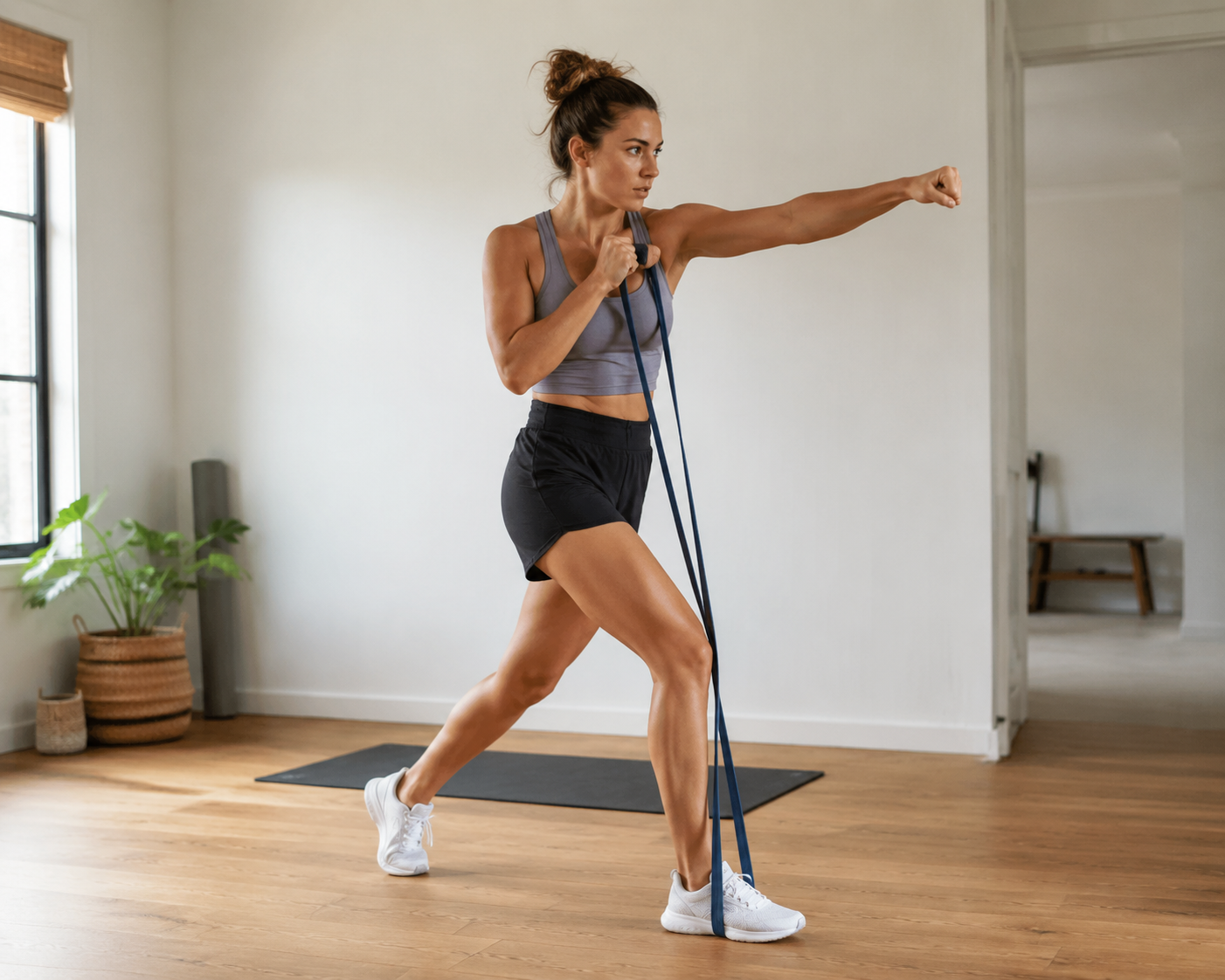
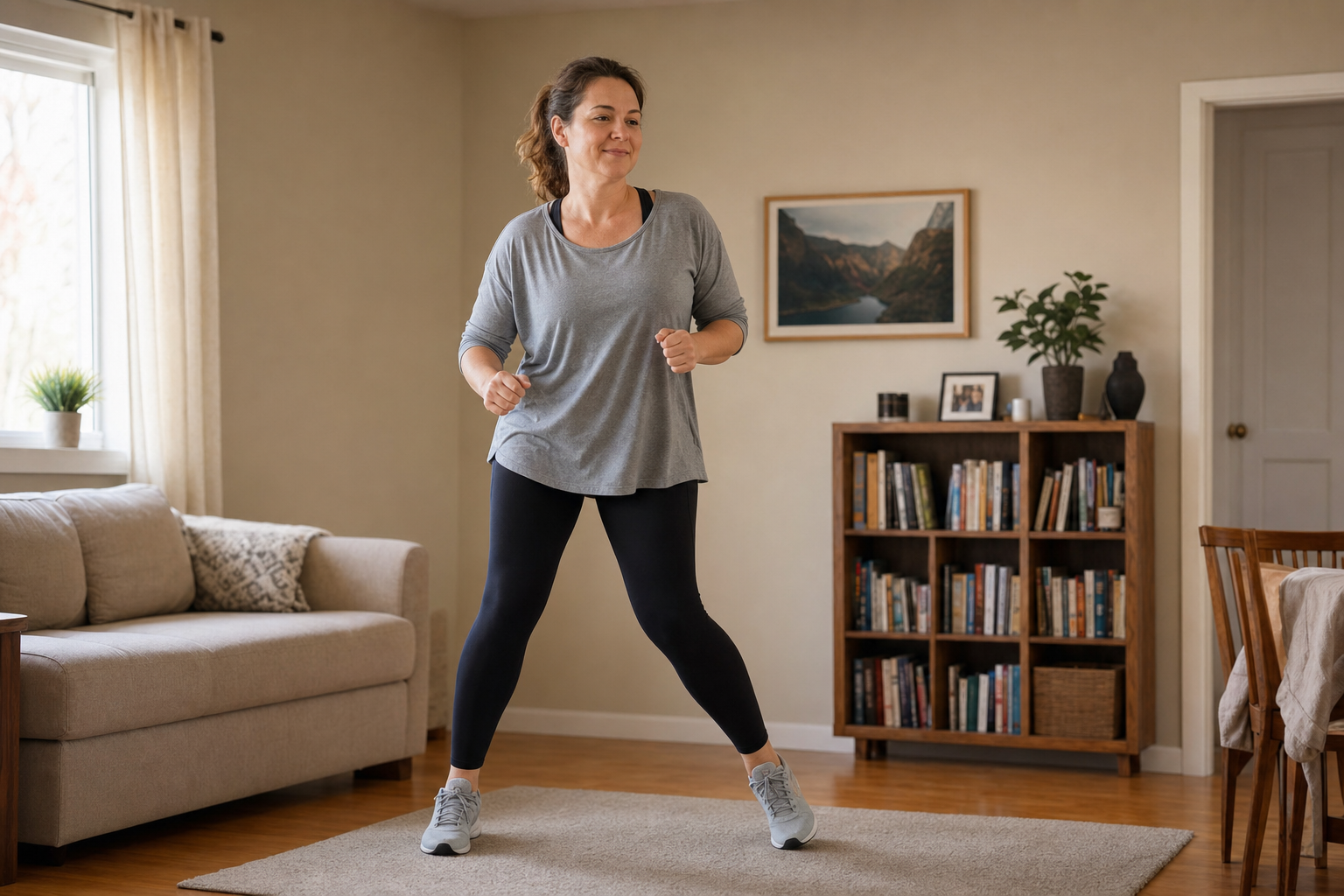
Five minutes is enough if you do not waste it. Start with 60 seconds of easy bouncing or marching in place, then move through ankle rocks, hip circles, arm circles, squat-to-reach reps, and light shadow boxing. Keep the punches relaxed. The goal is not speed yet; it is finding a stance that lets your knees, hips, ribs, and shoulders cooperate.
- 60 seconds: easy march, bounce, or step-touch
- 60 seconds: ankle rocks and hip circles
- 60 seconds: squat-to-reach with a slow exhale at the top
- 60 seconds: shoulder circles, scapular push-ups, or wall slides
- 60 seconds: easy shadow boxing with small steps
If your shoulders are already tense in the warm-up, lower the punch volume later. A home workout does not get more authentic because your neck locks up.
Round 1: Band-Resisted Power, Borrowed Carefully from Canelo
Canelo's documented training includes band-resisted step-ups and band-resisted sprint work, which are two of the cleaner elite-camp ideas to adapt at home because they do not require a ring, bag, or partner.[1] The home version should feel like explosive conditioning, not like a circus trick with a band.
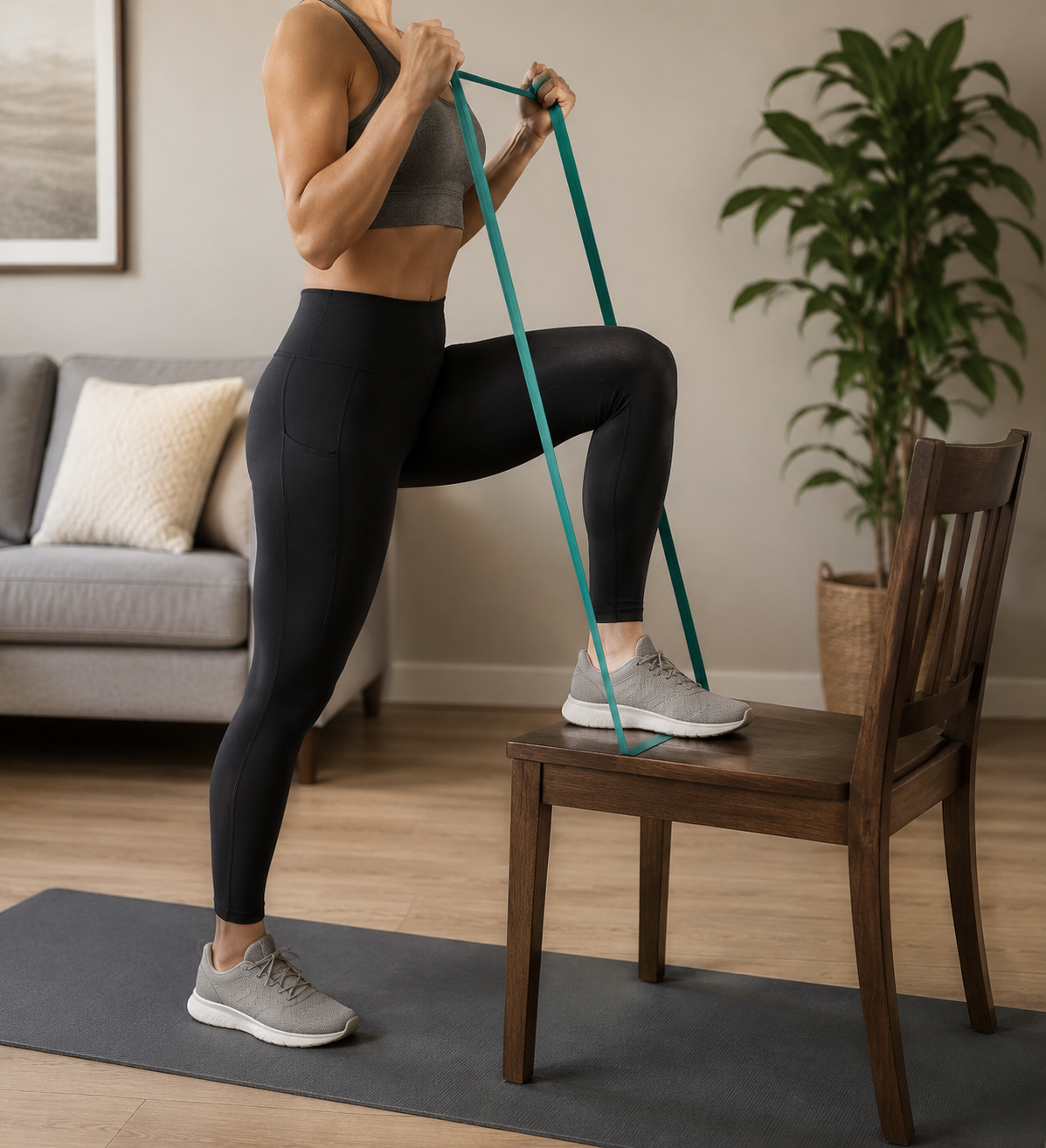
Set a timer for 3 minutes and cycle through these three movements. Do not sprint through the setup. The band should add resistance, not pull you out of position.
| Segment | Exercise | How to Do It | No-Band Option |
|---|---|---|---|
| 0:00-1:00 | Band-resisted step-up | Loop the band under the foot on the chair or low step. Hold the band near shoulder height. Drive through the whole foot, stand tall, step down under control. Switch legs at 30 seconds. | Bodyweight step-ups or reverse lunges |
| 1:00-2:00 | Door-anchored high knees | Anchor the band behind you at hip height. Lean slightly forward from the ankles and drive alternating knees without letting the ribs flare. | Fast high-knee march or low-impact mountain climbers |
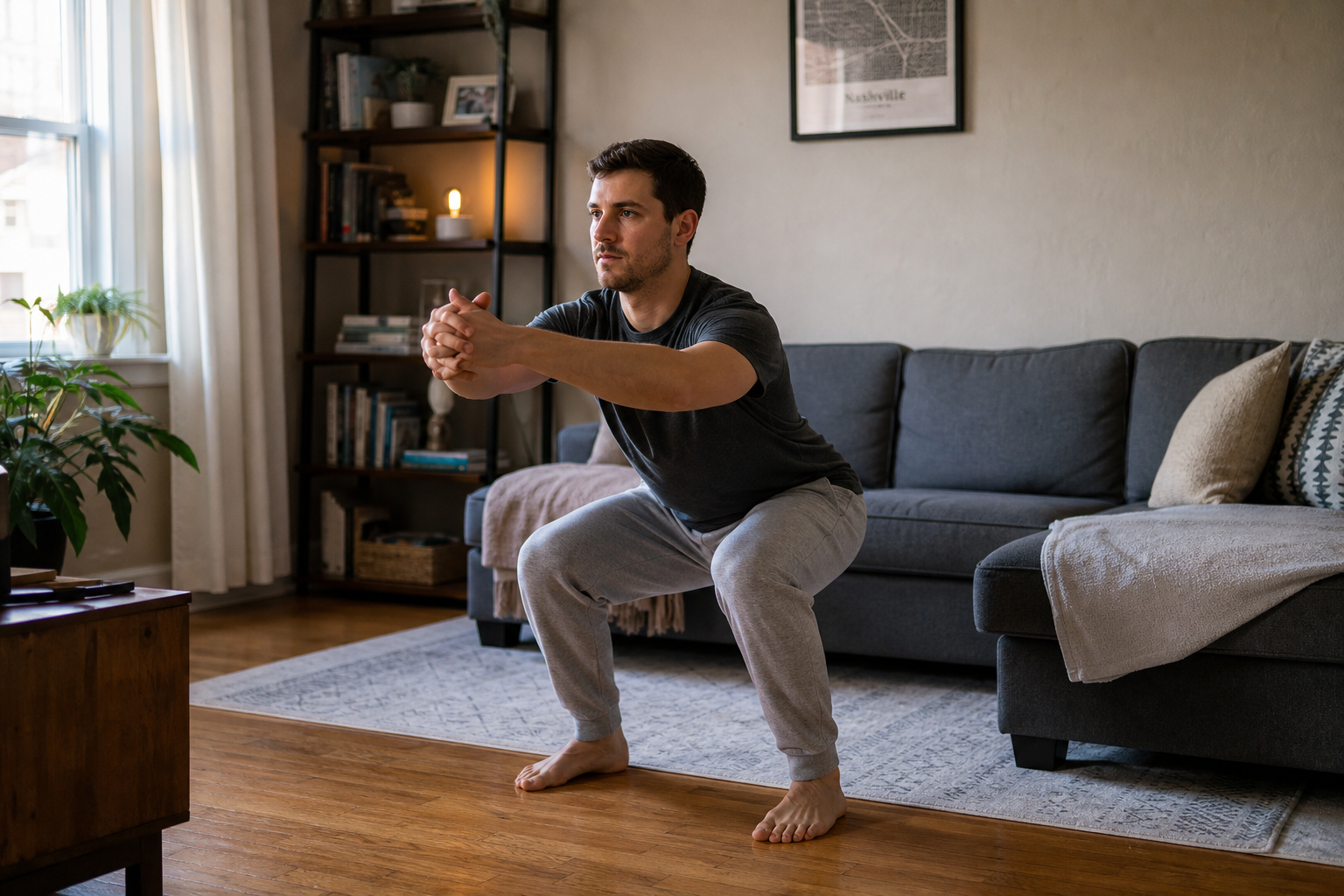
| 2:00-3:00 | Squat-to-punch rhythm | Stand on the middle of the band and hold the ends at chest height. Squat, stand, then throw two light straight punches against gentle band tension. | Air squat plus two relaxed straight punches |
The step-up is the most valuable piece here. A band under the working foot loads the drive phase without needing a barbell. Use a lower step if your knee caves inward, your heel pops up, or you have to shove off hard with the back leg. For many home exercisers, a stair is better than a dining chair.
The high-knee drill is only worth doing with an anchor you trust. If the band yanks the door, shifts the furniture, or makes you shorten your stride awkwardly, drop the band. A hard bodyweight march with clean posture beats a sketchy anchor every time.
Canelo's longer roadwork, including reported 4-6 mile runs, belongs in the background here.[6] This 30-minute routine is not recreating that aerobic base. It is extracting a supplemental conditioning slice: legs producing force while the heart rate climbs.
Round 2: Core Work That Does More Than Burn
Core training in boxing gets oversold as if visible abs automatically equal punching power. The better home-training target is less glamorous: a trunk that resists collapse, controls rotation, and lets the hips and shoulders move without the low back taking the bill.
Boxing Science reports that trunk muscle mass had the strongest correlation with medicine ball punch distance, and it organizes boxing core training into anti-rotation, anti-extension, anti-lateral flexion, and hip flexion with a neutral spine.[2] That is useful as a map, though it should be treated as suggestive rather than settled science because the source is a commercial strength-and-conditioning brand and the available page does not give enough research detail to overclaim.
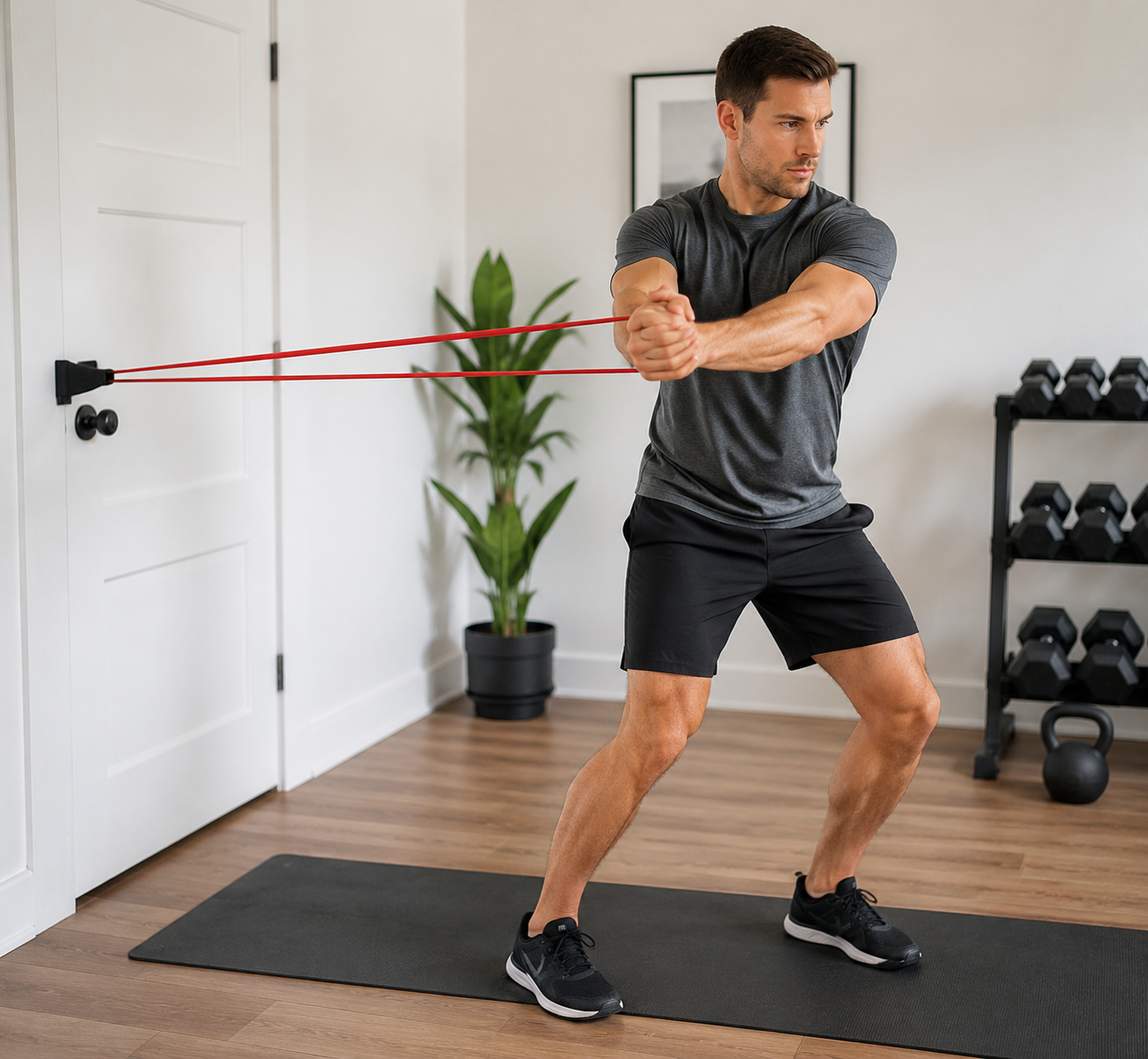
Canelo's listed core work includes cable-resisted crunches, hollow body holds, and V-ups, which translate reasonably well to a band and mat setup.[1] Crawford's camp has also been reported using a heavy medicine ball bounced off his stomach during crunches, a much more aggressive drill that does not need to be copied literally in a living room.[3]
| Segment | Core Category | Home Exercise | Coaching Cue |
|---|---|---|---|
| 0:00-0:45 | Anti-rotation | Band Pallof press hold or press-out | Ribs down, glutes lightly on, band pulling from the side |
| 0:45-1:30 | Anti-extension | Hollow body hold, dead bug, or band-resisted crunch | Low back stays controlled; shorten the lever before arching |
| 1:30-2:15 | Anti-lateral flexion | Side plank from knees or feet | Top hip stacked; do not sag toward the floor |
| 2:15-3:00 | Neutral-spine hip flexion | Slow mountain climber, seated knee tuck, or controlled V-up | Move the legs without yanking the neck or rounding hard through the low back |
The Pallof press is the least flashy drill in the whole session and probably the one most people need. Stand sideways to the anchor, hold the band at sternum height, and press your hands forward without letting the band twist your torso. If your feet are too narrow, the drill becomes a balance test. If the band is too heavy, your shoulders take over. Choose a tension that lets you breathe behind the brace.
For the Canelo-style cable crunch adaptation, anchor the band high in a door, kneel facing away or toward the anchor depending on your setup, and curl the ribs toward the pelvis without turning it into a hip hinge. If that setup feels awkward, do dead bugs. There is no prize for making a band substitute look like a cable machine when your floor version trains the same anti-extension control more cleanly.
For the Crawford-inspired stomach-bracing idea, use restraint. A partner bouncing a medicine ball off an elite fighter's abdomen is a camp drill with supervision.[3] At home, a safer version is to hold a light weighted household object, such as a small bag of rice or a book, against the torso during a slow crunch or dead bug breathing drill. The point is bracing and timing, not absorbing punishment.
Round 3: Shadow Boxing Intervals Without Pretending You're in Camp
This is where the session finally feels like boxing. Crawford is known for heavy boxing-specific work, and his long-running yoga practice has been described as part of his breath-control toolkit under pressure.[4][5] For home training, that pairing matters more than any attempt to mimic his style: high output, then enough breathing control to keep moving well.
FightCamp's home boxing protocol uses punch-count targets inside short at-home rounds, which makes a useful scaffold for people training without a bag.[7] Count punches if it helps you stay honest, but do not chase numbers so hard that your feet stop moving or every cross turns into a shoulder crank.
| Segment | Work | Focus |
|---|---|---|
| 0:00-0:45 | Easy jab-cross rhythm while stepping in place | Tall posture, relaxed shoulders, hands return to guard |
| 0:45-1:15 | Fast straight-punch burst | Output without leaning forward |
| 1:15-1:45 | Bodyweight finisher: squat thrusts, step-back sprawls, or fast feet | Conditioning spike |
| 1:45-2:30 | Shadow boxing with small lateral steps | Feet under hips, no crossing the legs |
| 2:30-3:00 | Final punch-count push | Clean reps over frantic reps |
Keep the punches simple: jab, cross, occasional hook shape if your shoulders tolerate it. This is not the place to teach slips, counters, angles, or combinations you have never practiced. The fitness value comes from rhythm, posture, repeated arm output, foot movement, and the discipline of staying organized for the whole 3-minute round.
If you want similar small-space conditioning without the boxing flavor, the same interval logic pairs well with FitAtHome's small-space workout plan or a more schedule-friendly 4-week home workout plan for busy parents.
Run the Second Pass Cleaner, Not Just Harder
After Round 3, rest one minute and repeat the three-round sequence. The second pass is where the workout earns its keep. Band step-ups feel different when your breathing is already up. Pallof presses expose sloppy rib position. Shadow boxing gets uglier if you start chasing speed instead of rhythm.
Use a simple rule: if the first pass was an 8 out of 10, make the second pass a cleaner 8, not a reckless 10. Add band tension only if you can keep the same joint positions. Add punch output only if your shoulders stay down and your hands return to guard. Add speed only if your feet are still quiet and controlled.
- Make it easier: use bodyweight step-ups, dead bugs, knee side planks, and march-punch intervals.
- Make it harder: increase band tension slightly, raise the step height safely, or add punch-count targets.
- Make it joint-friendlier: replace squat thrusts with fast feet or step-back lunges.
- Make it quieter: remove jumps, keep footwork low, and use controlled step patterns.
For progression outside this session, use the same thinking: increase range, control, density, or tension one at a time. FitAtHome's no-equipment upper-body progression guide is useful if your shoulders and pushing strength are the limiting factor. If your band setup feels too light or too improvised, the budget home exercise equipment guide can help you choose better bands, a mat, or a safer anchor before adding load.
The 3-Minute Finisher Is Optional
If the two full passes already put you at a hard effort, skip the finisher and cool down. If you still have clean movement left, choose one of these for 3 minutes:
- Fast feet for 20 seconds, easy march for 10 seconds, repeated for 3 minutes
- Plank shoulder taps for 20 seconds, child's pose breathing for 10 seconds, repeated for 3 minutes
- March-punch intervals for 30 seconds hard, 30 seconds easy, repeated 3 times
The finisher should not introduce a new skill. It is there to extend the conditioning effect, not to prove you can keep suffering after your mechanics disappear.
Cool Down with Breathing, Not More Shadow Boxing
Crawford has practiced yoga since 2013, with breath control described as one reason it stayed in his routine.[5] The home version does not need to become a yoga class. It just needs to give your breathing somewhere to land after six hard rounds.
- 60 seconds: lie on your back with one hand on your ribs and one on your abdomen; inhale quietly, exhale slowly.
- 45 seconds: child's pose with a side reach, switching halfway.
- 45 seconds: half-kneeling hip flexor stretch, switching halfway.
- 30 seconds: gentle open-book rotation or supine twist.
If recovery is the part you usually rush, pair this workout with FitAtHome's complete post-workout recovery routine at home. Hard intervals are easier to repeat when the last three minutes are not treated as dead time.
How Often to Use This Workout
Use this session one or two times per week, especially if you already lift, run, cycle, or do other home conditioning. It is dense enough that doing it daily would turn the best parts into background fatigue.
Choose the bodyweight alternatives when your band anchor is questionable, when your low back feels overworked during the core round, or when your shoulders are irritated during resisted punches. Stop the session if a band slips, a chair shifts, pain changes your movement, or your back starts taking over the hip-flexion drills.
The transferable value in these Terence Crawford and Canelo Alvarez boxing training tips is not celebrity imitation. It is a compact structure: resisted power, braced core work, timed striking intervals, then breathing control. That is enough to make a 30-minute home workout feel sharp, demanding, and honest about what it is.
References
- Canelo Alvarez Workout Boxing Training, Men's Health, 2021
- Boxing Training Core, Boxing Science
- Terence Crawford's Boxing Training Secrets, POWA Boxing
- Terence Crawford vs Canelo Alvarez Super Middleweight Showdown Preview & Training Secrets, Muscle & Fitness
- Boxing Champ Terence Crawford Tips to Be the Best, Muscle & Fitness
- Canelo Alvarez: The Training Behind The Legend, GymNation
- 15 Minute At-Home Boxing Workout (No Equipment Needed), FightCamp
Comments
Join the discussion with an anonymous comment.