
Do a 20-Minute Beginner Dance Workout at Home
Want real cardio at home when you have no equipment and little floor space? This follow-along routine takes about 20 minutes with every move named and cued, plus a no-jumping apartment version, realistic calorie estimates, and a talk-test check to keep intensity honest.
- Equipment tier required
- none
- Duration
- 20 min
- Difficulty
- beginner
- Target area
- full body
- Space footprint needed
- small cleared area
- Noise level
- low (no-jumping)
This is a 20-minute dance workout tutorial at home for the realistic room: couch pushed back, no equipment, no choreography memory, and probably someone living below you. You’ll move through a warm-up, three simple dance blocks, a short finisher, and a cool-down. Every move is named, and every jumpy idea has a quieter version.
Use the talk test for intensity: during the main blocks, you should be able to talk but not sing. That is the CDC’s simple marker for moderate-intensity activity, and adults are advised to get at least 150 minutes of moderate-intensity activity per week — often thought of as about 30 minutes on five days. [1] If you want the bigger evidence argument for why this counts as cardio, save Is Dance Cardio Actually Real Cardio? for after the workout. Right now, the useful question is what to do with your feet.
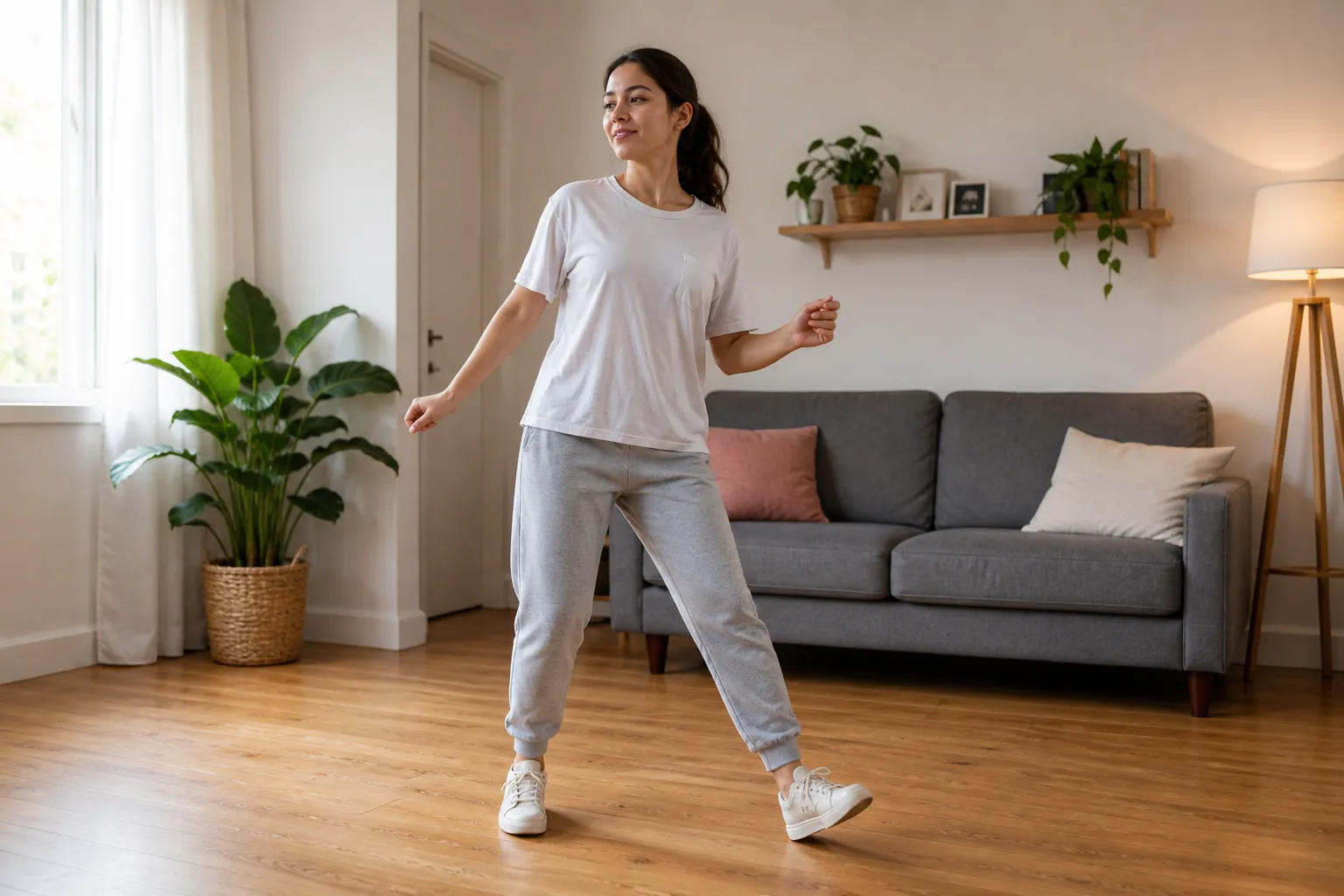
Before you press play: space, shoes, and the no-jumping rule
Clear roughly a room-sized patch where you can step right, step left, turn a quarter turn, and lift one knee without kicking furniture. You do not need travel space. If a grapevine feels too wide, shrink it to a side step and a tap.
Hard, smooth floors are usually easier for dance movement than carpet, and loose rugs can become trip hazards when your feet start changing direction. [2][3] If you need cushioning, use supportive shoes rather than a sliding rug. Socks on slick flooring are funny for about three counts, then annoying.
For an apartment version, “quiet” means low-impact movement choices, not a measured noise guarantee. Keep one foot on or close to the floor, replace hops with step-touch, and turn running moves into knee lifts or marching patterns. No decibel claim is being made here.
| If the move says… | Do this in the apartment version |
|---|---|
| Jump | Step out, tap in |
| Hop side to side | Step-touch side to side |
| Running man with bounce | March back and forward with soft knees |
| Big grapevine | Small side-cross-side-tap, or just side-tap |
| Fast twist | Slow heel swivel with knees bent |
| Arms overhead with a stomp | Arms chest-height with a light tap |
The 20-minute beginner routine
The structure uses a gradual warm-up and cool-down because the American Heart Association recommends a 5–10 minute warm-up before exercise and static stretches of about 10–30 seconds during cool-down. [4] The move names are familiar beginner dance-cardio vocabulary — two-step, shoulder lean, running man, box step, twist, grapevine — with cueing informed by beginner move libraries and dance glossaries. [5][6][7]
| Time | What you do | Effort |
|---|---|---|
| 0:00–5:00 | Warm-up: step-touch, shoulder rolls, knee lifts, small grapevine | Easy |
| 5:00–9:00 | Block 1: two-step, shoulder lean, step-touch reach | Moderate |
| 9:00–13:00 | Block 2: box step, grapevine, knee lift | Moderate |
| 13:00–17:00 | Block 3: low running man, twist, repeat combo | Moderate to lively |
| 17:00–18:30 | Finisher: choose your best quiet combo | Lively but controlled |
| 18:30–20:00 | Cool-down: march, breathing, calf/quad/hamstring stretch | Easy |
0:00–5:00 — Warm-up without choreography
Start with the plainest rhythm possible. Put on music with a steady beat, stand tall, soften your knees, and begin with a march in place for 30 seconds. Keep your feet under your hips. Let your arms swing naturally instead of trying to look like anyone on a stage.
- 0:30–1:30 — Step-touch: step right, tap left foot beside it; step left, tap right foot beside it. Keep the tap light. Add small arm swings once the feet feel automatic.
- 1:30–2:15 — Shoulder rolls: keep the step-touch going and roll both shoulders back for four counts, then forward for four counts. This is not a dance audition; it is just getting the upper body involved.
- 2:15–3:15 — Knee lifts: step right, lift left knee; step left, lift right knee. Bring the opposite hand toward the lifted knee if that feels natural. If balance is shaky, lift the knee lower.
- 3:15–4:15 — Small grapevine: step right, cross left foot behind, step right, tap left. Then reverse. If crossing behind feels too much, do two step-touches instead.
- 4:15–5:00 — Warm-up combo: two step-touches, two knee lifts, one small grapevine each way. Keep it easy enough that you could speak a full sentence.
Beginner correction: if you lose the beat, do not stop. March in place until you hear the downbeat again, then rejoin on the next step-touch. The workout keeps moving even when your timing wanders.
5:00–9:00 — Block 1: two-step, shoulder lean, reach
Now make the step-touch feel more like dancing without making it harder to follow.
- 5:00–6:00 — Two-step: step right, bring left foot in, step right again, tap left. Then go left. Think “side, together, side, tap.” Keep the steps narrow if your floor space is tight.
- 6:00–7:00 — Shoulder lean: return to step-touch. As you step right, lean the right shoulder slightly right; as you step left, lean the left shoulder slightly left. The lean is small. Your ribs do not need to travel across the room.
- 7:00–8:00 — Step-touch reach: step right and reach both arms forward at chest height; step left and pull elbows back. Then change it: reach diagonally right, diagonally left, forward, pull back.
- 8:00–9:00 — Block 1 combo: two-step right, two-step left, four shoulder-lean step-touches, four step-touch reaches.
Quiet version: nothing here needs a hop. Make each tap a toe touch, not a stomp. If your arms make you bounce, lower them and let the legs keep the rhythm.
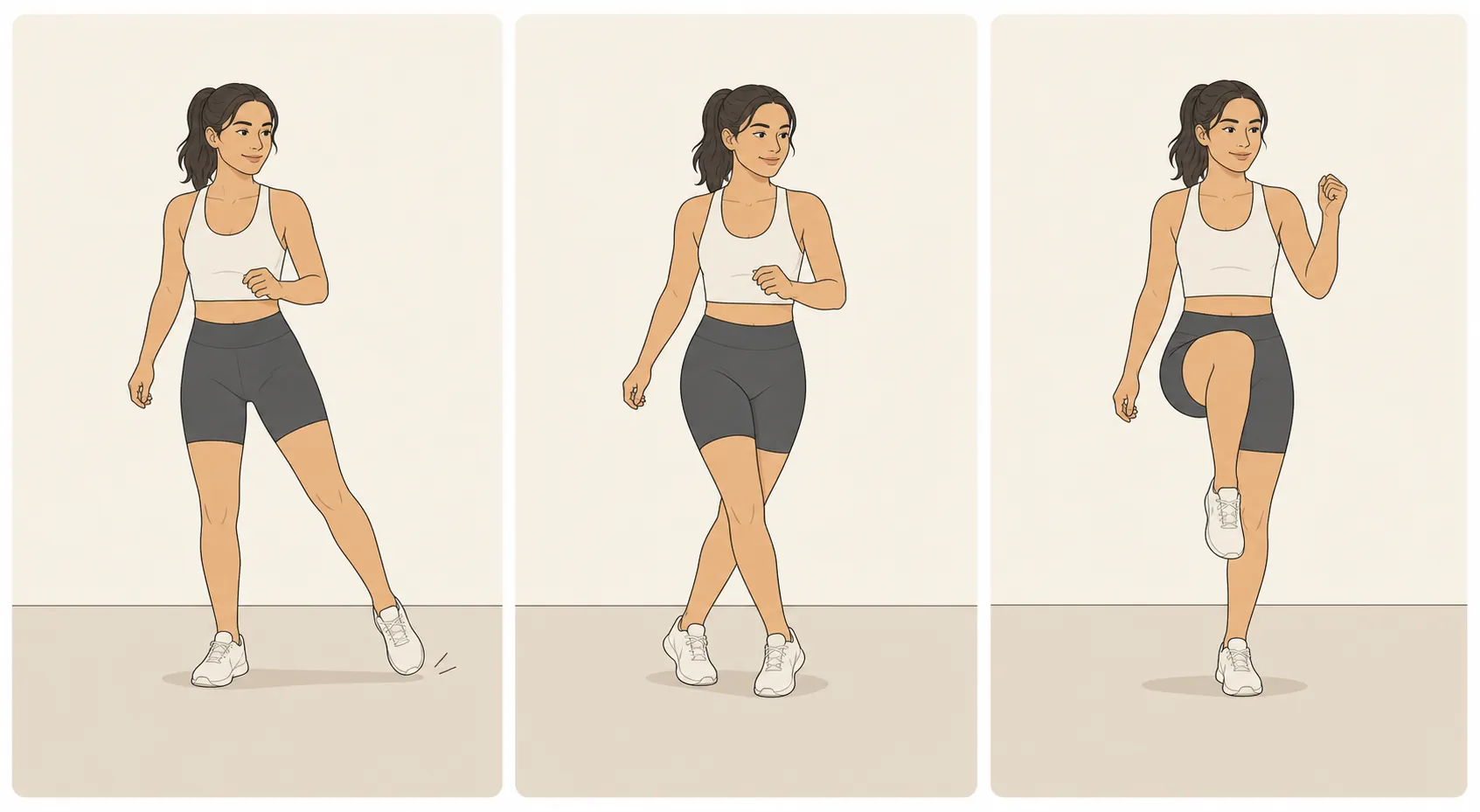
9:00–13:00 — Block 2: box step, grapevine, knee lift
This block adds direction changes. Keep the steps small enough that you could do the whole thing beside a coffee table without clipping it.
- 9:00–10:00 — Box step: step right foot forward, step left foot across or slightly forward, step right foot back, step left foot back. Then try leading with the left. Imagine tracing a tiny square on the floor.
- 10:00–11:00 — Grapevine: step right, cross left behind, step right, tap left. Reverse left. If the cross-behind tangles your feet, replace it with step right, tap left, step right, tap left.
- 11:00–12:00 — Knee lift with arm swing: step right, lift left knee while swinging right arm across your body; step left, lift right knee while swinging left arm. Keep the knee under hip height if you feel your lower back arching.
- 12:00–13:00 — Block 2 combo: one box step, one grapevine right, one grapevine left, four knee lifts.
Beginner correction: on the box step, do not chase perfect diagonals. Forward, forward, back, back is enough. The name helps you repeat it; the floor drawing does not need to be pretty.
13:00–17:00 — Block 3: low running man, twist, repeat combo
The running man is where many “beginner” dance workouts quietly stop being beginner. Use the low version first. You can always add bounce later; you cannot un-annoy your downstairs neighbor after four minutes of heel drops.
- 13:00–14:00 — Low running man: step right foot back, lift left knee slightly, then switch. Keep it more like a rhythmic march than a jump. Arms pump gently as if walking fast.
- 14:00–15:00 — Twist: feet wider than hips, heels swivel right-left-right-left while the torso stays tall. Let the arms swing opposite the hips. Keep knees bent and movements small.
- 15:00–16:00 — Step-touch plus twist: two step-touches right-left, then four small twists. Repeat. If twisting bothers your knees, replace the twist with four marches.
- 16:00–17:00 — Full repeat combo: two-step right, two-step left, one box step, four knee lifts, four low running-man switches, four twists.
Intensity check here: you should be breathing faster, but still able to say a short sentence. If you can sing along cleanly, make the arm swings bigger or step a little faster. If you cannot talk, shrink the steps and return to step-touch until your breathing settles.
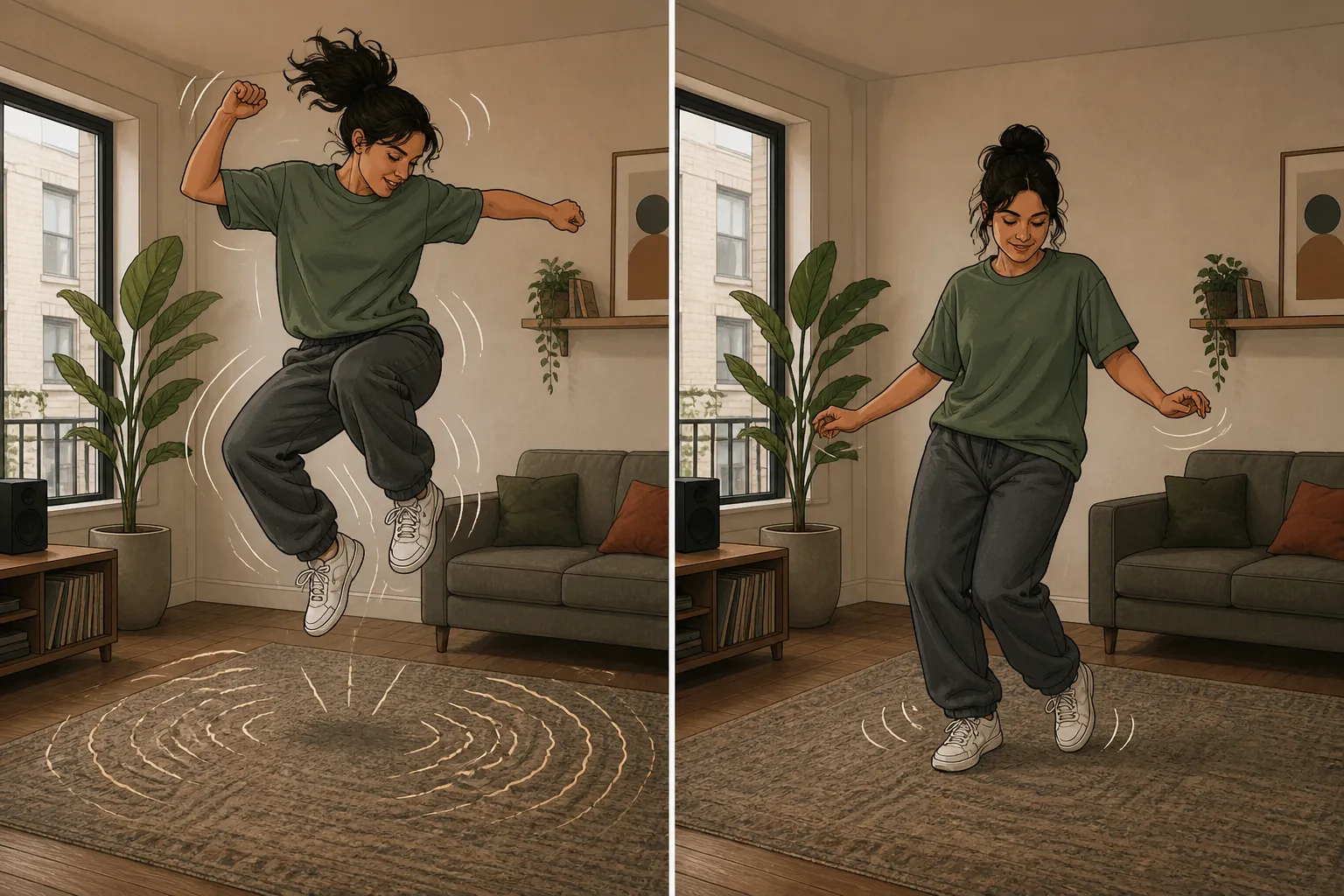
17:00–18:30 — Finisher: your best quiet combo
For 90 seconds, repeat the moves that felt best: two step-touches, two knee lifts, one grapevine each way, four twists. If you want more cardio, increase arm range before you add impact. Reaching higher, pulling elbows back harder, and bending the knees a little more usually raises effort without turning the floor into a drum.
A no-jumping apartment cardio format is a common way to keep movement contained, and step-touch, knee-lift, and low-impact substitutions are the useful part to borrow from that approach. [8] Still, building construction varies. If your floor carries every heel tap, lower the music, soften your knees, and favor toe taps over full-foot drops.
18:30–20:00 — Cool down and stretch
March in place for 30 seconds, then return to a slow step-touch. Let your arms drop lower each time. When your breathing comes down, hold each stretch without bouncing:
- Calf stretch: one foot back, heel down, both toes facing forward.
- Quad stretch: hold one ankle behind you or use a couch/wall for balance.
- Hamstring stretch: one heel forward, hips back, chest long.
- Chest opener: hands behind back or elbows wide, shoulders relaxed.
Ten to 30 seconds per static stretch is enough for this short session. [4] If you only have time for one lower-body stretch, take calves seriously; step-touch and grapevine patterns sneak in more calf work than they advertise.
How quiet can this actually be?
The quiet version is not a magic floor. It is a set of choices: no jumps, no stomps, no big traveling patterns, and no frantic pivots on a rug. The workout becomes more apartment-friendly when your feet stay close to the floor and your steps land through the ball of the foot instead of the heel.
| Workout moment | Regular version | Quieter small-space version |
|---|---|---|
| Warm-up | March with arm swings | Soft march or step-touch |
| Grapevine | Full side-cross-side-tap | Half-width grapevine or two step-touches |
| Running man | Bouncy switch | Low march back-forward with knee lift |
| Twist | Fast heel swivels | Slow heel swivels or marches |
| Finisher | Bigger arms and faster feet | Bigger arms, same soft feet |
If you need the lowest-noise version, do the whole routine as step-touch, knee lift, grapevine, and march. That is less flashy than a jump combo, but it is also much more likely to survive a rental floor.
What should 20 minutes feel like?
During the warm-up, you should feel slightly warmer, not winded. During Blocks 1–3, use the CDC talk test: talking is possible, singing is not. That puts the session in the intended moderate zone. [1] During the cool-down, full sentences should come back quickly.
If the routine feels too easy, first increase arm range, then bend the knees a little more, then slightly increase tempo. Add jumping last, and only if your floor, joints, and neighbors can handle it. If the routine feels too hard, remove the arms and make every move a step-touch until you recover.
Calories: useful range, bad scorecard
Calorie estimates for dance are not neat because body weight, style, intensity, and measurement method all change the number. Harvard Health’s 30-minute table estimates fast dancing, ballet, or twist at about 180, 216, and 252 calories for people weighing 125, 155, and 185 pounds; disco, ballroom, or square dancing is listed lower, at about 165, 198, and 231 calories for those same body weights. [9]
Healthline’s style-based examples use a 150-pound person and give different estimates by dance style, including ballet at 179 calories, hip hop at 207, salsa at 143, swing at 207, and tap at 164. [10] Those numbers are useful for expectations, not for grading the workout. A low-impact apartment version may burn less than a bigger, jumpier routine, but if it keeps you moving at moderate effort for the full session, it is doing the job this routine was built to do.
How to make it a weekly cardio base
This routine is 20 minutes, so it is a starting session rather than a full weekly plan. To line up with the CDC’s 150-minute moderate-activity target, build toward roughly 30 minutes on five days per week. [1] The easiest upgrade is not a harder move; it is one more block. After the finisher, repeat Block 1 or Block 2 before cooling down.
If you like quieter, gliding dance cardio, try the Dancing with the Stars home workout. If you want something more performance-flavored, use Derek Hough–style dance cardio, Broadway dance workouts, or DWTS-inspired dance fitness routines as style branches. For the budget path, keep it in the $0 lane with the $0 home workout tier build.
The honest verdict: the $0, no-equipment, small-space claim is strong. The apartment-friendly claim depends on doing the no-jumping version. Calorie burn is an estimate. The better win is finishing 20 minutes with named moves you can repeat tomorrow.
References
- Adult Activity: An Overview — CDC
- 16 Dance Workouts You Can Do In Small Spaces — STEEZY
- Home dance workouts — Red Bull
- Warm Up, Cool Down — American Heart Association
- Here are 10 Dance Moves Beginners Can Do — Rockstar Academy
- The Dance Move Glossary: Popular Moves To Know — STEEZY
- 75 Dance Steps Names For Beginners — ipassio
- 10-Minute No-Jumping Cardio Workout For Apartments — POPSUGAR
- Calories burned in 30 minutes for people of three different weights — Harvard Health
- Dancing to Lose Weight — Healthline
What a small equipment investment adds
We don't have a build tagged to this exact tier yet. Browse all builds.
How often should you repeat this?
See our recovery and rest reference for citation-anchored rest-interval guidance.
Spot something off?
Tell us if a movement, tier assumption, or duration didn't match your experience.