The honest answer to a Diego Lopes UFC home workout is that nobody outside his team has published his exact daily sets, rounds, and sparring schedule. That is not a small detail. A real UFC camp includes coaches, partners, pads, mats, recovery work, and consequences that do not fit between a sofa and a doorway pull-up bar.
What is public, though, is useful. Lopes’ training image is not built around a giant specialist staff or a glossy celebrity routine. At Lobo Gym, he has worked under Francisco Grasso, whom Lopes described as covering striking, grappling, and conditioning rather than splitting every discipline across the large staffs common at some major U.S. gyms.[1] That matters for a home version because the system is lean: drill movement, build usable strength, then condition the body to keep wrestling and striking under fatigue.
So the goal here is not to pretend your apartment is a UFC Performance Institute lane. It is to train the same underlying pattern with the tools most disciplined home athletes can actually use: floor space, a pull-up option, dumbbells or substitutes, and enough patience to repeat the boring work.

The Three Pillars That Actually Transfer
For a home athlete, Lopes’ camp logic is best reduced to three pillars: movement and drilling, bodyweight-dominant strength, and wrestling-based conditioning. That is not a claim that these are his only training methods. It is a practical translation of what the public record supports.
| Pillar | What it means at home | Why it fits the Lopes model |
|---|---|---|
| Movement and drilling | Footwork, stance switches, shadow striking, hip movement, technical get-ups | A fighter camp starts with skill positions, not random fatigue |
| Bodyweight-dominant strength | Chin-ups, push-ups, squats, hinges, presses, carries | Lobo Gym’s lean structure and UFC strength templates both favor simple, repeatable work |
| Wrestling-based conditioning | Stance motion, sprawls, level changes, carries, short hard intervals | Lopes has sought additional wrestling work, including time around Oklahoma State’s program |
The strongest published strength template that matches this kind of training is not labeled “Diego Lopes’ workout.” It is UFC.com’s EXOS program, designed by Brett Bartholomew, MS Ed, CSCS*D, a performance specialist who has trained NFL and UFC athletes. The program uses clean pulls, goblet squats, chin-ups, dumbbell presses, kettlebell swings, and farmer carries, with prescribed sets, reps, and rest intervals.[2] Bartholomew’s own warning is the right tone for this whole project: “The simplicity of this program will likely shock you. But if done the right way, it is an absolute monster.”[2]
That template gives the home workout its spine. Lopes supplies the camp logic; the UFC/EXOS program supplies the safer loading structure. Keeping those separate is how the routine stays honest.
A Camp-Style Home Session
Run this as a compact session two or three times per week, with easier movement-only days between harder sessions. If you already train jiu-jitsu, boxing, Muay Thai, or wrestling, this should support that work, not bury it. A professional can train for hours across disciplines because his day is built around that job. A home athlete usually needs the opposite: fewer parts, better order, and no wasted fatigue.
| Block | Work | Time or volume |
|---|---|---|
| Movement prep | Stance motion, shoulder prep, hip movement, light shadow striking | 8–12 minutes |
| Strength | Hinge or clean-pull pattern, goblet squat, chin-up variation, dumbbell press, swing or hip hinge, carry | 25–35 minutes |
| Wrestling conditioning | Stance-and-motion intervals, sprawls, level changes, loaded carries | 8–15 minutes |
| Cooldown | Breathing, hips, calves, upper back | 3–6 minutes |
Start With Movement, Not Exhaustion
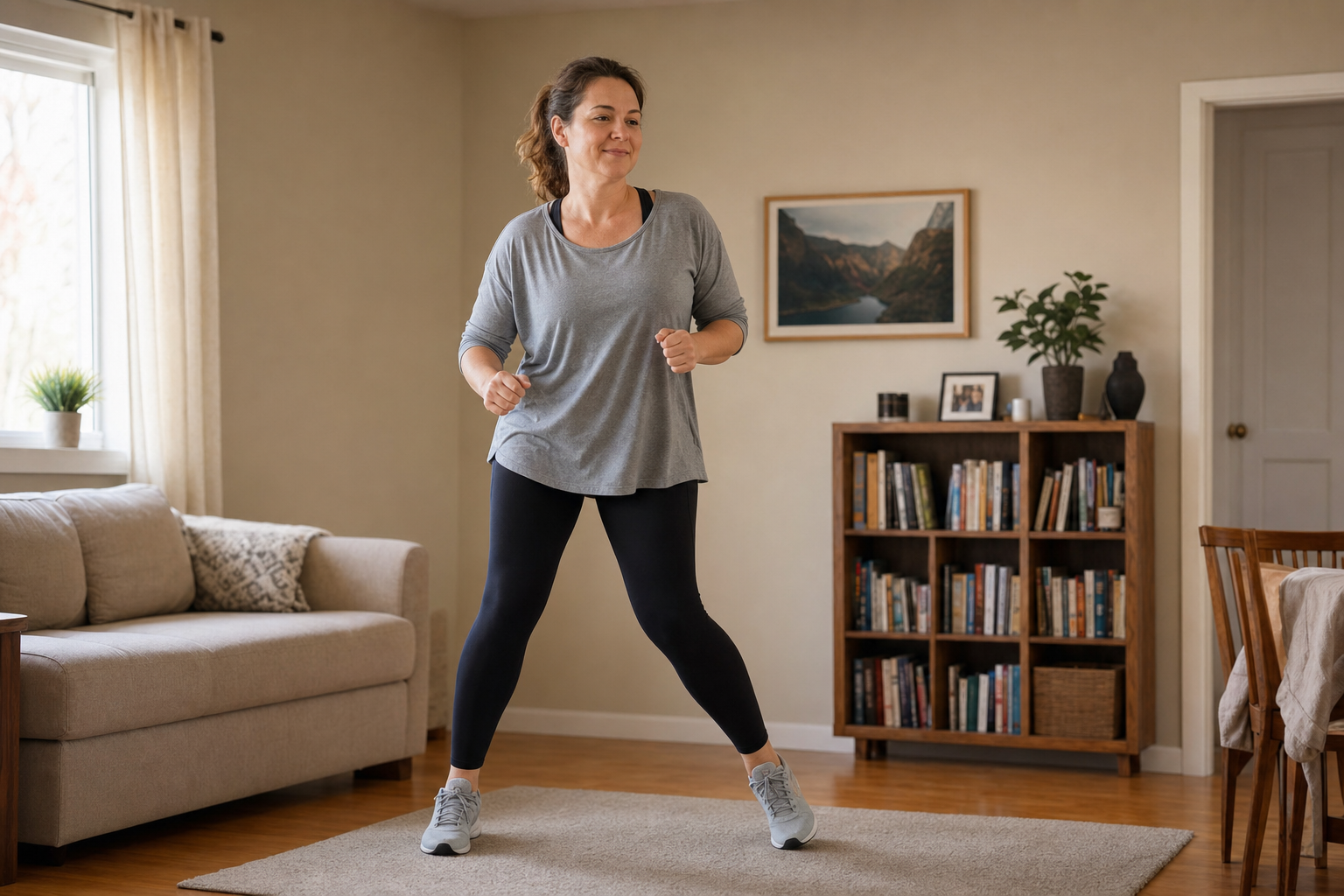
The first block should make you move more like a fighter before you try to get tired like one. In a small apartment, that means working inside a rectangle you can control: one or two steps forward, one or two steps back, angle out, reset. You do not need to bounce around the room. You need clean positions you can repeat when your legs are fresh and when they are not.
- 2 minutes: easy stance motion, switching between orthodox and southpaw if you can do it without crossing your feet
- 2 minutes: shadow striking at low intensity, focusing on returning hands and feet to position
- 2 minutes: level changes without touching the floor, keeping posture tall enough to move again
- 2 minutes: hip escapes, technical stand-ups, or sit-throughs, depending on available floor space
- 2–4 minutes: shoulder circles, scap push-ups, light squats, and easy hinges before loading
Do not turn this into cardio yet. If your first ten minutes already feel like a punishment, the strength block will become sloppy and the conditioning block will become theater.
Build Strength Around Simple Fighter Patterns
The EXOS/UFC template is valuable because it does not chase novelty. It uses explosive pulling, squatting, vertical pulling, pressing, hip extension, and carrying: the same broad qualities a fighter needs when he has to posture, clinch, scramble, frame, and keep his legs under him.[2]
| Exercise | Home version | Working target |
|---|---|---|
| Clean pull pattern | Dumbbell high pull from the hang, dumbbell clean pull, or fast deadlift-style hinge | 3–5 sets of 3–5 crisp reps |
| Goblet squat | One dumbbell, kettlebell, or loaded backpack held close | 3–4 sets of 6–10 reps |
| Chin-up | Chin-ups, negatives, band-assisted reps, or table rows | 3–5 sets, stopping before grip failure |
| Dumbbell press | One-arm floor press, standing press, or push-up variation | 3–4 sets of 6–10 reps per side |
| Swing or hinge | Kettlebell swing, dumbbell swing, band hinge, or Romanian deadlift | 3–5 sets of 8–15 reps |
| Farmer carry | Dumbbells, loaded bags, buckets, or suitcase carry in place | 4–6 carries or timed holds |
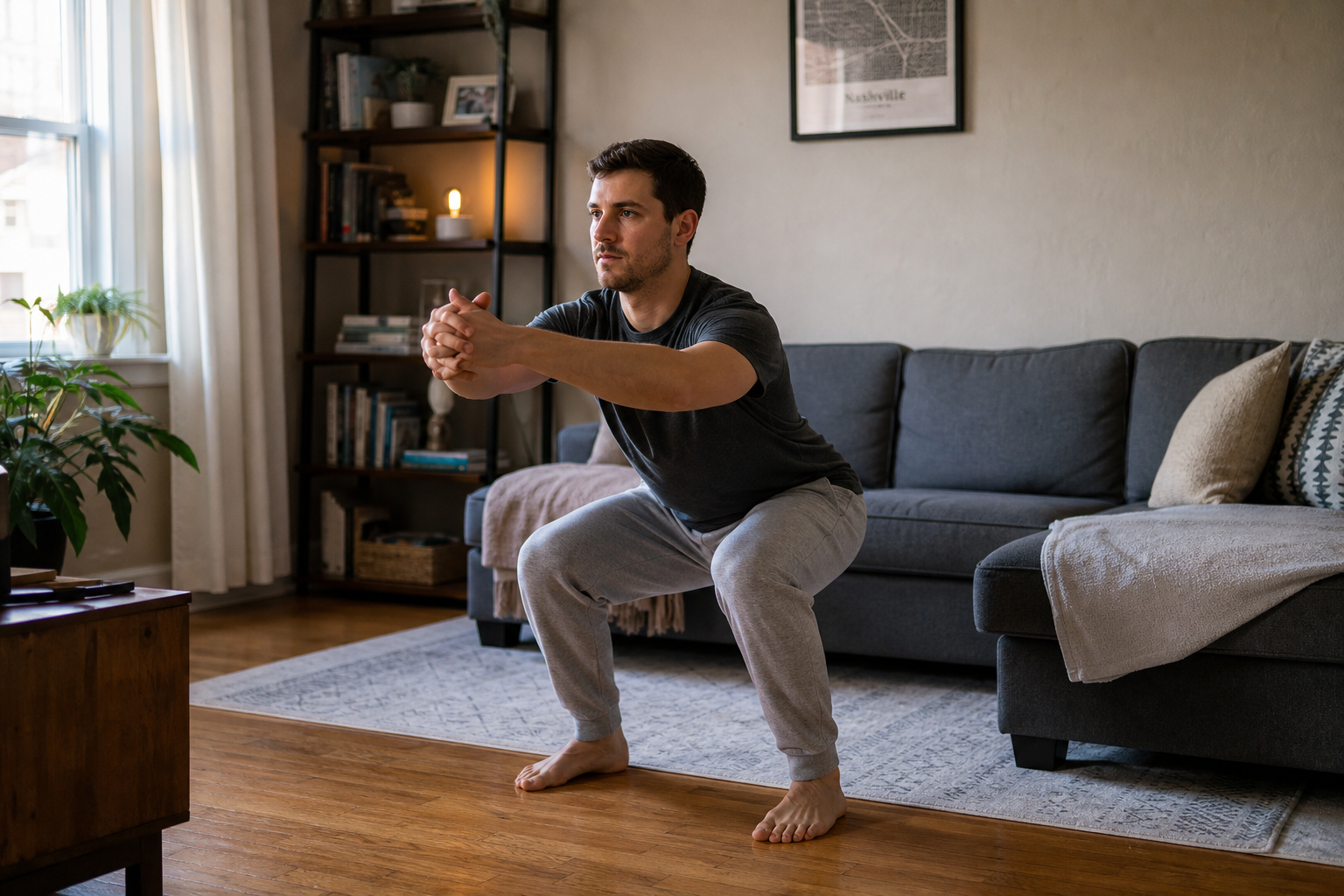
The clean-pull slot is the one most home athletes should treat with respect. If you have never learned Olympic-lift derivatives, do not yank a dumbbell off the floor and call it athletic. Use a fast hip hinge from the hang, keep the reps low, and stop each set while the movement still looks sharp. Power work loses its point when every rep turns into a lower-back negotiation.
For the squat, press, and chin-up slots, leave one or two clean reps in reserve on most sets. A UFC fighter can separate hard strength sessions from hard skill sessions because the whole week is planned. At home, fatigue leaks into everything: your workday, your sleep, your next grappling class, your knees when you stand up from the couch.
The carry is the least glamorous piece and one of the hardest to fake. Walk if you have a hallway. March in place if you do not. Use one hand sometimes instead of two. A suitcase carry forces the trunk to resist bending, which has more transfer to clinch posture than another rushed ab circuit.
Use Wrestling Conditioning as a Finisher, Not the Whole Workout
Lopes’ willingness to go sharpen wrestling is one of the more useful public details about his training. MMA Fighting documented him seeking work around Oklahoma State’s wrestling program ahead of UFC 314, with David Taylor and Wyatt Hendrickson praising his initiative.[3] The available reporting does not give a complete drill sheet, so the home version should stay generic: stance motion, level changes, sprawls, and carries inspired by wrestling demands, not advertised as secret Oklahoma State work.
A good finisher is short enough that you can keep position. Try this after the strength block:
- Round 1: 30 seconds stance motion, 30 seconds rest
- Round 2: 20 seconds sprawls, 40 seconds rest
- Round 3: 30 seconds level-change to angle step, 30 seconds rest
- Round 4: 30–45 seconds farmer carry or suitcase hold, 45 seconds rest
- Repeat for 2–4 total cycles, depending on conditioning and joint tolerance
Sprawls are not mandatory every session. They are high-impact for wrists, shoulders, hips, and toes, especially on hard floors. If your apartment setup punishes every landing, use step-back sprawls, squat-thrust variations, or level-change intervals instead. The conditioning goal is repeated defensive motion under fatigue, not collecting floor burns.
The Full Weekly Setup
Most intermediate home athletes will do better with three focused sessions than with a fake fight-camp schedule. The week below assumes you also need recovery, work, and maybe actual martial arts practice.
| Day | Session |
|---|---|
| Monday | Full 3-pillar session: movement, strength, wrestling conditioning |
| Tuesday | Easy movement only: footwork, mobility, light shadow striking |
| Wednesday | Full 3-pillar session with slightly different strength emphasis |
| Thursday | Rest or skill class |
| Friday | Full 3-pillar session, shortest conditioning block if fatigue is high |
| Saturday | Optional easy drilling, walking, mobility, or martial arts class |
| Sunday | Rest |
If you train combat sports outside the home, count those sessions first. Hard sparring, live wrestling, and intense rolling are not “extra cardio.” They are the expensive work. On those weeks, cut the home conditioning before you cut the movement prep or the basic strength work.
No Pull-Up Bar, No Kettlebell, No Problem
The home version only works if substitutions are built into the plan instead of treated as apologies. A compact apartment is not a failed gym. It is a constraint. Lopes’ own Lobo Gym context is a reminder that a lean setup can still produce serious work when the pieces are chosen carefully.[1]
| Missing item | Use instead | Keep the intent |
|---|---|---|
| Dumbbell | Loaded backpack, gallon jugs, sandbag, resistance band | Load the squat, hinge, press, or carry without changing the movement into a circus trick |
| Pull-up bar | Band pulldown, table row, towel row setup, slow negatives if a safe bar is available elsewhere | Train pulling strength and shoulder control |
| Kettlebell | Dumbbell swing, band hinge, Romanian deadlift, hip-thrust variation | Train hip extension without needing a specific implement |
| Long hallway | Marching farmer carry, suitcase hold, slow loaded step-ups | Keep loaded posture under time |
| Soft floor | Yoga mat, folded mat, step-back sprawls, level changes | Reduce impact while keeping wrestling-style rhythm |
A pull-up bar is useful, but it is not the price of entry. The second UFC.com fighter example worth noticing is Mike Swick’s no-machine approach, which used max-rep push-ups, chin-ups, and bodyweight squats to build practical strength without relying on machines.[4] The useful lesson is not that every set needs to be a max set. It is that bodyweight staples still belong in serious fighter-style programming when they are progressed and repeated.
If you do not have a pull-up bar, table rows are usually the closest home substitute, assuming the table is heavy and stable enough. If that is not safe, use a band anchored in a closed door only if the anchor is designed for that purpose. A bad anchor turns back training into dental work.
Progress the Routine Without Turning It Into a Fantasy Camp
Progression should be quiet. Add a rep here, a little load there, one more carry, or a cleaner round of stance motion. Do not add everything at once. The professional camp temptation is to copy the visible suffering and ignore the invisible support: coaching eyes, partners, treatment, food, sleep, and a schedule built around training.
| If the workout feels easy | Change this first |
|---|---|
| Strength block is too light | Add load or one set to the main squat, pull, or press |
| Conditioning is too easy | Add one round before shortening rest |
| Movement prep feels automatic | Make footwork cleaner, not faster |
| Carries are too easy | Use one-sided carries or longer holds |
| Recovery is getting worse | Remove conditioning volume before removing strength quality |
A clean eight-week run is enough to tell whether the plan is working. You should see better repeatability: steadier footwork, stronger pulls, less panic after sprawls, and cleaner posture under carries. If all you gain is soreness, the program is too dense or too dramatic.
Safety Boundaries That Matter in a Living Room
Home fight-style training needs more restraint than gym training because the room is less forgiving. You may be training near furniture, on hard flooring, without a coach, and with equipment that was never meant to be dropped. That changes exercise selection.
- Do not perform fast clean-pull variations if you cannot hinge without back pain or rounding.
- Do not swing household objects that shift unpredictably, leak, or cannot be gripped securely.
- Do not sprawl hard on tile, concrete, or thin carpet if wrists, shoulders, or toes complain.
- Do not use a doorframe, table, or anchor point for rows unless it can clearly support your weight and direction of pull.
- Do not let conditioning turn every strength rep into a rushed rep.
The home version earns its keep by being repeatable. Movement first, strength second, conditioning third. That order protects the session from becoming another pile of burpees with a fighter’s name attached.
What You Can and Cannot Copy
You cannot reproduce Diego Lopes’ UFC camp at home. You do not have his coaches, partners, fight calendar, medical support, or daily training environment. You also do not have a verified Lopes spreadsheet showing exact exercises, loads, and rounds.
You can copy the useful structure: move like a fighter before loading, build strength with simple bodyweight and dumbbell-dominant patterns, then finish with wrestling-based conditioning that respects your space. That is the version that survives contact with an apartment floor.
References
- UFC news: Diego Lopes opinion Lobo Gym coach Francisco Grasso coach of year MMA Alexa, MMA Junkie, November 21, 2023
- Elite UFC training made simple, UFC.com
- David Taylor, Wyatt Hendrickson praise Diego Lopes for coming to Oklahoma State to sharpen wrestling ahead of UFC 314, MMA Fighting, April 11, 2025
- UFC Gym Training: No Machines, Just Muscle, UFC.com
Comments
Join the discussion with an anonymous comment.