Search for a ufc fight training workout routine and you usually get noise: burpees stacked on shadowboxing, pushups done past the point of useful form, and enough sweat to make the workout look serious. The more interesting thing about the UFC.com strength program designed by EXOS performance specialist Brett Bartholomew is how little it tries to entertain you. It is three weight-training days per week. It puts at least one rest day between lifting sessions. Each day starts with a power movement, then moves into two circuits built around compound exercises, with rest periods written into the plan instead of treated as optional downtime.[1]
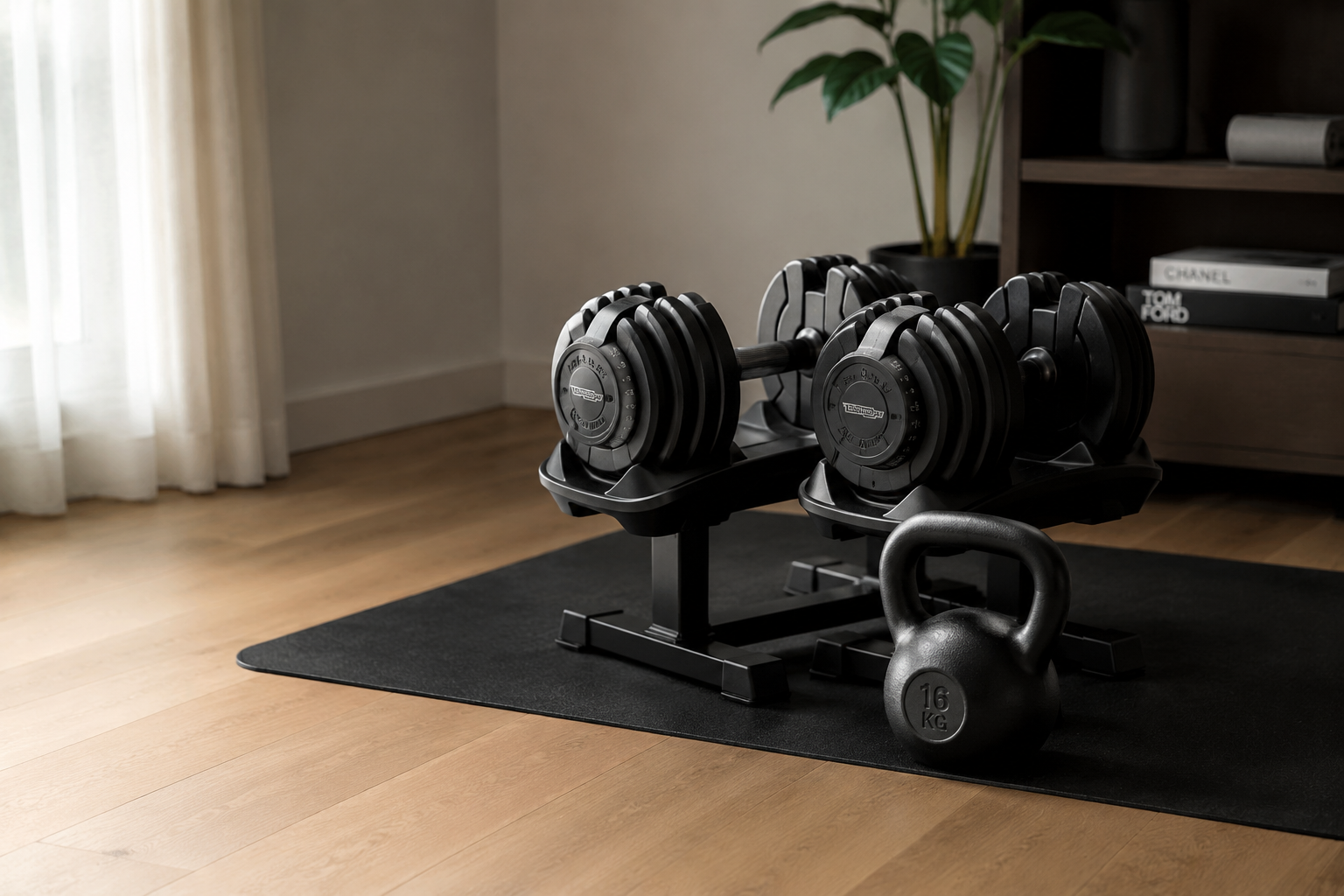
That matters for home training because most people are not short on ways to get tired. They are short on repeatable structure. A pair of adjustable dumbbells, a kettlebell, and a pull-up option can preserve far more of this program than a random high-rep circuit can, provided the goal stays clear: this is the strength and power portion of a fighter’s week, not a complete fight camp with striking, sparring, roadwork, conditioning, and fight-week tapering.
The Actual Weekly Shape
The program’s first useful lesson is the weekly rhythm. It does not ask for daily lifting. It uses three sessions with recovery days between them, and every session follows the same broad architecture: a leadoff power exercise, then Circuit 1, then Circuit 2.[1]
| Day | Leadoff Power Work | Circuit 1 | Circuit 2 | Rest Prescription |
|---|---|---|---|---|
| Monday | Clean pull, 3 sets of 5 | Squat, chin-up, hip flexor stretch | One-arm dumbbell press, kettlebell swing, farmer carry | 60-90 seconds after power sets; 2-3 minutes between Circuit 1 bouts; 1 minute between Circuit 2 bouts |
| Wednesday | Depth jump, 3 sets of 3 | Lower-body strength work paired with upper-body pulling and mobility | Pressing, pulling, and loaded movement work | Same rest logic: longer recovery for heavier work, shorter recovery for the second circuit |
| Friday | One-arm dumbbell snatch, 3 sets of 5 | Compound strength pairings with a push-pull balance | Accessory compound work and loaded carries or swings | Same prescribed recovery structure |
The Monday session alone tells you what kind of program this is. Clean pull. Squat. Chin-up. Hip flexor stretch. One-arm dumbbell press. Kettlebell swing. Farmer carry. There is no machine dependency there, and there is no attempt to turn the weight room into a pretend cage fight. You produce force, squat, pull, restore hip position, press with one arm, hinge explosively, and carry load.[1]
That is why the template adapts well to a serious home setup. It assumes load, but not necessarily a commercial gym. Dumbbells, kettlebells, or a barbell can all be used in the program’s exercises.[1] A bodyweight-only version may still be useful for general conditioning, but it is no longer the same strength program. Removing external load changes the training problem.
Why the Rest Periods Are Part of the Workout
Bartholomew’s best line in the UFC.com piece is that “rest is a weapon.” It is not a decorative quote. The program gives 60 to 90 seconds between sets of the leadoff power exercise, 2 to 3 minutes between bouts in the first circuit, and 1 minute between bouts in the second circuit.[1]

Those pauses change the entire character of the workout. A clean pull or dumbbell snatch is not improved by turning it into breathless cardio. Once power drops, the exercise stops training the quality it was chosen for. The rest interval protects speed, position, and intent.
The longer 2-to-3-minute recovery in Circuit 1 is just as important. That circuit carries the heavier strength work, where a rushed next set usually means a lighter load, shortened range of motion, or sloppy compensation. At home, the temptation is to keep moving because nobody is watching and the room is quiet. The program says the opposite: wait long enough to make the next bout worth doing.
The 1-minute rest in Circuit 2 can create more density, but it still is not chaos. It comes after the main strength work, and it still preserves enough recovery to keep swings, carries, presses, and pulls from dissolving into survival reps.[1]
The Push-Pull Balance Is Not Cosmetic
One quiet strength of the program is that pressing does not get to run the room. Every pressing movement has a pulling counterpart built into the same session, a design choice the UFC.com article connects to preventing shoulder imbalances in fighters who over-emphasize pushing.[1]
That is worth keeping when you bring the plan home. Fighter-branded workouts often drift toward pushups, sprawls, burpees, and more pushups because those movements are easy to film and easy to fatigue. Shoulders do not care that the workout has a good label. They care whether pressing volume is balanced by rows, chin-ups, carries, and scapular control.
If you substitute exercises, preserve the relationship. A one-arm dumbbell press can pair with a chin-up, pull-up, or one-arm row. A floor press can pair with a chest-supported dumbbell row if you have a bench, or a hinge-supported row if you do not. The exact tool can change; the shoulder math should not.
How to Run the Monday Session at Home
Start with Monday because it shows the whole idea without needing much interpretation. You need a load you can pull from the floor or hang position, a squat variation, a pulling station or substitute, a dumbbell for one-arm pressing, a kettlebell or dumbbell for swings, and enough floor space to carry.
| Program Exercise | Home Version | Keep the Intent |
|---|---|---|
| Clean pull, 3x5 | Dumbbell clean pull, kettlebell clean pull, or barbell clean pull | Explosive hip and leg drive; stop before reps slow down |
| Squat | Goblet squat, double-dumbbell front squat, or barbell squat | Heavy lower-body strength with a stable torso |
| Chin-up | Chin-up, pull-up, band-assisted chin-up, or heavy one-arm dumbbell row | Upper-body pulling to balance pressing |
| Hip flexor stretch | Half-kneeling hip flexor stretch | Restore hip position between strength bouts |
| One-arm dumbbell press | Standing one-arm dumbbell press or kettlebell press | Single-arm pressing without leaning or twisting |
| Kettlebell swing | Kettlebell swing or dumbbell swing | Fast hip hinge, not a squat-front raise hybrid |
| Farmer carry | Heavy dumbbell farmer carry or suitcase carry | Grip, trunk stiffness, and loaded posture |
If you own only one kettlebell, the session still works with a few compromises. Use the kettlebell clean pull for power work, goblet squat for the squat pattern, a row variation if you do not have a pull-up bar, single-arm kettlebell press, kettlebell swings, and suitcase carries. The loading ceiling will arrive sooner than it would with adjustable dumbbells or a barbell, but the session’s structure survives.
If you own adjustable dumbbells, do not turn every movement into a light conditioning drill. Load the squat and carry honestly. Make the press heavy enough that the final reps require attention. Keep the clean pull crisp rather than grinding it. The program’s phrase “Do the simple things savagely well” only works if the simple things are loaded and performed with care.[1]
What to Substitute, and What Not to Pretend
Good substitutions preserve the job of the exercise. Poor substitutions preserve only the sweat. That distinction keeps the home version from drifting into a different program.
- For Olympic-style power pulls: use a dumbbell clean pull, kettlebell clean pull, high pull, or one-arm dumbbell snatch when you can keep the rep fast and controlled.
- For squats: use goblet squats, double-dumbbell front squats, split squats, or a barbell squat if you have the setup.
- For chin-ups: use chin-ups, pull-ups, band assistance, suspension rows, or heavy dumbbell rows rather than adding more pushups.
- For presses: use one-arm dumbbell presses, kettlebell presses, landmine-style barbell presses if available, or floor presses when overhead work is not appropriate.
- For carries: use farmer carries, suitcase carries, front-rack carries, or heavy static holds if your training space is too short to walk.
The substitution line is clearest with load. A bodyweight squat is not the same training stimulus as a loaded squat unless the athlete is so new that bodyweight is still challenging. Mountain climbers are not a clean pull. Shadowboxing is not a one-arm press. Those can be useful elsewhere, but they do not replace the strength and power work in this template.
Where the UFC Label Helps, and Where It Does Not
The UFC connection is useful here because the source is specific. This is not a generic influencer circuit with “fighter” added to the title. UFC.com published the program, and Bartholomew is identified as an EXOS performance specialist who works directly with UFC athletes.[1] The authority signal earns attention because it comes attached to a complete structure: days, movements, sets, reps, and rest periods.
There is also some broader fit with the UFC training ecosystem. Another UFC.com piece on UFC Gym training emphasizes a no-machines approach built around muscle and ground-based work rather than commercial-gym machine circuits.[2] That supports the idea that minimal-equipment, load-bearing training is not a watered-down home invention.
Still, the date should be handled cleanly. The EXOS article appears tied to an older UFC Magazine context and does not show a visible publication date on the page.[1] That makes it better to treat the plan as a durable published strength template than as a claim about the latest UFC Performance Institute programming in 2026.
It also does not claim to be the whole week of a professional fighter. A fighter still needs technical practice, sparring, energy-system work, skill-specific conditioning, recovery management, and coaching decisions that change across a camp. This program gives the strength room piece. For a home trainee, that is already plenty to execute well.
How Hard Should the Sets Feel?
The source gives sets, reps, and rest, but it does not provide a full long-term progression model or fight-camp periodization plan.[1] For home use, that means you need a simple rule for load selection: power reps should stay fast, strength reps should feel heavy but repeatable, and second-circuit work should challenge posture without turning into a collapse.
On the clean pull, depth jump, or one-arm dumbbell snatch, stop chasing fatigue. If the first rep is sharp and the fifth rep is slow and ugly, the load or set length is wrong for power. On squats, presses, rows, and carries, use enough weight that the set requires focus, but leave enough in reserve to perform the next bout after the prescribed rest.
For progressing a home dumbbell version, the cleanest approach is to add reps within the programmed range when form is stable, then increase load when all sets are strong. If you want a more detailed framework for that, the full-body dumbbell workout progression framework explains how to use double progression and reps in reserve without turning every session into a max test.
Who This Routine Fits
This routine fits the home trainee who has at least some external load and wants strength work that feels athletic without becoming theatrical. Adjustable dumbbells, one or two kettlebells, a pull-up bar, and a small training area are enough to preserve most of the intent. A barbell expands the ceiling, but it is not required for the basic home version.
It is a poor fit if you want a zero-equipment routine, a striking workout, or a conditioning-only sweat session. It is also not the best first stop if you cannot hinge, squat, press, row, and carry with basic control. The exercises are simple, but they are not disposable.
If you like the three-day structure but want a less UFC-specific plan, the no-bench full-body dumbbell workout follows the same practical home constraint. If you want to place this kind of training inside a longer equipment strategy, the home gym workout plan that grows with your equipment gives a broader path.
The Home Version Is Serious Because It Stays Simple
If you have dumbbells or kettlebells and want the strength template behind the elite label, this is a better model than endless fatigue circuits. It gives you three repeatable strength days, heavy compound movements, pushing matched with pulling, power work placed before fatigue, and enough recovery to keep quality high. Do the clean pulls or snatches while they are fast. Take the rest periods seriously. Load the squats, presses, rows, swings, and carries with intent. Effective home UFC-style strength training is less about copying the chaos of a fight and more about repeating simple work well enough for it to build.
References
- Elite UFC Training Made Simple — UFC.com.
- UFC Gym Training: No Machines, Just Muscle — UFC.com.
Comments
Join the discussion with an anonymous comment.