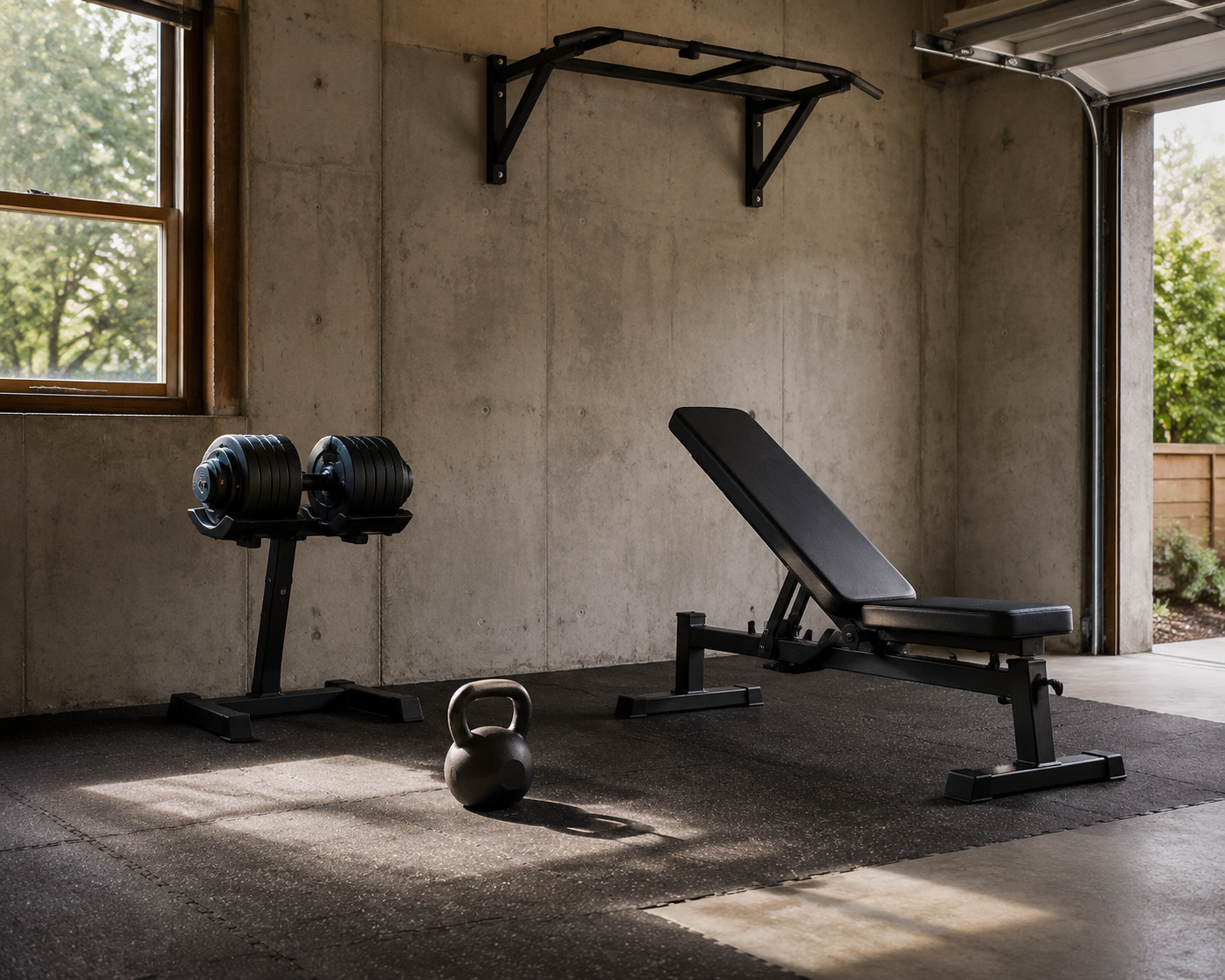
An actual UFC fighter home workout routine is less dramatic than most people expect. The EXOS strength template shared by UFC.com is built around three full-body sessions per week, usually placed on Monday, Wednesday, and Friday. Each session starts with one lead power or strength movement, then moves into two circuits. No machines are required; the exercises can be run with barbells, dumbbells, kettlebells, bands, a medicine ball, and a pull-up bar depending on what the athlete has available.[1]
That is the useful surprise. The value is not that the plan looks brutal on paper. It is that it gives a home lifter enough structure to train seriously without turning every workout into a random fight-themed sweat session.
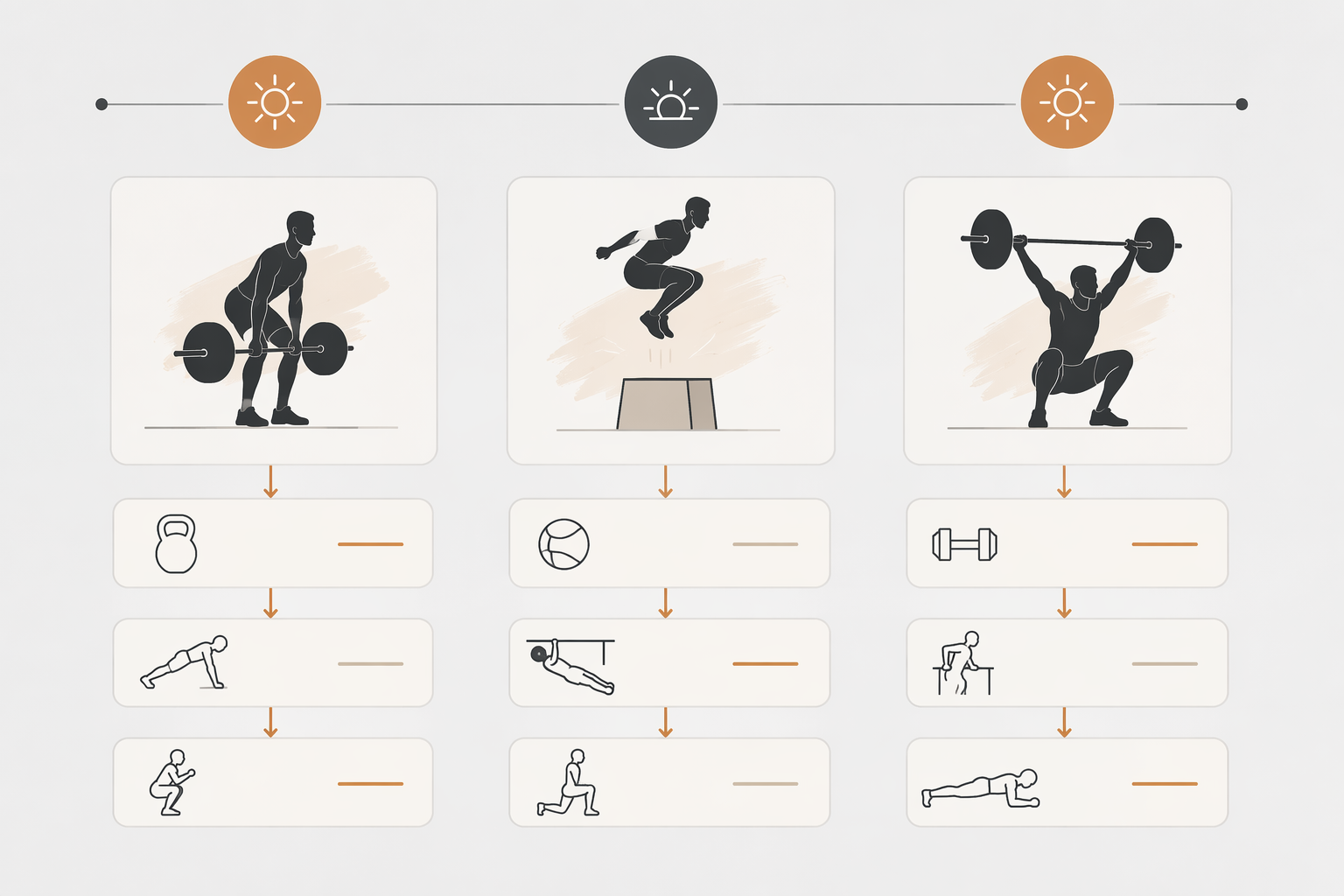
The Weekly Shape of the UFC-EXOS Strength Template
Brett Bartholomew, MS Ed, CSCS*D, framed the program around ground-based, multi-joint, multi-planar work rather than bodybuilding isolation or machine circuits. In the UFC.com piece, he also makes the larger point that “MMA is behind its peers in the training curve,” arguing that fighters still need foundational strength, power, mobility, and core work instead of endless sport-specific novelty.[1]
| Day | Lead movement | Circuit 1 | Circuit 2 | Main home-gym need |
|---|---|---|---|---|
| Monday — Workout A | Clean Pull | Squat + Chin-Up | One-Arm Dumbbell Bench + Kettlebell Swing + Farmer Carry | Dumbbells or kettlebell, pull-up bar, bench or floor |
| Wednesday — Workout B | Depth Jump | Incline One-Arm Press + One-Leg RDL + Band Pull-Apart | One-Arm Row + Reverse Lunge + Med-Ball Throw | Stable box or step, dumbbells, band, optional medicine ball |
| Friday — Workout C | One-Arm Dumbbell Snatch | Deadlift + Opposite Arm-Leg Plank | Overhead Press + Lateral Lunge + Deadbug | Dumbbells or kettlebell, open floor space |
The rest intervals matter as much as the exercise names. The template prescribes 60–90 seconds between lead-movement sets, 2–3 minutes between Circuit 1 blocks, and 1 minute between Circuit 2 blocks. Bartholomew is blunt about this: violating those rest intervals is a failure, and “rest is not a weakness; it’s a weapon.”[1]
Before You Start: What This Program Is and Is Not
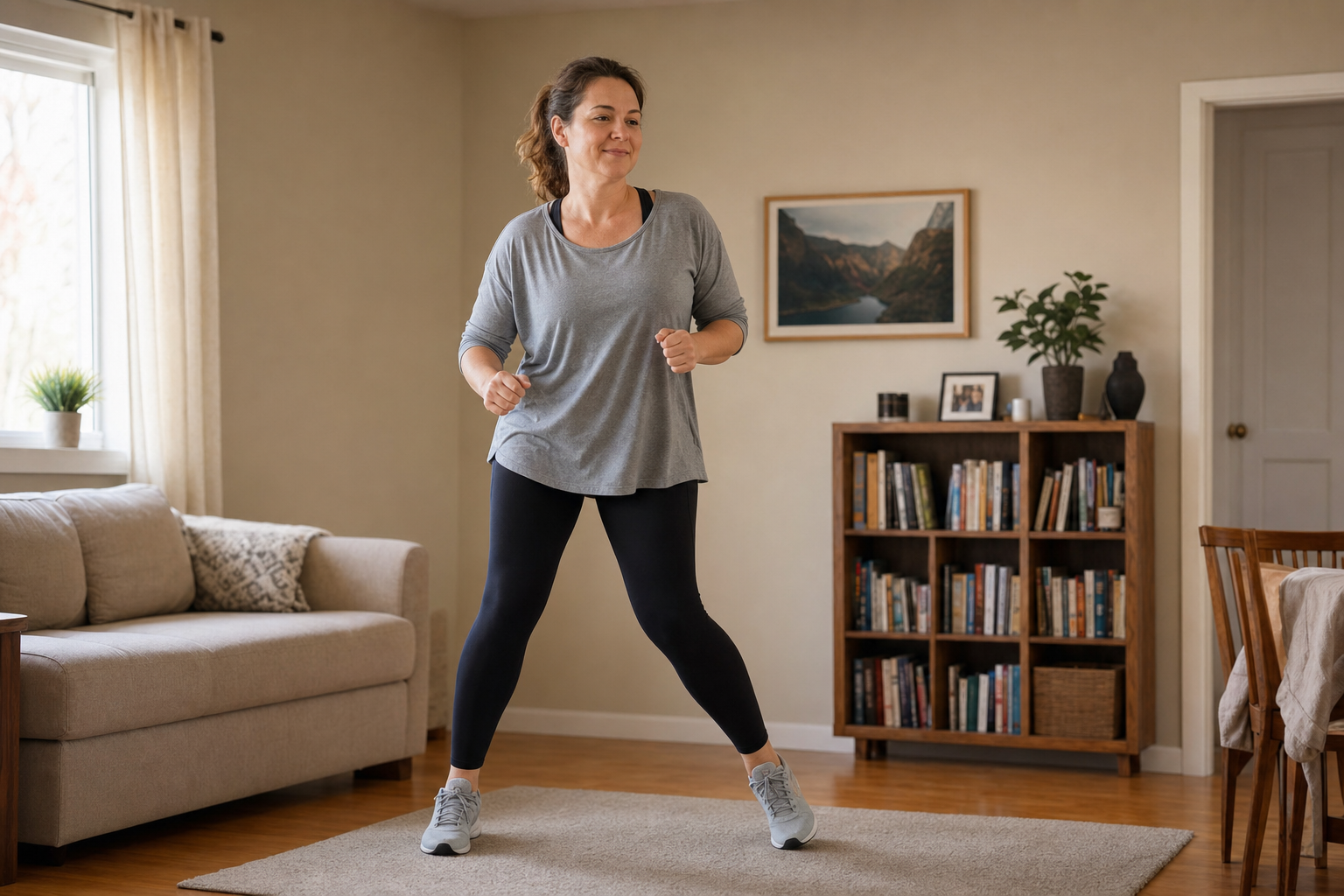
This is a fighter strength and power template. It is not a full MMA camp. There are no striking rounds, grappling sessions, sparring blocks, tactical drills, weight-cut protocols, or coaching progressions in the routine as presented. Running it well can support the physical qualities a fighter needs, but it does not replace fight practice.
The UFC-EXOS training philosophy also pushes back against a common home-gym mistake: collecting hard exercises without checking whether the week still balances movement patterns. Bartholomew specifically warns against programs that load the chest and shoulders with four or six pushing exercises while giving the back only two pulling movements.[1]
For a home setup, that means your substitutions have to preserve the job of the movement. A dumbbell floor press can replace a one-arm dumbbell bench if you do not own a bench. A kettlebell deadlift can replace a barbell deadlift if load is limited. But swapping chin-ups for another press because the pull-up bar is inconvenient changes the program.
Workout A: Clean Pull, Squat, Chin-Up, Swing, Carry
Workout A is the cleanest example of why the template works at home. It opens with the clean pull, then pairs a squat with a chin-up, then finishes with one-arm pressing, hip power, and loaded carrying.[1] That gives you a lower-body drive, a vertical pull, a horizontal press, a hinge, and grip-heavy trunk work without needing a commercial gym.
Lead movement: Clean Pull
The clean pull trains force from the floor through the hips without requiring the athlete to receive the weight in a full clean. For a fighter, the point is not Olympic lifting style points. The point is producing force from the ground while staying organized through the trunk.
At home, use the version you can control. A barbell clean pull is closest to the classic lift. A dumbbell clean pull or kettlebell high pull can work if the load path stays tight and the movement is driven by the legs and hips rather than a shrug-and-yank from the arms. If the pull gets sloppy, scale to a jump shrug or a fast kettlebell deadlift.
- Set each rep from a stable start instead of bouncing through the floor.
- Keep the weight close; do not let dumbbells swing forward like a curl.
- Rest 60–90 seconds between lead sets as prescribed, even if you feel ready sooner.[1]
- Stop the set when speed drops or the pull turns into an arm exercise.
Circuit 1: Squat + Chin-Up
The first circuit is simple: squat, then chin-up.[1] It is also where a home lifter can accidentally expose the weakest part of the garage setup. Adjustable dumbbells may be heavy enough for pressing and rowing but too light for serious squatting. A doorway pull-up bar may be enough for strict chin-ups but not for aggressive kipping or rushed reps.
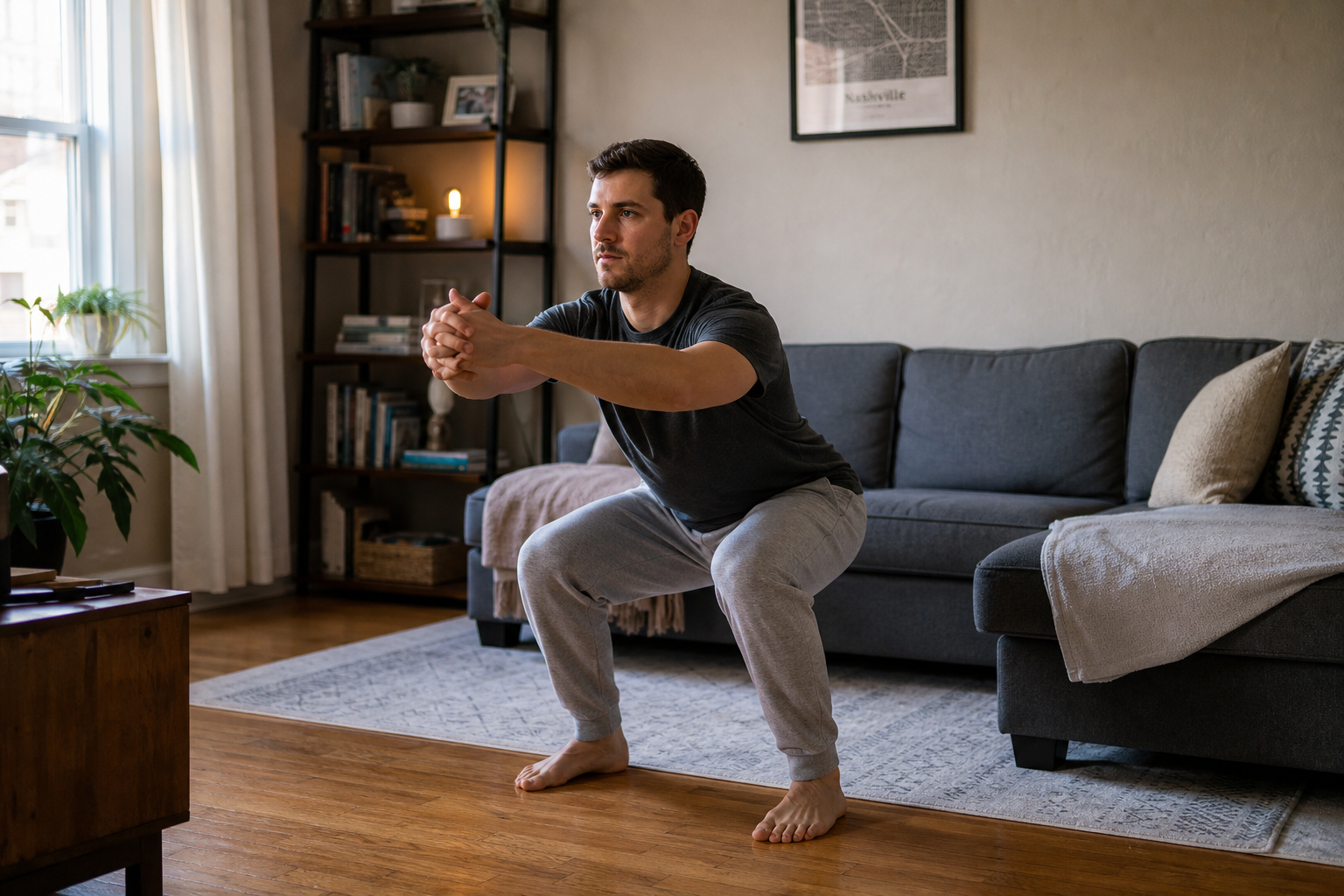
Use a front-loaded squat if you have dumbbells or a kettlebell. Goblet squats work when load is limited, but they become a trunk and upper-back limiter before they become a true leg strength exercise. If that happens, slow the lowering phase, pause at the bottom, or use a split-squat variation instead of pretending a light goblet squat is the same stimulus.
For chin-ups, keep the vertical pull in the plan. Assisted chin-ups, band-assisted chin-ups, eccentric-only reps, or inverted rows are better substitutes than another biceps curl. Circuit 1 gets 2–3 minutes between blocks, which is long enough to keep the work strong instead of turning it into conditioning.[1]
Circuit 2: One-Arm Dumbbell Bench + Kettlebell Swing + Farmer Carry
The second circuit moves faster but still has a clear structure: one-arm dumbbell bench, kettlebell swing, and farmer carry.[1] The one-arm press forces the trunk to resist rotation. The swing brings back hip snap. The carry finishes with grip, posture, and bracing under load.
No bench is not a deal-breaker. Use a one-arm dumbbell floor press and accept the shorter range of motion. For swings, use a kettlebell if you have one; if not, a dumbbell swing can work if the handle and grip are secure. For farmer carries, walk in a hallway, around a garage mat, or march in place if space is tight.
Workout B: Depth Jump, One-Leg Hinge, Row, Lunge, Throw
Workout B is the day that most deserves restraint. The lead movement is a depth jump, followed by an incline one-arm press, one-leg Romanian deadlift, band pull-apart, one-arm row, reverse lunge, and med-ball throw.[1] This is not a license to jump off whatever chair happens to be nearby.
Lead movement: Depth Jump
A depth jump trains landing, stiffness, and rapid force production. It also punishes poor mechanics quickly. The home version needs a stable elevated surface around 12–24 inches high, clear floor space, and a landing surface that does not slide.[1]
If you cannot land quietly with knees tracking and the torso under control, do not use depth jumps yet. Use a box jump, snap-down, or pogo jump. Those alternatives keep the power and landing intent without forcing a higher-risk drop that your setup or skill level cannot support.
- Step off the box; do not jump upward before dropping.
- Land softly, then reset instead of chaining sloppy rebounds.
- Keep the lead-movement rest at 60–90 seconds so each jump stays crisp.[1]
- Remove the exercise if your floor, box, knees, or ankles make you hesitate.
Circuit 1: Incline One-Arm Press + One-Leg RDL + Band Pull-Apart
This circuit balances pressing, single-leg posterior-chain work, and upper-back volume.[1] If you have an adjustable bench, the incline one-arm press is straightforward. If not, use a half-kneeling one-arm press or a slight incline created by a stable bench alternative only if it is safe under load.
The one-leg RDL is where lighter home weights can still be useful. A single dumbbell or kettlebell creates enough coordination demand for many lifters. Keep the pelvis square, reach the free leg long, and stop the range when the back wants to round or the hip opens to the side.
Band pull-aparts are not filler. They help preserve the push-pull balance Bartholomew emphasizes, especially on a day that already includes pressing.[1] Use clean shoulder-blade motion rather than snapping the band apart with bent wrists and shrugged traps.
Circuit 2: One-Arm Row + Reverse Lunge + Med-Ball Throw
The second circuit gives you a horizontal pull, a single-leg knee-dominant pattern, and an explosive throw.[1] The one-arm row can be done from a bench, a split stance, or a hand-supported position on a sturdy surface. The reverse lunge is usually easier to control in a small space than a walking lunge.
The medicine-ball throw is the one piece many home gyms may not have. If you own a ball and a wall or outdoor space that can take impact, use it. If not, do not throw a dumbbell, and do not invent a risky substitute. Use a fast band press, rotational band punch, or explosive push-up variation only if it keeps the same power intent without creating a safety problem.
Workout C: Snatch, Deadlift, Overhead Press, Lateral Lunge
Workout C closes the week with a one-arm dumbbell snatch, deadlift, opposite arm-leg plank, overhead press, lateral lunge, and deadbug.[1] After Monday’s clean pull and Wednesday’s depth jump, this day keeps the power theme but adds more frontal-plane movement and trunk control.
Lead movement: One-Arm Dumbbell Snatch
The one-arm dumbbell snatch is explosive, but it should not look frantic. The weight travels from below the hips to overhead in one coordinated pull. The legs and hips start the movement; the arm guides the weight; the shoulder finishes stacked and stable.
A kettlebell snatch is not automatically easier. For many home lifters, it is more technical because the bell has to rotate around the hand cleanly. If you have not learned that skill, use a dumbbell snatch, a dumbbell high pull, or a one-arm clean instead. The point is fast hip extension with control, not collecting bruises on the forearm.
Circuit 1: Deadlift + Opposite Arm-Leg Plank
The deadlift gives the week its heaviest hinge pattern. The opposite arm-leg plank asks the trunk to resist rotation and extension after the hinge work.[1] That pairing makes sense for fighters, but it also makes sense for anyone training at home who needs strength to carry over to real movement rather than just a bigger pump.
Use the heaviest safe deadlift version your equipment allows: barbell deadlift, double-dumbbell deadlift, kettlebell deadlift, suitcase deadlift, or staggered-stance deadlift. If load is light, increase control rather than turning the set into cardio. Pause at the bottom, slow the lowering phase, or use a single-leg-supported variation.
Circuit 2: Overhead Press + Lateral Lunge + Deadbug
The final circuit asks for overhead strength, side-to-side lower-body control, and a trunk drill that rewards patience.[1] This is a good place to notice whether the week has been rushed. If the overhead press turns into a lean-back grind and the deadbug turns into leg-flailing, the issue is not exercise selection. It is execution.
For the lateral lunge, start with body weight if your hips or adductors are not used to the range. Add a goblet hold or two dumbbells only after you can shift, sit, and push back without collapsing inward. The deadbug should stay quiet: ribs down, low back controlled, limbs moving without the pelvis rocking.
How to Substitute Equipment Without Changing the Program
The UFC.com template states that the exercises can be performed with a barbell, dumbbells, or kettlebells, which is why the plan translates so well to a garage or spare bedroom.[1] That flexibility has a catch: substitutions should match the movement pattern and training purpose, not just the body part.
| Original movement | Home substitute that usually preserves the intent | Avoid replacing it with |
|---|---|---|
| Clean Pull | Dumbbell clean pull, kettlebell high pull, jump shrug | Slow upright row |
| Squat | Goblet squat, double-dumbbell front squat, split squat | Extra swings or lunges only because squats are uncomfortable |
| Chin-Up | Assisted chin-up, eccentric chin-up, inverted row | Another pressing exercise |
| One-Arm Dumbbell Bench | One-arm floor press, one-arm push-up progression | Two-arm machine-style pressing if it removes the anti-rotation demand |
| Depth Jump | Box jump, snap-down, pogo jump | Jumping from an unstable chair or high surface |
| Med-Ball Throw | Band punch, rotational band press, explosive push-up variation | Throwing a dumbbell or kettlebell |
| One-Arm Dumbbell Snatch | Dumbbell high pull, one-arm clean, kettlebell snatch if trained | A heavy, slow shoulder raise |
The equipment-minimal approach is not unique to this one UFC.com article. UFC training coverage around the EXOS partnership emphasizes usable strength without machine dependence, and a separate Muscle & Fitness fight-camp routine also supports the idea that fight-oriented training can be organized around limited tools rather than specialized gym stations.[2][3]
Movement-library pieces can help when you need options, but variety should stay in its lane. Men’s Journal has published full-body UFC-style workout material that can give lifters ideas for related exercises, yet that kind of library is best used to solve a specific substitution problem, not to rewrite every circuit because novelty feels more athletic.[4]
The Rest Rules Are Part of the Workout
Most home lifters know how to make a workout harder. Fewer know how to keep it honest. The easiest way to ruin this UFC fighter home workout routine is to compress every section into a breathless circuit because the stopwatch makes you feel productive.
| Training block | Rest prescription | What it protects |
|---|---|---|
| Lead movement | 60–90 seconds between sets | Power, speed, technical quality |
| Circuit 1 | 2–3 minutes between blocks | Strength output and push-pull quality |
| Circuit 2 | 1 minute between blocks | Density without turning the whole session into conditioning |
Those rest windows come directly from the UFC.com program.[1] They are not decorative. If clean pulls slow down, depth jumps get loud, chin-ups turn into half reps, or deadlifts lose position, shortening rest did not make the program more advanced. It just changed the stimulus.
What to Track in a Home Gym
Because the template is simple, tracking does not need to be complicated. Write down the load used, the version of each exercise, whether you hit the prescribed rest, and one note on technical quality. That is enough to see whether the plan is actually progressing or just getting messier.
- Lead movement quality: fast, controlled, or too slow to keep loading.
- Pulling volume: chin-ups, rows, and band work completed without being skipped.
- Rest compliance: especially the 2–3 minutes between Circuit 1 blocks.[1]
- Substitutions: exact movement used so the program does not drift week to week.
- Joint feedback: shoulders after snatches and presses, knees and ankles after jumps and lunges.
If you want a cleaner logging setup, use Which Strength Training App Fits Your Home Gym Setup? to pick an app that handles sets, loads, and rest timers without turning the workout into data entry.
Who Should Run This Routine
This routine fits a home lifter who already knows basic dumbbell, kettlebell, and bodyweight strength movements and wants a three-day structure that leaves room for conditioning, mobility, sport practice, or recovery on the other days. It is especially good for someone with adjustable dumbbells, one kettlebell, a band, a bench or floor-press option, and a pull-up bar.
Scale it if you are new to explosive lifts, returning from injury, or training in a cramped space. Clean pulls, one-arm snatches, and depth jumps ask for coordination and load control. If those are not there yet, use the simpler substitutes and earn the faster versions later.
Choose a different plan if you do not have the equipment to train both push and pull patterns. The no-equipment route can still be productive, but it needs a different structure. For that case, start with The No-Equipment Upper Body Workout That Trains Both Push and Pull instead of stripping this program down until it no longer resembles itself.
If your equipment is still changing, A Home Gym Workout Plan That Grows With Your Equipment and Home Gym Workout Plan: 5 Complete Weekly Programs by Equipment Tier are better fits for deciding what to run now and what to add later.
The three-day UFC-EXOS template can work very well in a basic home gym. The catch is that “simple” has to mean repeatable, not casual. Keep the Monday-Wednesday-Friday rhythm, preserve the push-pull balance, respect the rest intervals, and scale the technical lifts before they become circus tricks. Recovery still matters, so use Foam Rolling and Active Recovery for Home Gym Training if the strength days are doing their job and your joints need some attention between sessions.
References
- Elite UFC training made simple — UFC.com
- UFC Gym Training: No Machines, Just Muscle — UFC.com
- The Minimal-Equipment Fight Camp Training Routine — Muscle & Fitness
- 6 full-body UFC workouts for a leaner physique — Men’s Journal
Comments
Join the discussion with an anonymous comment.