
Clear a little floor space, set the dumbbells where you will not kick them, and keep the jump rope close. That is enough room to do useful welterweight fighter training at home if the session has a point. The point is not to become the strongest person in the room. It is to produce force fast, recover while the clock is still running, and avoid adding the kind of slow mass that makes a weight class harder instead of making a round easier.
One precision note comes first: welterweight means different limits in different sports. In UFC-style MMA, welterweight is 170 pounds; in boxing, welterweight is 147 pounds. The training problem overlaps, but the bodyweight margin does not. A 170-pound MMA athlete has more room for muscle than a 147-pound boxer, yet both run into the same mistake quickly: chasing strength that does not show up fast enough, or chasing cardio until every strike loses pop.
Boxing Science reports amateur boxing punch-force data around 2,500 newtons, roughly 3.5 times body mass, delivered in about 60 milliseconds. The useful part of that number is not the bragging right. It is the time window. A punch is over before slow strength can rescue it, so the training target is rate of force development: how quickly you can express force, not only how much force you could grind out if given time. Boxing Science also treats contrast training as a way to connect strength work with explosive output rather than leaving them in separate buckets.[1]
Why Welterweight Training Has To Stay Fast
Fight fans often describe welterweight as the place where speed and power meet. That is not a laboratory finding, but it does match what you can see in the division: athletes are big enough to hit hard and wrestle hard, yet small enough that hand speed, foot speed, and repeated entries still matter. Bad training choices show up fast here. Add mass without improving snap and the athlete looks heavy. Train only for sweat and the athlete gets moved around by stronger bodies.
That is why conventional home strength advice can be a poor fit. Three slow sets of heavy presses, then three slow sets of rows, then a burnout finisher may build general muscle. It may also leave the fighter better at lifting slowly and worse at moving explosively under fatigue. On the other side, random burpee marathons make people tired, but tired is not the same as ready for a round. A useful home plan has to protect speed while still building the physical base to hit, sprawl, clinch, and change levels.

The Main Method: Heavy Then Explosive
Contrast training pairs a loaded compound movement with an explosive movement that shares a similar pattern. Kyle Hunt Fitness uses examples such as trap bar deadlift into broad jump and front squat into seated box jump for MMA-style training.[2] At home, most people do not have a trap bar or a rack, so the principle matters more than copying the exact exercise. A dumbbell goblet squat into a jump squat makes sense. A slow dumbbell curl into a burpee does not.
The heavy movement is not there to exhaust the legs. It is there to wake up the pattern. The explosive movement is not a finisher. It is the part you are trying to make faster. If the jump turns into a tired hop, the set is over. If the dumbbell is so heavy that the squat becomes a grinding lift, the load is wrong for this goal.

| Home contrast pairing | What it trains | Use this cue |
|---|---|---|
| Goblet squat + jump squat | Leg drive for punches, shots, sprawls, and exits | Squat controlled, jump crisp, stop before jump height drops |
| Dumbbell Romanian deadlift + broad jump | Hip snap and posterior-chain power | Hinge cleanly, then jump forward without collapsing on landing |
| Push-up or dumbbell floor press + explosive push-up | Upper-body force transfer for striking frames and posting | Press fast, land soft, keep the ribs down |
| Single-arm row + band row snap or fast shadowboxing pullback | Back strength for clinch control and punch recovery | Pull hard without twisting the torso open |
| Reverse lunge + split jump | Single-leg drive for stance changes and level changes | Keep the knee tracking and make the switch sharp |
Use low reps for the explosive side. Three to five good jumps beat twelve ugly ones. Rest long enough that the next set is fast, but not so long that the session turns into powerlifting with a token jump attached. For most home sessions, 60 to 90 seconds between contrast sets is a practical starting point; if speed is clearly fading, extend rest or cut a set instead of pretending fatigue is the plan.
A Four-Day Home Week That Does Not Become Random HIIT
A clean week uses two contrast-strength days and two conditioning days. That gives the explosive work enough quality to matter and gives the round-based sessions enough space to build repeatability. The exact days can move around work and sparring, but do not stack both contrast days back-to-back unless the loads are very light.
| Day | Session | Main goal |
|---|---|---|
| Day 1 | Lower-body contrast strength | Leg drive and hip power without slow volume |
| Day 2 | Round-based boxing/MMA conditioning | Footwork, shadowboxing, jump rope, and bodyweight intervals |
| Day 3 | Rest, mobility, or easy technical work | Recovery and skill quality |
| Day 4 | Upper-body and mixed contrast strength | Pressing, pulling, rotation control, and explosive transfer |
| Day 5 | Round-based conditioning circuit | Repeat hard efforts inside a fight-style clock |
| Days 6–7 | Rest, light roadwork, drilling, or sparring as appropriate | Adjust around actual combat practice |
Before each session, spend five to eight minutes raising temperature and rehearsing positions: light jump rope, hip circles, shoulder circles, inchworms, bodyweight squats, reverse lunges, and two easy shadowboxing rounds. The warm-up should leave you springy, not smoked. If the first explosive rep feels stiff, add another easy round instead of forcing the session open cold.
Day 1: Lower-Body Contrast Strength
This is the day that makes the simple garage setup feel useful. Keep the dumbbell heavy enough that the loaded rep demands attention, but light enough that posture and speed survive. A welterweight does not need a slow five-rep max in a narrow hallway.
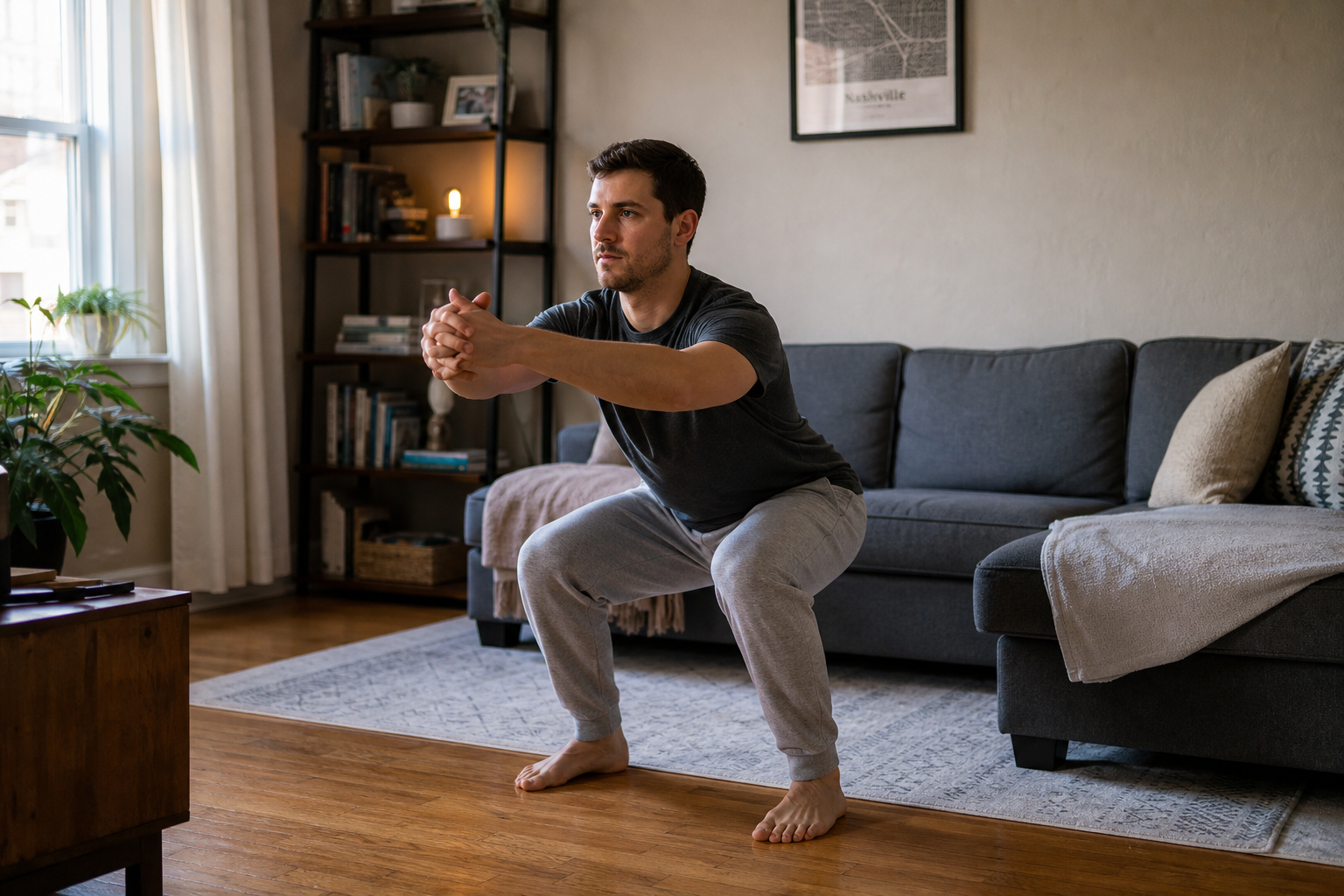
- Goblet squat: 4 sets of 4–6 reps, then jump squat: 4 sets of 3–5 reps
- Dumbbell Romanian deadlift: 3 sets of 5–6 reps, then broad jump or standing long jump: 3 sets of 3 reps
- Reverse lunge: 3 sets of 5 reps per side, then split jump: 3 sets of 3 reps per side
- Plank shoulder tap or dead bug: 2–3 controlled sets to finish trunk control without crushing recovery
Land every jump as if someone downstairs can hear you. Knees track over the feet, ribs stay stacked, and the landing is part of the rep. If the floor is slick, use a mat that does not slide or swap broad jumps for vertical jumps. If knees or ankles are not tolerating jumps, use fast calf raises, step-up drives, or medicine-ball-style intent with a light object only if the space is safe. The purpose is explosive intent, not proving that the concrete floor always wins.
Day 4: Upper-Body And Mixed Contrast Strength
Upper-body contrast work needs restraint. Punching power is not built by turning every push-up into a sloppy clap push-up contest. The legs and trunk still matter, and the shoulder has to survive the week.
- Dumbbell floor press or weighted push-up: 4 sets of 4–6 reps, then explosive push-up: 4 sets of 3–5 reps
- Single-arm dumbbell row: 4 sets of 5–6 reps per side, then fast band row or sharp shadowboxing pullback: 4 sets of 5 reps per side
- Dumbbell push press: 3 sets of 4 reps per side, then fast straight-punch flurry in stance: 3 sets of 8–10 seconds
- Lateral lunge: 3 sets of 5 reps per side, then skater hop: 3 sets of 3–5 reps per side
The shadowboxing pieces are not air-punching for fatigue. Throw from stance, recover the hand, and keep the feet under you. When the punch flurry starts to pull your chin up or your stance apart, stop the set. Fight-speed practice done badly becomes practice at leaking position.
Conditioning Uses Rounds, Not Just Sweat
BarBend’s boxing workout guidance from coach Mike Winkeljohn uses a familiar fight container: 3-minute rounds with 1-minute rest.[3] That structure matters at home because it stops conditioning from becoming a shapeless punishment block. You learn what happens in minute one, what breaks in minute two, and whether you can still move cleanly in the last thirty seconds.
Conditioning days should include footwork, strikes, level changes, and floor-to-feet transitions. Verywell Fit’s at-home MMA circuit with UFC veteran Chris Camozzi includes bodyweight staples such as burpees, sprawls, and mountain climbers.[4] FightCamp’s 15-minute at-home boxing workout uses shadowboxing combination progressions and round structure.[5] Those pieces fit well when they are organized around the clock instead of thrown together as a fatigue dare.
Day 2: Boxing-Based Conditioning
| Round | Work |
|---|---|
| Round 1 | Jump rope at a smooth pace; every 30 seconds add a 5-second fast skip |
| Round 2 | Shadowboxing: jab-cross, jab-cross-hook, cross-hook-cross; reset the feet after each combination |
| Round 3 | Jump rope footwork: boxer skip, side-to-side hops, forward-back hops; stay relaxed through the shoulders |
| Round 4 | Shadowboxing with defense: combination, slip or roll, step out; keep the last minute technical |
| Round 5 | Mixed finisher: 20 seconds fast rope, 20 seconds shadowboxing, 20 seconds easy bounce, repeated for the round |
Rest one minute between rounds. During rest, do not pace around pretending recovery is optional. Breathe through the nose if you can, shake out the shoulders, and check whether your next round can start sharp. If the rope keeps catching because your calves are gone, the answer is not more rage-skipping. Shorten the fast bursts or drop one round.
Day 5: MMA-Style Round Circuit
This day is rougher, but it still needs shape. Set a timer for 3-minute rounds and 1-minute rests. The work should make you change levels, hit the floor, stand back up, and keep your stance. That is different from doing burpees until every landing looks like a bad accident.
| Round | Work |
|---|---|
| Round 1 | Shadowboxing with level change every third combination |
| Round 2 | Sprawl, reset stance, jab-cross; repeat at a sustainable pace |
| Round 3 | Mountain climbers for 20 seconds, reverse lunges for 20 seconds, shadowboxing for 20 seconds; repeat |
| Round 4 | Burpee without push-up, lateral shuffle, two straight punches; repeat |
| Round 5 | Lunge circuit: reverse lunge, lateral lunge, split stance bounce, then 10 seconds of fast hands |
Keep the first two rounds slightly under the red line. The home-training trap is to win the first round and spend the next four surviving. A welterweight needs repeated speed, not one dramatic collapse. If you can no longer sprawl and return to stance without looking down for the floor, switch to a step-back sprawl or remove the floor contact for the rest of the round.
Progression: Add Speed Before You Add More
The first progression is cleaner reps at the same workload. Jump higher with the same dumbbell squat before using a heavier dumbbell. Recover better between 3-minute rounds before adding a sixth round. Keep the fast parts fast before making the session longer.
- Weeks 1–2: Learn the pairings, keep two to four reps in reserve on the loaded movements, and stop explosive sets early.
- Weeks 3–4: Add one set to the main contrast pairing or add one conditioning round, not both in the same week.
- Weeks 5–6: Slightly increase dumbbell load only if jump height, landing quality, and round pace stay intact.
- Every fourth week if needed: reduce volume and keep movement speed high, especially if sparring or hard skill sessions are also in the week.
A useful rule: if a heavier dumbbell makes the explosive movement worse, it did not make the session more fighter-specific. It only made the heavy part heavier. For this plan, the jump, push, sprawl, and combination quality are the feedback.
Bodyweight Still Sets The Boundaries
Welterweight training cannot ignore the scale, but this is not weight-cut advice. Heatrick’s fight-weight guidance places elite male fighters around 5–10% body fat as body-composition context, not as a blanket target for every amateur training in a garage.[6] The useful takeaway is narrower: extra mass has a cost when the athlete has to make a class and keep moving late in rounds.
That cost should affect strength choices. High-volume hypertrophy blocks, endless slow eccentrics, and bodybuilding-style isolation work may have a place for some athletes at some times, but they are not the center of a home welterweight plan built around speed-strength. If bodyweight is already close to the limit, the program should bias power quality, conditioning, and skill work over adding more lifting volume just because the dumbbells are there.
Small-Space Setup And Safety Cues
A 6-by-6-foot clear space, dumbbells, and a jump rope are enough for the core plan. If the ceiling is low, replace jump rope with line hops, pogo hops, or fast shadowboxing feet. If noise is a problem, remove broad jumps and use snap-downs, step-up drives, or low-amplitude squat jumps with quiet landings. The session should fit the room you have, not the room a fitness video pretends you have.
- Keep dumbbells outside the jump and footwork path.
- Use shoes that grip the floor and let you land without sliding.
- Stop plyometrics when landings get loud, crooked, or slow.
- Treat shadowboxing as technical work even when tired.
- Cool down with easy walking, nasal breathing, hip flexor mobility, calf work, and shoulder mobility instead of dropping straight onto the couch.
The standard is practical. If you can move explosively, recover inside the 3-minute-round structure, and keep your strength work from undermining your bodyweight goals, you are training in a way that makes sense for a welterweight at home.
References
- Strength Training for Boxing: The Six Pillars — Boxing Science
- MMA Workout Plan — How to Train Like a Fighter — Kyle Hunt Fitness
- The Best Boxing Workouts According to a World Champion Coach — BarBend
- The MMA Workout You Can Do at Home — Verywell Fit
- 15-Minute At Home Boxing Workout — FightCamp
- What Is My Ideal Fight Weight Class? — Heatrick
Comments
Join the discussion with an anonymous comment.