
How Long Does Hamstring Recovery Really Take?
Hamstring recovery time varies widely by strain grade, and calendar guesses consistently fail. This guide gives the grade-based windows clinicians actually use, explains why roughly one in three strains recurs within the first year, and lays out home-testable milestones that should gate a return to running and sport.
- Equipment tier required
- none
- Duration
- 20 min
- Difficulty
- beginner
- Target area
- Hamstrings
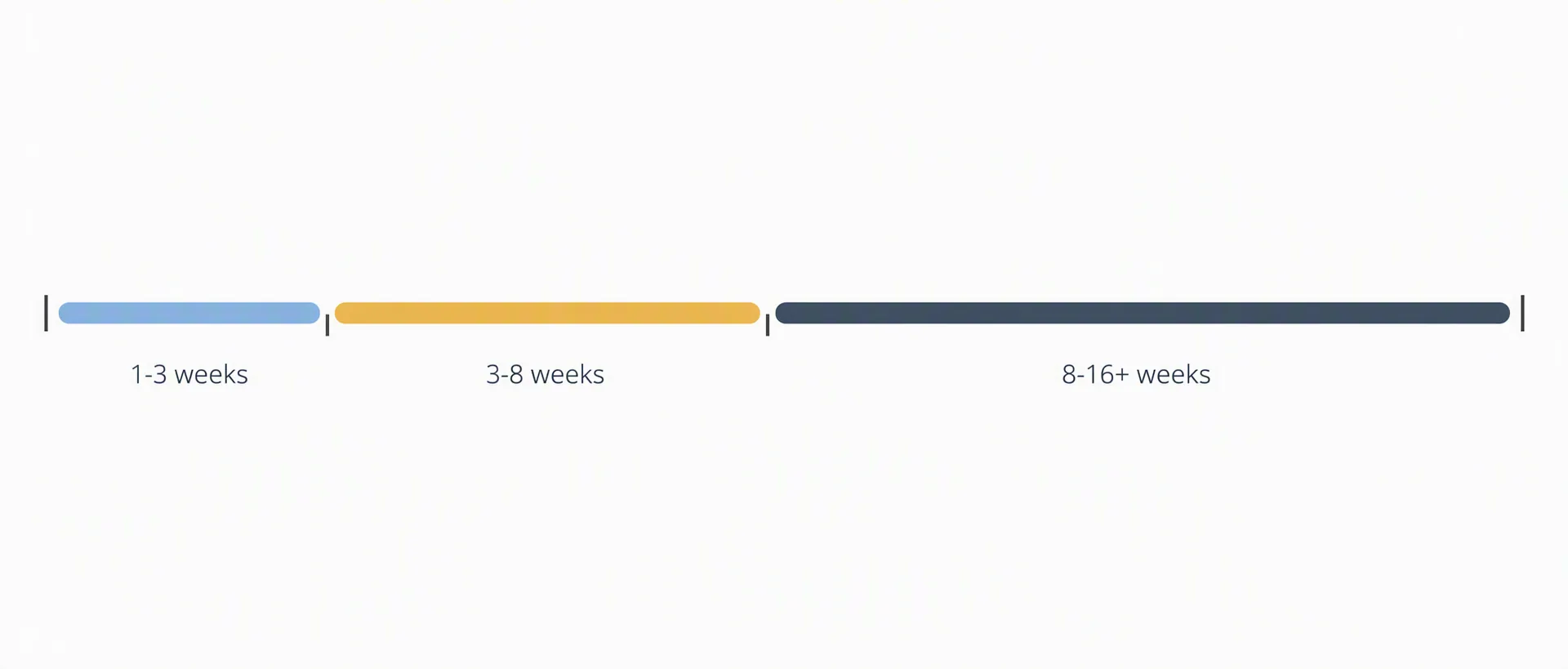
The honest answer is that hamstring recovery can take about 1–3 weeks for a mild grade 1 strain, about 3–8 weeks for a moderate grade 2 strain, and about 8–16+ weeks for a severe grade 3 injury or tendon-involved tear. Those are useful clinical anchors, not return-to-running promises. A runner who can walk normally the next day is not in the same situation as someone who limps for a week, even if both call it a “pulled hamstring.” Clinical guidance and review literature consistently push hamstring rehabilitation toward criteria-based progression rather than a fixed date circled on the calendar.[1][2]
This piece is the timeline companion, not another routine. If you need the actual loading progressions, start with Hamstring Strain Recovery Exercises You Can Do at Home. The question here is narrower and usually more urgent: when is this likely to be safe enough for jogging, racing, hiking, pickup soccer, or whatever you were planning before the back of your thigh objected?
Start with the grade range, then immediately stop trusting the calendar
| Likely severity | Common recovery window | What usually separates it from the next level |
|---|---|---|
| Grade 1 | About 1–3 weeks | Mild strain, walking normalizes quickly, strength and range of motion return without much symptom carryover.[1][2] |
| Grade 2 | About 3–8 weeks | Partial tear pattern, more obvious pain, loss of strength, possible bruising, and slower return of pain-free hinging or jogging.[1][2] |
| Grade 3 | About 8–16+ weeks | Severe tear or tendon involvement, major weakness, significant bruising, poor walking tolerance, and a much stronger case for medical evaluation.[1][2] |
The ranges are wide because a “hamstring strain” is not one injury. A small sprint-related strain in the muscle belly behaves differently from a high hamstring injury near the sit-bone. A person who tweaks the hamstring slowing down on a run is not automatically comparable to someone who feels a pop during an all-out sprint or slips into an aggressive lengthened position.
That matters for anyone searching for hamstring injury recovery exercises at home. Home rehab can be appropriate for many uncomplicated grade 1–2 strains, but there is no randomized trial proving that a fully home-based hamstring program, as a standalone category, reliably produces a specific return date. The stronger evidence supports the principles being translated into home work: controlled loading, restoration of range of motion, progressive strength, and return-to-sport criteria rather than passive rest until the leg “feels okay.”[1][3]
The first few days tell you more than most online timelines
One early clue is brutally practical: how long does it take to walk pain-free? In athletes, taking more than 1 day to walk without pain was associated with being 4 times more likely to need longer than 3 weeks before returning to sport.[2] That does not diagnose the grade by itself, but it is a useful reason to distrust an optimistic “you’ll be back by next weekend” guess.
Range-of-motion loss can also point toward a longer course. The JOSPT/APTA clinical practice guideline describes active knee-extension limitation as one severity marker: grade I injuries with less than 15° limitation averaged about 25.9 days, grade II injuries with 16–25° limitation averaged about 30.7 days, and grade III injuries with 26–35° limitation averaged about 75 days in the cited grading framework.[1] Other reports use somewhat different angle bands and timelines, so this is not a home math formula. It is a clue: a hamstring that will not tolerate the knee straightening with the hip flexed is not ready to be treated like a minor twinge.
If you cannot assess active knee extension safely, skip it. There is no prize for turning a self-check into a second injury. Walking, hinging, bridging, and jogging tolerance are usually more useful home gates anyway.
Red flags that should interrupt the home timeline
- You felt or heard a pop and cannot walk normally.
- Heavy bruising appears within 24–72 hours.
- Pain is high near the sit-bone or feels more like a tendon/attachment injury than a mid-thigh strain.
- You have numbness, tingling, radiating symptoms, or unusual weakness.
- You see no week-over-week improvement, or symptoms get worse as soon as you add very light activity.
Those signs do not prove a severe tear, but they do make the home-only approach a poor bet. A clinician can check whether you are dealing with a larger tear, tendon involvement, nerve symptoms, or another source of posterior thigh pain.
Why “I rested until it felt fine” is not the same as recovered
Hamstring strains have an irritating habit: they can calm down during daily life before the tissue and neuromuscular system are ready for fast running. Reviews report that approximately one-third of hamstring strains recur within the first year, with the greatest recurrence risk in the first 2 weeks after returning to sport.[2] That is the danger zone for the runner who jogs once pain-free, declares victory, and then tries intervals, hills, or a game at near-normal speed.
History also matters. A prior hamstring strain raises future hamstring injury risk by about 2.7 times in a large meta-analysis cited by the JOSPT/APTA guideline.[1] This is where comeback math gets people into trouble. The question is not just whether the original pain has disappeared. It is whether the hamstring has rebuilt enough capacity to tolerate the exact task that injured it: sprinting, decelerating, kicking, jumping, climbing, or hinging under fatigue.
A little anatomy is enough here. The hamstrings cross the hip and knee, so they are heavily stressed when the hip is flexed, the knee is extending, and the muscle is controlling length under load. Sprinting asks for that repeatedly at high speed. Deadlifts and toe-touchy stretching put the muscle in a lengthened position. A recovery plan that never rebuilds controlled lengthening is missing the piece that often matters most when sport returns.

Loading early is useful when it is controlled, not heroic
Complete rest is rarely the whole answer after the acute phase. Current rehabilitation reviews emphasize progressive loading, trunk and pelvic control, gradual exposure to lengthened positions, and criteria-based return to sport.[2][3] The early work is usually modest: pain-limited isometrics, gentle range of motion, and basic movement tolerance. The later work becomes more demanding: bridges, hip hinges, eccentric loading, faster running, and sport-specific drills.
The strongest practical signal is for eccentric and lengthening-focused work. In the Askling studies summarized by Erickson and Sherry, an L-protocol built around controlled lengthening exercises was associated with substantially faster return than conventional rehabilitation: 28 versus 51 days in elite footballers, and 49 versus 86 days in sprinters, with fewer re-injuries in the L-protocol groups.[2] A meta-analysis cited in the JOSPT/APTA guideline also found that adding eccentric exercises to conventional stretching, strengthening, and stabilization significantly reduced time to return, with a hazard ratio of 3.22.[1]
That is not a promise that every home exerciser can halve recovery time. Elite athletes are supervised, carefully progressed, and often have imaging, strength testing, and daily rehab access. The takeaway for home rehab is more restrained and more useful: once symptoms allow, the hamstring needs progressive strength in positions that resemble the demands of running and sport. It does not need a random hard stretch on day three to “test it.”
The home gates that matter more than the week number
A criteria-based timeline does not ignore time. Tissue still needs time. But each step asks whether the leg has earned the next exposure. These are home-testable gates, not medical clearance tests.
| Gate | What you are looking for | What it changes |
|---|---|---|
| Normal walking | You can walk without limping and without pain increasing afterward. | If this takes more than 1 day, the odds of a longer-than-3-week return increase in athlete data.[2] |
| Pain-free hinge | You can perform a small hip hinge with a neutral spine and no pulling pain in the injured hamstring. | You can begin treating the hamstring as load-tolerant rather than merely symptom-quiet. |
| Range-of-motion tolerance | If safely assessed, active knee extension is not sharply limited or worsening. | Large deficits suggest more caution and possibly a longer course.[1] |
| Single-leg bridge capacity | The injured side can bridge repeatedly without pain, cramping, or obvious collapse. | Low capacity suggests strength/endurance is not yet ready for faster running. |
| Pain-free jog build-up | Easy jogging is symptom-free during the run and the next day. | This opens the door to gradual running volume before speed, hills, or sport. |
The single-leg bridge test has some useful context, but it should not be over-read. In Australian footballers, fewer than 20 single-leg bridge repetitions was classified as poor, 25 as average, and more than 30 as good.[2] That does not mean every recreational runner must hit 31 perfect reps before jogging. It does mean that a hamstring that cramps at 6 reps probably has not earned sprinting.
The most protective rule is boring: symptoms during the session and symptoms the next day both count. If a jog feels fine but the hamstring is tighter, sorer, or more protective the next morning, the last step was not passed. Back up the intensity or volume instead of arguing with the tissue.
A practical timeline map for uncomplicated grade 1–2 strains
For a likely grade 1–2 strain without red flags, the home timeline usually looks less like a countdown and more like a set of permissions. Use the companion hamstring recovery exercise plan for exercise form and progression details; this is only the map.
| Phase | Main job | Do not move on until |
|---|---|---|
| Days 0–3 | Settle symptoms, protect walking, avoid aggressive stretching or speed. | Walking is improving and daily pain is not escalating. |
| Days 3–10 | Restore gentle range of motion and begin low-irritation isometric or basic strength work. | You can walk normally and hinge lightly without hamstring pain. |
| Weeks 1–3 | Build bridge variations, controlled hip-hinge strength, and gradual loading tolerance. | Strength work does not cause next-day symptom flare. |
| Weeks 2–6+ | Introduce more demanding eccentric and lengthened-position work when tolerated. | The injured side can handle repeated loading without pain, cramping, or protective tightness. |
| Return-to-run block | Walk-jog intervals, then easy continuous running, then volume, then speed. | Jogging is pain-free during and the next day before faster running begins. |
| Return-to-sport block | Add accelerations, decelerations, hills, cutting, kicking, or position-specific demands. | Sport-specific drills are symptom-free and the first 2 weeks back are treated as high risk, not as a victory lap.[2] |
That order matters. Volume usually comes before speed. Easy flat jogging usually comes before hills. Controlled hinges usually come before explosive starts. The weekend-athlete mistake is not always doing too much total work; it is jumping straight to the one thing the hamstring is worst prepared to handle.
What return to running should look like
Return to running should begin with walk-jog intervals on flat ground at an easy pace. If that is pain-free during the session and the next day, increase duration before intensity. Speedwork, hills, strides, and games come later because they increase hamstring demand quickly. A pain-free 20-minute jog is useful information; it is not proof that a maximal sprint is safe.
For field sports, the return gate is stricter. The hamstring has to tolerate acceleration, deceleration, cutting, and fatigue. The first 2 weeks after return to sport deserve extra caution because that is when recurrence risk is highest.[2] This is the window where “I’m back” can quietly turn into “I’m starting over.”
Where this fits with other home rehab timelines
Hamstring strains share a recovery logic with other muscle strains: calm the acute symptoms, restore pain-free movement, load progressively, then reintroduce the activity that caused the problem. The details differ by tissue and sport demand. If you are comparing timelines, the sibling guide on adductor strain recovery time and the companion groin injury home exercise plan use the same staged-progression mindset.
For broader recovery framing, the site’s review of the 2026 ACSM guidelines and home injury recovery is useful. Just do not treat it as a hamstring-specific protocol. Hamstring return decisions are better anchored to the APTA/JOSPT guideline, peer-reviewed rehabilitation reviews, and how your own leg behaves under carefully progressed load.[1][2][3]
The safest useful answer
Hamstring recovery is not unknowable. A mild strain may settle in 1–3 weeks, a moderate strain often takes 3–8 weeks, and a severe tear can take 8–16+ weeks. But the date matters less than the gates: normal walking, pain-free hinging, improving range of motion, adequate bridge capacity, progressive strength tolerance, and a jog build-up that stays quiet the next day.
Check for red flags first. If the injury behaves like an uncomplicated grade 1–2 strain, use a criteria-gated progression and follow the linked exercise companion for the actual loading steps. If walking, hinging, strength, or easy jogging does not improve week over week, get evaluated before you turn a wide recovery window into a recurring problem.
References
- Hamstring Strain Injury in Athletes: Clinical Practice Guidelines, Journal of Orthopaedic & Sports Physical Therapy, February 2022.
- Rehabilitation and return to sport after hamstring strain injury, PMC, 2017.
- Hamstring Strain Injury Rehabilitation, Journal of Athletic Training.
What a small equipment investment adds
We don't have a build tagged to this exact tier yet. Browse all builds.
How often should you repeat this?
See our recovery and rest reference for citation-anchored rest-interval guidance.
Spot something off?
Tell us if a movement, tier assumption, or duration didn't match your experience.