
High School Runner Speed Workout for Small Spaces
Stuck at home without a track? This no-equipment speed workout uses hallways and small rooms to improve acceleration, agility, and lactic tolerance with drills proven by a state-winning high school coach.
- Equipment tier required
- none
- Duration
- 30 min
- Difficulty
- beginner
- Target area
- full body
- Space footprint needed
- Under 10 meters of hallway or small room
- Noise level
- low
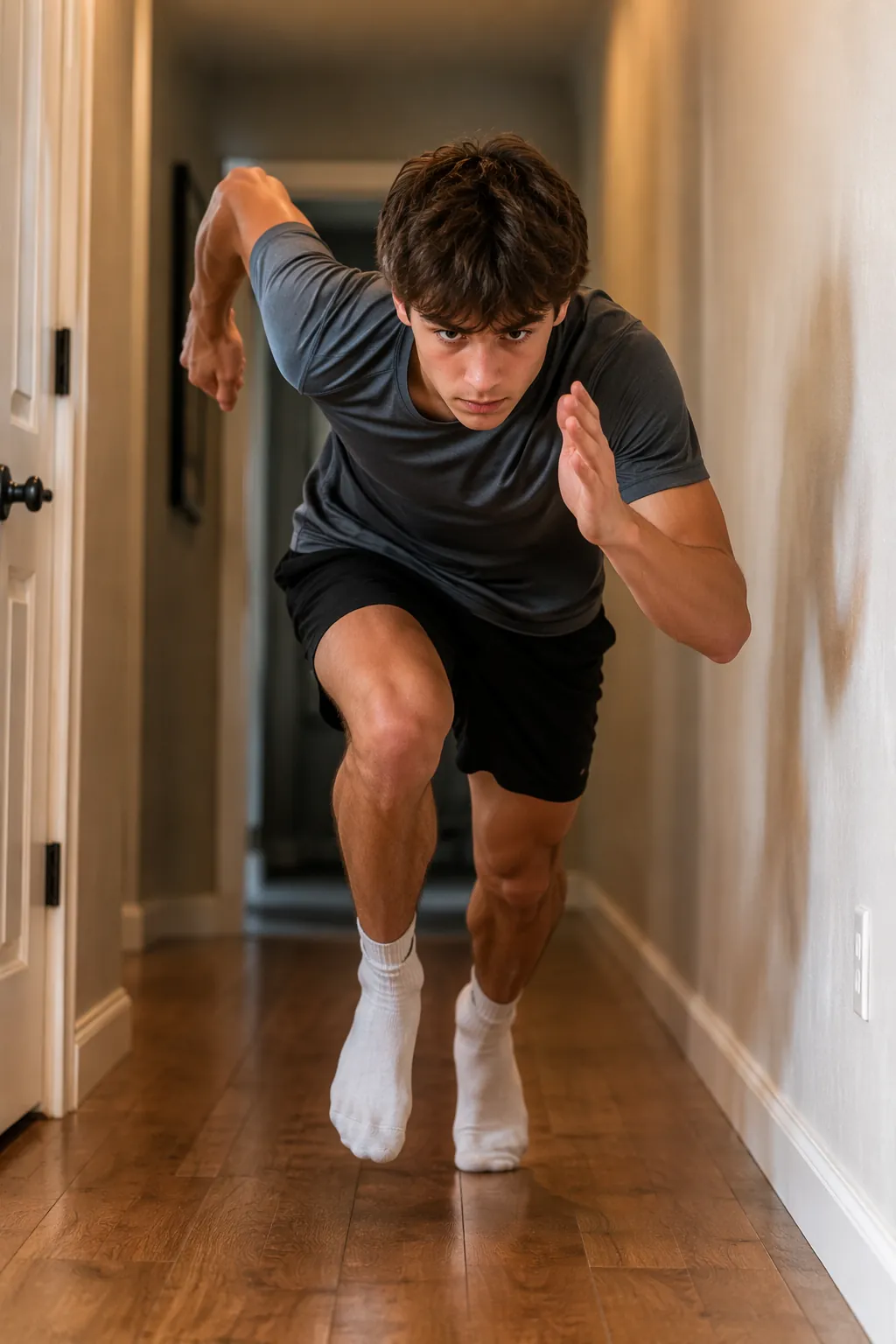
If your “training facility” is a hallway, a bedroom, or the strip of floor between the couch and the front door, the goal is not to fake a track workout. A useful high school runner home workout in that space should train the pieces of speed that actually fit there: shin angle, first-step power, knee drive, arm timing, foot speed, short acceleration, turn control, and a little carefully dosed lactic work.
That means no indoor 100s, no pretending a slick hallway is a straightaway, and no sprint spikes scraping across the floor. The small-space version works best when the reps are short, the intent is high, and the athlete stops before the floor, the shins, or the downstairs neighbor becomes the limiting factor.
What a hallway can train well
Phil Surprenant’s Salt Fork High School program is the useful proof of concept here, with one big asterisk. Salt Fork, a small Illinois school with enrollment around 300, has used a school hallway as its primary winter sprint venue; since 2016, the program has won two 1A state titles, multiple conference championships, and produced All-State performers across sprints, distance, and field events. The hallway Surprenant describes is about 60 meters, which is not the same as a home hallway, but the important part is not the exact building. It is the way the workout targets sprint qualities instead of shrinking a full track practice until it looks absurd. [1]
At home, that model has to be scaled down. A coached team in a school hallway can run farther, turn faster, and get corrected rep by rep. A 15-year-old alone at home needs fewer moving parts: a wall, a clear straight line, tape if allowed, stairs if available, and a hard rule that pain and slipping end the session.
| Space you have | Best use | What to avoid |
|---|---|---|
| Straight hallway under 10 meters | Wall boom-booms, prone starts, kneeling starts, 3–6 step accelerations, short controlled shuttles | Trying to sprint full 100m-style reps indoors |
| Longer hallway, basement, garage, or safe driveway connection | Short accelerations plus flys where there is room for a run-in and a clear deceleration zone | Max-speed reps with no braking space |
| Small bedroom or living room | Wall drills, isometric positions, tape-pattern agility, stair taps if stairs are nearby | Hard cutting on rugs, wet floors, or loose mats |
Before the workout: make the floor pass the test
The surface decides what kind of workout you get to do. Tile and hardwood are common at home, and they are exactly where indoor sprint advice can get careless. Surprenant specifically flags running on tile in tennis shoes as a shin-splint concern, then uses barefoot heel-to-toe walking, ABC drills, ankle wipers, and reduced reps when needed as countermeasures. Those ideas transfer well to home training, but they should be treated as practical safeguards, not as a medical guarantee. [1]
Do this quick check before any hallway speed day:
- Clear the lane. Shoes, bags, rugs, cords, pets, and half-open doors are not “obstacles”; they are session-enders.
- Walk the whole path once. If your foot slides during a normal walk, do not sprint there.
- Use regular trainers, not spikes. Barefoot is for controlled walking drills, not sprinting down the hall.
- Give yourself a braking zone. If you can accelerate but cannot stop without grabbing a wall, the rep is too long.
- Keep the noise test honest. If every landing sounds like furniture falling over, shorten the rep or switch to wall drills.
A good hallway workout should sound quick, not destructive. If you need a separate way to think about floor protection and quiet movement in shared housing, the testing mindset from quiet apartment boxing drills applies here too: test the surface first, then earn intensity.
Warm up like your shins matter
This warm-up is not filler. It prepares ankles, feet, and shins for short, sharp contacts on a harder surface than most runners would choose if they had a track.
- Barefoot heel-to-toe walk: 2 slow passes across the room or hallway. Roll from heel to big toe without slapping the floor.
- Ankle wipers: 10–15 controlled reps each direction. Keep the heel planted and sweep the forefoot side to side.
- A-march or A-skip: 2 short passes. Knee up, toe up, tall posture.
- B-skip pattern: 1–2 short passes if you have room. Extend, then pull the foot back under the body.
- C-skip or butt-kick rhythm: 1–2 short passes. Keep it springy, not stompy.
Surprenant uses ABC drills as part of his approach to managing the lower-leg stress of hallway sprinting. At home, they are also a useful honesty check: if skipping lightly already hurts the shin, the answer is not to sprint harder. [1]
The main drill: wall boom-booms
Wall boom-booms are the best small-space sprint drill because they make the athlete practice the shape of acceleration without needing a runway. The drill comes from Tony Holler’s method and is adapted in Surprenant’s hallway program to train shin angle, knee drive, arm mechanics, and forceful ground contact in under 6 feet of space. Surprenant also describes a loaded version, where a partner stands behind the runner and applies pressure to the back. [1]

Set up with both hands on the wall at about shoulder height. Walk the feet back until the body is in a straight forward lean. The heel should not be jammed into the floor. The athlete should feel like they are pushing the floor back and down, not bicycling the legs under the hips.
- Hold the lean. Ribs down, hips tall, eyes toward the wall.
- Drive one knee forward and up. The opposite leg pushes long behind you.
- Switch legs fast on command or on your own count: boom-boom.
- Reset if the hips sag, the foot lands flat and loud, or the knee crosses the midline.
For a solo home session, use 3–5 sets of 5–8 seconds. Rest long enough that the next set is crisp. The loaded version only belongs in the workout if the partner is sensible, similar in size, and understands that the job is steady resistance, not shoving. A parent does not need to become a blocking sled.
Turn wall mechanics into starts
After wall boom-booms, the next job is to leave the ground without standing straight up. Prone and kneeling starts are useful because they force the athlete to organize the first few steps from a bad position. Surprenant uses prone and kneeling start accelerations for 3–5 reps from 5–20 yards, teaching the low shin angle and forward lean needed for start mechanics. [1]
At home, the distance changes. If your hallway is short, think in steps instead of yards: explode for 3–6 steps, then shut it down smoothly. The first step should push the body forward. The second and third should keep projecting, not pop the chest up like the race is already over.
Prone start
- Lie face down with hands near the chest, like the bottom of a push-up.
- On “go,” push up, bring one foot under the body, and drive forward.
- Sprint 3–6 steps, then coast and stop under control.
- Walk back. Do not jog back in a narrow hallway.
Kneeling start
- Start on one knee with the front foot flat.
- Lean slightly forward before moving. Do not rock back to gather momentum.
- Push through the front foot and drive the back knee through.
- Run 3–6 steps, brake early, and switch lead legs on the next rep.
Use 4–8 total start reps. That is enough for a home session if every rep is fast and clean. More is not automatically better indoors, because fatigue makes the athlete reach, slap the floor, and brake late.
Short flys, only if you have the runway
Flys are where home workouts often start lying to themselves. A true fly rep needs space to build speed, a marked zone to hold it, and room to slow down. Surprenant’s staple is 10x40m with a run-in and a 10-yard fly zone, and he also describes 10–20 yard flys when hallway space allows. [1]
Most homes do not have that. If you have a long basement, a garage-to-driveway setup, or a safe straight hallway with a real stopping area, you can use a shortened version:
- Build-up: 4–6 smooth steps.
- Fly zone: 3–5 fast steps with tall posture and quick contacts.
- Deceleration: shut down before the wall, door, stairs, or furniture.
- Volume: 4–6 reps with full walk-back recovery.
If you cannot decelerate safely, skip the flys. Wall boom-booms plus starts are a better speed session than a reckless five-second hallway race.
The 30-second shuttle: useful, not magic
The shuttle is the hard conditioning piece, and it should be treated with more respect than a finisher. Surprenant uses an indoor 30-second shuttle as a version of his outdoor 23-second drill, with athletes sprinting down a hall and back repeatedly. His top runners have reached about 200 meters in 30 seconds indoors, compared with about 230 meters outdoors, with the indoor difference coming from turns and reduced traction on tile. [1]
That comparison matters. Indoors, the turns slow you down and beat up the legs. The workout still creates lactic stress, but it is not equivalent to an outdoor track rep. At home, keep the shuttle shorter and more controlled:
- Mark two safe turn points with tape or soft objects.
- Run hard for 20–30 seconds, depending on surface and experience.
- Plant and turn under control. No sliding, spinning, or bouncing off walls.
- Rest 2–4 minutes between reps.
- Do 1–3 reps total. Stop at the first sign that the turns are getting sloppy.
Sprinters and 400m runners will get the most obvious value from this. Cross-country runners can use it to stay sharp before fall season, but it should not replace sustained aerobic work. If you are distance-focused or coming back from pain, pair this speed day with lower-impact aerobic work such as home cross-training for injured runners or a structured non-running cardio day.
Agility and stairs when straight-line space runs out
A small room can still train coordination and foot speed. YouthRunner describes indoor options such as tape patterns in place of ladders, cone weaving with household objects, quick-feet stair taps, and single-foot stair taps for foot speed and coordination in a 10x10-foot area. It also presents stair running variations such as walk-up, quick-step, and two-at-a-time work for explosive power. [2]
Use these as support work, not as a circus. Tape a simple line, cross, or box on the floor. Move quickly for 8–12 seconds, then rest. The feet should be light and accurate. If the drill turns into stomping, the set is over.
| Drill | How to use it | What it trains |
|---|---|---|
| Tape line quick steps | Step over and back for 8–12 seconds | Foot speed and rhythm |
| Tape box in-in-out-out | Move through the pattern without crossing feet | Coordination and ankle stiffness |
| Stair quick taps | Tap one foot or alternate feet on the first step | Fast contacts and hip timing |
| Two-at-a-time stair walk or bound | Use only if stairs are dry, clear, and safe | Hip and glute power for acceleration |
Stairs are not automatically safer than a hallway. They add height, edges, and consequences. Start with walk-ups and quick taps before anything explosive. Never sprint down the stairs.
A 3-day small-space speed week
Use this split 2–3 days per week, with at least one easier day between speed sessions. Each workout should take about 20–35 minutes if the rest periods stay honest and the setup is ready before you start.
| Day | Focus | Workout |
|---|---|---|
| Day 1 | Acceleration mechanics | Warm-up; wall boom-booms 3–5 x 5–8 seconds; prone starts 3–4 reps; kneeling starts 3–4 reps; optional 3–5 short fly reps if space allows |
| Day 2 | Lactic tolerance and controlled turns | Warm-up; tape agility 3–5 short sets; 30-second shuttle 1–3 reps with long rest; stair taps or walk-ups 3–4 sets |
| Day 3 | Max-velocity posture and sharpness | Warm-up; wall boom-booms 3–4 sets; short flys 4–6 reps if safe; stair quick taps 3 sets; light ABC cooldown |
If you only have a small room, keep Day 1 and Day 3 mostly stationary: wall boom-booms, wall holds, A-march positions, tape agility, and stair taps if stairs are available. Do not force starts if the first step sends you into furniture.
If you also lift or do runner-specific strength work, keep it simple around these days. Heavy legs make indoor contacts louder and sloppier. A short complementary routine like Nikki Hiltz’s home strength workout for runners fits better on a non-shuttle day or after the speed work, not before it.
How hard should it feel?
The starts and flys should feel fast, not exhausting. If the third rep is much slower than the first, rest longer or stop the set. Speed work at home is usually limited by coordination and surface quality before it is limited by fitness.
The shuttle is different. It can burn. It can make the legs heavy. But the turns must stay controlled. A slower shuttle with clean plants is better than a faster one that teaches the athlete to skid into every change of direction.
The clearest red flag is shin pain that sharpens as the session goes on. General lower-leg fatigue is one thing. A focused, worsening ache along the shin is not something to bargain with. Cut the running reps, return to barefoot heel-to-toe walking and mobility, and use low-impact conditioning until the leg is ready for contacts again.
What progress looks like indoors
Do not judge this workout by whether it feels like a track practice. Judge it by cleaner positions. The wall drill should show a stronger forward lean and a sharper knee drive. Starts should cover the first few steps without popping upright. Fly reps, if you have room for them, should feel tall and quick rather than frantic. Shuttles should show better braking and turning without more noise.
A hallway can build meaningful speed qualities for a high school runner, especially before fall cross-country or the next track cycle, but only when the workout respects the room. Short reps, high intent, clean mechanics, controlled surfaces, and no ignoring shin pain: that is the standard that makes small-space speed training useful instead of just loud.
References
- Creating a Hallway Speed Workout — SimpliFaster, updated 2026
- Fun Indoor Running Drills for Getting Workouts In On Cold Days — YouthRunner
What a small equipment investment adds
We don't have a build tagged to this exact tier yet. Browse all builds.
How often should you repeat this?
See our recovery and rest reference for citation-anchored rest-interval guidance.
Spot something off?
Tell us if a movement, tier assumption, or duration didn't match your experience.