
Should You Do a Home Workout During Wildfire Smoke?
Wondering whether it's safe to train indoors during wildfire smoke? This evidence-based explainer covers how much extra pollution you inhale while exercising, what the AQI bands actually mean for a workout, and why indoor training with filtration beats skipping — with honest caveats for sensitive groups.
- Equipment tier required
- none
- Duration
- 30 min
- Difficulty
- beginner
- Target area
- full body
There is no single AQI number that makes a home workout during wildfire smoke “safe” for every body and every session. A 30-minute easy mobility circuit in a filtered apartment is not the same exposure as a two-hour tempo ride outside, and a healthy adult is not in the same risk category as someone with asthma, heart disease, diabetes, pregnancy, older age, or smoke-triggered symptoms.
The useful question is narrower: how much smoke dose are you taking in, and can you reduce it enough to keep training without pretending the air is normal? For most healthy exercisers, indoor training with filtration is a reasonable compromise when smoke makes outdoor training questionable. As AQI rises, reduce duration and intensity. At the highest bands, or when symptoms show up, skipping is not a character flaw; it is the correct default.
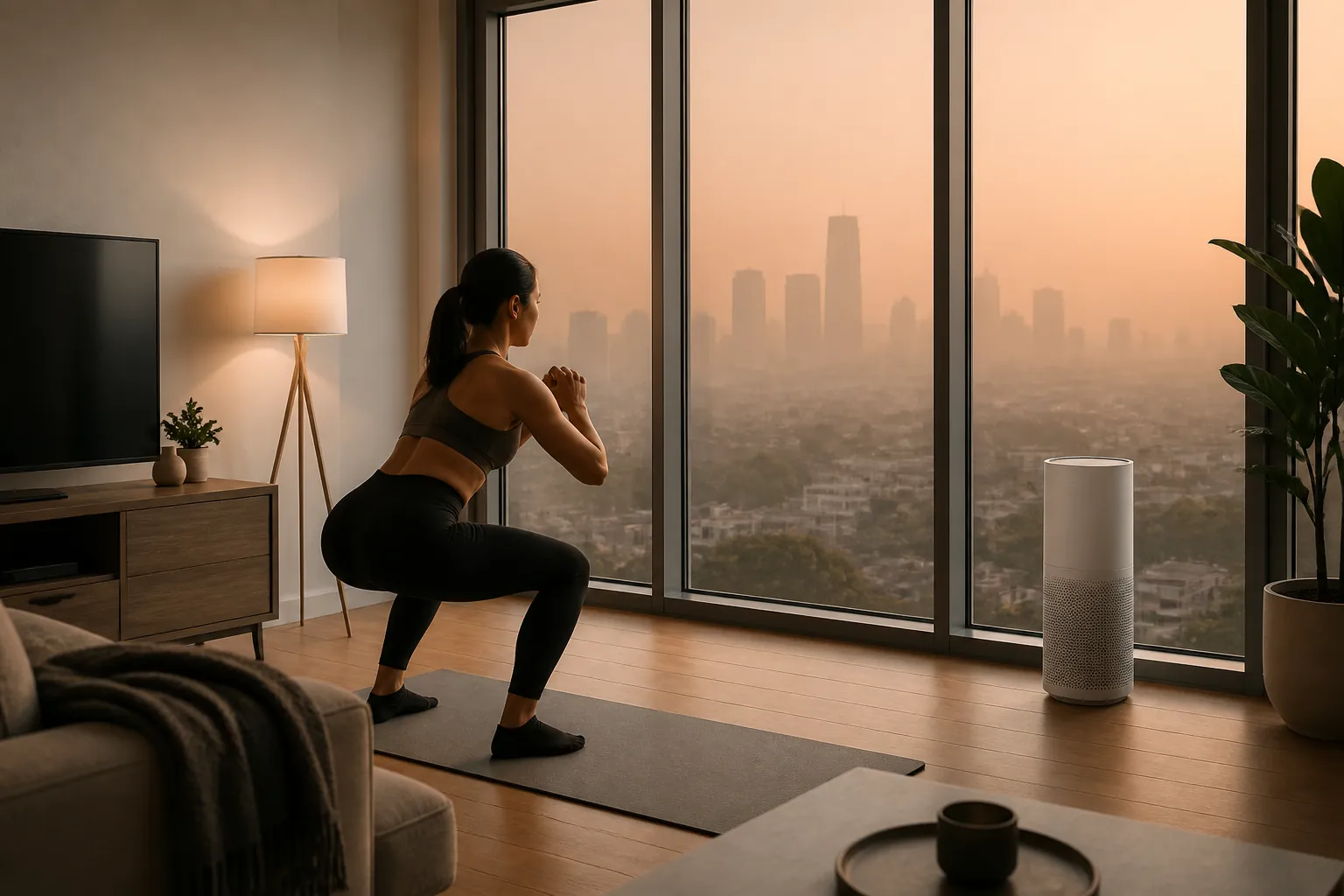
Why exercise changes the smoke calculation
AQI maps are easy to stare at, but the number on the map is only half the story. The other half is ventilation: how much air you pull through your lungs while you train.
At rest, a person breathes roughly 15 times per minute and moves about 12 liters of air per minute. During exercise, breathing can rise to 40–60 breaths per minute and around 100 liters of air per minute.[1] That means the same outdoor smoke concentration can become a much larger inhaled dose once you start running intervals, riding hills, doing a hard circuit, or chasing a workout that was written for clean air.
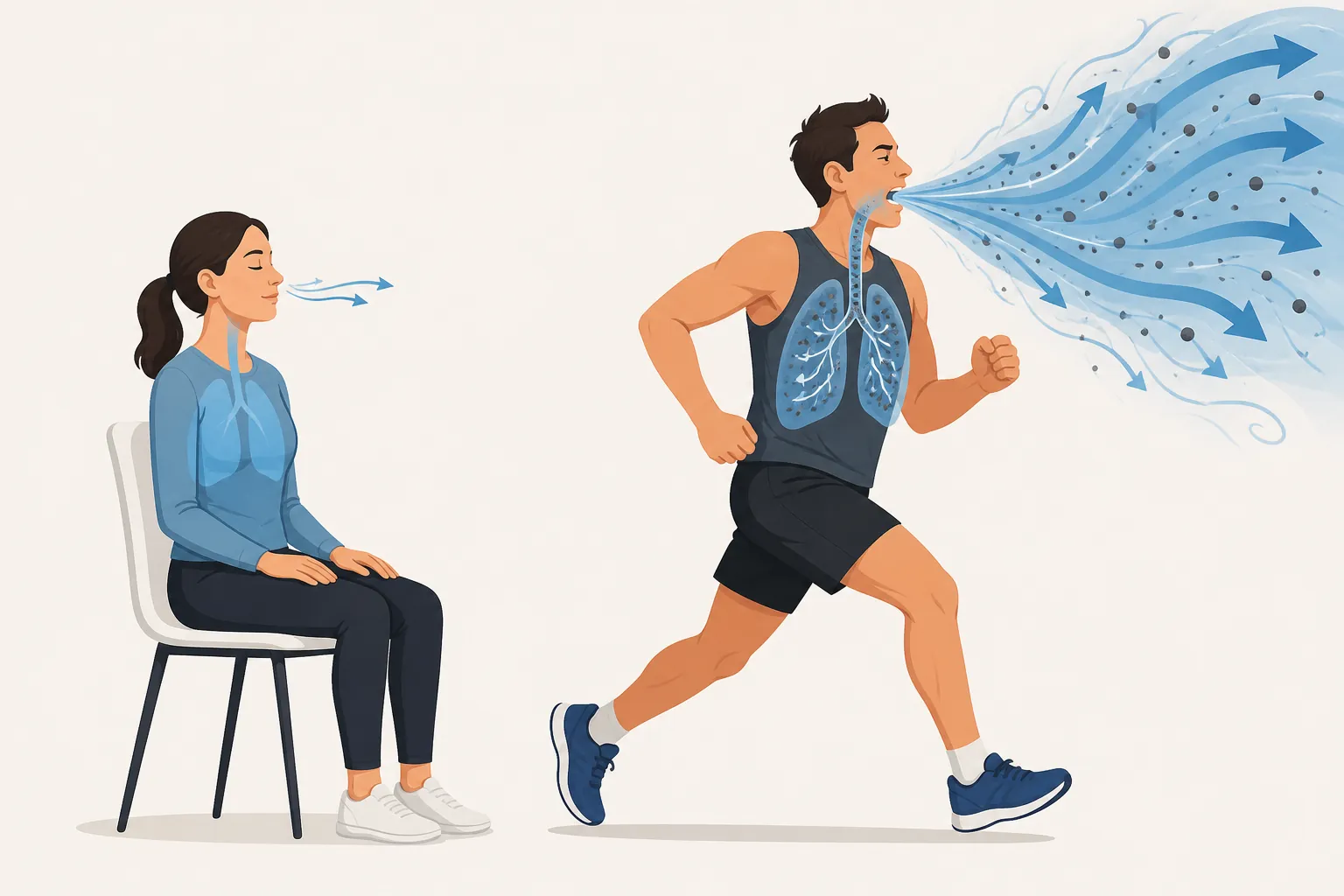
The mouth-breathing part matters too. As intensity rises, exercisers tend to breathe more through the mouth, which bypasses some of the filtering and conditioning normally done by the nose.[2] That does not mean the nose is a smoke-proof respirator. It means a hard workout removes one of the body’s partial defenses at the exact moment air volume is climbing.
This is why “it’s only moderate” can be a weak argument for training normally. A moderate exposure while sitting on a porch is not the same as a moderate exposure while ventilating near exercise levels. Dose is concentration multiplied by how much you inhale, how long you inhale it, and how deeply it reaches.
What wildfire smoke is doing in your lungs
Wildfire smoke is a mixture, but the exercise decision often centers on fine particulate matter, especially PM2.5. These particles are smaller than 2.5 micrometers, about one-thirtieth the width of a human hair.[3] Another useful size comparison: PM2.5 particles are roughly 40–50 times smaller than a grain of sand.[2]
Particles that small can reach deep into lung tissue, and the smallest material can cross into the bloodstream.[3] That is the part fitness advice tends to underplay. Smoke is not just an unpleasant smell, and AQI is not just a vibe check on whether the sky looks gross. If you increase ventilation dramatically, you increase the amount of this material you are asking your respiratory and cardiovascular systems to handle.
A home workout changes that equation in two ways. First, it gets you away from direct outdoor smoke during the session. Second, if the workout room is reasonably sealed and filtered, it can lower the concentration side of the dose equation. That still leaves duration and intensity under your control, which is why an indoor smoke-day session should usually look easier than the workout you would have done on a clean-air day.
How to read AQI bands for training, not just for weather talk
The major public-health and training sources do not give identical personal cutoffs, and they should not be flattened into one magic number. AirNow’s wildfire-smoke guidance uses the familiar AQI color bands, with “Unhealthy” beginning at 151.[4] Michigan’s health department reproduces the same activity-style guidance for wildfire smoke.[5] The American Lung Association advises lighter or morning activity once AQI reaches 101 and moving exercise indoors at 151 or higher.[6] TrainingPeaks describes 151 as a key cutoff for healthy athletes and 100 for sensitive athletes.[7]
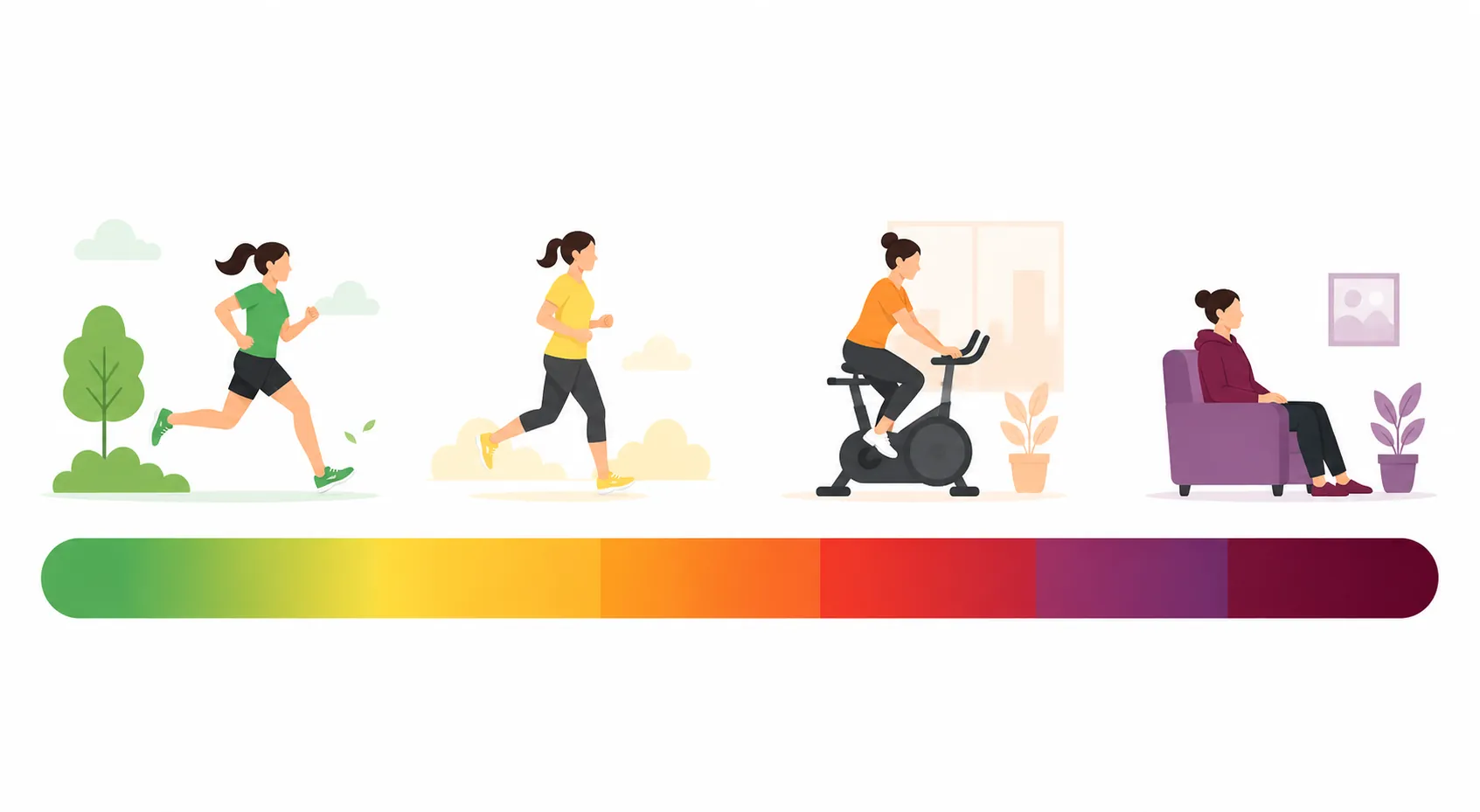
The shared pattern is more important than pretending every organization says the same sentence: as AQI rises, the workout should get shorter, easier, or move indoors; sensitive groups should act earlier; and once air is unhealthy, outdoor training becomes hard to justify for most people.
| AQI situation | Practical workout interpretation |
|---|---|
| Good to moderate range | Many healthy adults can usually train, but smoke sensitivity still matters. If smoke is visible or irritating, keep the session easier than planned and consider moving indoors. |
| Around 101+ | This is the negotiation zone. Use lighter effort, shorter duration, and lower thresholds if you are in a sensitive group or have symptoms. The American Lung Association specifically advises lighter or morning activity at this level. |
| Around 151+ | Treat outdoor training as a poor default. AirNow’s “Unhealthy” band starts here, and both the American Lung Association and athlete-focused guidance point toward moving indoors or stopping outdoor exercise. |
| Very unhealthy or hazardous bands | Skip the workout unless there is a compelling, clinician-cleared reason not to. This is not the time to prove consistency by increasing smoke dose. |
The 101–150 range is where many runners and cyclists bargain hardest with themselves. It may not look apocalyptic. The workout may seem short. The training plan may be in a key block. But this is exactly where dose logic is useful: if you insist on keeping the day, cut the total air moved through your lungs. That can mean replacing a threshold run with easy indoor cycling, changing a metcon to strength work with longer rests, or doing mobility and core instead of a high-ventilation session.
At 151 and above, the argument shifts. For healthy adults, an indoor workout in filtered air may preserve the habit while sharply reducing outdoor exposure. For sensitive groups, even the indoor plan should be more conservative, especially if the home is leaky, unfiltered, or already smells smoky.
Who should use stricter cutoffs
Children, older adults, pregnant people, people with heart or lung disease, people with diabetes, and anyone who develops symptoms from smoke should not use the same decision line as a healthy adult trying to maintain a training block. CDC lists people with heart disease, lung disease, diabetes, pregnancy, children, and older adults among groups at higher risk from wildfire smoke.[8]
For these groups, the more honest default is to move indoors earlier, train easier, and get clinician guidance if there is any uncertainty. “I feel fine right now” is useful information, but it is not a complete risk assessment when the exposure involves small particles, elevated breathing rates, and underlying vulnerability.
What exercise-specific research does—and does not—prove
The most directly relevant exercise evidence is still limited, but it points in the direction you would expect from the dose math. In a 2025 University of Montana wildfire-smoke simulation study described by exercise scientist John Quindry, 20 healthy adults in their mid-20s cycled for two hours at about half-maximal effort while breathing filtered pine smoke. Blood-vessel and nervous-system function declined immediately afterward and recovered within an hour, with stronger declines among stress-responsive participants.[9]
That study should not be inflated into proof that one smoky workout causes lasting damage in everyone. It was small, short term, and done in healthy young adults. Its value is more modest and more useful: even controlled exercise exposure can produce measurable short-term vascular and autonomic changes, and individuals do not all respond the same way.
Broader air-pollution evidence gives context for why PM2.5 spikes deserve respect. During a July 2026 Northeast smoke event, Harvard Chan’s Joe Allen noted that Boston’s pollution was running four to five times above normal and cited research associating each 10-fold increase in pollution with about a 2.5% higher risk of heart attack.[10] That is an association, not proof that a single workout triggers a cardiac event. It does, however, make the “just push through” attitude look less like grit and more like unnecessary exposure.
Masks help with errands; they are not a great hard-workout solution
A well-fitted N95 or KN95 can reduce particle exposure outdoors. Harvard Chan notes that N95 and KN95 respirators can capture at least 95% of smoke particles when properly fitted, and public guidance also emphasizes respirator fit for smoke protection.[10][11][4]
That does not make a respirator a clean solution for hard training. Fit can slip with sweat and movement, breathing resistance becomes more noticeable as ventilation rises, and particulate respirators do not filter smoke gases.[11][4] For a short outdoor errand, a good respirator may be a sensible layer. For intervals or a long run in smoke, moving the workout indoors is usually the more defensible adaptation.
What to change in the workout itself
Once you decide to train indoors, the goal is not to recreate the outdoor session at all costs. It is to keep a useful stimulus while reducing smoke dose. Colorado State University’s guidance emphasizes cutting duration before intensity when adjusting outdoor exercise in smoke, and the same idea is useful indoors when air is imperfect: shorten the session first, then decide whether the planned intensity still makes sense.[12]
A practical smoke-day hierarchy looks like this:
- Move the session indoors if outdoor AQI is trending into unhealthy territory or smoke is irritating your eyes, throat, or breathing.
- Use the cleanest room available, ideally with filtration running and windows closed.
- Cut total workout time before trying to salvage every interval or every set.
- Replace high-ventilation work with lower-ventilation options when AQI is elevated: strength, mobility, technique drills, easy zone work, or longer-rest circuits.
- Stop immediately if symptoms appear, even if the plan says you have more work left.
For the execution side, use How to Do an Indoor Home Workout When Air Quality Is Bad as the practical decision-band playbook. If the outdoor plan is canceled and you need substitutions rather than theory, go to Indoor Workout Alternatives When Smoke Cancels Outdoor Plans.
Symptoms that end the session
Do not negotiate with smoke symptoms. CDC lists coughing, trouble breathing, wheezing, chest tightness, stinging eyes, scratchy throat, runny nose, headache, and fast heartbeat as symptoms associated with wildfire smoke exposure.[8]
If any of those show up during a workout, stop. Move to cleaner air if possible, bring intensity down gradually if you were working hard, and treat recovery as part of the decision rather than as a reward for finishing. For a structured cool-down and recovery routine after you shut it down, use Your Complete Post-Workout Recovery Routine at Home.
When indoor training is the better default
For healthy exercisers, a home workout during wildfire smoke is often better than losing the day completely, provided the indoor air is meaningfully cleaner and the session is scaled to conditions. That usually means filtration, closed windows, lower total volume, and fewer high-ventilation efforts as outdoor AQI worsens.
The home setup matters. If you need the room-air layer, start with Prepare Your Home Gym for Safe Workouts in Poor Air Quality. For apartments and compact rooms, 3 Conditions for Safe Indoor Workouts During Wildfire Smoke in Small Spaces is the better next read. If you want a smoke-day training tier system, use Exercising in Smoky Air? Tips for Your Home Gym Setup.
If your real question is when to go back outside, do not rely on hope or the fact that the sky looks slightly less orange. Use local monitoring, forecasts, and timing guidance from Use Smoke Clearing Times to Plan Outdoor Workouts. Outdoor training is worth protecting, but not by pretending smoke dose disappears because the plan says “long run.”
References
- The impact of air pollution on athletes and exercise — European Respiratory Society / PMC
- Tips from an exercise physiologist on how to stay fit safely when air quality is poor — University of Toronto
- Outdoor Physical Activity — Yolo-Solano Air Quality Management District
- When Smoke Is in the Air — AirNow
- Your Health and Wildfire Smoke — Michigan Department of Health and Human Services
- Four Things to Know About Air Quality and Exercise — American Lung Association
- Is High AQI Safe to Exercise Outside? — TrainingPeaks
- Risk Factors for Wildfire Smoke — Centers for Disease Control and Prevention
- Wildfire smoke can make your outdoor workout hazardous to your health. An exercise scientist explains how to gauge the risk — The Conversation
- Wildfire smoke: How to protect yourself, according to experts — Harvard T.H. Chan School of Public Health
- Wildfire smoke, air quality and your health — Canada.ca
- Is it safe to exercise outside when there is wildfire smoke in the air? — Colorado State University
What a small equipment investment adds
We don't have a build tagged to this exact tier yet. Browse all builds.
How often should you repeat this?
See our recovery and rest reference for citation-anchored rest-interval guidance.
Spot something off?
Tell us if a movement, tier assumption, or duration didn't match your experience.