The most useful thing Kamaru Usman has said about conditioning is not that he loves suffering. It is that he has not run in years because of knee issues, and that he leans instead on the assault bike, aqua jogging, skipping, and sled work to build his engine.[1] For a home-gym athlete, that matters. It means the point of Kamaru Usman's strength and conditioning is not road mileage or copying a pro facility. It is repeated power, trunk tension, grip, and short recoveries arranged in a way that still respects the joints you have to train with tomorrow.
Usman's conditioning reputation is not built on gym folklore alone. His UFC profile lists 4.16 significant strikes landed per minute, 2.67 absorbed per minute, 97.3% takedown defense, and an average fight time of 17:50.[2] Those numbers do not tell you his VO2 max or lactate threshold; no public lab data does. They do show the kind of repeat-output problem his training has to solve: strike, wrestle, defend, reset, and do it again without the whole system coming apart.

The documented workout below comes from a 2021 Men's Health UK session, so it should be treated as a published Usman protocol, not a guaranteed snapshot of his training in Q3 2026.[3] That distinction matters, especially after later career changes and weight-class context. Still, as a strength-and-conditioning template, the session is unusually clean: pull, sprint, rotate, drive, carry, punch.
The Original Usman Session
| Station | Original prescription | Main training effect |
|---|---|---|
| L-sit pull-ups | 5 sets of 5 reps | Grip, lats, hip flexors, trunk stiffness |
| Assault bike sprints | 10 rounds: 10-second sprint, then 7 deep breaths recovery | Alactic power, breathing control, repeated sprint recovery |
| Landmine punches | 5 sets of 15 reps | Rotational power, shoulder drive, trunk transfer |
| Weighted sled sprints + offset kettlebell farmer's carries | 40-yard sled sprints paired with offset carries | Leg drive, acceleration, bracing, anti-lateral flexion |
| Explosive medicine ball punches | 5 sets of 15-second efforts | Fast upper-body output under fatigue |
That is the whole architecture from the 2021 published session: not a chest day, not a leg day, and not random "MMA cardio." It is a hybrid block where strength movements keep feeding the conditioning demand, and the conditioning stations are short enough that power still matters.[3]
Usman has also spoken about major historical strength numbers from his early MMA transition period: a 230 kg squat, or 507 lb, and a 165 kg bench press, or 363 lb.[1] Those are impressive, but they are not the entry fee for this workout. A home athlete should read them as context for the kind of base he had, not as targets to chase before touching the routine.
The Home Version You Can Actually Run
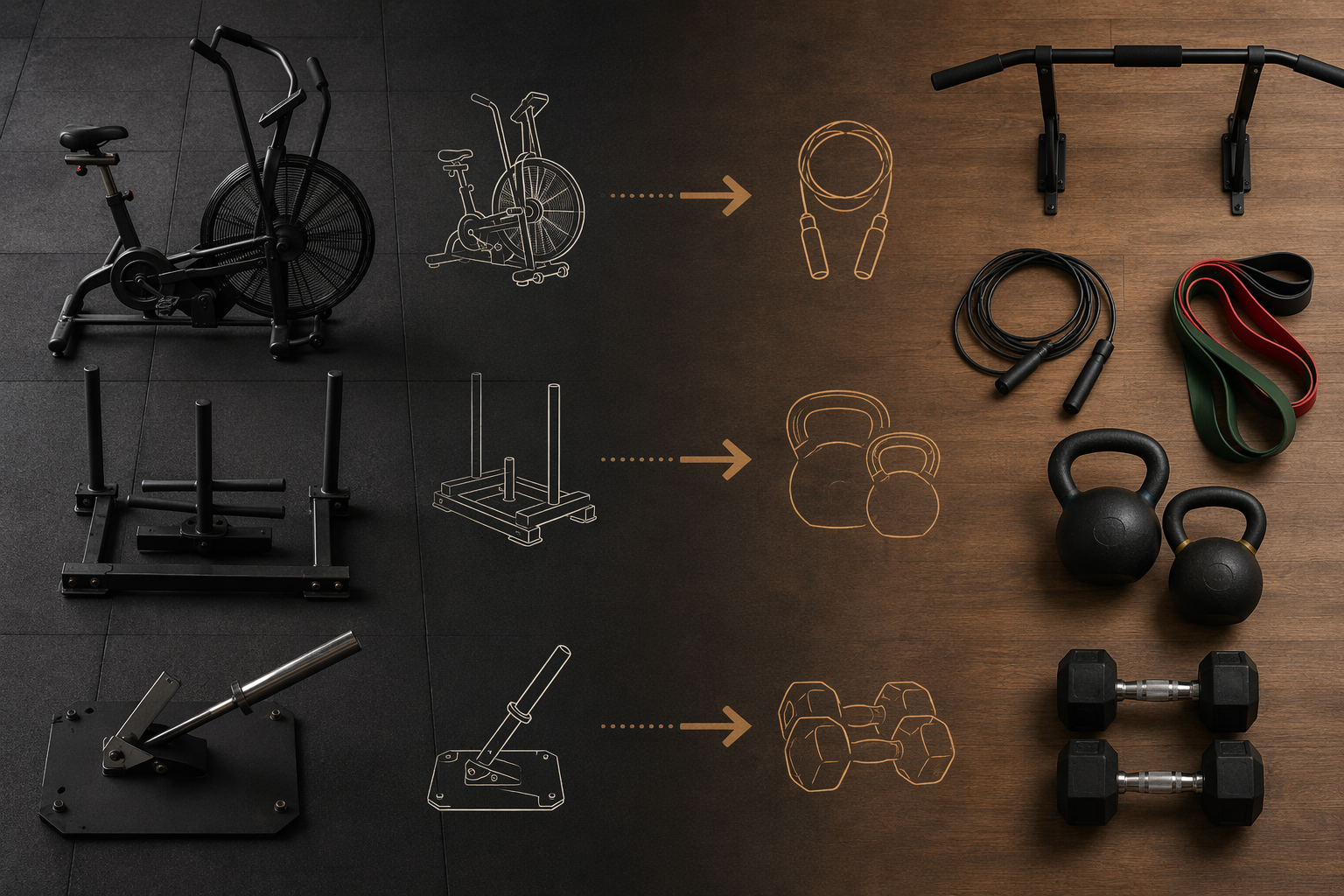
If you have a pull-up bar, a jump rope, a kettlebell or dumbbell, resistance bands, and a medicine ball or light dumbbells, you can preserve the shape of the session. You will not perfectly recreate an assault bike or turf sled in a spare room. You can recreate the decision-making: hard 10-second outputs, controlled breathing, loaded carries, rotational intent, and enough rest to keep reps sharp.
| Original station | Home substitution | What changes |
|---|---|---|
| L-sit pull-ups | Tuck L-sit pull-ups, strict pull-ups, chin-ups, or ring rows | Scale the lever before you turn it into sloppy pulling |
| Assault bike | Jump rope sprint, high-knee sprint in place, or burpee interval | Bike is lower impact; burpees add more muscular fatigue |
| Landmine punches | One-arm dumbbell punch press or band-resisted punch | Less anchored rotation; more control required |
| Sled sprint | Band-resisted sprint, hill sprint, or heavy march | Less horizontal loading unless the band or hill is set up well |
| Offset kettlebell farmer's carry | One-sided kettlebell or dumbbell suitcase carry | Very close substitution if the load is challenging |
| Medicine ball punches | Medicine ball chest punch to wall, band punches, or light dumbbell speed punches | Wall throws are closest; dumbbells require restraint and clean mechanics |
At-home workout flow
- Warm up for 8-12 minutes with easy skipping, hip hinges, lunges, scapular pulls, dead bugs, and a few short accelerations.
- Do 5 sets of 5 L-sit pull-ups, tuck L-sit pull-ups, strict pull-ups, or ring rows. Rest 90-150 seconds between sets.
- Do 10 rounds of 10-second jump-rope sprints, high-knee sprints, or burpees. After each round, take 7 deep breaths before the next sprint.
- Do 5 sets of 15 landmine-style dumbbell punches or band-resisted punches per side. Rest 60-90 seconds.
- Superset 6-10 short band-resisted sprints or hill sprints with 20-40 meters of one-sided suitcase carries. Rest as needed to keep speed and posture.
- Finish with 5 sets of 15-second explosive medicine ball punches, band punches, or very light dumbbell speed punches. Rest 45-75 seconds.
This is a better garage-gym target than a half-owned copy of the professional setup. The work still has a pull, a sprint interval, a rotational press, a resisted drive, a carry, and a fast punch finisher. The substitutions are not decorative. They decide whether the session still feels like combat-sports conditioning or turns into ordinary circuit training.
The 10-Second Sprint Block Is the Centerpiece
The assault bike prescription is the part worth protecting most closely: 10 seconds all-out, 7 deep breaths, repeated 10 times.[3] The clock is short, but the standard is high. If the first sprint is explosive and the fifth sprint is just survival pedaling, the load is too hot or the recovery breaths are too rushed.
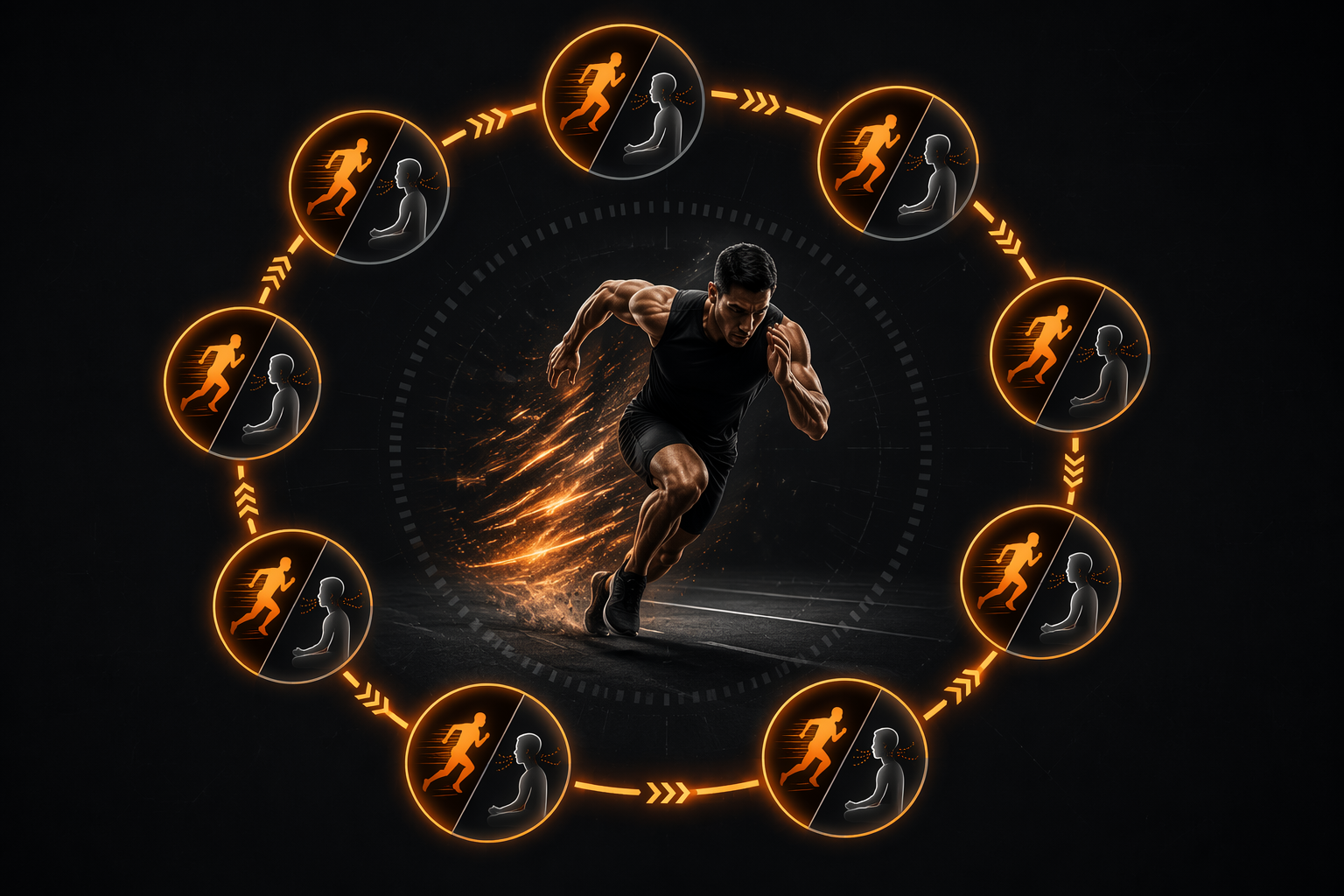
On an assault bike, the arms and legs share the violence, and the machine lets you pour effort in without having to brake your bodyweight on every landing. That is why the jump-rope and burpee versions are useful but not identical. Jump rope keeps the rhythm fast and light, but it is skill-dependent. Burpees are brutally accessible, but they add push-up, hip-snap, and landing fatigue that can swallow the sprint quality.
| If you use... | Do this | Stop the set if... |
|---|---|---|
| Assault bike | 10 seconds maximal effort, 7 deep breaths recovery x 10 | Power drops hard and you are just spinning |
| Jump rope | 10 seconds fast singles or high-knee rope sprint, 7 breaths x 10 | Trips turn the interval into frustration instead of output |
| Burpees | 10 seconds crisp burpees, 7 breaths x 8-10 | Your landing gets heavy or your low back starts taking over |
| High-knee sprint in place | 10 seconds fast knees and arm drive, 7 breaths x 10 | Cadence collapses or posture folds |
Seven deep breaths is not a vague rest period. It forces you to recover without drifting into a long break. Breathe through the nose and mouth if needed, get tall, drop the shoulders, and start the next round before you feel fully comfortable. If you want more low-impact options for this station, use a broader cardio-at-home framework rather than forcing burpees into every program.
Pulling Strength: L-Sit Pull-Ups Without Ego Reps
Five sets of five L-sit pull-ups is a serious opening station.[3] The L-sit turns a pull-up into more than a back exercise: the abs, hip flexors, grip, and lats all have to cooperate while the legs try to drag the pelvis out of position.
At home, scale the shape before you reduce it to kipping. Use a tuck L-sit if straight legs break your position. Use strict pull-ups if the L-sit makes every rep grind. Use chin-ups if your shoulders prefer them. Use ring rows or table rows if you cannot yet control clean vertical pulls for multiple sets.
- Best match: L-sit pull-up or tuck L-sit pull-up, 5 x 5.
- Strength scale: strict pull-up or chin-up, 5 x 3-5.
- Volume scale: ring row, 5 x 8-12.
- Quality rule: stop each set with one clean rep left rather than turning the last rep into a neck-and-kick contest.
Landmine Punches: Rotate, Brace, Then Drive
The original session uses landmine punches for 5 sets of 15 reps.[3] A landmine gives the bar an angled path and a fixed pivot, which makes it easier to load a punch-like drive without asking the shoulder to solve everything alone.
No landmine? Use a single dumbbell held near the shoulder and punch on a slight upward angle, or anchor a resistance band behind you and punch against the band. The dumbbell version loads the shoulder more directly. The band version feels more like acceleration through the punch, but only if the anchor is secure and the band path does not pull you into a twisted mess.
- Dumbbell punch press: 5 x 10-15 per side, light to moderate load.
- Band-resisted punch: 5 x 15 per side, fast extension with a controlled return.
- Half-kneeling option: use this if your hips rotate wildly or your low back steals the movement.
- Power cue: turn the foot, hip, and trunk together before the arm finishes the strike.
Sled Sprints and Offset Carries Are the Hardest Part to Replace
The sled-and-carry pairing is where many home versions get dishonest. A weighted sled sprint over 40 yards gives you horizontal force, acceleration mechanics, and leg drive without the same eccentric pounding as repeated open sprints.[3] A suitcase carry gives you the opposite problem: move under control while one side tries to pull you out of alignment.
A resistance-band sprint is the closest home substitute if you have a strong anchor and enough space. A hill sprint can also work, especially if the grade lets you drive hard without overstriding. If you have neither, use heavy marching or low-impact step drives, but be honest: that becomes a leg-and-bracing substitute, not a true sled sprint.
| Home setup | Sprint substitute | Carry pairing |
|---|---|---|
| Band and outdoor space | 6-10 band-resisted sprints of 10-20 seconds | Suitcase carry 20-40 meters per side |
| Hill nearby | 6-10 short hill sprints | Suitcase carry after walking back down |
| Apartment or small room | Heavy marching, step drives, or split-squat jumps if tolerated | Suitcase hold or march 20-40 seconds per side |
| Sensitive knees | Band march, incline walk push, or low-impact step drive | Suitcase carry with moderate load and perfect posture |
The carry should feel heavy enough that your ribs want to lean toward the weight. Do not let them. Walk tall, keep the loaded hand slightly away from the thigh, and make the unloaded side work. If the sled substitute exposes a weak leg-strength base, spend a training block with a structured home leg workout progression before trying to make every sprint maximal.
Medicine Ball Punches: Finish Fast, Not Sloppy
The original finisher is 5 sets of 15-second explosive medicine ball punches.[3] By this point, the pull-ups, sprint intervals, punches, sled work, and carries have already taxed the system. The finisher is not there to prove you can suffer for another ten minutes. It is there to ask whether you can still produce fast, coordinated upper-body output under fatigue.
If you have a medicine ball and a sturdy wall, use it. Punch or chest-pass the ball explosively, reset quickly, and keep the rib cage down. If you do not, band punches are safer than pretending heavy dumbbell punches are the same thing. Very light dumbbells can work for speed punches, but the load should be light enough that you can stop each rep cleanly without yanking the shoulder forward.
- Medicine ball wall punches: 5 x 15 seconds, 45-75 seconds rest.
- Band speed punches: 5 x 15 seconds, smooth return every rep.
- Light dumbbell speed punches: use only if your shoulders tolerate them and the weights stay genuinely light.
- Finish rule: end the set when speed disappears, even if the timer has a few seconds left.
How Often to Use This Workout
Usman has described training 2-3 times per week in the off-season and daily during fight camp.[4] A home exerciser should borrow the first number, not romanticize the second. Fight-camp "daily" work can include skill sessions, film, drilling, recovery, and coached adjustments. It does not mean a regular person should run maximal strength-and-conditioning intervals every day.
| Training level | Frequency | Adjustment |
|---|---|---|
| New to high-intensity conditioning | 1 time per week | Use easier pull-up scales and 6-8 sprint rounds |
| Regular home-gym trainee | 1-2 times per week | Run the full structure, but keep one or two reps in reserve on strength work |
| Well-conditioned athlete | 2 times per week, occasionally 3 in a short block | Separate hard sessions by at least 48 hours when possible |
| Beat-up knees or ankles | As tolerated | Choose bike, rope, band march, aqua jogging, or other lower-impact conditioning |
Usman's Colorado training context also matters, but only up to a point. He has trained at 6,800 feet in Colorado with Elevation Fight Team, a setting that helps explain why his gas tank has become part of his reputation.[1] That does not mean a home athlete needs altitude. It means the session should be judged by repeatability under pressure, not by how ruined you feel after the first station.
Recovery and Fuel Are Brief, but Not Optional
Usman's broader routine has been described with a carb-based diet managed through the UFC Performance Institute, along with recovery methods such as cryotherapy and ice baths.[4] Other published summaries have listed supplements including whey, creatine, BCAAs, glutamine, and pre-workout.[5] Those details are useful context, not a shopping list. The workout itself already supplies enough stress.
For home training, the more important recovery checks are simple: do your sprint outputs stay fast, do your knees tolerate the impact choice, does your grip recover before the carries, and can you train productively two days later? If the answer is no, reduce the sprint rounds, choose the lower-impact cardio option, or split the strength and conditioning pieces into separate days.
Run this session as a repeat-power workout, not as a punishment circuit. Keep the pull-ups strict, make the 10-second intervals violent but repeatable, choose sled substitutes honestly, and let the carries expose your trunk instead of your ego. That is close enough to the architecture of Kamaru Usman's strength and conditioning to be useful at home, without pretending your garage is a UFC performance facility.
References
- Why Kamaru Usman Is the Pound-for-Pound King of UFC, Men's Journal
- Kamaru Usman - UFC Record, Stats and Profile, CBS Sports
- The Cardio and Lifting Sessions That Built Kamaru Usman's Body, Men's Health UK, 2021
- UFC champ Kamaru Usman reveals favorite training routines, MMA Junkie, 2022
- Kamaru Usman's Workout & Diet Plan, Total Shape
Comments
Join the discussion with an anonymous comment.