
15-Minute Kids Soccer Drills You Can Do Inside an Apartment
Kids 5–12 can build real touches indoors even in an apartment; the real constraints are noise and floor damage, not square footage. A 15-minute age-scaled drill plan with $0–$30 gear substitutions and neighbor-friendly rules turns a living room into a practice space that supports, not replaces, team training.
- Equipment tier required
- $0-100
- Duration
- 15 min
- Difficulty
- beginner
- Target area
- legs
- Space footprint needed
- small living-room lane or hallway
- Noise level
- low
The hard part of kids soccer drills at home is rarely the square footage. It is the ball hitting the baseboard, the thud that travels through the floor, and the moment a child forgets that “inside touches” are not the same thing as “shoot at the couch.”
For ages 5–12, a useful apartment session can fit into 15 minutes if the room is set up in the right order: choose a lower-bounce ball, mark a small lane, protect what the ball might hit, and keep the drills low to the floor. This is not a replacement for coached team practice. It is the quiet extra work: more touches, more comfort using both feet, and a little more confidence before the next practice.
You do not need a yard, cones, a rebounder, or a parent with a whistle. The best version of this routine uses what an apartment can actually tolerate: painter’s tape, rolled-up socks, flat markers, cushions, and a futsal or lower-bounce ball. If the budget is $0–$30, spend first on the ball and only then on anything that looks like training equipment.
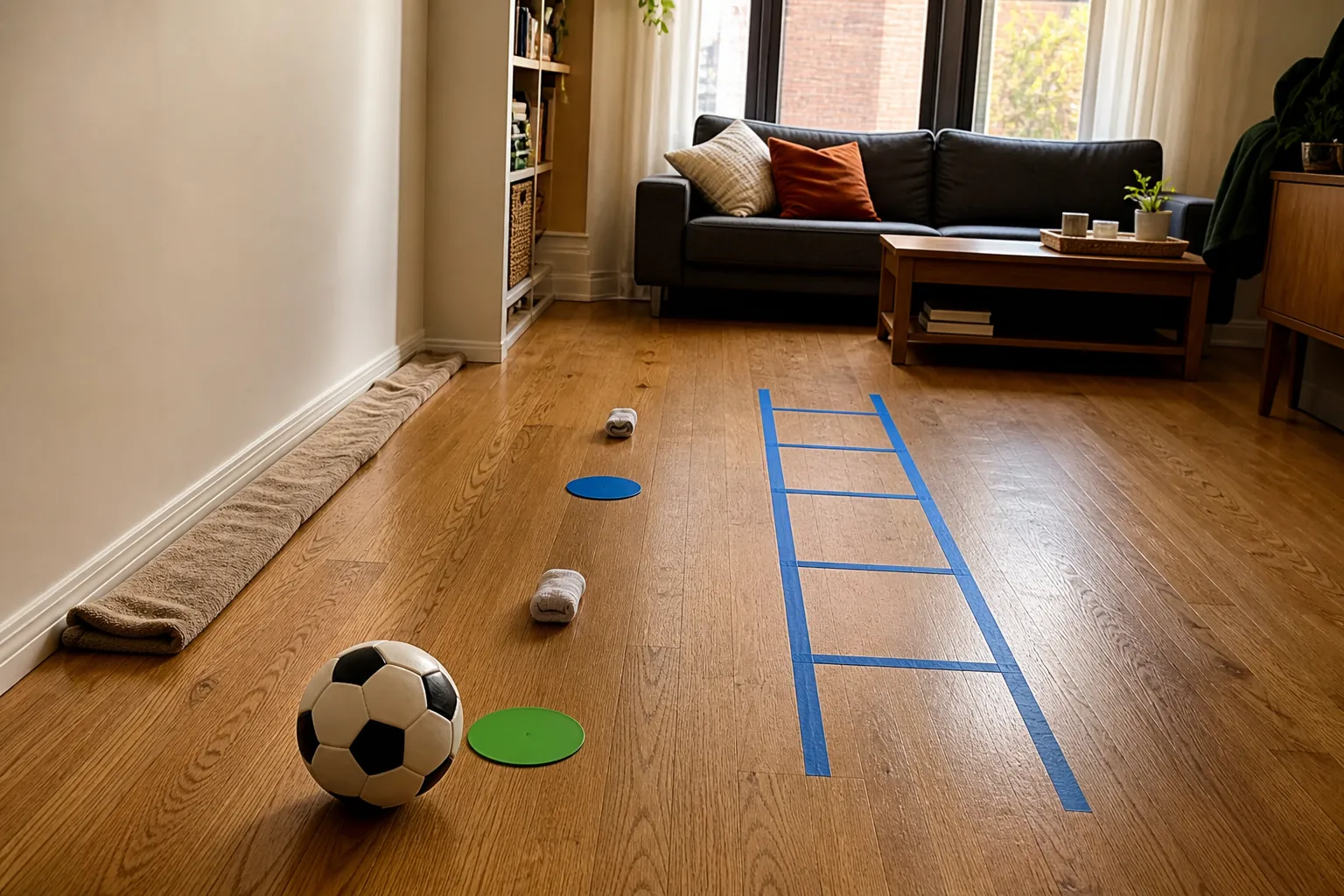
Set up the apartment before you set up the drill
A child can work in a space about the size of a small living-room lane. The safer question is not “Is there enough room?” but “Where will the ball go if the touch is too hard?” Clear the coffee table, move breakables above waist height, and define one no-kick direction before the first touch. A short hallway can work for dribbling, but only if doors, mirrors, plants, and framed art are out of the danger line.
The ball matters more than the cones. SoccerWire’s indoor youth-soccer guidance points to a futsal or lower-bounce ball as the indoor substitution because it is easier to control in tight areas and less likely to become a furniture-seeking missile than a lively outdoor ball.[1] That does not make indoor play silent or risk-free, but it does lower the chaos level in a way parents can feel immediately.
| Child’s age | Ball size to start with | Apartment note |
|---|---|---|
| 5–7 | Size 3 | Small enough for beginning control; keep all work on the floor. |
| 8 | Size 3 or size 4 | If the child is small or new, stay with size 3; if club play uses size 4, practice with size 4. |
| 9–12 | Size 4 | Good size for tighter control work before the jump to a full-size ball. |
| 13+ | Size 5 | Included for context, but this routine is aimed at ages 5–12. |
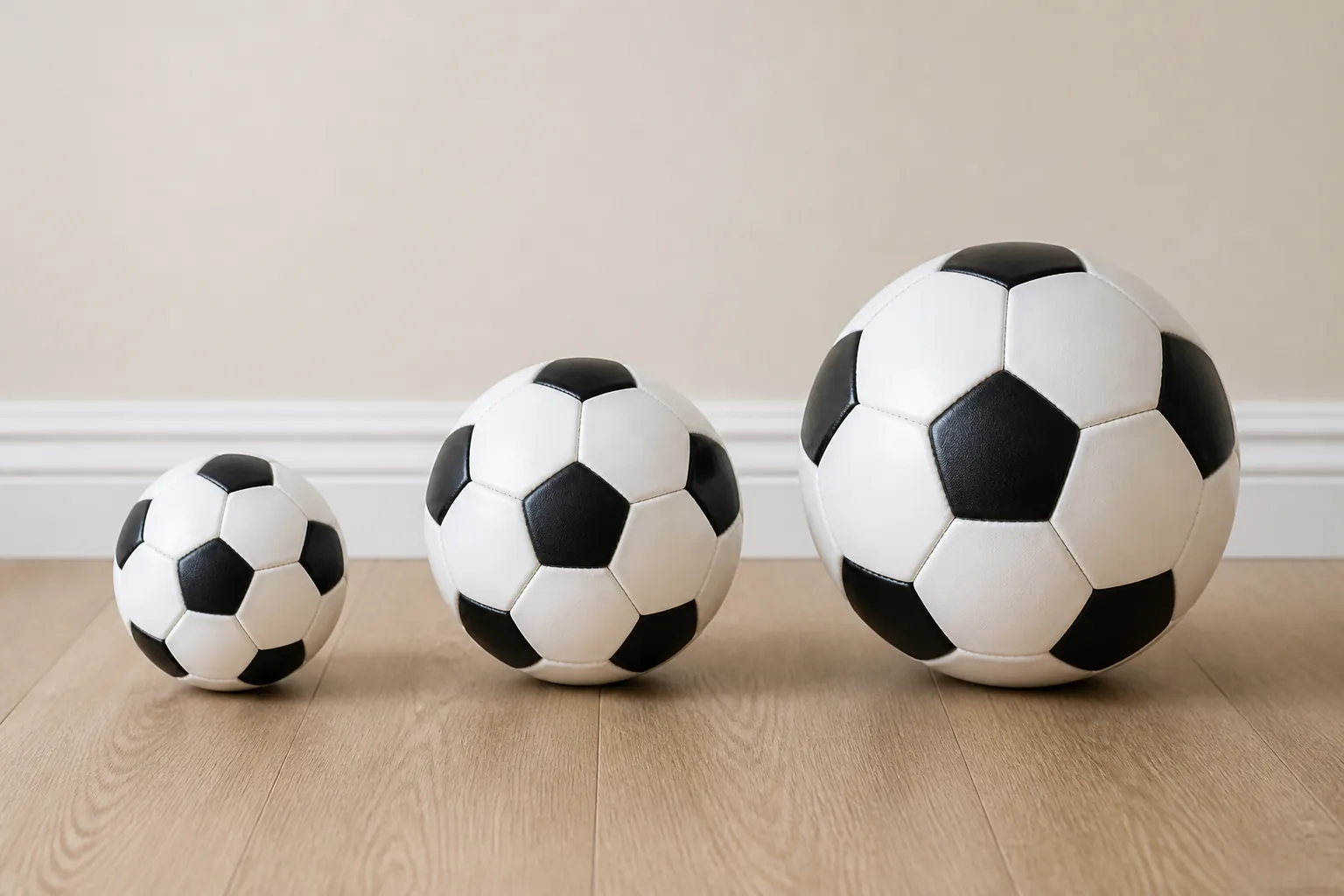
Markers should be flat. Tall cones are fine on grass; indoors they become tripping props and tempt kids to run around them at full speed. Use flat plastic discs if you own them, or make a $0 version with rolled socks, folded washcloths, or small pieces of painter’s tape. A painter’s-tape ladder is better than a plastic agility ladder in a cramped room because it cannot slide under a child’s foot.
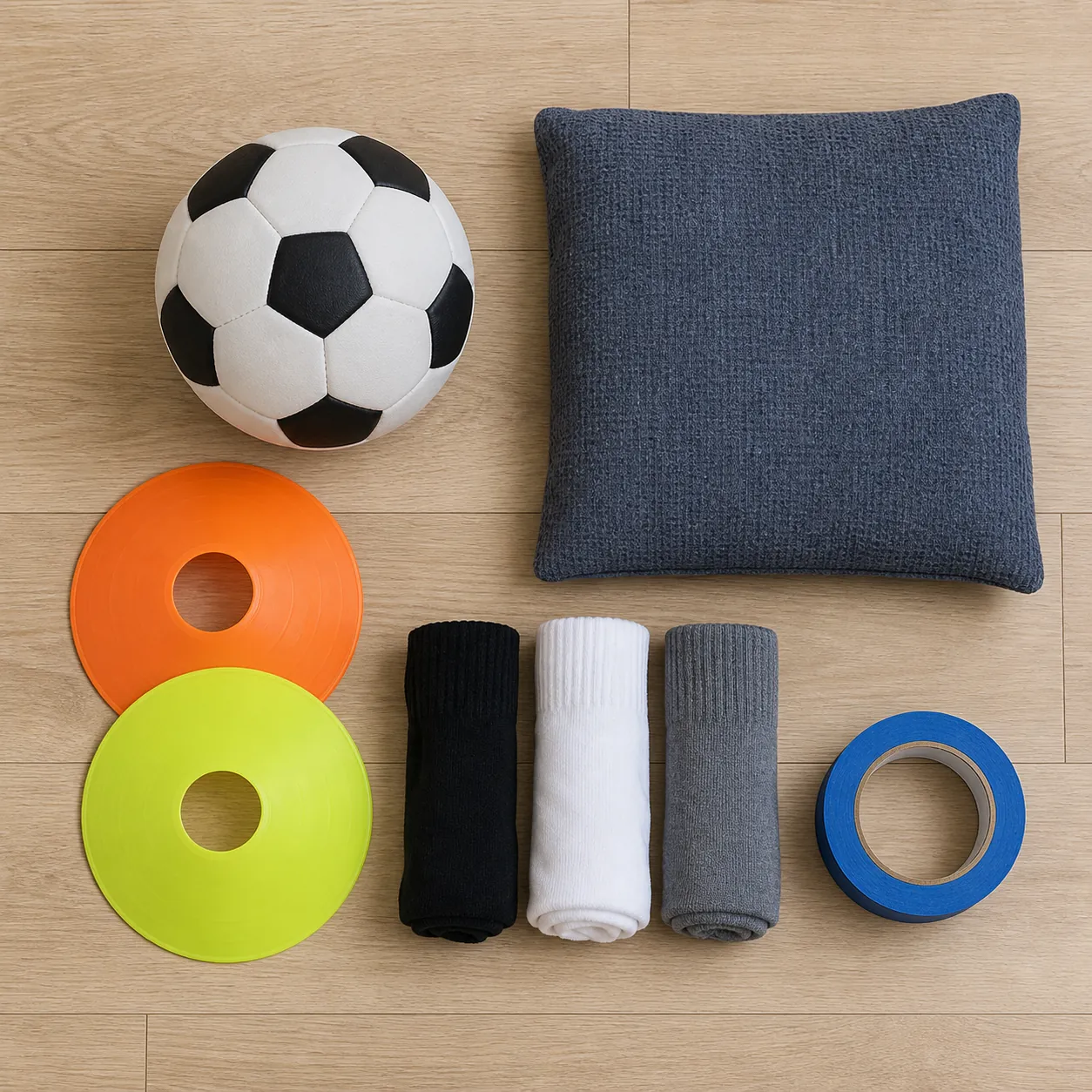
Wall work is optional, not automatic. A solid interior wall with no pictures, shelves, outlets in the strike zone, or shared-neighbor sensitivity may handle gentle passes with a softer ball. Drywall behind a sofa, a hollow door, a closet mirror, a TV wall, or anything near a sleeping baby downstairs should be treated as off-limits. If you are not sure, skip wall passing and use sole rolls, toe taps, and dribbling lanes instead.
- Put a folded towel, cushion, or yoga mat along the baseboard at the end of the lane.
- Avoid hard kicking, chipped balls, volleys, and any drill where the ball leaves the floor.
- Use socks or clean indoor shoes with grip; do not let a child sprint in slippery socks on wood or tile.
- Set a noise rule before the timer starts: quiet feet, soft touches, no shooting.
- Choose a reasonable time of day. A technically beautiful drill at 8:45 p.m. is still a bad apartment decision.
If you already think this way for other apartment workouts, the same logic applies here: protect the rental first, then train. The renter-first gear thinking in this home boxing setup for renters is a useful comparison because both activities can look harmless until repeated impact starts bothering the room around you.
The 15-minute apartment soccer session
Use one timer, one ball, and a lane of three to six markers. The child should be able to repeat the session without a parent narrating every touch. If the drill needs a coaching lecture, it is too fussy for a weekday living room.
| Time | Drill | What the child does | Apartment rule |
|---|---|---|---|
| 0:00–2:00 | Quiet-foot warmup | March, side-step, ankle circles, then light toe taps without speed. | No jumping; feet stay soft. |
| 2:00–4:00 | Toe taps | Alternate right and left foot on top of the ball. | Ball barely moves. |
| 4:00–6:00 | Sole rolls | Roll the ball side to side, then forward and back with the sole. | Stay in one square or taped box. |
| 6:00–9:00 | Marker dribble | Dribble through three to six flat markers using small touches. | Walk speed first; no racing. |
| 9:00–11:00 | Inside-outside touches | Use the inside and outside of the same foot, then switch feet. | Touch rhythm matters more than speed. |
| 11:00–13:00 | Pullback turn | Stop the ball with the sole, pull it back, turn, and dribble to the next marker. | No stamping on the ball. |
| 13:00–14:30 | Both-feet challenge | Repeat the easiest drill using the weaker foot first. | Short, controlled touches only. |
| 14:30–15:00 | Freeze finish | Dribble slowly, stop the ball under the sole, and hold still. | End calm, not with a shot. |
The order matters. Toe taps and sole rolls teach the child to feel the ball without sending it across the room. Marker dribbling adds movement only after the first four minutes have established control. The pullback turn gives a useful game skill without needing speed or space. The final both-feet challenge is short on purpose; it is long enough to build the habit and short enough to avoid a frustrated child smashing the ball with the preferred foot.
For the marker lane, start with three markers spaced by a child’s small step, not an adult stride. In a narrow room, make a triangle instead of a straight line. In a hallway, use two markers and turn around them. If the child keeps hitting furniture, do not tell them to “be careful” ten times; shorten the lane, slow the drill, or remove the drill.
Ages 5–6: fewer drills, more repeats
Five- and six-year-olds do not need the full menu. FlickTec’s age guidance starts this group with simple touches such as toe taps and sole rolls rather than a long list of technical drills.[3] That fits an apartment well. Give them a smaller target: two minutes of toe taps, two minutes of sole rolls, two minutes of dribbling around socks, a water break, then repeat the favorite drill.
The parent’s job at this age is mostly environmental. Put the markers where they belong, remind the child that the ball stays on the floor, and stop before the session turns into wrestling with the couch. A good 10-minute version is better than a 15-minute argument.
Ages 7–8: use the full sequence, but keep the speed capped
Seven- and eight-year-olds are usually ready for the full 15-minute flow if the rules are clear. They can move from toe taps into dribbling, turns, and inside-outside touches without needing a new explanation every minute. This is also the age where “faster” starts to feel fun, so make the scoring system about quiet control: one point for every clean turn, one point for using both feet, zero points for hitting the wall.
If the child plays organized soccer with a size 4 ball at this age, practicing with that ball may make sense. If the ball looks too big for clean indoor touches, stay with a size 3 for the apartment and let team practice handle the regulation feel. The goal here is not to recreate Saturday’s field; it is to make the ball feel less strange underfoot.
Ages 9–12: make it tighter, not louder
Older kids can make the same 15 minutes more demanding without adding impact. Move the markers closer. Require two touches between markers. Add a “weak foot first” rule. Ask for a pullback turn at every marker, or a pattern such as inside-inside-outside before moving forward.
This is where both-feet work stops being a cute add-on. FlickTec emphasizes using both feet in home drills, and the apartment version should build that into the routine instead of saving it for a rushed finish.[3] A simple rule works: every drill starts with the less comfortable foot for the first 30 seconds, then switches. That keeps the weaker foot from getting only leftover attention.
- Too easy: move markers closer together before adding speed.
- Too loud: remove turns and return to sole rolls for one minute.
- Too messy: reduce the lane to two markers and require the ball to stop under the sole at each end.
- Too frustrating: let the child choose one favorite drill and one weaker-foot drill.
For another example of keeping sport footwork inside a living room without pretending the room is a court or field, see these living-room tennis footwork drills. The useful overlap is the same: small steps, quiet feet, and a defined boundary.
What the 15 minutes can realistically do
FlickTec says a focused 15-minute home session can produce more than 500 ball contacts, compared with roughly 2–3 minutes of individual ball time in a 60-minute group practice.[3] That is a motivating comparison, but it should be read as FlickTec’s figure, not as a universal measurement of every team practice. A crowded practice, a small-group station, and a coach who gives every child a ball will not all produce the same touch count.
Still, the basic point is practical: at home, there is no line to wait in. A child can repeat a touch pattern again and again, which is exactly what indoor space is good for. The apartment cannot supply teammates, defensive pressure, or a full passing lane, but it can supply repetition.
FlickTec also suggests that kids may show noticeable ball-confidence gains after 2–3 weeks of consistent short home work.[3] Treat that as a reasonable expectation, not a guarantee. The visible change may be modest: fewer panicked touches, more willingness to use the weaker foot, or a child who receives the ball at practice without immediately kicking it away.
The 15-minute length also respects the age of the player. FlickTec’s review of US Youth Soccer session-length guidance lists U6 sessions at 45 minutes, U8 at 45–60 minutes, U10 at 60–75 minutes, and U12 at 75 minutes.[4] A home add-on does not need to imitate that. Younger kids especially benefit from stopping while the drill is still going well.
For general health, the CDC recommends that children and adolescents ages 6–17 get 60 minutes or more of moderate-to-vigorous physical activity daily.[5] This soccer routine can contribute to that daily movement, but it will not fill the whole target by itself unless it is paired with other active play, walking, school activity, team practice, or outdoor time.
$0–$30 substitutions that actually help
Cheap substitutions are only useful when they solve the apartment problem. A laundry basket may be a funny goal, but it invites shooting. A row of shoes may work as cones, but it creates hard edges and scuff marks. The better substitutions are boring because boring is safer indoors.
| Need | $0 option | Low-cost option | What to avoid |
|---|---|---|---|
| Markers | Rolled socks or folded washcloths | Flat disc markers | Tall cones in a tight room |
| Agility ladder | Painter’s tape on a floor that tolerates it | Flat roll-out ladder only if it does not slide | Raised rungs on slippery floors |
| Boundary | Two pillows or a towel line | Yoga mat or foam strip | Hard bins, chairs, or anything with sharp corners |
| Ball | Soft indoor ball if already owned | Futsal or lower-bounce ball | Overinflated outdoor ball for hard touches |
| Baseboard protection | Folded towel | Cushion or foam pad | Bare wall at the end of a dribble lane |
Painter’s tape deserves one caution: test a small hidden patch first and remove it after the session. Some finishes dislike tape, even the kind marketed as gentle. If the floor is delicate, use socks as markers and skip taped ladders altogether.
Storage is part of compliance. A lower-bounce ball and a few flat markers are much easier to live with than a corner full of cones and rebound nets. If your apartment already has equipment creeping into every doorway, the narrow-space lessons from this home gym storage test are more relevant than another gear list.
When to stop or change the drill
Apartment soccer needs a few hard stops. If the ball leaves the floor repeatedly, switch to sole rolls. If the child starts using the wall as a goal, remove wall work. If downstairs noise is a concern, avoid jumping toe taps and use slow inside-outside touches instead. If the child is tired enough that every touch gets heavier, end the session.
The quietest productive session is usually the one that feels almost too controlled. That can disappoint a child who wants to shoot, so save shooting for the park, the schoolyard, or team practice. Inside, the win is a ball that stays close to the foot and a room that still looks like a room afterward.
Done consistently, indoor home drills can build touches, close control, ball confidence, and comfort with both feet. They do not replace a coach, teammates, open space, defending pressure, or the decisions that happen in a real game. That boundary is not a weakness of the routine; it is what keeps it useful in the apartment you actually live in.
References
- Indoor Workouts Youth Soccer Players Can Do Anywhere — SoccerWire
- Why Different Age Groups Use Different Size Soccer Balls — Charlotte Rise FC
- 10 Soccer Drills Kids Can Do at Home with No Equipment — FlickTec
- How Long Is Youth Soccer Practice? Session Length by Age — FlickTec
- Child Activity: An Overview — CDC
What a small equipment investment adds
Cable Machine Alternatives That Save Space and Money
Compare the best cable machine alternatives for home gyms – from resistance bands and pulley systems to suspension trainers and compact digital units – and find the right option for your space and budget.
Small Treadmill Buying Guide: 7 Critical Specs to Check Before You Buy
A cross-category spec primer for apartment and small-space dwellers comparing walking pads, ultra-compact folding treadmills, and full-size folding treadmills. Learn the concrete thresholds for motor HP, deck length, noise, warranty, and subscription lock-in so you can compare apples to apples.
How to Practice Basketball at Home Without Noise Complaints
Learn how to run a full basketball workout in a small apartment without noise complaints. This guide covers no-dribble handling drills, wall form shooting, and silent ball options that let you train without disturbing neighbors.
How often should you repeat this?
See our recovery and rest reference for citation-anchored rest-interval guidance.
Spot something off?
Tell us if a movement, tier assumption, or duration didn't match your experience.