Seeing your city land in the least fit US cities 2025 ranking can feel personal, especially if the headline stops at “worst” and moves on. The 2025 ACSM American Fitness Index put Oklahoma City last among the 100 largest U.S. cities it evaluates, with Memphis, North Las Vegas, Indianapolis, Lubbock, Bakersfield, Louisville, Wichita, Detroit, and Port St. Lucie also in the bottom ten.[1]
| 2025 ACSM bottom-ten city | How to read the result |
|---|---|
| Oklahoma City | Lowest-ranked ACSM city in 2025 |
| Memphis | Bottom-ten ACSM city in 2025 |
| North Las Vegas | Bottom-ten ACSM city in 2025; dropped out of the 2026 bottom ten |
| Indianapolis | Bottom-ten ACSM city in 2025 |
| Lubbock | Bottom-ten ACSM city in 2025 |
| Bakersfield | Bottom-ten ACSM city in 2025 |
| Louisville | Bottom-ten ACSM city in 2025 |
| Wichita | Bottom-ten ACSM city in 2025 |
| Detroit | Bottom-ten ACSM city in 2025 |
| Port St. Lucie | Bottom-ten ACSM city in 2025 |
The newer 2026 ACSM list changed slightly: Oklahoma City remained last for a ninth consecutive year, Tulsa entered the bottom ten, and North Las Vegas dropped out. The 2026 bottom ten were Oklahoma City, Memphis, Port St. Lucie, Indianapolis, Lubbock, Bakersfield, Louisville, Wichita, Detroit, and Tulsa.[2]
That is the ranking answer. It is not the personal verdict. ACSM is not measuring whether one parent in a duplex can get stronger, whether a beginner can build a walking habit indoors, or whether an apartment renter can train without bothering the people downstairs. It is measuring a city's health ecosystem: behavior, chronic disease indicators, recreation access, policy, infrastructure, air quality, and other conditions that shape how easy or hard fitness is at scale.
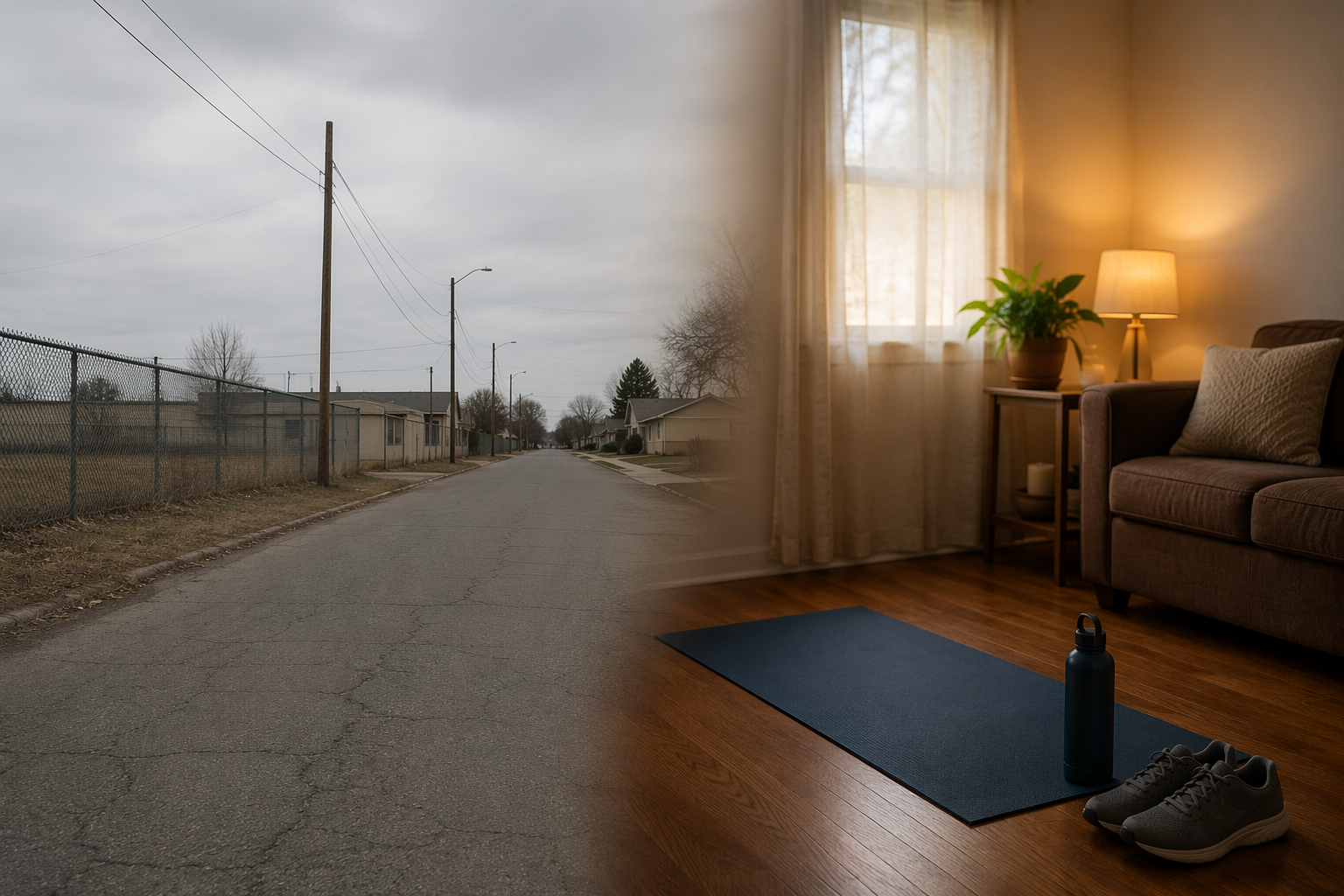
A Low Ranking Measures Friction
If a city has few safe walking routes, long driving distances, uneven park access, expensive food, bad-air days, and limited recreation options, residents have to spend more effort just getting to the starting line. That effort is real. It is also not the same thing as low motivation.
Oklahoma City is a useful example because “go use the park” sounds simple until the map gets involved. Local reporting has described the city as spanning 621 square miles with rural pockets, while MAPS 4 includes $278 million in parks investment whose benefits take time to reach every daily routine.[3][4] A parks budget can be necessary and still be too slow to help tomorrow morning.
That is where the home-workout answer belongs: not as a replacement for sidewalks, parks, grocery access, or clean air, but as the thing a resident can control while those bigger systems lag.
Turn Each Deficit Into a Home Training Decision
A bottom-ten ranking can be translated into a short training plan. The city-level problem names the friction. The home routine removes one piece of it.
| Structural deficit | What it blocks | At-home response |
|---|---|---|
| Low aerobic activity | Enough weekly movement to build basic endurance | Low-impact indoor cardio, walking intervals, or beginner Zone 2 sessions |
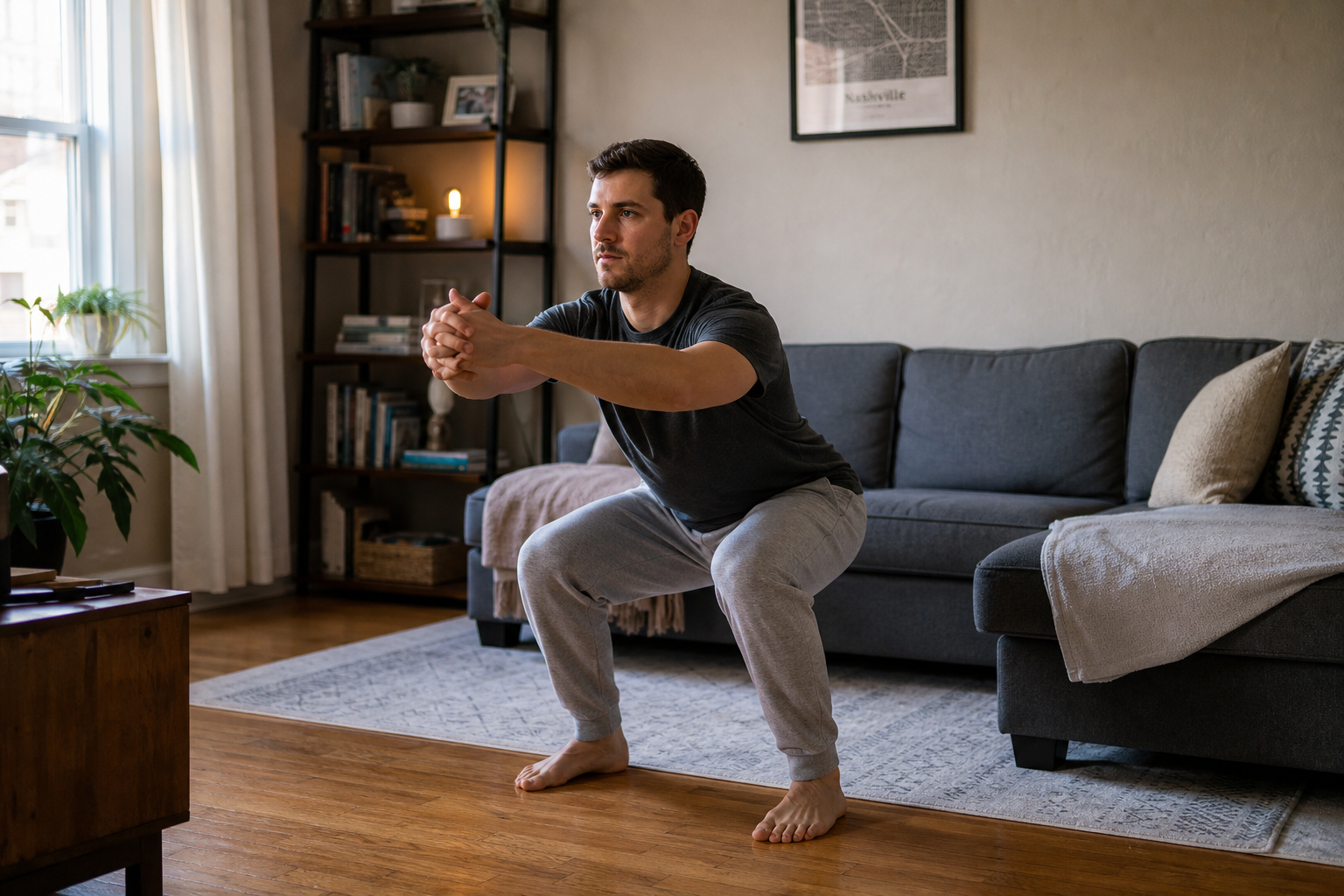
| Low strength training participation | Muscle, joint capacity, balance, and everyday resilience | Counter push-ups, chair squats, hinges, rows, carries, and floor work |
| Poor air quality | Reliable outdoor walking, running, or cycling | Indoor substitutions with intensity adjusted to breathing conditions |
| Food insecurity | Consistent recovery and protein intake | Training that does not require supplements, gym fees, or high-cost meal plans |
| Small spaces and weak infrastructure | Room to move, privacy, quiet, safe routes | No-jump, no-equipment routines that fit beside a couch or bed |
Start With Aerobic Work Because the Data Already Moved
The most encouraging number in the ACSM material is not a rank. In the 2025 report, 94 of 100 cities improved aerobic activity rates from 2024 to 2025, and the average share of residents meeting the aerobic guideline rose from 50.9% to 59.9%.[1] That does not prove every city became easy to exercise in. It does show that behavior can shift before the built environment is fully repaired.
For a beginner in a low-ranking city, the first aerobic target should be boring on purpose: repeatable, joint-friendly movement that can happen indoors. Walk in place during one TV segment. March beside the couch. Step side to side in the kitchen. Use a hallway. If there are stairs, climb one flight slowly and recover fully before repeating. If stairs are not safe or available, skip them.
A practical first week can look like this:
- Day 1: 10 minutes of easy marching or walking in place
- Day 2: 5 rounds of 1 minute slightly faster, 1 minute easy
- Day 3: Rest or take a gentle walk if air, safety, and schedule allow
- Day 4: 12 minutes steady indoor walking
- Day 5: 6 rounds of 1 minute faster, 1 minute easy
- Weekend: One optional easy session, not a punishment session
The pace test is simple: during most sessions, you should be able to speak in short sentences. If you want a fuller version of that effort level, use a no-equipment Zone 2 cardio routine rather than trying to turn every living-room workout into a sweat test.
Add Strength Because It Changes What Daily Life Feels Like
The 2025 ACSM report also found that 89 cities averaged a 7.6% increase in residents meeting both aerobic and strength guidelines. Richmond, Virginia had the largest single-city gain at 18.8% and moved from No. 40 to No. 20.[1] That is not a promise that one routine will lift a whole city, but it is a clean reminder that strength training is not decoration. It is one of the behaviors ACSM is watching.
The beginner strength routine does not need a rack, a trainer, or a garage. It needs a few movement patterns done often enough to become familiar:
- Counter push-up: hands on a counter, body straight, lower under control
- Chair squat: sit to a chair, stand tall, use hands only as needed
- Hip hinge: push hips back as if closing a car door, then stand
- Wall or towel row variation: pull shoulder blades back and down with control
- Loaded carry: hold grocery bags, laundry jugs, or a backpack and walk slowly through the room
- Dead bug or heel tap: train the trunk without jumping or floor-shaking impact
Do two rounds the first time. Stop each set with a few good reps still available. A beginner who finishes feeling capable is more likely to come back than a beginner who turns day one into a test they never want to repeat.
For progression, make the exercise slightly harder before adding more exercises: lower the counter push-up to a sturdy table, squat to a lower seat, slow the lowering phase, or add a backpack. If you want the broader case for this approach, bodyweight training can work as real strength training when the movements are progressed instead of merely repeated.
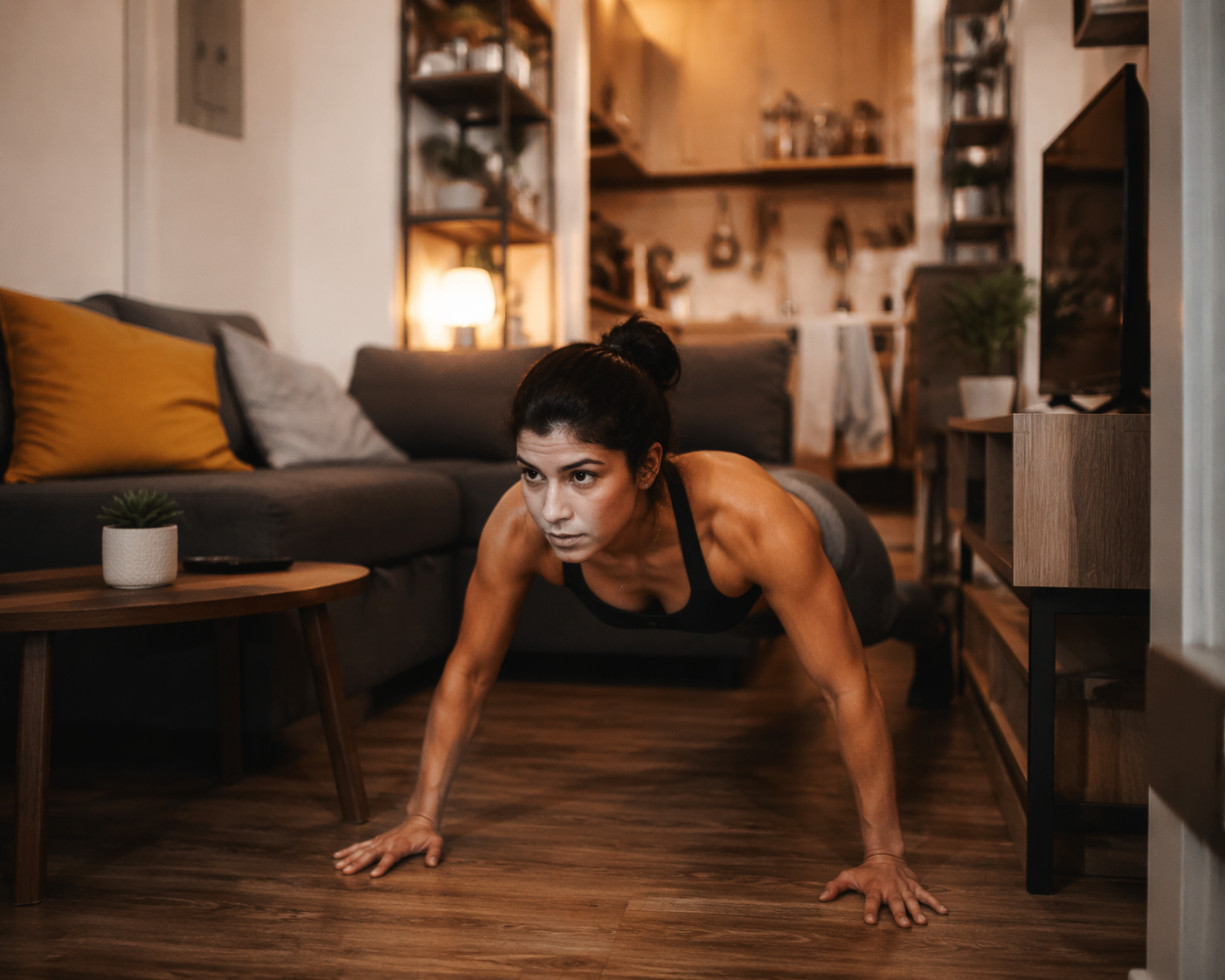
Move Indoors When the Air Is the Barrier
Outdoor exercise advice often assumes the air is cooperating. ACSM’s 2026 report found that, across the 100 cities evaluated, days with good air quality averaged only about 51%, and eight cities reported good air quality on 10% or fewer days.[5] That is not a small inconvenience if your usual plan is walking, jogging, biking, or taking a child to a playground.
The indoor substitution should match the reason you came inside. On a bad-air day, the goal is not to prove toughness. Replace the run with easy marching, step taps, shadow boxing without breathless intervals, mobility work, or a strength session that lets breathing stay controlled. If symptoms show up, stop.
A simple bad-air swap:
- 5 minutes easy walking in place
- 8 minutes alternating 30 seconds step taps and 30 seconds easy marching
- 2 rounds of chair squats, counter push-ups, and dead bugs
- 3 minutes slow breathing and gentle mobility
For days when smoke, pollution, or an alert changes the plan, keep poor-air-quality workout guidance handy. The point is to preserve the habit without pretending outdoor conditions are harmless.
Train for Small Rooms, Shared Walls, and No Sidewalks
A lot of home fitness advice quietly assumes spare rooms, high ceilings, and neighbors who do not hear your feet. Many residents in low-ranking cities are working with a strip of carpet, a bedroom corner, a kitchen chair, or a living room that has to become normal again in ten minutes.
Use quiet movements first: step-back lunges instead of jump lunges, marching instead of high knees, slow mountain climbers instead of burpees, sit-to-stands instead of squat jumps. A small-space workout is not a lesser workout. It is a constraint-aware workout.
| If the usual exercise is | Use this quieter home version |
|---|---|
| Jogging | Marching intervals or step taps |
| Burpees | Hands-elevated step-back plank |
| Jump squats | Slow chair squats |
| Jumping jacks | Side steps with arm reaches |
| Sprints | Fast-feet march with soft steps |
If noise is the limiting factor, start with a small-space muscle-building plan. If impact is the problem, use no-jump HIIT for apartments and keep the intensity in the muscles rather than the floorboards.
Keep Nutrition Advice Modest When Food Costs Are Part of the Problem
The 2026 ACSM press release reported that national food insecurity rose from 12.9% to 14.4%, affecting 99 of the 100 cities in the index.[6] That matters for workout advice because recovery is harder when food is inconsistent, and because expensive fitness prescriptions can become another way of telling people they are failing.
Do not build a beginner plan that depends on supplements, specialty groceries, or a paid app. Train with the food reality you have. If protein is available, put some near the workout window. If it is not, the session can still be worth doing. Strength, walking, mobility, and consistency do not become useless because the recovery meal is imperfect.
When there is room to choose a recovery option, compare ordinary foods first. Milk, yogurt, eggs, beans, canned fish, peanut butter, or leftovers may do more practical good than a product that strains the week’s budget. For a narrow comparison of drinkable recovery options, see protein milk for muscle building or Fairlife, chocolate milk, and whey for post-workout recovery. Those are support decisions, not the price of admission.
A Tomorrow-Morning Routine for a Bottom-Ten City
This routine assumes no park, no gym, no equipment, no jumping, and no extra room beyond a cleared patch of floor. It also assumes the person doing it may be tired, watched by a child, short on time, or coming back after a long layoff.
| Part | Exercise | Dose |
|---|---|---|
| Warm-up | Easy march, shoulder rolls, gentle side steps | 3 minutes |
| Cardio | March in place or step taps | 6 rounds of 45 seconds comfortable, 15 seconds easier |
| Strength | Chair squat | 2 sets of 6-10 reps |
| Strength | Counter push-up | 2 sets of 5-10 reps |
| Strength | Hip hinge | 2 sets of 8-10 reps |
| Core | Dead bug, heel tap, or seated knee lift | 2 sets of 6-10 slow reps per side |
| Cool-down | Slow walk, easy breathing, calf and chest stretch | 3 minutes |
Repeat it three days this week. On two other days, do the aerobic portion only. If soreness, joint pain, illness, air quality, heat, caregiving, or shift work interferes, reduce the dose instead of dropping the plan. Five minutes keeps the habit alive better than a perfect routine postponed to a better city.
What the Ranking Should and Should Not Do
The ACSM index is useful because it points at civic problems residents should not have to solve alone. A city can need safer routes, cleaner air, better park access, stronger recreation funding, and more affordable food at the same time that one person starts with counter push-ups in a kitchen.
Top-ranked cities having obesity rates more than 10 percentage points lower than bottom-ranked cities is a population-level warning, not a character reading.[6] Home workouts do not erase that gap by themselves. They also do not need permission from a ranking to begin.
If your city appears in the least fit US cities 2025 ranking, read it as a civic warning light. Then set out a chair, clear the rug, choose the quiet version, and do the first no-equipment session tomorrow morning.
References
- 2025 ACSM American Fitness Index Rankings, ACSM.org, 2025.
- 2026 ACSM American Fitness Index Rankings, ACSM.org, July 14, 2026.
- Oklahoma City American Fitness Index coverage, The Oklahoman.
- Oklahoma City American Fitness Index and MAPS 4 parks coverage, KFOR.
- 2026 ACSM American Fitness Index Report, ACSM.org, July 14, 2026.
- 2026 ACSM American Fitness Index Press Release, ACSM.org, July 14, 2026.
Comments
Join the discussion with an anonymous comment.