
Are long or short walks better for heart health?
Should you take one long walk or several short ones for heart health? There's no single winner: longer continuous walks are linked to lower cardiovascular-disease and mortality risk in under-active adults, while short, frequent walks are the better choice for blood pressure and post-meal glucose control — so combine one longer daily walk with short after-meal walks.
- Equipment tier required
- none
- Duration
- 30 min
- Difficulty
- beginner
- Target area
- cardiovascular
- Noise level
- low
For long vs short walks for heart health, the honest answer is: it depends on which heart-health problem you are trying to solve. Longer continuous walks have the strongest evidence for lower long-term cardiovascular-disease and mortality risk in under-active adults. Shorter, repeated walks look especially useful for blood pressure and post-meal glucose. If you can do both, the most practical routine is one steady 20- to 30-minute walk most days, with 10-minute brisk walks after meals when life allows.
That may sound less tidy than “one long walk wins” or “three short walks win,” but it is more useful. Those claims are usually talking about different measurements. A long-bout walking study that follows cardiovascular events for years is not answering the same question as a small trial that measures blood pressure over 24 hours or glucose after a drink.
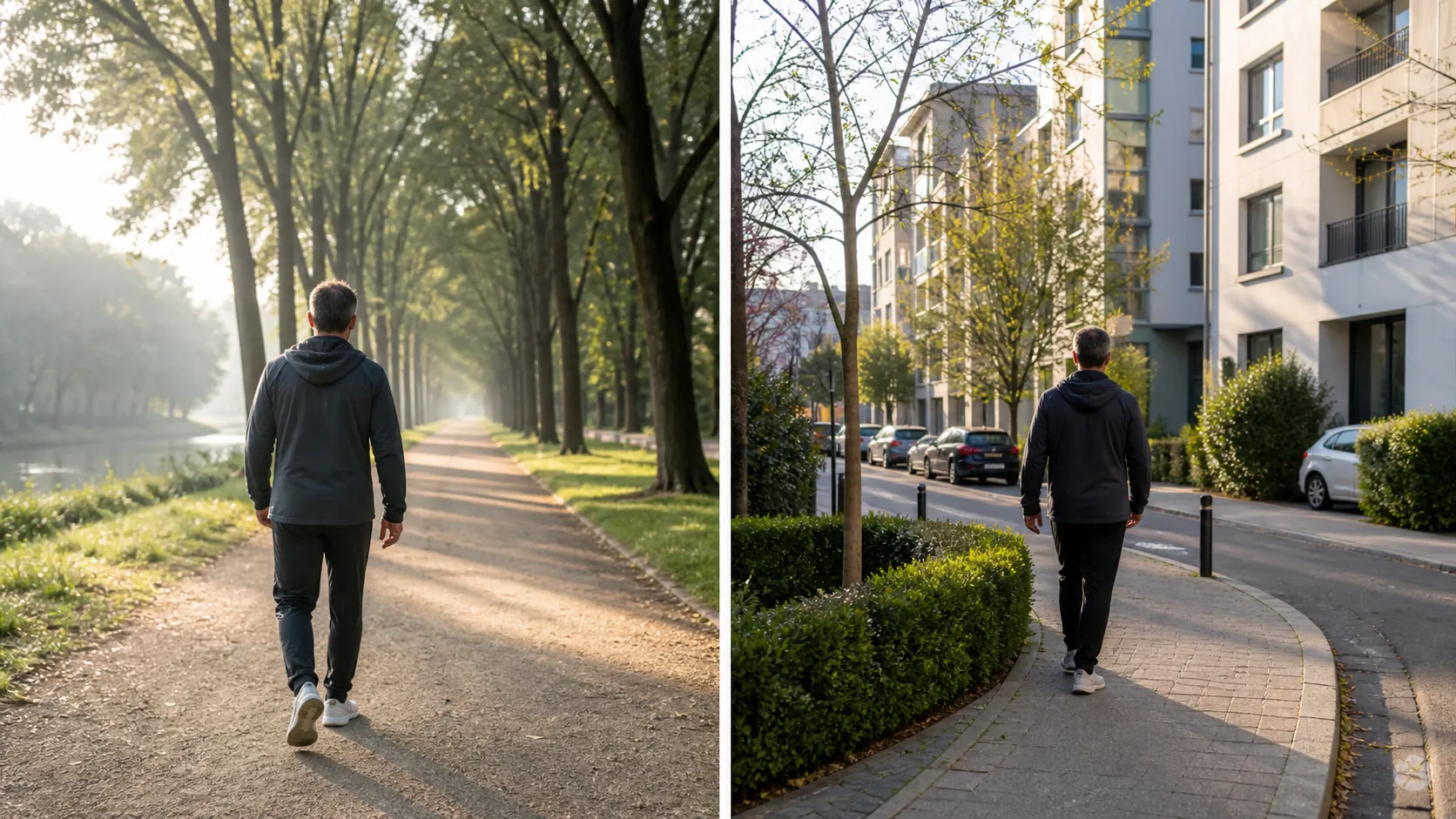
The clearest long-walk signal comes from under-active adults
The most relevant evidence for ordinary walkers is a 2025 Annals of Internal Medicine cohort study of 33,560 UK Biobank adults who averaged fewer than 8,000 steps per day. Their median step count was 5,165 steps per day, so this was not a study of runners or high-volume hikers; it was much closer to the person trying to become less sedentary without turning walking into a second job. The cohort’s mean age was 62, and 59% of participants were women. [1]
The study grouped people by how their daily steps were accumulated. The contrast that matters for this question was not simply “more steps versus fewer steps,” but whether those steps came mostly in very short fragments or in longer continuous bouts. Over 9.5 years, cumulative cardiovascular disease incidence was 13.03% among people whose steps were mostly in bouts under 5 minutes, compared with 4.39% among people whose steps were accumulated in bouts of 15 minutes or longer. All-cause mortality was 4.36% in the mostly-under-5-minute group and 0.80% in the 15-minute-plus group. [1]
Those are observational numbers, not a guarantee that stretching every walk to 15 minutes will cause the same risk drop for every person. People who can sustain longer walks may differ in health, fitness, routines, neighborhood access, job demands, or other ways the study cannot fully erase. Still, the pattern is hard to ignore if your current steps are mostly accidental: from the car to the door, from the desk to the kitchen, from one errand to the next.
The finding also held special interest for the lowest-step group. In adults taking fewer than 5,000 steps per day, reported cardiovascular disease risk was about 15% for the short-bout walkers and about 7% for those taking longer bouts; death risk moved from about 5% to under 1%. [2]
That is the part worth protecting in a beginner routine. If your day already contains 25 minutes of scattered walking, the first upgrade may not be “walk farther.” It may be “stop chopping every step into scraps.” Turn one errand loop, one hallway pacing session, or one walking-pad block into a continuous 10- to 15-minute stretch.
In public comments about the study, Ahmadi made the practical point bluntly: he suggested “adding one or two longer walks per day, each lasting at least 10-15 minutes at a comfortable but steady pace,” especially for people who do not walk much. [2]
Why short walks still belong in the plan
The long-bout evidence does not make short walks useless. It answers a long-term risk question. Blood pressure and post-meal glucose are more immediate, and the studies that test them often favor frequent, well-timed walks.
In an Arizona State trial, three 10-minute brisk walks per day kept 24-hour blood pressure lower for longer than one 30-minute walk, with the effect extending into nighttime and the next morning. [3]
A separate 2025 crossover trial looked at walking after glucose intake. A 10-minute walk immediately afterward blunted peak glucose compared with control, with peak values of 164.3 mg/dL versus 181.9 mg/dL, and also reduced 2-hour glucose area under the curve. A delayed 30-minute walk did not significantly blunt the peak. [4]
Those trials are smaller and shorter-term than the Annals cohort, and they measure surrogate outcomes rather than cardiovascular events. That limits how far the claims should go. They do not prove that short walks prevent heart attacks. They do explain why a 10-minute walk after lunch can be the right tool even if a longer continuous walk is the better long-term walking habit to build around.
| If your main target is... | Lean toward... | Why |
|---|---|---|
| Long-term cardiovascular disease and mortality risk | One continuous walk of 10-15+ minutes, building toward 20-30 minutes | In under-active adults, longer step bouts were associated with lower cumulative cardiovascular disease incidence and mortality. |
| Blood pressure across the day | Several 10-minute brisk walks | The available trial evidence favors fractionized brisk walking for longer-lasting 24-hour blood-pressure effects. |
| Post-meal glucose | A 10-minute walk soon after eating | Timing matters; the immediate short walk blunted peak glucose in the crossover trial. |
| A realistic weekly routine | Combine them | Use the longer walk as the anchor, then add short meal-timed walks where they fit. |
What counts as “brisk” without turning this into training math
For this routine, brisk does not need to mean breathless. A useful target is a comfortable but steady pace: warm enough that you notice the effort, steady enough that the walk feels intentional, and controlled enough that you could still speak in short sentences. If you want a clearer home-workout calibration, use a talk-test approach like the one in our beginner guide to zone 2 cardio without equipment.
The American Heart Association also leaves room for broken-up activity. Its adult activity guidance says the weekly goal of 150 minutes of moderate-intensity aerobic activity can be broken into “five or ten minutes a few times a day.” [5]
That guidance is helpful because most people do not fail at walking from lack of admiration for walking. They fail because the day keeps slicing itself apart. The research does not require a perfect 30-minute outdoor walk at sunrise. It does suggest that, when you can, you should let some of your steps stay connected.

A weekly pattern that covers the evidence
Start with the part that has the best long-term signal: one continuous walk most days. If 20 to 30 minutes is realistic, protect it. If it is not, use two 10- to 15-minute steady walks instead. That still moves you away from a day made only of one- and two-minute fragments.
Then add the short walks where they are most likely to matter: after meals. A 10-minute brisk walk after lunch is more specific than “walk more later.” After dinner, it may be a loop around the block, hallway pacing, or a quiet walking pad session while the kitchen is still settling. If you live above neighbors or walk indoors, shoe comfort and noise matter more than most plans admit; our apartment walking shoe test is aimed at exactly that kind of home setup.
- Most days: one 20- to 30-minute continuous walk at a comfortable, steady pace.
- Split days: two 10- to 15-minute steady walks instead of one longer block.
- After meals when possible: one 10-minute brisk walk, especially after the meal that usually leaves you sitting for hours.
- First upgrade: combine scattered errands or indoor pacing into one uninterrupted bout before adding more distance.
If you track your walks, bout length is the number to watch before you obsess over a perfect step total. A watch or phone can help you notice whether your day contains any 10- to 15-minute stretches at all. If you are using phone-based tracking during home workouts, it is worth remembering that accuracy can vary by placement and movement pattern; our home workout tracking accuracy test is useful if you want to monitor walk duration without making the device the center of the routine.
Total volume still matters. Researchers quoted by Health.com cautioned that longer-bout findings should not be read as all-or-nothing; Amanda Paluch and Kelly Gabriel emphasized that total activity remains important, with Gabriel putting it plainly: “It’s not an all-or-nothing situation.” [6]
So the answer is not to discard short walks or worship one long walk. Rearrange what you already do first. Turn a few scattered steps into one continuous bout. Keep the short after-meal walks because they answer a different problem. That pattern best matches the evidence as it stands: longer bouts for long-term cardiovascular and mortality associations, short frequent walks for blood pressure and post-meal glucose, and enough weekly movement underneath both.
References
- Daily Step Bout Duration and Incident Cardiovascular Disease and Mortality Among Adults Taking Fewer Than 8000 Steps per Day, Annals of Internal Medicine.
- Long walks may protect the heart better than taking short strolls, ScienceDaily, October 27, 2025.
- Effects of fractionized and continuous exercise on 24-h ambulatory blood pressure, PubMed.
- Acute effects of immediate versus delayed postprandial walking on glycemic responses after oral glucose loading: a randomized crossover trial, Scientific Reports, 2025.
- American Heart Association Recommendations for Physical Activity in Adults and Kids, American Heart Association.
- Longer Walks May Be Better for Your Health Than Shorter Walks, New Study Suggests, Health.com.
What a small equipment investment adds
We don't have a build tagged to this exact tier yet. Browse all builds.
How often should you repeat this?
See our recovery and rest reference for citation-anchored rest-interval guidance.
Spot something off?
Tell us if a movement, tier assumption, or duration didn't match your experience.