
Home Workout During Wildfire Smoke? Measure Your Air First
Neither your home nor your commercial gym is automatically safe during wildfire smoke. Learn how to size a portable air cleaner for your training room, verify indoor PM2.5 with a corrected low-cost monitor against the WHO 15 µg/m³ target, and judge whether a gym is actually cleaner.
- Equipment tier required
- none
- Duration
- 20 min
- Difficulty
- beginner
- Target area
- full body
Shoes are on, smoke is outside, and the choice looks simple: use the apartment corner or drive to the gym. The missing piece is the one that decides the session: the PM2.5 number in the room where you are about to breathe hard.
“Indoors” is only a direction. It is not proof that the air is clean enough for a home workout during a wildfire-smoke air quality alert, and it is not proof that a commercial gym is cleaner than your living room. A closed door, a purifier glowing on “auto,” or a front desk answer about “good HVAC” does not tell you what you are inhaling.
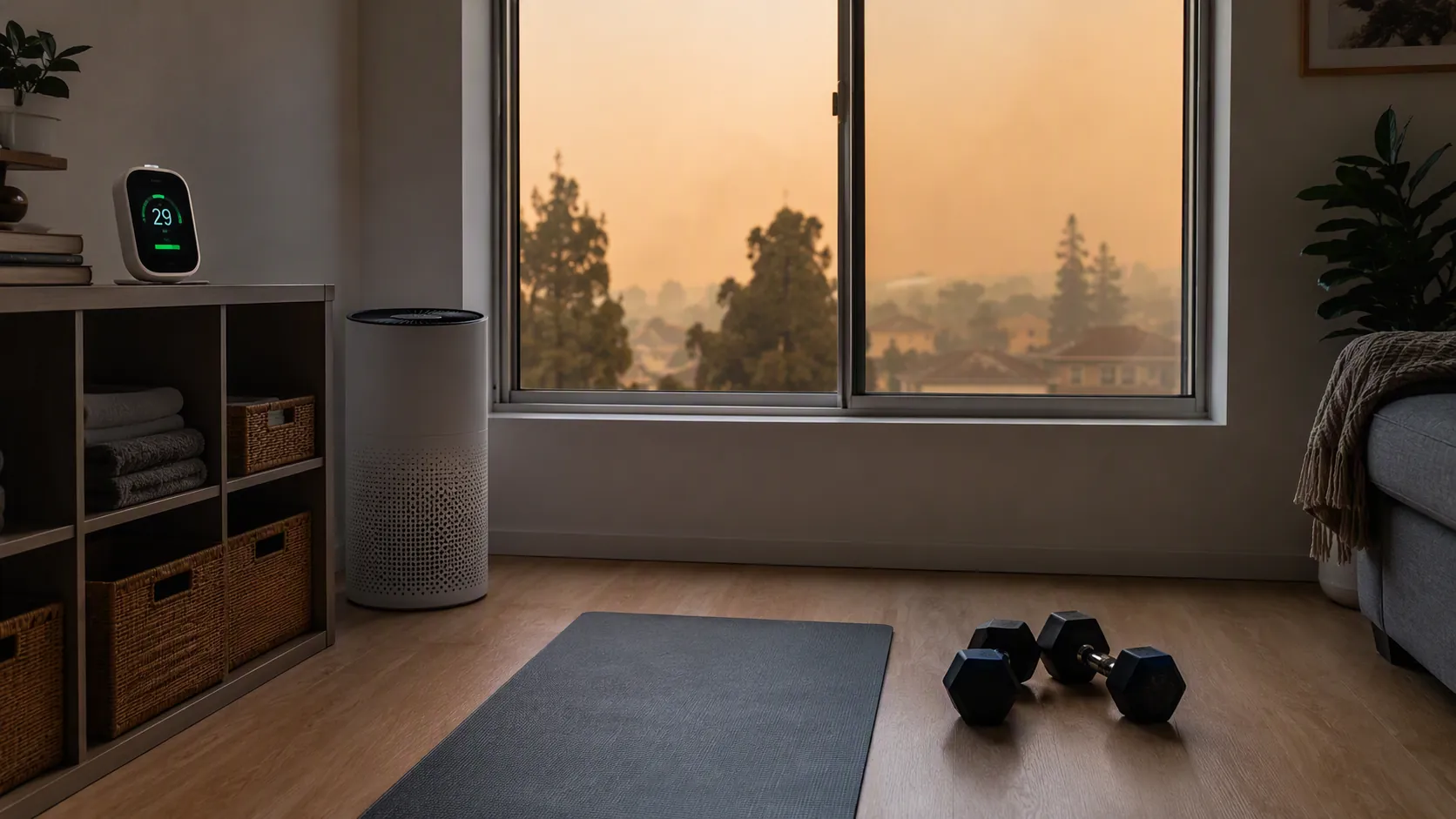
The defensible pre-workout question is narrower: after you close the room, run enough filtration, and check a corrected PM2.5 reading, what number are you willing to breathe hard in?
The gym is not automatically the safer fallback
A commercial gym can be the better choice. It can also be a larger room full of people breathing heavily, with air you have not measured.
In a 2023 study of health clubs in Porto, Portugal, Peixoto and colleagues found per-club PM2.5 medians ranging from 5.8 to 35.9 µg/m³, with an overall median of 21.4 µg/m³. PM2.5 was 1.1 to 2.7 times higher while spaces were occupied, and 63% of clubs’ training areas had medians above 25 µg/m³.[1]
That study was not a wildfire-smoke study. It was conducted in Porto during COVID-era occupancy restrictions, so it should not be turned into a claim that every gym is dirty or that your gym will look the same during a smoke event. Its value is more basic: even before adding wildfire smoke, “health club” did not equal “low PM2.5.” The overall median was also above the World Health Organization’s 2021 24-hour PM2.5 guideline of 15 µg/m³.[2]
That makes the home-versus-gym decision a measurement problem, not a loyalty test. If your gym measures cleaner than your apartment training room, use the gym. If your closed, filtered room measures cleaner than the gym floor, train at home. If neither has been checked, both are guesses.
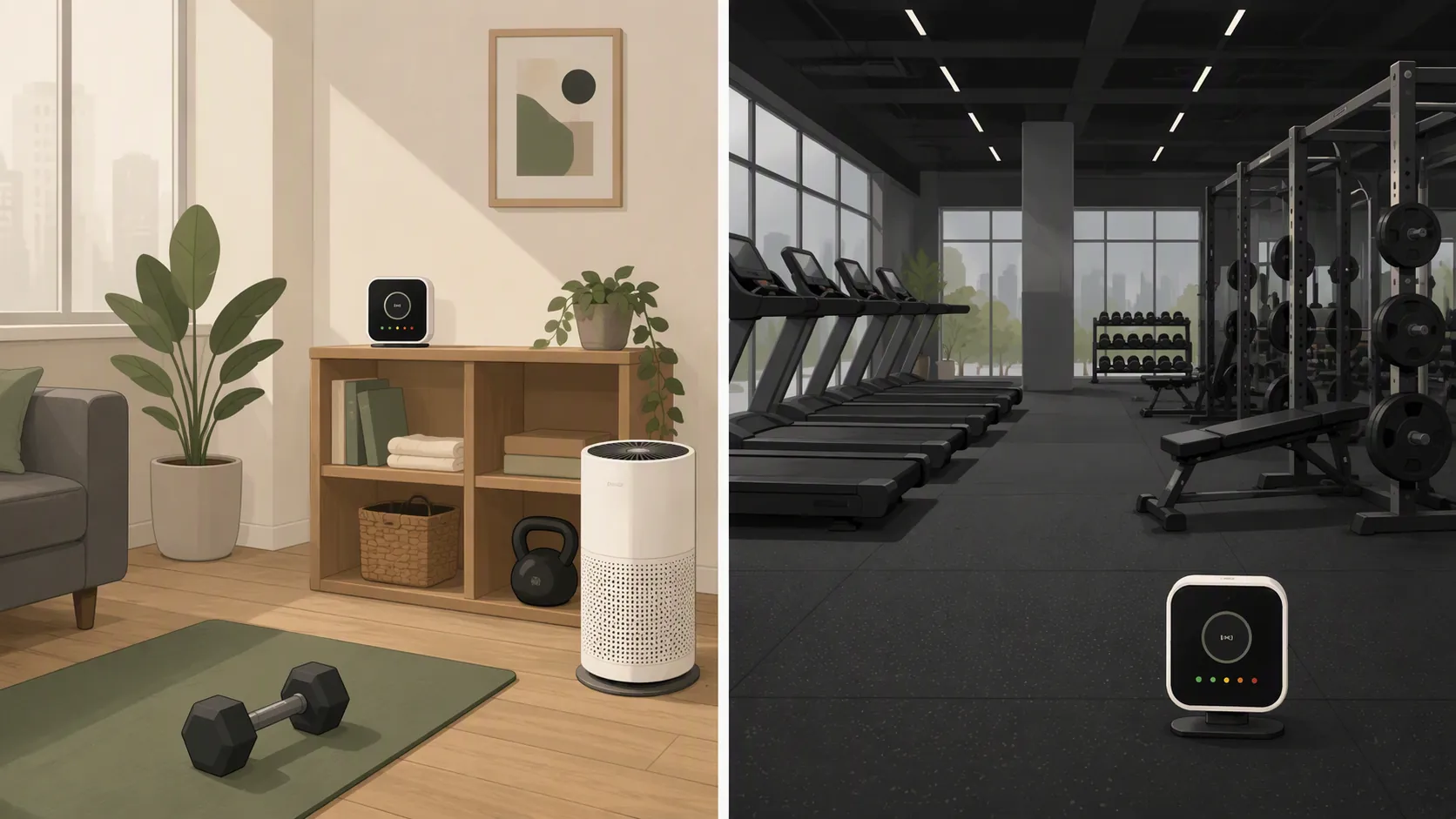
Use 15 µg/m³ as a conservative gate, not a fake exercise law
The WHO 15 µg/m³ value is a 24-hour outdoor air quality guideline for PM2.5, not an official indoor workout cutoff.[2] There is no exercise-specific indoor PM2.5 guideline to cleanly answer, “At this exact number, intervals are allowed.” Choi and colleagues note the absence of exercise-specific indoor PM2.5 guidance in their 2023 review.[3]
Still, the number is useful because it is conservative, public, and harder to hand-wave than “seems fine.” For this article’s workflow, treat 15 µg/m³ as a pre-workout verification target: if the corrected indoor PM2.5 reading in the training room is at or below that level after the room has been closed and filtered, the air has passed a cautious screen. If it is above that level, the room has not passed this screen.
This is especially relevant for training because the room is not being used like a bedroom during sleep or a desk during quiet work. Heavy exertion can raise ventilation 10- to 20-fold, according to Laumbach’s review of air pollution and exercise.[4] A European Lung Foundation factsheet gives the same point in more concrete terms: ventilation may be about 12 L/min at rest and about 100 L/min during exercise.[5]
The practical consequence is ugly but simple: a “borderline” room matters more when you are doing hard intervals than when you are sitting on the couch. If you cannot get the room to pass the conservative target, the next move is not to debate the last decimal place. It is to reduce exposure: postpone, downgrade intensity, shorten the session, or use one of the decision guides such as Should You Do a Home Workout During Wildfire Smoke? or How to Exercise Safely When Air Quality Is Poor.
Make the room small, closed, and filterable
Portable filtration works best when it is assigned a realistic job. A purifier that is undersized for an open-plan apartment is not failing mysteriously; it is being asked to clean too much air while smoke keeps leaking in.
The first compromise is spatial: train in the smallest room that still allows safe movement. Close the door. Close windows. Avoid unnecessary door swings during the cleaning period. If the room has obvious leaks you can reasonably reduce as a renter — a drafty window, a smoky gap under a door, a bathroom fan pulling smoky air through the unit — handle those before judging the purifier.
Field evidence points in the same direction. NCCEH’s 2026 review reports that unfiltered homes during smoke averaged about 31.5 µg/m³, compared with 4.7 µg/m³ during background periods. It also reports a median indoor/outdoor PM2.5 ratio of 0.75, a median infiltration factor of 0.45, and a wildfire-specific infiltration factor of 0.58.[6] In plain terms: being inside reduces smoke exposure, but smoke still gets indoors.
Closing windows helps. In the same NCCEH evidence base, closing windows reduced the indoor/outdoor ratio from 0.76 to 0.62.[6] That is not enough by itself to bless a workout room, but it explains why the workflow starts with containment before filtration.
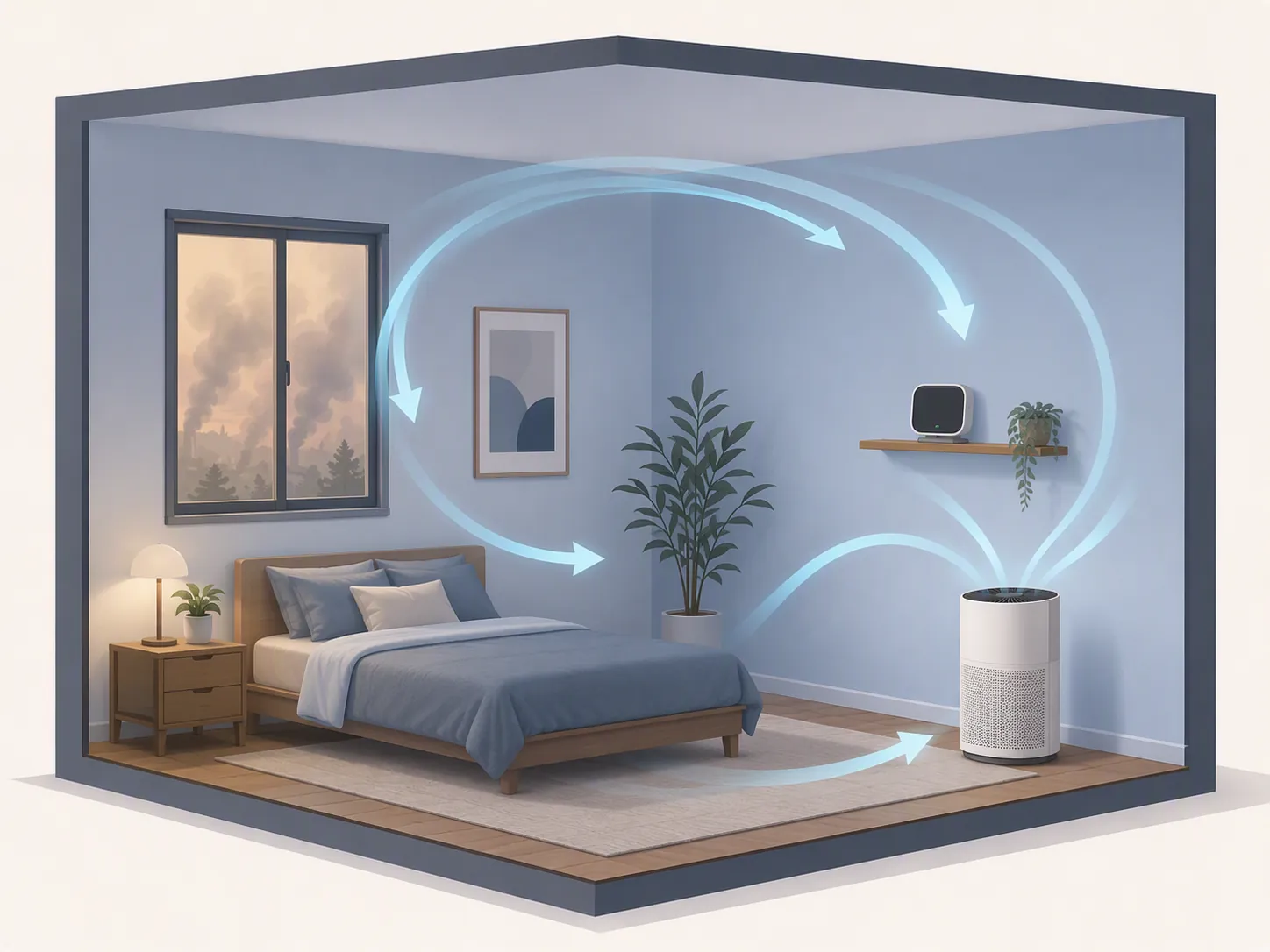
Size the cleaner by CADR, not by the box claim
The useful purifier number is CADR — clean air delivery rate — and for this purpose the dust CADR is the rating to use. The label claim that a device removes a high percentage of particles inside the filter is not the same as cleaning your room fast enough. The room cares about how much cleaned air the unit delivers per minute, where it is placed, and whether it is actually running hard enough.
Harvard Healthy Buildings’ portable air cleaner guidance uses air changes per hour, or ACH, to connect room size to CADR. Its selection guidance describes 6 ACH as ideal, 5–6 as excellent, 4–5 as good, 3–4 as minimum, and below 3 as low.[7] For a smoke-day training room, aim for roughly 5–6 ACH if you can do it without creating a setup you will never actually use.
The math is not complicated, and doing it once is better than trusting a marketing phrase.
| What to find | Why it matters |
|---|---|
| Room area | A 100 ft² bedroom and a 500 ft² living room are different filtration jobs. |
| Ceiling height | Air volume depends on cubic feet, not just floor area. |
| Target ACH | Use roughly 5–6 ACH as the training-room target. |
| Dust CADR in cfm | This tells you whether the cleaner can deliver enough filtered air. |
The working formula is:
Required CADR (cfm) = room area (ft²) × ceiling height (ft) × target ACH ÷ 60So a 120 ft² room with an 8 ft ceiling has 960 ft³ of air. At 5 ACH, the required CADR is 80 cfm. At 6 ACH, it is 96 cfm. That is a very different problem from cleaning an open living room, kitchen, and hallway at once.
Harvard’s sizing tool gives a useful larger-room anchor: a 500 ft² room with an 8 ft ceiling needs about 300 cfm of dust CADR.[8] If your purifier is far below the calculated need, it may still improve the room, but you should not assume it will bring smoke-day PM2.5 down to a conservative training target.
Run it like you mean it
Auto mode is a comfort setting, not a verification plan. On smoke days, run the cleaner on a high enough speed to match the CADR you used in the math, with the room closed, before you train. If the high setting is too loud for the workout itself, pre-clean the room on high, then test whether a lower setting can hold the number while you move.
NCCEH’s 2025 filtration review found that a portable air cleaner with windows closed reduced indoor PM2.5 by a median of about 71%, from 29.2 to 8.5 µg/m³, with a reported range of 18–99%. With windows open, the median reduction fell to about 37%. The same review reports that MERV-13 HVAC or fan-filter approaches reduced indoor PM by 40–95%.[9]
Laumbach’s review also notes that properly sized HEPA cleaners can reduce indoor particulate matter by up to about 80%, drawing on EPA residential air cleaner evidence.[4] The phrase “properly sized” is doing real work there. A capable filter in the wrong room, on the wrong setting, with smoky air continuously entering, is no longer the same intervention.
For a more construction-minded setup path, use the seal-and-filter companions after you understand the measurement gate: 3 Conditions for Safe Indoor Workouts During Wildfire Smoke in Small Spaces and Prepare Your Home Gym for Safe Workouts in Poor Air Quality.
Verify with a corrected PM2.5 monitor
A low-cost PM2.5 monitor is not a laboratory instrument. That does not make it useless. Used consistently, with corrected readings, it can give you the thing purifier marketing cannot: a pass/fail check in the actual room, on the actual day, after the actual setup is running.
Jaffe and colleagues’ 2023 evaluation of PurpleAir-class sensors found that these sensors can be precise, but raw readings are biased high. The Barkjohn 2021 and EPA Fire and Smoke Map corrections performed well for smoke, with slopes of about 0.9 to 1.08 versus regulatory monitors, but those smoke corrections under-reported dust by a factor of 5–6.[10]
That means two things for a home workout during wildfire smoke. First, do not make the call from a raw sensor number if a validated smoke-corrected value is available. Second, do not assume a correction built for wildfire smoke transfers cleanly to every indoor particle source. If you are kicking up dust, cooking nearby, burning candles, or using sprays, the monitor may be seeing a mix that is not the same as outdoor smoke.
Place the monitor where it represents your breathing zone without sitting in the purifier’s direct blast. A shelf across the room is usually more honest than the floor beside the air outlet. Let the room stabilize after closing it and starting filtration. Then read the corrected PM2.5 value before the warm-up, and check again after a few minutes of movement if the session will last long enough for the room conditions to change.
- Pass: corrected PM2.5 is at or below 15 µg/m³ in the closed, filtered training room.
- Caution: corrected PM2.5 is above 15 µg/m³ but improving; keep filtering, reduce leakage, and retest before deciding.
- Fail for this conservative workflow: corrected PM2.5 remains above 15 µg/m³ where you plan to train.
This is deliberately stricter than “the purifier is on” and more honest than pretending the WHO value was written as a workout rule. It is a conservative screen for a situation where you are about to increase ventilation substantially.
Compare home and gym by measuring both
If you have both options, measure them the same way as much as practical: corrected PM2.5, near where you will train, close to the time you will train. The gym does not need to be perfect to beat your apartment. Your apartment does not need to be fancy to beat the gym. The cleaner number wins.
A gym reading is harder to control. You may not be able to choose the ventilation mode, close doors, move filtration, or avoid peak occupancy. That is exactly why a front desk answer is not enough. If the gym has visible air quality displays, ask what they measure, where the sensor is located, and whether the number is PM2.5 rather than a general comfort or CO2 readout. If you bring your own monitor, give it time to settle instead of walking in, seeing one number near the entrance, and declaring the whole facility clean.
The fairest comparison is not “home air” versus “gym air.” It is your mat corner after filtration versus the squat rack area while occupied, or your bedroom training space versus the studio where the class will happen. Peixoto’s finding that occupied training areas ran higher is the part that matters here: the air can change when people are actually using the room.[1]
| If the corrected PM2.5 reading shows… | Then the least-bad choice is… |
|---|---|
| Home room is at or below 15 µg/m³ and gym is higher or unmeasured | Train at home, keeping the room closed and filtration running. |
| Gym training area is at or below 15 µg/m³ and home room is higher | Use the gym, preferably at a lower-occupancy time. |
| Both are at or below 15 µg/m³ | Choose based on workout needs, exposure time, and practical convenience. |
| Neither is at or below 15 µg/m³ | Postpone, shorten, or downgrade the session instead of forcing a hard workout. |
| One space is unmeasured | Treat it as unverified, not as safe by default. |
What to do when the room does not pass
If the corrected number stays above the target, do not solve it by arguing yourself into harder exercise. Make the filtration job easier first.
- Move to a smaller room if the workout can be done safely there.
- Close windows and reduce obvious leakage before retesting.
- Run the cleaner on a higher setting or add enough filtration to reach the needed CADR.
- Wait longer before training; a room may need time to clean down after smoke has entered.
- Switch from hard intervals to mobility, technique work, or a short low-impact session only if the broader smoke-day decision still makes sense for you.
For workout substitutions rather than air verification, use How to Work Out Indoors When the Air Quality Is Bad, Smoky Air? Swap Outdoor Workouts for Indoor Alternatives, or Wildfire Smoke Exercise Safety Tips for Every AQI Level. For home-gym setup during alerts, see Exercising in Smoky Air? Tips for Your Home Gym Setup and How to Work Out at Home During an Air Quality Alert.
The practical verdict is blunt because the invisible assumptions are where smoke-day workouts go wrong: your apartment training room is unverified until measured, and your commercial gym is unverified until measured. A defensible indoor session starts with a room you can close, filtration sized for roughly 5–6 air changes per hour, and a corrected PM2.5 reading that meets the conservative 15 µg/m³ target where you will actually train.
References
- Indoor air quality during physical activity in health clubs: A prospective observational study. Frontiers in Public Health. 2023.
- WHO global air quality guidelines: particulate matter (PM2.5 and PM10), ozone, nitrogen dioxide, sulfur dioxide and carbon monoxide. World Health Organization. 2021.
- Indoor Particulate Matter and Exercise in Children. Iranian Journal of Public Health. 2023.
- Outdoor Air Pollution and Health: Implications for the Practice of Medicine. Annals of the American Thoracic Society. 2019.
- Air pollution and physical activity. European Lung Foundation.
- Wildfire smoke: What is the relationship between outdoor and indoor air? National Collaborating Centre for Environmental Health. 2026.
- Portable Air Cleaners: Selection and Application Considerations for COVID-19 Risk Reduction. Harvard Healthy Buildings.
- Portable Air Cleaner Sizing Tool. Harvard Healthy Buildings.
- Indoor air filtration during wildfires: Impacts on air quality and health. National Collaborating Centre for Environmental Health. 2025.
- Evaluation and application of corrections to low-cost particulate matter sensors in wildfire smoke. Atmospheric Measurement Techniques. 2023.
What a small equipment investment adds
We don't have a build tagged to this exact tier yet. Browse all builds.
How often should you repeat this?
See our recovery and rest reference for citation-anchored rest-interval guidance.
Spot something off?
Tell us if a movement, tier assumption, or duration didn't match your experience.