
Most healthy Ninja Creami recipes for a fitness diet fail in the same annoying way: they show a finished pint, maybe list calories and protein, and then leave you to guess what happens when you change the milk, swap the protein powder, add peanut butter, or try to make it fit a cut instead of maintenance.
That is fine if you only want someone else’s dessert once. It is not enough if the pint needs to fit tomorrow’s macros after training, during a late-night snack window, or inside a week of meal prep where the numbers actually matter.
A better way to build Creami pints is to stop thinking in recipes first and start thinking in four building blocks: liquid base, protein source, thickener or stabilizer, and sweetener. Across tested recipe sources, common fitness-style Creami pints land roughly between 235-450 calories and 22-62 grams of protein per pint, depending on the ingredients used; that range is a planning guide, not a guarantee, because brand formulas and mix-ins move the numbers quickly.[1][2][3][4][5][6]
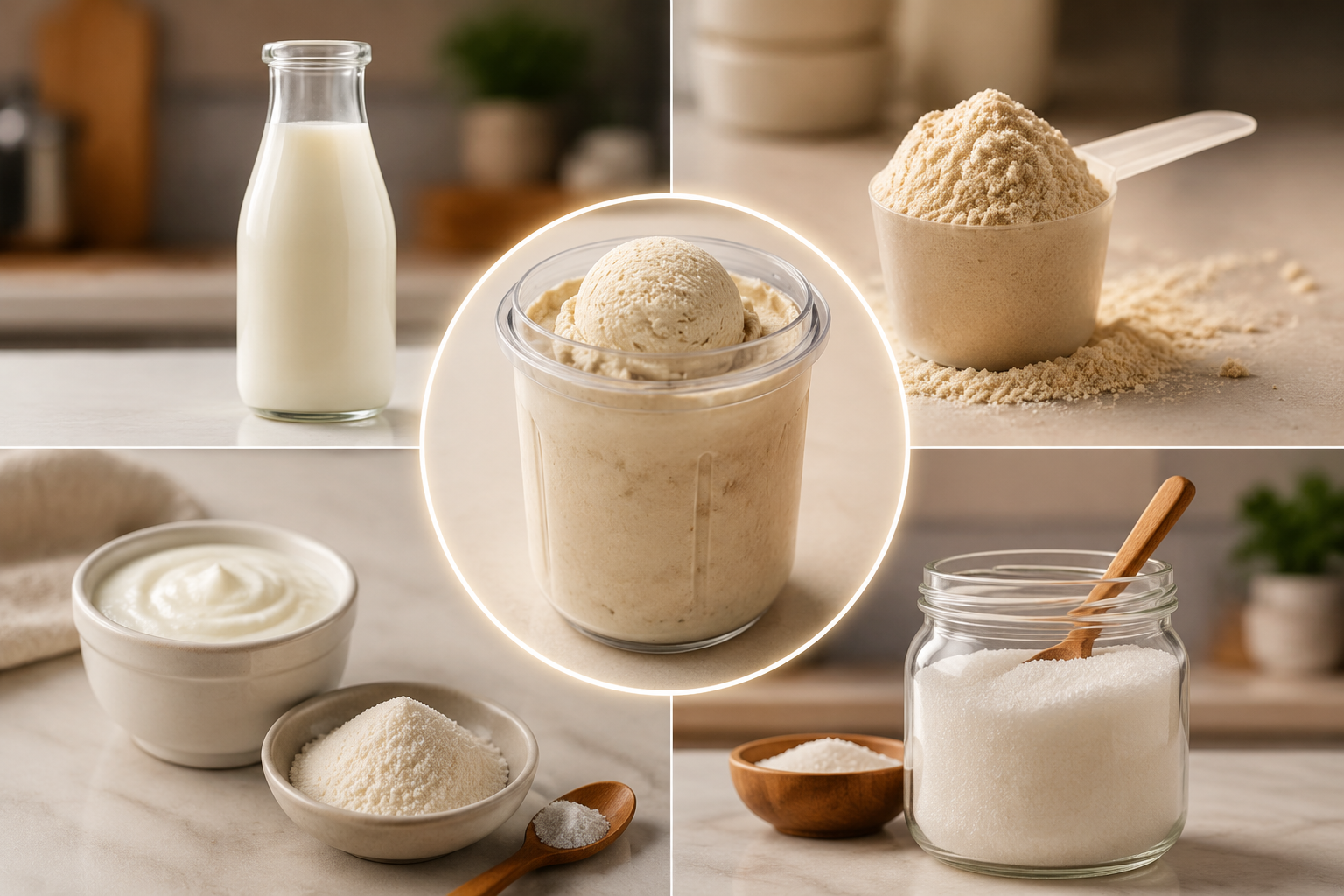
The Four-Block Formula
Every macro-friendly Creami pint is built from the same decision tree. Choose the liquid that sets the calorie and protein floor. Choose the protein that changes both macros and texture. Add a thickener or stabilizer so the frozen base does not spin into flavored ice. Then choose the sweetener that fits the calorie target and your tolerance for sugar alcohols or low-calorie sweeteners.
| Block | What it controls | Best default for fitness pints |
|---|---|---|
| Liquid base | Calories, protein density, creaminess, total volume | Fairlife-style high-protein milk when it fits the budget and macros |
| Protein source | Protein total, body, flavor, chalkiness risk | Whey/casein blend for the most reliable creamy texture |
| Thickener or stabilizer | Ice control, scoopability, mouthfeel | Greek yogurt, cottage cheese, pudding mix, or 1-2g xanthan gum |
| Sweetener | Sweetness, calories, freezing behavior, aftertaste | Monk fruit, allulose-based blends, or small amounts of regular sweetener depending on the lane |
The point is not to make every pint as low-calorie as possible. A 240-calorie volume-eating pint and a 450-calorie bulking pint are both useful if they are built on purpose. The mistake is treating them as the same recipe with different toppings.
Pick the Macro Lane Before the Flavor
Flavor is easier once the lane is set. A chocolate peanut butter pint can be a cutting pint, a maintenance pint, or a bulking pint. What changes is not the name; it is the base, the fat source, and the amount of calorie-dense add-ins.
| Goal | Useful pint target | Ingredient bias |
|---|---|---|
| Cutting | Under 250 calories, over 30g protein, under 10g fat | High-protein milk, lean protein powder, low-calorie sweetener, xanthan gum or yogurt for texture |
| Maintenance | 250-350 calories, 25-35g protein | More room for Greek yogurt, pudding mix, fruit, or modest mix-ins |
| Bulking | 350-450+ calories, 30-45g protein | Higher-calorie milk, more protein base, nut butter, granola, chocolate, or other dense additions |
Those targets are categories for planning, not moral labels. A cutting pint is not “better” than a bulking pint. It just solves a different problem: more volume for fewer calories, enough protein to matter, and fat kept low enough that the rest of the day stays workable.
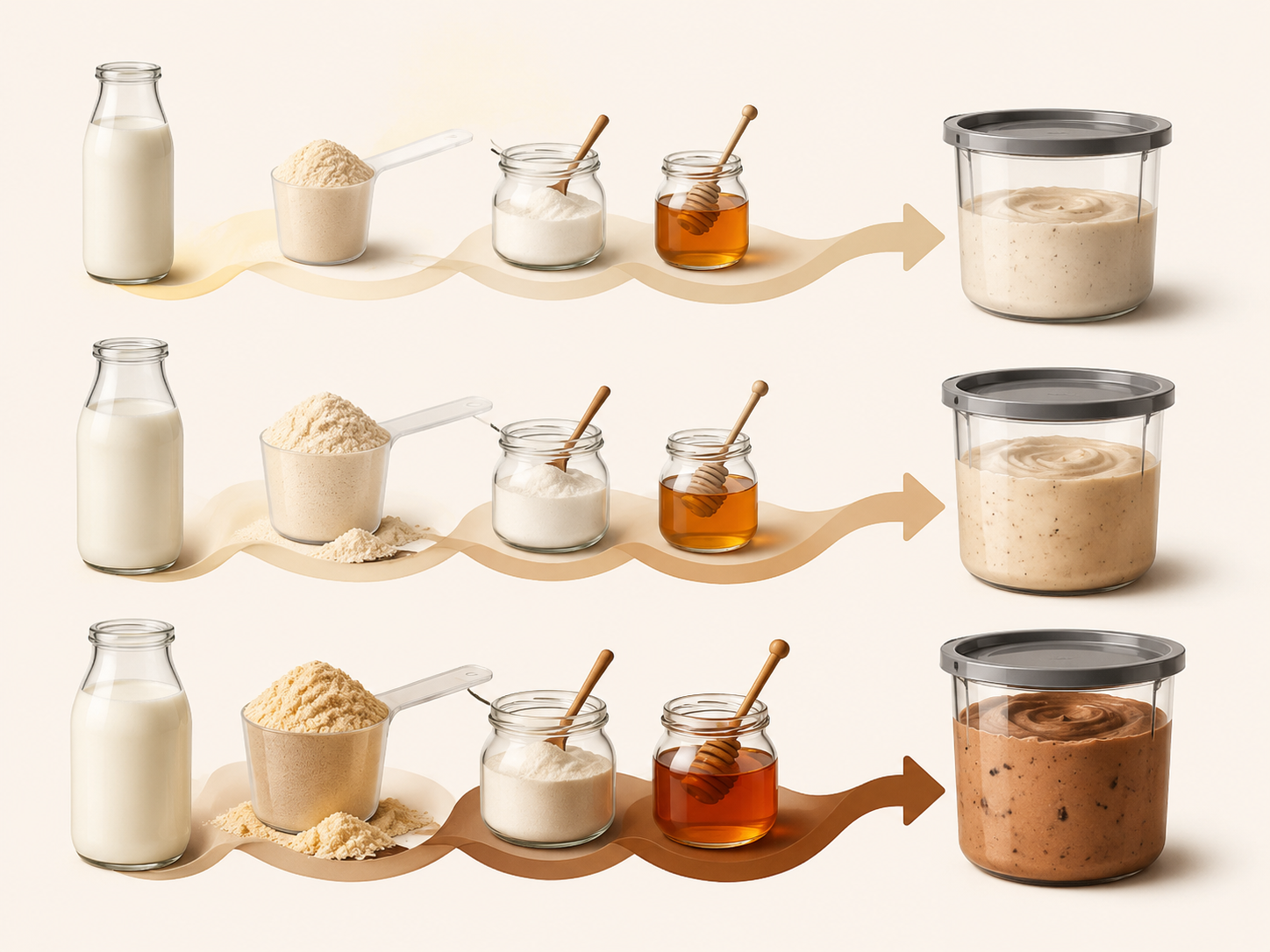
Start With the Liquid Base
The liquid base is where many pints are won or lost before the protein powder even hits the blender. It controls the starting calories, how much protein you get before adding powder, and how creamy the pint can become without relying on heavy fat.
For a high-protein default, Fairlife-style milk has the best texture-to-macro ratio in the sources reviewed because it brings more protein density than standard milk while still behaving like milk in the frozen base. Paired with the right protein powder, it makes a pint that can stay creamy without needing a large calorie budget.
| Liquid choice | Best use | Tradeoff |
|---|---|---|
| Fairlife-style high-protein milk | Default for cutting, maintenance, and post-workout pints | Costs more than standard milk and macros vary by product |
| Skim or low-fat dairy milk | Simple lower-calorie base | Less protein-dense than high-protein filtered milk |
| Unsweetened almond milk or other very low-calorie milk | Aggressive volume-eating cuts | Can turn icy unless the thickener is strong |
| Higher-fat milk | Bulking or dessert-first pints | Better richness but calories rise quickly |
If the pint keeps coming out icy, do not immediately blame the Creami. A very lean liquid base has little fat, little sugar, and sometimes little protein. That is great for the calorie line, but it gives the machine less to work with. The fix is usually not more spin cycles forever; it is a better stabilizer, a thicker protein source, or a slightly less austere base.
Choose Protein for Texture, Not Just Grams
Protein powder is not a neutral macro plug-in. Whey isolate, whey concentrate, whey/casein blends, and plant proteins freeze and spin differently. The same 25 grams of protein can produce a creamy pint, a chalky pint, or a pint that needs repeated respins and still tastes thin.
The strongest default is a whey/casein blend with a high-protein milk base. Whey helps keep the protein high without too many calories, while casein usually brings more body and thickness. That combination is not magic, and brand formulas still matter, but it is more forgiving than relying on a very lean liquid plus a thin whey isolate alone. Additional protein-powder formulation guidance also points to blend choice as a texture variable rather than just a macro decision.[10]
| Protein source | What it tends to do | Where it fits |
|---|---|---|
| Whey isolate | High protein for fewer calories, but can taste thinner or icier | Cutting pints where calories are tight |
| Whey/casein blend | Better body and creaminess for most high-protein pints | Best default for repeatable fitness Creami bases |
| Greek yogurt | Adds protein, tang, and thickness | Maintenance pints, fruit flavors, cheesecake-style bases |
| Cottage cheese | Adds protein and thickness with a mild dairy base when blended smooth | Pudding-mix-free bases and higher-satiety pints |
| Plant protein | Can work, but texture varies widely by formula | Dairy-free builds after small-batch testing |
Greek yogurt and cottage cheese are especially useful because they solve two problems at once: they raise protein and thicken the base. Macro-focused Creami recipes use both as ways to avoid depending entirely on sugar-heavy pudding mixes for body.[3][4]
The Stabilizer Is Where Low-Calorie Pints Survive
Under-300-calorie Creami pints often fail because they remove the ingredients that make traditional ice cream behave like ice cream. Less sugar, less fat, and more water-heavy liquid can mean a base that freezes hard and spins powdery or icy.
Xanthan gum is the most efficient fix when calories are tight. The useful range is small: 1-2 grams per pint can improve stability and reduce iciness in low-fat bases, while too much can make the texture gummy.[7]
| Thickener or stabilizer | Why use it | Watch for |
|---|---|---|
| Xanthan gum | Very low-calorie ice control; good for lean bases | Measure carefully because the difference between creamy and gummy is small |
| Sugar-free pudding mix | Easy flavor and body | Adds ingredients and sweetness; macros vary by brand |
| Greek yogurt | Protein plus thickness | Tang works better with some flavors than others |
| Cottage cheese | Protein plus creamy body when blended smooth | Needs proper blending or the base can taste uneven |
For cutting pints, xanthan gum earns its spot because it barely moves the calories. For maintenance pints, Greek yogurt or cottage cheese often gives a better eating experience because the thickener is also food, not just texture insurance. For bulking pints, you may not need much help if the base already includes more dairy, nut butter, or other calorie-dense ingredients.
Sweeten According to the Lane
Sweetener is the easiest block to underestimate because it can change both calories and texture. Sugar helps frozen desserts feel softer, but it also adds calories fast. Low-calorie sweeteners help with cutting, but they can bring aftertaste or digestive tolerance issues depending on the person.
Allulose-based sweeteners are popular for lower-calorie Creami recipes because allulose contributes about 0.4 calories per gram compared with 4 calories per gram for sugar, though individual response and product blends vary.[6]
| Sweetener | Best fit | Main caveat |
|---|---|---|
| Monk fruit blend | Cutting and low-sugar pints | Blend ingredients vary, so check the label |
| Allulose-based sweetener | Cutting, keto-leaning, or lower-calorie dessert bases | Tolerance and texture vary by person and product |
| Maple syrup or regular sugar | Maintenance or bulking pints where flavor matters more | Calories accumulate quickly |
| Flavor drops or extracts | Adding flavor without many calories | Can taste artificial if overused |
Use Mix-Ins Like Macro Levers
Mix-ins are where a disciplined pint quietly turns into a normal dessert. That is not a problem if it is planned, but it matters if the goal is a predictable macro target.
Powdered peanut butter is the cleanest example of a swap that keeps the flavor direction while changing the macro outcome. PBfit provides 45 calories and 5 grams of protein per tablespoon, compared with regular peanut butter at 95 calories and 4 grams of protein per tablespoon. That difference is enough to matter when the whole pint is supposed to stay under a cutting target.
- For cutting: use powdered peanut butter, cocoa powder, extracts, berries, or low-calorie syrups.
- For maintenance: add measured cereal, fruit, cookie pieces, or a small amount of real nut butter.
- For bulking: use regular peanut butter, granola, chocolate chips, higher-fat dairy, or denser toppings.
The Creami mix-in cycle is not a free macro zone. If the add-in has calories, it belongs in the log just like the base.
Five Pint Builds to Show the System
These are not sacred recipes. Treat them as templates that show how the four blocks shift by goal. Exact macros depend on the brands in your kitchen, especially the milk, protein powder, sweetener blend, and mix-ins.
| Use case | Liquid base | Protein source | Thickener | Sweetener and flavor direction |
|---|---|---|---|---|
| Cutting chocolate pint | High-protein low-fat milk | Whey/casein chocolate protein | 1-2g xanthan gum | Allulose-based sweetener, cocoa powder, vanilla |
| Maintenance strawberry cheesecake pint | High-protein milk | Vanilla protein plus Greek yogurt | Greek yogurt as the main thickener | Monk fruit blend, strawberries, cheesecake extract |
| Bulking peanut butter pint | Higher-calorie milk or larger dairy base | Whey/casein vanilla or chocolate protein | Cottage cheese or pudding mix | Regular peanut butter or measured chocolate mix-ins |
| Post-workout lean pint | High-protein low-fat milk | Fast-digesting whey-heavy protein blend | Xanthan gum or Greek yogurt | Low-calorie sweetener, fruit, low-fat flavor add-ins |
| Volume-eating vanilla pint | Very low-calorie milk plus some high-protein milk if needed | Lean protein powder | 1-2g xanthan gum | Monk fruit or allulose-based sweetener, vanilla, salt |
The post-workout version is just one application of the formula. General sports-nutrition guidance often discusses eating within a 30-60 minute post-workout window, and Creami-specific post-workout frameworks tend to keep fat below 10 grams when the goal is faster digestion; that does not make the Creami uniquely anabolic, it just makes the pint easier to fit into that recovery-style meal slot.[8][9]
How to Diagnose a Bad Pint
When a pint misses, diagnose the block that caused the miss. Most failures are not mysterious; they are the predictable result of pushing one macro lever too far without compensating somewhere else.
| Problem | Likely cause | Next adjustment |
|---|---|---|
| Too icy | Liquid base is too lean or watery | Add 1-2g xanthan gum, use Greek yogurt or cottage cheese, or shift part of the liquid to high-protein milk |
| Too chalky | Protein powder dominates the base | Try a whey/casein blend, reduce powder slightly, or add a dairy thickener |
| Too high-calorie | Mix-ins or fat sources are adding more calories than the base | Swap regular peanut butter for powdered peanut butter or move dense toppings to a bulking pint |
| Not enough protein | Liquid base is low-protein and powder amount is conservative | Use high-protein milk, Greek yogurt, cottage cheese, or a protein powder that fits the flavor |
| Too sweet | Sweetener plus flavored protein plus pudding mix stacked together | Reduce sweetener first, then check whether the protein powder is already heavily sweetened |
| Too thin after spinning | Not enough stabilizer or body | Add Greek yogurt, cottage cheese, pudding mix, or a carefully measured amount of xanthan gum next batch |
The easiest way to make this repeatable is to log the base before freezing, not after tasting. Save the milk, protein powder, thickener, sweetener, and planned mix-ins as one recipe in your tracker. If the pint works, duplicate it and change one block at a time. If it fails, you know which lever moved.
A Reliable Creami Pint Is a Formula, Not a Hack
“Healthy” is too vague to build from. A pint for cutting needs different decisions than a pint for bulking. A post-workout pint has different constraints than a late-night volume snack. Once the target is clear, the build becomes simple: choose the liquid base, choose the protein, choose the stabilizer, choose the sweetener, then treat every mix-in as a deliberate macro lever.
That is where the Ninja Creami becomes useful for a fitness diet. It rewards measured tinkering. The machine does not need one perfect recipe; it needs a base that gives it enough protein, body, sweetness, and stability to spin into something you actually want to eat.
References
- The Best Ninja Creami Protein Ice Cream, The Protein Chef
- Healthy Ninja Creami recipes, George Eats
- Ninja Creami Recipes, The Flexible Dieting Lifestyle
- 25 Best Healthy Ninja Creami Recipes, Fit Healthy Macros
- Favorite Low Calorie Ninja Creami Recipe (High Protein), Live Simply
- The BEST Ninja Creami LOW CALORIE Recipes, The Tasty Travelers
- 12 Ninja Creami Tips for Creamier Ice Cream, Maria Lucey Dietitian
- Ninja Creami recipes to power your post-workout routine, Freeletics
- Ninja Creami Protein Ice Cream, Functional Bodybuilding
- Ninja Creami High-Protein Ice Cream Ideas, Katelynnutrition.com


Comments
Join the discussion with an anonymous comment.