
The Rock-Inspired Home Workout for Muscle Growth
Dwayne Johnson's coach Dave Rienzi builds muscle with pause reps, slow negatives, static holds, and short rests — none of which require an Iron Paradise gym. Here's how to run those coach-tested techniques on dumbbells and bands at home, in a full-body session built for real hypertrophy.
- Equipment tier required
- $100-300
- Duration
- 60 min
- Difficulty
- intermediate
- Target area
- full body
- Space footprint needed
- one clear strip of floor
- Noise level
- low
The useful part of a Dwayne Johnson-inspired home workout for muscle building is not pretending your living room is a movie-star training compound. It is asking what his coach is trying to make the muscle do, then recreating that stress with the tools most home lifters actually own.
For this session, the assumed gear tier is simple: dumbbells plus resistance bands. If you are still matching equipment to workouts, use the dumbbells-and-bands home setup as the reference point. You do not need machines, a barbell, or a 90-minute bodybuilding split to use the methods below.
Dave Rienzi, Johnson’s strength coach, gave the key in one line during Johnson’s Black Adam prep: “The philosophy I have now isn’t about lifting maximal weight, it’s about how can I maximally fatigue the muscle with a certain weight.” In the same discussion, Rienzi pointed to pre-exhaustion, pause reps, and static holds as tools used to build more muscle without simply chasing heavier loads.[1]

That is the bridge from celebrity routine to home training. Johnson’s actual programming changes by role, year, and training phase, so this is not presented as his program. It is a principle-based adaptation of methods his coach has publicly described.
What transfers from Johnson’s training, and what does not
The equipment does not transfer cleanly. A full gym lets a coach use cables, machines, specialty stations, multiple angles, and fast exercise changes. A home lifter may have one clear strip of floor and two dumbbells that are either slightly too light for legs or slightly too heavy for lateral raises.
The fatigue methods transfer very well. Slow negatives, peak squeezes, pauses, static holds, pre-exhaust sets, short rests, and high-rep leg work all make a moderate load feel heavier because they reduce the room for momentum and increase the time the target muscle spends working.
That matters for the home lifter with limited load. If your dumbbells are not heavy enough for classic low-rep strength work, you can still make sets difficult by controlling the eccentric, pausing where the muscle has to stay active, shortening rest, and placing an isolation move before a compound move.
The coach-tested methods, translated for dumbbells and bands
| Method | What Rienzi has described | Home translation |
|---|---|---|
| Pre-exhaust | Using an isolation-style move before a bigger lift was one of the Black Adam prep techniques Rienzi discussed.[1] | Do band flyes before dumbbell floor presses, band pull-aparts before rows, or bodyweight split squats before loaded split squats. |
| Pause reps with peak squeeze | Rienzi identified pause reps as a way to increase muscular fatigue during Johnson’s prep.[1] | Pause for 1–2 seconds where the target muscle is most contracted: top of a curl, top of a row, top of a lateral raise, or squeezed position of a band fly. |
| Static holds | Static holds were also named as a Black Adam hypertrophy tool.[1] | Hold the last rep of a row, curl, lateral raise, wall sit, or band fly for 10–30 seconds instead of ending the set immediately. |
| Slow negatives | Rienzi told Men’s Health in 2019 that “35-pound dumbbell curls with a 4-second negative for 10 reps is a brutal exercise.”[2] | Use a 3–4 second lowering phase on curls, Romanian deadlifts, goblet squats, split squats, and floor presses when the dumbbells are not heavy enough. |
| Short rests | Rienzi described resting “a minute to a minute and a half between sets.”[2] | Use 60–90 seconds for the main hypertrophy work, and shorter transitions only when form does not fall apart. |
| High-rep leg work | Rienzi said, “I’ve found the legs actually tend to grow a little better in that higher rep range,” in the context of chasing blood volume.[2] | Use 15–25 rep goblet squats, split squats, and lunges when your dumbbells are too light for heavy lower-body loading. |
| Drop-set finishers | Rienzi’s 2019 leg-day discussion included drop-set lunge finishers.[2] | After loaded reverse lunges, put the dumbbells down and continue with bodyweight lunges or split-squat pulses. |
Pre-exhaust: make the target muscle show up early
Pre-exhaust is useful at home because your strongest muscles and best leverage often take over when load is limited. If your triceps dominate floor presses, do band flyes first. If your upper traps hijack rows, do controlled band pull-aparts or straight-arm band pulldowns first. The point is not to destroy yourself before the main lift. It is to make the muscle you care about easier to find once the compound movement starts.
Keep these sets smooth and moderately hard. A pre-exhaust set that turns into a sloppy max-effort set usually steals performance from the lift it was supposed to improve.
Slow negatives and pause reps: remove the places you normally cheat
The 4-second negative curl example is the cleanest home-training lesson in the material. A 35-pound dumbbell curl can be brutally hard when the lowering phase is controlled instead of dropped.[2] The same logic works with lighter dumbbells: curl up normally, squeeze briefly, then take 3–4 seconds to lower without letting the elbow drift forward or the shoulder roll.

Pause reps are not just “stop somewhere and suffer.” Put the pause where the target muscle still has to work. On a dumbbell row, pause with the elbow pulled back and the shoulder blade controlled. On a band fly, pause with the hands together and the chest squeezed. On a squat, pause just above the bottom rather than relaxing into the joints.
Static holds: finish the set after the reps are done
Static holds are a practical way to extend a set without needing a heavier dumbbell. After your final rep, hold the hardest useful position: top of a lateral raise, contracted row, midpoint wall sit, or squeezed band fly. Ten honest seconds can be enough if the reps before it were strict.
Do not turn every exercise into a hold. Use them where the setup is stable and the position is easy to control. A shaky overhead hold with tired shoulders is a poor trade; a held row or wall sit is cleaner.
Short rests and high-rep legs: the home lifter’s pressure cooker
Rienzi’s “minute to a minute and a half” rest window is home-friendly because it keeps the session dense without turning it into cardio.[2] For most of the workout below, rest 60–90 seconds after hard sets. If a set leaves you breathing too hard to brace or control the next rep, take the full 90 seconds.
Legs usually need special handling at home. A pair of moderate dumbbells may be plenty for curls and lateral raises, but not enough for heavy squats. Higher reps, longer descents, split-stance work, and lunge drop sets help close that gap without jumping or pounding the floor.
If you need more neighbor-safe options around this style of training, the same no-jump logic shows up in the quiet apartment workout for bad air quality days and the boxing workout at home with no equipment. This workout stays in that apartment-friendly lane: controlled reps, no jumps, no dropped weights.
The Rock-inspired dumbbell-and-band hypertrophy workout
Run this as a full-body session 2–3 times per week, with at least one day between hard sessions. It is built for an intermediate home lifter who already knows basic dumbbell technique and can train close to failure without losing position.
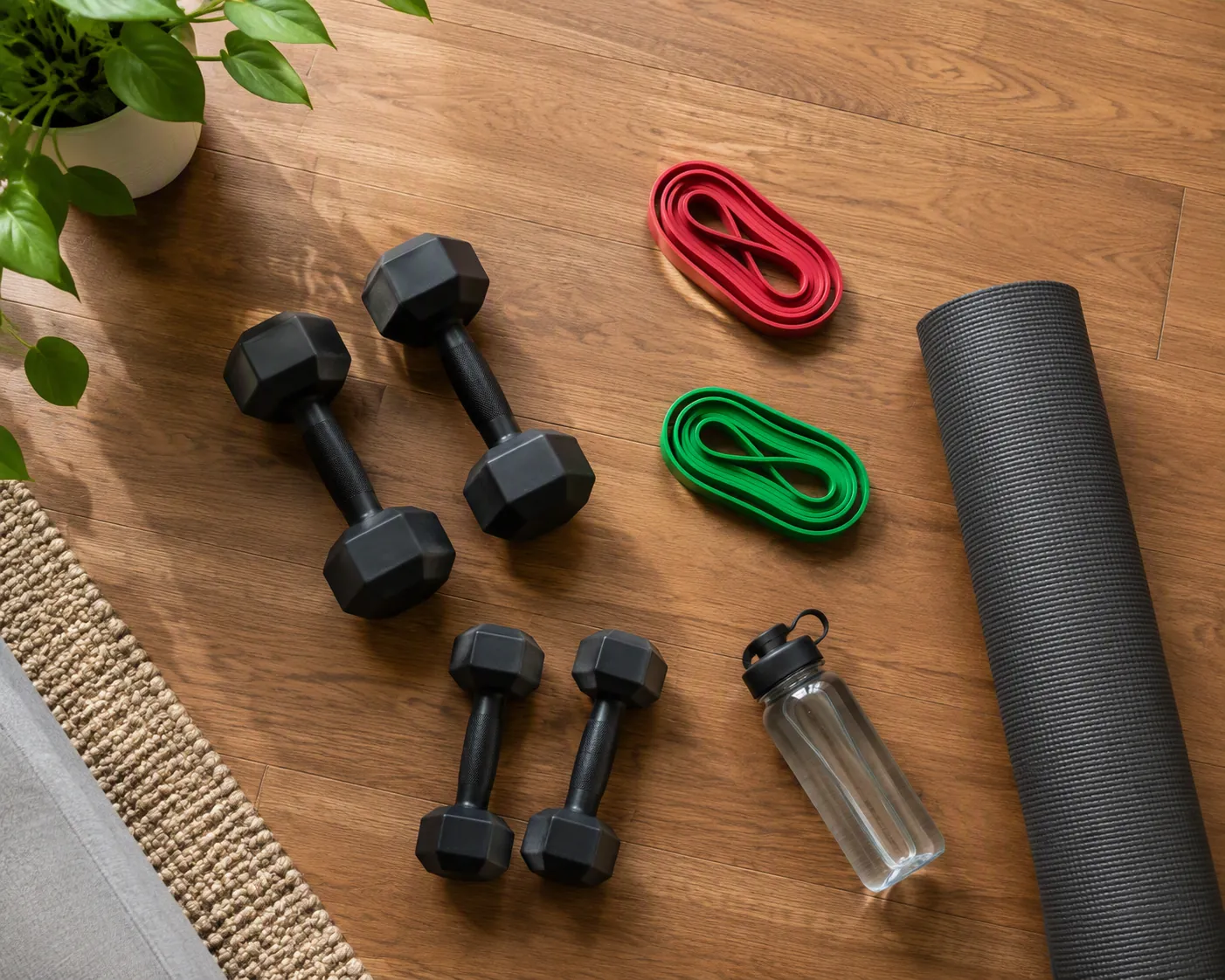
Choose a load that leaves about 2–3 good reps in reserve on the first working set. By the final set of an exercise, you should be close to technical failure: the target muscle is nearly done, but your joints, balance, and tempo are still under control.
| Block | Exercise | Sets and reps | Tempo / pause / hold | Rest |
|---|---|---|---|---|
| Warm-up | Band pull-aparts, hip hinges, bodyweight squats, incline or kneeling push-ups | 1–2 easy rounds | Move smoothly; do not fatigue yourself yet | As needed |
| Chest pre-exhaust | Band fly | 2 x 15–25 | 1-second stretch, 2-second squeeze at the front | 30 seconds before floor press |
| Chest press | Dumbbell floor press | 3 x 8–12 | 3-second lower, light pause with upper arms on floor, press hard without bouncing | 60–90 seconds |
| Back pre-exhaust | Band pull-apart or band straight-arm pulldown | 2 x 15–25 | Hold the squeezed position for 1–2 seconds each rep | 30 seconds before row |
| Back row | One-arm dumbbell row | 3 x 10–15 each side | 2-second squeeze at the top; final rep hold for 10–20 seconds | 60–90 seconds after both sides |
| Quad focus | Goblet squat | 3 x 15–25 | 3-second lower, 1-second pause just above bottom, stand without locking out hard | 60–90 seconds |
| Hip hinge | Dumbbell Romanian deadlift | 3 x 10–15 | 4-second lower, 1-second stretched pause, controlled rise | 60–90 seconds |
| Shoulders | Dumbbell lateral raise | 3 x 12–20 | Raise under control, pause 1 second near shoulder height; last set ends with a 10-second partial-range hold | 60 seconds |
| Arms superset | Dumbbell curl + band overhead triceps extension | 2–3 x 10–15 curls and 12–20 extensions | Curl with a 4-second negative; squeeze triceps hard at full extension | 60–90 seconds after both moves |
| Leg finisher | Reverse lunge drop set | 2 rounds: 8–12 each leg loaded, then 8–15 each leg bodyweight | No bouncing; put dumbbells down only after the loaded reps are complete | 90 seconds between rounds |
| Optional trunk hold | Suitcase hold or front rack dumbbell hold | 2 x 30–45 seconds each side or position | Stand tall, ribs down, no leaning | 60 seconds |
How the session should feel
The first working set of each exercise should feel almost too controlled. That is intentional. The difficulty should climb because the muscle is spending more time under tension, not because the reps are getting loose.
By the end of the floor presses, rows, goblet squats, Romanian deadlifts, and lunges, the last 2–3 reps should move slowly even though you are trying to move them with intent. If you could hold a conversation during the final set of goblet squats, the load, tempo, or range of motion is probably too easy. If you have to twist, bounce, or cut the range short to survive the set, the load is too heavy for this method.
If your dumbbells are too light
- Use the top of the rep range before changing anything else. A light goblet squat becomes a different exercise at 25 controlled reps.
- Lengthen the negative to 4 seconds on the main lift of the block.
- Add a 1–2 second pause where the target muscle is still loaded.
- Switch to unilateral work: split squats, one-arm rows, one-arm presses, single-leg Romanian deadlifts.
- Add a band only if it increases tension in the right place. A band that pulls you out of position is not an upgrade.
- Shorten rest toward 60 seconds, but only while you can still hit the intended reps and tempo.
If the workout is too long
Keep the chest, back, squat, hinge, and lunge finisher. Cut the optional trunk hold first. Then reduce the arms superset to 2 rounds. The session still works if the major patterns are trained hard and the fatigue methods are applied honestly.
Progress it without changing everything
Rienzi has said he changes Johnson’s program roughly every 2–3 weeks to keep the stimulus varied.[2] For a home lifter, that does not mean randomizing the workout every session. It means running the same structure long enough to see whether you are actually improving, then rotating the emphasis before the work gets stale.
Use this progression order:
- First, add reps within the listed range while keeping the same tempo.
- When you can hit the top of the range on every set, add dumbbell load or band tension if available.
- If load is capped, add a longer negative or a longer peak squeeze to one exercise per muscle group.
- After about 2–3 weeks, rotate one variable: change the pre-exhaust move, swap goblet squats for split squats, or move the static hold to a different exercise.
- Do not increase reps, tempo, holds, rest restriction, and exercise difficulty all at once.
A simple log is enough: exercise, load or band, reps, tempo, rest, and whether the last set stayed clean. If those numbers are not moving over several sessions, the workout is hard but not necessarily progressive.
Where this fits next to other celebrity-inspired home routines
This is the muscle-building version of a celebrity-inspired home routine: heavier effort, closer proximity to failure, longer sets, and more local muscular fatigue. If you want the opposite end of that spectrum — movement quality, longevity, and consistency with less bodybuilding pressure — the Mick Jagger longevity workout at home is the better sibling article.
Recovery still decides how much of this work you can absorb. If you are dieting hard, returning from a layoff, or using medication that changes appetite, treat muscle retention and protein as a separate problem rather than burying it inside this workout. The GLP-1 muscle-preservation guide covers that lane more directly.
The honest limitation
You are not copying Dwayne Johnson’s actual training week here. You are not recreating his role-specific schedule, recovery setup, food intake, coaching access, or gym options. The exact routine changes depending on the job in front of him, and public workout snapshots from different years should not be stitched together as if they were one permanent master plan.
What you can copy is the useful part: make a moderate weight brutally effective through pre-exhaustion, slow negatives, pause reps, static holds, short rests, and high-rep leg work. The Rock’s equipment is not the lesson. Rienzi’s way of making the muscle run out of options is.
References
- 3 Workout Techniques The Rock Used to Take His Physique to the Next Level for Black Adam, According to His Strength Coach, Business Insider, October 2022.
- The Rock's Strength Coach Dave Rienzi Shares His Leg Day Workout, Men’s Health, 2019.
What a small equipment investment adds
We don't have a build tagged to this exact tier yet. Browse all builds.
How often should you repeat this?
See our recovery and rest reference for citation-anchored rest-interval guidance.
Spot something off?
Tell us if a movement, tier assumption, or duration didn't match your experience.