
Schwarzenegger Debunks Testosterone Myths with Home Workout
Learn the three testosterone myths Arnold Schwarzenegger has debunked using the latest research, and discover his bodyweight home workout that can help support natural testosterone levels without TRT or supplements.
- Equipment tier required
- none
- Duration
- 30 min
- Difficulty
- beginner
- Target area
- full body
- Space footprint needed
- small room
- Noise level
- low
Search for Arnold Schwarzenegger, testosterone, and a home workout, and it is easy to expect one of two things: a secret hormone hack from a bodybuilding legend, or another warning that testosterone turns men into reckless gym animals. Arnold’s recent Pump Club writing is more useful than either version. He has been separating the loud myths from the evidence, and the result is oddly practical for the guy training between a couch, a doorframe, and two chairs.
The important distinction: Arnold has not presented his old bodyweight routine as a testosterone protocol. He has debunked testosterone myths in separate pieces, and he has separately shared a no-gym routine built around basic bodyweight moves. The connection worth making is narrower and more honest: the research he points to makes the home-training route look more credible than the usual shortcut talk.
The aggression myth is the fastest one to clear out
Arnold’s July 23, 2026 Pump Club piece addressed the popular claim that testosterone causes aggression or reckless decision-making. He cited a 1,000-man adversarial collaboration study and a 12-trial meta-analysis, then landed on a plain conclusion: testosterone “turns up the volume on who you already are,” rather than simply making men aggressive or reckless [1].
That matters because a lot of home-training testosterone content starts with fear or fantasy. The fear version treats testosterone as a behavioral contaminant. The fantasy version treats it as the chemical source of confidence, dominance, and better workouts. Arnold’s framing is less dramatic. It makes testosterone relevant, but not magical.
There is a boundary here. The study Arnold discussed involved single-dose administration in men ages 18 to 45, not years of testosterone replacement therapy or steroid use [1]. So it should not be stretched into a blanket statement about every clinical or nonmedical testosterone scenario. But it does puncture the lazy claim that more testosterone automatically means more reckless behavior.
The post-workout spike is not the prize
The more useful myth for lifters is the idea that a workout “works” because it creates a temporary testosterone spike. This one has been sold for years with heavy squats, brutal circuits, and the kind of programming that makes a hotel-room workout feel second-rate before it even starts.
Arnold highlighted research showing that men who produced massive post-workout testosterone spikes over a 12-week training period did not gain more muscle than men with lower spikes. The differentiator was not the size of the temporary hormone surge; it was androgen receptor content in muscle tissue [2].
For home training, that is good news. It means the useful question is not, “Did this session create the biggest testosterone spike?” It is, “Did I give the muscles a strong enough reason to adapt, and can I repeat that work consistently?” Pushups taken close to technical failure, slow chair rows, hard squats, chinups, and conditioning intervals can answer that question without a barbell or a lab panel.
This also keeps the workout honest. A hard session may temporarily move hormones, but the temporary movement is not the same as long-term muscle gain or treatment for low testosterone. If symptoms point toward clinical hypogonadism, a home circuit is not a diagnosis and not a substitute for medical evaluation. For readers weighing shortcuts, it is worth separating training from therapy and understanding the real risks of testosterone for home workouts.
The biggest natural lever is usually fat loss, not a booster
Arnold’s most practical testosterone point is also the least glamorous: for men carrying excess body fat, fat loss appears to be a stronger natural lever than the supplement aisle. In a 46-year research review he cited, losing 5 percent of body weight was associated with an average testosterone increase of about 58 ng/dL, losing 10 percent with about 84 ng/dL, and losing 30 percent with about 251 ng/dL [3].
Those numbers should be read carefully. They come from a long research review, not a promise that every man will see the same change after losing a specific amount of weight. Still, the direction is hard to ignore. If a man is overfat, the reliable work is not hunting for a cleaner “natural testosterone booster.” It is building a calorie-controlled eating pattern, training enough to preserve or build muscle, and keeping conditioning in the week.
That is where a home program becomes useful. The best home workout is not special because the living room has some hormonal advantage. It is special because the barriers are lower. No commute, no waiting for equipment, no need to turn one missed gym day into a missed week. Pair that with a sensible food plan—something like a home gym athlete’s nutrition plan—and the boring lever becomes usable.

HIIT belongs beside the routine, not above it
High-intensity interval training is the one place where the testosterone discussion gets more specific for home trainees. A study discussed in coverage of Arnold’s HIIT recommendations had sedentary young men, ages 18 to 45, perform HIIT three times per week for 12 weeks. The protocol used four 4-minute sprint intervals with 3-minute rests, and total testosterone increased by up to 16 percent, or about 37 to 45 ng/dL [4].
That is useful, not universal. The men were young and sedentary, so the result should not be casually applied to older men, already-trained lifters, or men with medically low testosterone. But for the home trainee who has only been doing casual sets of pushups, it gives a reasonable next lever: add hard conditioning a few days per week, scaled to the joints and space available.
At home, “sprints” do not have to mean a track. They can be stationary bike intervals if you have one, stair climbs if the setup is safe, fast step-ups, shuttle runs in a garage, or low-impact intervals built around mountain climbers and squat-to-reach movements. The standard is not theatrical exhaustion. The hard portions should feel hard enough that talking becomes difficult, and the rests should let you repeat quality work.
For men thinking about age-related changes, the useful comparison is not HIIT versus strength training. It is how to combine them without turning every day into a stress test. A fuller look at the type of home workout that counteracts testosterone decline after 30 belongs next to this conversation because resistance work, conditioning, recovery, and body composition are tangled together in real life.
Arnold’s no-gym routine is the practical payoff
Arnold has been unusually consistent about one simple training idea: the body itself is a serious tool. In Pump Club, he wrote, “Your body is a great training tool,” and his older fitness writing described bodyweight training as one of the oldest training methods [5][6]. He also said on Reddit that he began with chinups on a tree branch by a lake in Austria, before the famous gyms, the competitive career, and the later performance-enhancing-drug context people often attach to his name [7].
The no-gym routine he shared in 2020 is built from nine moves: pushups, dips between chairs, rows between chairs, situps, bent-leg raises, bent-over twists, squats, calf raises, and chinups. Published versions of the routine included beginner and advanced rep targets, with some high numbers by modern recreational standards, such as 50 pushups and up to 100 situps [7][8][9].
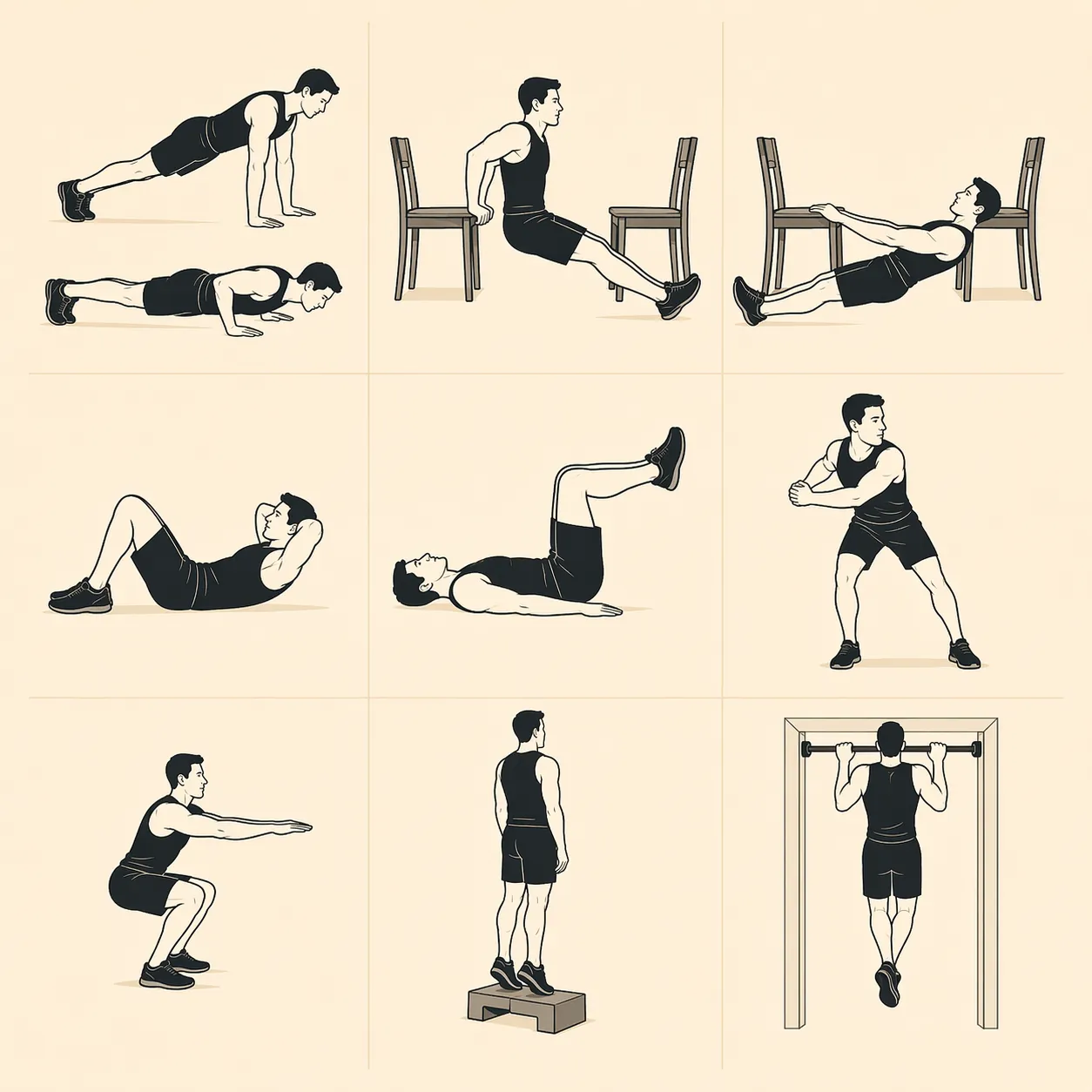
| Exercise | Home setup | How to use it now |
|---|---|---|
| Pushups | Floor space | Use clean reps; elevate hands if full floor pushups break down. |
| Dips between chairs | Two stable chairs | Only use chairs that will not slide; keep shoulders controlled. |
| Rows between chairs | Two chairs and a sturdy bar or broom handle setup | Treat setup safety as the limiting factor; if uncertain, use towel rows or table rows only with a stable surface. |
| Situps | Floor space | Cap reps when hip flexors or low back take over. |
| Bent-leg raises | Floor space | Move slowly and keep the low back from arching hard off the floor. |
| Bent-over twists | Floor space | Use as trunk rotation work, not a speed contest. |
| Squats | Floor space | Add tempo, pauses, or single-leg progressions when regular reps get too easy. |
| Calf raises | Floor or step | Use a wall or rail for balance; pause at the top and bottom. |
| Chinups | Tree branch, beam, or pullup bar | Use assisted reps, negatives, or hangs if full chinups are not there yet. |
The chair work deserves a little adult supervision. A dip between two chairs is only a good exercise if the chairs are stable. A row setup is only useful if it does not collapse when you pull. Home training removes the gym commute, not the need for judgment.
The original rep schemes also need context. Arnold’s numbers came from a man with a lifetime of training and a taste for volume. A middle-aged home trainee does not need to open with 100 situps to prove commitment. Better starting rules are simple: stop a set when form changes, leave one or two clean reps in reserve on early rounds, and add volume only after the joints tolerate the work.
A reasonable way to run it
For most home trainees, the routine works better as a repeatable template than as a one-day test. Put the strength moves first, keep the trunk work controlled, and add conditioning on separate days or after a shorter strength session.
- Two or three days per week: bodyweight strength using the nine Arnold movements, scaled to form.
- One to three days per week: short HIIT or vigorous conditioning, depending on recovery and current fitness.
- Most days: walking or easy movement to support fat loss without adding more high-intensity stress.
- Every week: adjust food intake if fat loss is part of the testosterone-support goal.
A simple session could be pushups, chair rows, squats, calf raises, dips, chinup practice, and then two or three trunk movements. Another day could be a shorter strength circuit followed by intervals. If the joints complain, reduce range of motion, slow the tempo, or swap the exercise. The point is progressive work, not reenacting someone else’s best training day.
Readers who like the nine-move format can also compare it with Anthony Joshua’s 9-move home workout circuit or use a separate no-equipment home workout challenge for variety. Variety is helpful when it keeps training consistent; it is not helpful when it becomes another way to avoid progression.
What this can and cannot do for testosterone
Arnold’s myth-busting does not prove that one bodyweight workout will raise testosterone in a meaningful or lasting way. The post-workout spike research argues against judging training by temporary hormone bumps. The fat-loss review points toward body composition as a major natural lever. The HIIT study gives a promising but limited example in young sedentary men. Put together, they support a practical strategy, not a hormonal guarantee.
That strategy is still worth taking seriously. Train against resistance, even if the resistance is bodyweight. Add hard conditioning if your recovery allows it. Lose excess fat if you need to. Keep the routine repeatable enough that you can do it in an apartment, garage, or hotel room without waiting for perfect equipment.
The useful Arnold lesson is not that testosterone is irrelevant, or that a home circuit replaces TRT, or that supplements are always harmless because they are sold as “natural.” It is that the most credible levers are already close at hand: muscle work, conditioning, fat loss when needed, and enough consistency for those levers to matter.
References
- Does Testosterone Make Men Reckless and Aggressive? — Arnold’s Pump Club — July 23, 2026
- What Most People Get Wrong About Testosterone and Growth Hormone — Arnold’s Pump Club
- Let’s Talk About Testosterone — Arnold’s Pump Club
- Why Arnold Schwarzenegger Swears by HIIT to Boost Testosterone — Hone Health
- Training at home — Arnold’s Pump Club
- Your Body is All You Need — Schwarzenegger.com
- Arnold Schwarzenegger shared his home workout routine on Reddit — CNBC — March 25, 2020
- Arnold Schwarzenegger Shared His No-Gym Home Workout Program — Men’s Health
- Arnold Schwarzenegger Shares His Favorite No-Gym Workout From His Youth — BarBend
What a small equipment investment adds
We don't have a build tagged to this exact tier yet. Browse all builds.
How often should you repeat this?
See our recovery and rest reference for citation-anchored rest-interval guidance.
Spot something off?
Tell us if a movement, tier assumption, or duration didn't match your experience.