
Can Seniors Do Pole Dancing Fitness at Home?
Seniors can safely practice pole dancing fitness at home by reframing it as seated and standing strength work using a pole as support. This guide covers the chair-to-standing progression, required equipment, and real case studies of older adults who improved bone density and balance.
Before you start
- Equipment required
- Pole, crash mat, chair
- Assumes build tier
- No specific tier required
- Duration
- 15 minutes
- Difficulty
- beginner
- Noise level
- low
If “pole dancing fitness at home for seniors” makes you picture climbing, spinning, or hanging upside down, put that picture aside. The safer starting version looks much plainer: a sturdy chair, a properly installed vertical pole, a crash mat, and an older adult using the pole like a well-placed handrail.
That is not a watered-down apology for pole fitness. It is the version that makes sense for a beginner in their 60s, 70s, or beyond. Bastet Dance Fitness’s Pole Gold program for mature adults and Moxie Movez’s senior classes both begin with seated work: hands on the pole, gentle rotations, grip practice, and confidence-building before standing drills are added.[1][2]
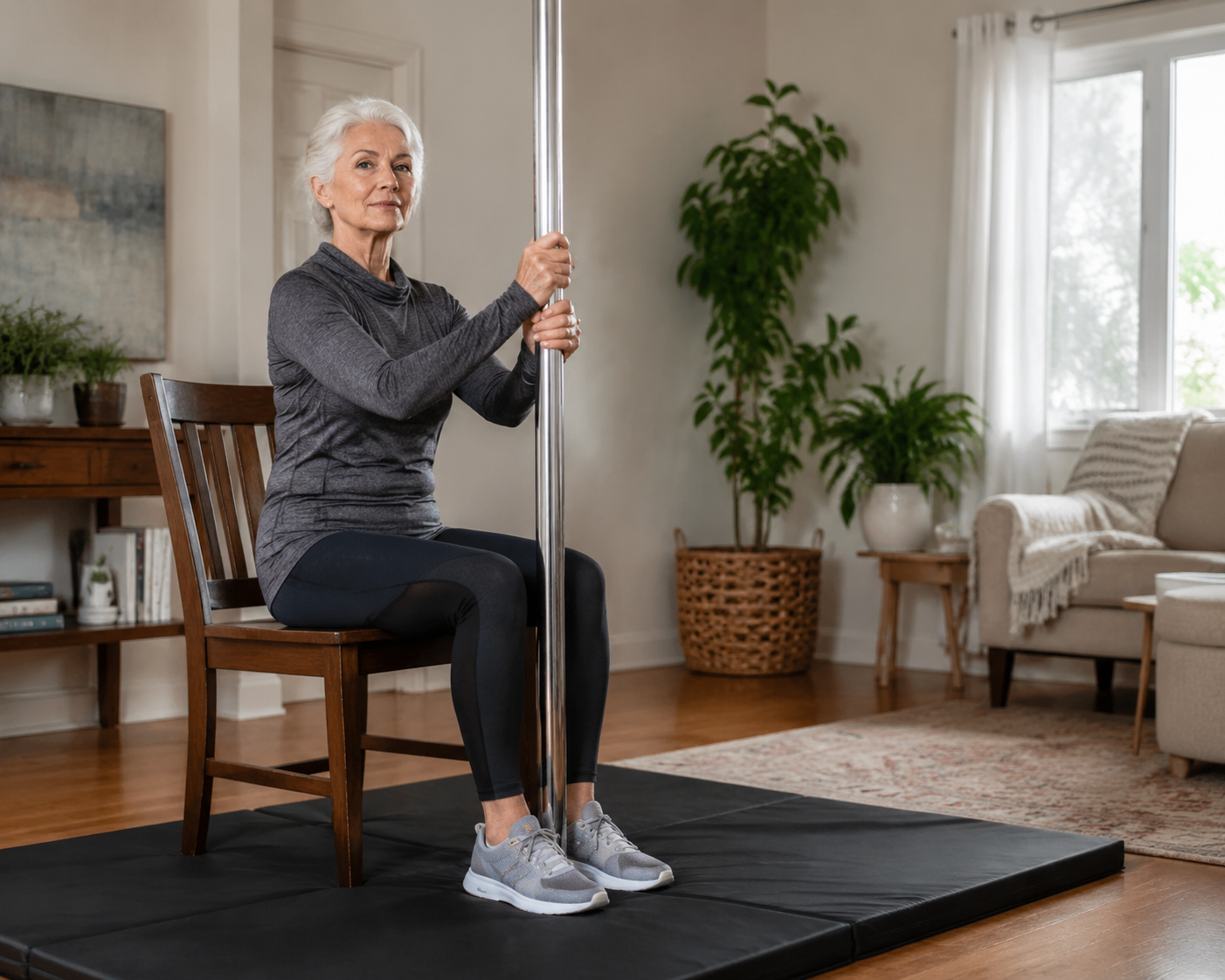
The Senior Version Starts In A Chair
A chair is not a beginner’s embarrassment. It is the control station. From seated, a senior can learn what the pole feels like in the hands without also managing a full body-weight shift, a nervous knee, or a sudden wobble.
The first useful session is small. Sit tall near the pole. Place both feet flat. Hold the pole around chest height. Practice closing the fingers fully, then easing the grip. Try a gentle seated torso turn while the pole gives the hands a reference point. Notice whether the shoulders hike up, whether the wrists complain, whether getting out of the chair already feels like the hard part.
That may sound too modest if you have watched studio clips online. For a home beginner, it is exactly where the information is. Grip strength, shoulder comfort, confidence, and the ability to stop without panic all matter before anyone adds standing movement.
| Stage | What It Looks Like | What It Is Testing |
|---|---|---|
| Seated grip and posture | Sit in a sturdy chair, hold the pole with one or both hands, breathe normally | Hand comfort, shoulder position, confidence |
| Seated rotation | Turn the torso gently while feet stay planted | Trunk mobility, dizziness response, control |
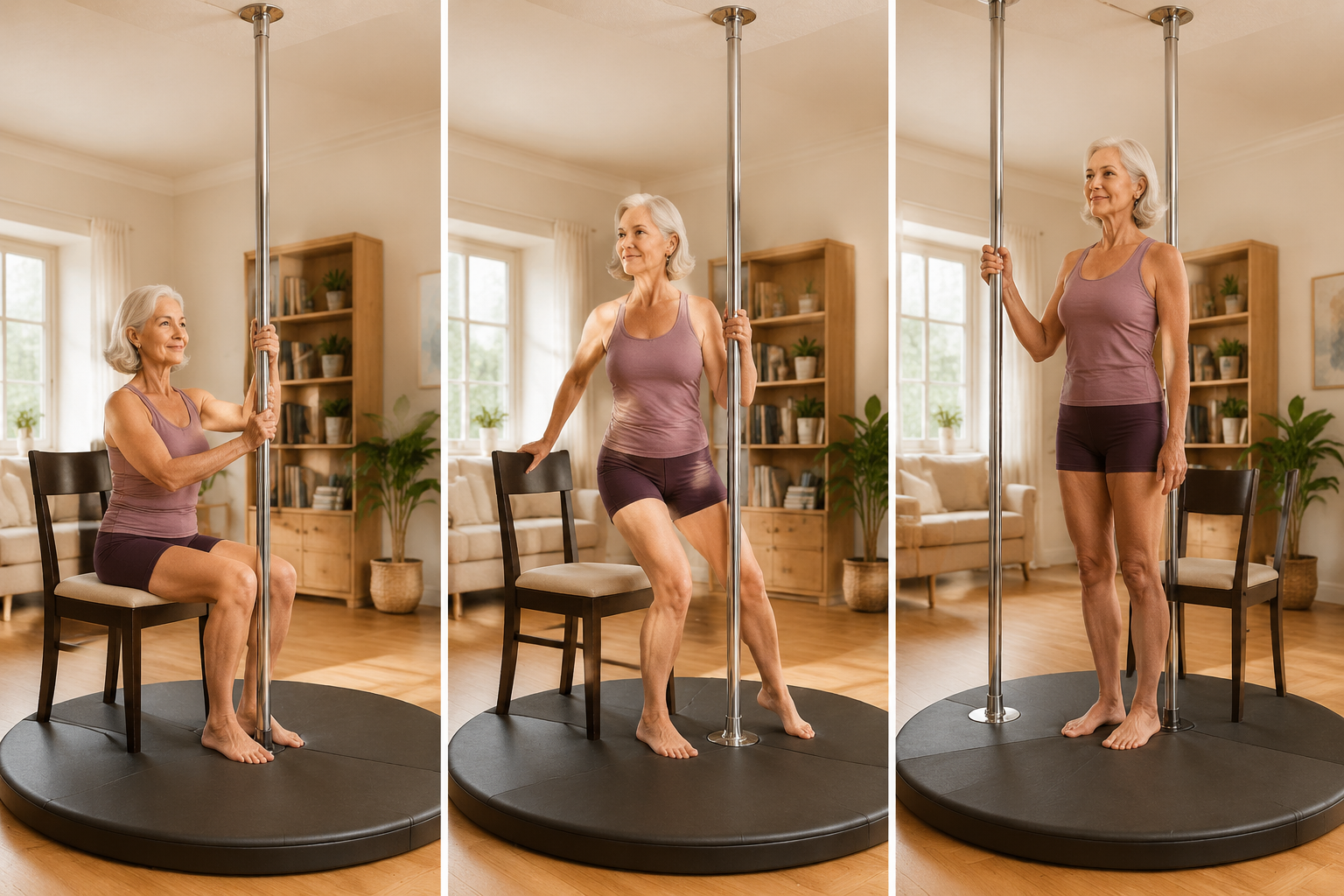
| Assisted sit-to-stand | Use the chair and pole together to rise slowly | Leg strength, balance recovery, knee tolerance |
| Supported standing hold | Stand beside the pole with one hand at about shoulder height | Upright balance, grip endurance, foot placement |
| Small supported weight shift | Shift weight side to side or forward and back while holding the pole | Reactive balance and confidence before any dance-like movement |
Only after those pieces feel calm does standing pole work belong in the routine. The pole is there to reduce the fear of falling, not to invite a person to pull harder than their shoulders, hips, or bones are ready for.
Who Should Get Medical Clearance First
Some seniors should not start with a home pole and a video. The International Pole Convention specifically advises medical clearance first for people with osteoporosis, joint replacements, or those taking blood thinners.[3] I would add recent surgery, unexplained dizziness, fainting, severe balance problems, uncontrolled blood pressure concerns, and any condition where a fall would carry unusually high consequences.
The words you use with a clinician matter. “Can I try pole dancing?” may bring to mind tricks, spins, and inversions. A better description is: “I want to do seated and chair-assisted strength and balance exercises while holding a fixed vertical pole at home. I would start seated, use a crash mat, avoid climbing and inversions, and have someone nearby.”
That gives the doctor something real to judge. The question is not whether the label sounds surprising. The question is whether this person can safely grip, stand, turn, shift weight, and recover balance with support.
- Ask whether wrist, shoulder, hip, knee, or spine restrictions change the plan.
- Ask whether bone density status changes what loading or twisting should be avoided.
- Ask whether medications increase bruising, dizziness, or fall risk.
- Ask whether you should begin with supervised physical therapy, chair exercise, or low-impact strength training before buying a pole.
What Pole Fitness Can Offer An Older Body
The case for senior pole work is strongest when it stays close to ordinary-life transfer. A supported sit-to-stand looks like getting up from a dining chair. A small standing weight shift looks like catching yourself before a stumble. A controlled reach around the pole looks like turning toward a cupboard without losing your feet.
Physiologically, pole work can combine body-weight resistance, balance reaction, and weight-bearing load. That makes it more serious than a novelty routine, even when it is low impact. It asks the hands, arms, trunk, hips, and legs to coordinate around a fixed support instead of letting a machine guide the path.
Still, the evidence has limits. Available examples are encouraging, but they are not the same as a controlled peer-reviewed trial proving results for adults 65 and older. It is fair to say pole fitness may help strength, balance confidence, and weight-bearing activity for some seniors. It is not fair to promise that it reverses osteoporosis or prevents falls.
The Stories Are Encouraging, Not Proof
Ms. Fran, a 76-year-old Moxie Movez student who uses a walker for daily mobility, is one of the better examples of what senior pole can look like when the ego is left outside. Her work includes seated and standing movements, and she reports better stability and fluidity.[2] That is the kind of outcome worth noticing because it points back to daily function.
Debbie Rondeau’s story is also worth holding carefully. She was diagnosed with osteoporosis, started pole at 59, and later reported increased bone density; FOX 10 Phoenix also included a Mayo Clinic staff comment that weight-bearing exercise such as pole can be beneficial.[4] That supports the idea that loading the body can matter. It does not prove that every senior with osteoporosis should install a pole at home.
A HealthUnlocked bone-health forum member also reported starting pole at 59 and seeing bone density improvements.[5] A forum report can be motivating, especially for someone tired of being told to do only the blandest movement available, but it remains a personal report rather than clinical evidence.
Greta Pontarelli, who has continued pole work into her 70s, shows another side of the picture: age alone does not make strength, skill, or expressive movement irrelevant.[6] But the lesson for a home beginner is not to copy an advanced performer. It is to respect progression.
The Equipment Question Is Really A Fall-Risk Question
A safe home setup is not a $30 experiment. Practical pole-buying guides point beginners toward a reputable 45mm tension-mounted pole from makers such as Pro Quality, X-Pole, or Lupit, with cited price ranges around $169 to $309.[7] PoleMoveBook’s home-pole guide also describes tension-mounted poles that can be installed without drilling and used under standard home ceilings.[8]
For a senior beginner, the realistic package is the pole, a crash mat, and a sturdy non-slip chair. The research materials place the safer home setup around $200 to $400, assuming a reputable pole rather than the cheapest no-name option. That puts pole above the under-$100 starter tier covered in many affordable home fitness equipment lists.
I would not try to make pole fitness fit a bargain category by buying a questionable pole. If the pole shifts, slips, or was never designed for body-weight support, the money saved has been moved straight into fall risk.
- Use a reputable 45mm tension-mounted pole, installed exactly as directed.
- Place a crash mat under the working area, even for seated practice.
- Choose a chair that does not roll, rock, slide, or fold.
- Clear roughly a 5-by-5-foot area so feet, chair legs, and the mat are not crowded.[8]
- Check ceiling height and surface compatibility before buying, especially in apartments or older homes.
If that space or cost already feels like too much, that is useful information. A compact routine using bands, a chair, or light weights may be a better first home setup. Readers weighing space, budget, and noise may want to compare this against a compact home gym or other small-space fitness equipment before committing.
Small Safety Details Matter More Than Style
Pole grip depends partly on skin contact. That can surprise older beginners, especially those with dry hands or thin skin. Super Fly Honey’s safety guidance notes the importance of grip, removing jewelry, warming up, and stopping with sharp pain; it also recommends not practicing alone.[9]
For a senior home routine, “not alone” does not have to mean an audience. It can mean another adult is in the house during the first sessions, the phone is within reach, and nobody is experimenting when dizzy, rushed, or tired. Pride is a poor spotter.
- Remove rings, bracelets, watches, and long necklaces before touching the pole.
- Warm up hands, shoulders, hips, ankles, and the spine before any standing work.
- Use grip aids only as needed; they help grip but do not replace strength or control.
- Wear clothing that allows safe skin contact without making the person feel exposed.
- Stop for sharp pain, new dizziness, chest symptoms, unusual shortness of breath, or sudden weakness.
A Sensible First Home Session
The first home session should feel almost too easy. That is how you leave room for judgment. Set up the chair on the mat beside the pole. Have another person nearby. Keep the session short enough that fatigue does not make the last movement the risky one.
- Check the pole, mat, chair, floor, and nearby clutter before starting.
- Warm up seated with ankle circles, gentle shoulder rolls, hand opening and closing, and easy breathing.
- Sit tall and practice two-handed pole holds at chest height without pulling hard.
- Add small seated torso turns while both feet stay flat.
- Try one or two assisted sit-to-stands only if the seated work feels steady.
- Finish before fatigue, then note what felt secure, what felt awkward, and what needs medical or instructor input.
A senior with knee pain may never need to rush beyond this. If standing from the chair is the limiting factor, a low-impact knee-pain workout may be the better preparation before more pole-supported standing work.
So, Can Seniors Do Pole Dancing Fitness At Home?
Yes, if the activity is redefined honestly. Senior pole fitness at home should begin as seated and supported strength-and-balance practice, not as climbing, spinning, or copying performance videos. The pole is a vertical support. The chair is part of the method. The crash mat is not optional.
It is a reasonable choice for a senior who has medical clearance when needed, can afford proper equipment, has enough safe space, and is willing to progress slowly from seated grip work to assisted standing. It is not the cheapest or lowest-commitment way to begin exercising at home. If those conditions are not in place, start with a simpler low-impact routine first.
References
- Pole Gold: Pole Dance for the Mature Adult, Bastet Dance Fitness.
- These Women Prove Pole Dancing Has No Age Limit, Blavity.
- Are You Too Old to Start Pole Dancing?, International Pole Convention.
- Arizona woman with osteoporosis takes up pole dancing, FOX 10 Phoenix.
- Bone health forum post on pole dancing and bone density, HealthUnlocked.
- Ageing & Empowerment, Achieve Pole Studio.
- Best Dance Poles to Buy for Home Use: Buyer’s Guide, Pole Fitness Dancing.
- Pole Guide, PoleMoveBook.
- 10 Safety Rules for Pole Dancing, Super Fly Honey.
Don't have the gear this routine assumes? Find the build that covers it.
Wondering how much rest you need after this? Read our ACSM-cited recovery reference.
Questions about form, substitutions, or a correction? Leave it below.
Comments
Join the discussion with an anonymous comment.