
How to Do Strength Training on Ozempic to Prevent Muscle Loss
This home strength routine shows you how to preserve muscle mass while taking GLP-1 medications like Ozempic, using bodyweight and resistance-band exercises you can do with no gym equipment. It includes protein targets, energy management tips, and a simple 2–3 day per week plan.
- Duration
- 30 min
Yes, lean mass loss can happen while you are losing weight on Ozempic or another GLP-1 medication. That is a reasonable thing to care about. It does not mean the medication is “eating your muscle,” and it does not mean you need to join a gym this week.
The calmer answer is this: GLP-1 medications can reduce appetite and help weight come off faster; muscle preservation still comes down to resistance training, enough protein, and a plan you can repeat when your appetite and energy are not predictable.
The worry usually comes from numbers like these: Cleveland Clinic notes that about 15% to 40% of weight lost on GLP-1s can come from lean mass, and in the STEP-1 semaglutide trial, about 6.9 kg, or 15 lb, of the weight lost over 68 weeks came from lean mass. The same discussion also matters for perspective: fat loss predominated, and the proportion of lean mass relative to total body mass actually increased.[1]
That distinction changes the response. A Mass General review describes the lean-mass loss as a consequence of rapid weight loss and calorie deficit, not a proven direct muscle-wasting effect of the drug itself, and notes that similar lean-to-fat loss patterns are seen with bariatric surgery and calorie-restricted diets.[2] So the job is not to panic about Ozempic. The job is to make your body keep using muscle while weight is coming down.
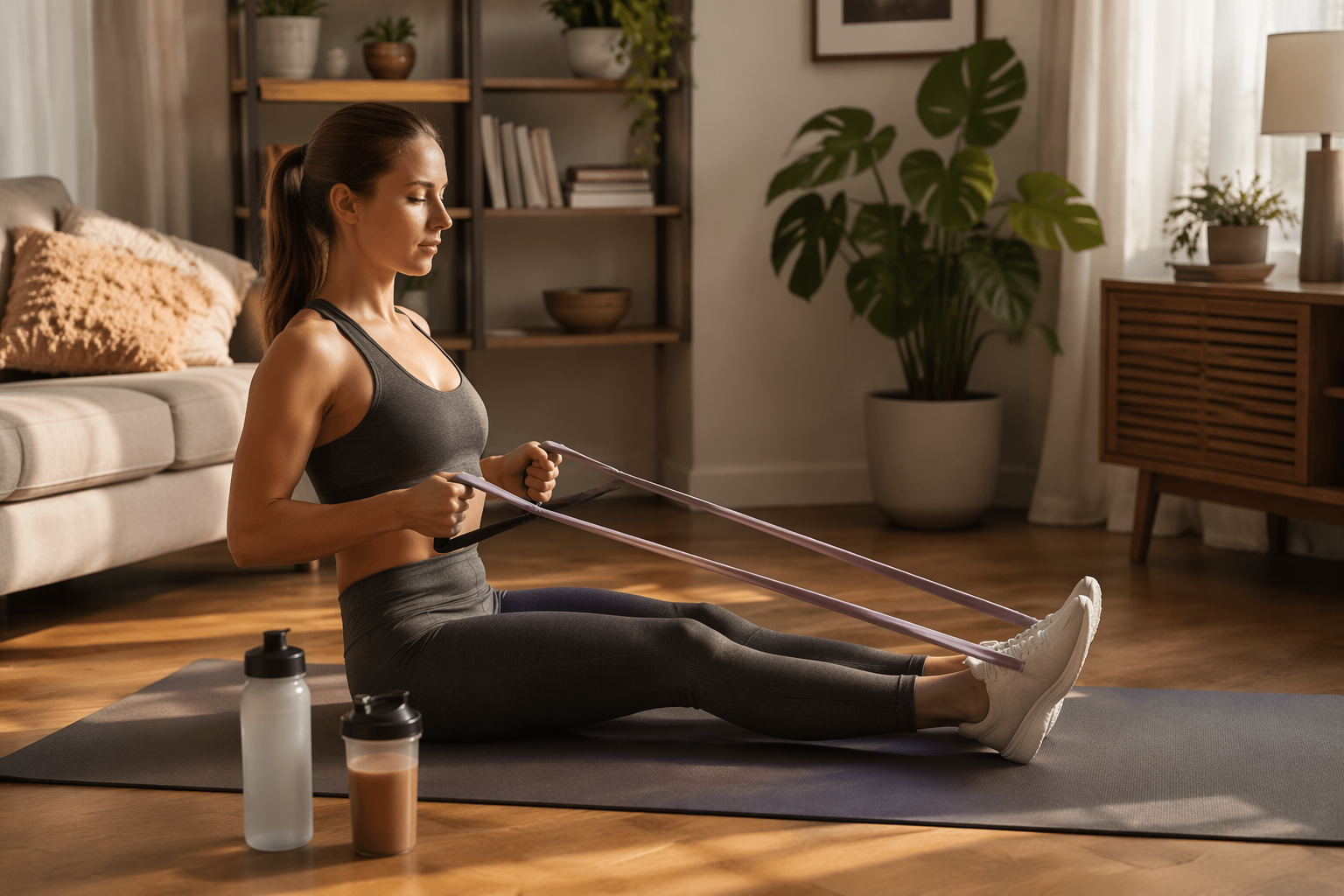
The Home Plan: 2–3 Full-Body Sessions Per Week
For a beginner doing strength training on Ozempic to prevent muscle loss, the target is not a heroic workout. It is a full-body routine you can finish, recover from, and repeat two or three times per week. Resistance training two to three times weekly is consistently recommended for preserving muscle during GLP-1-assisted weight loss, while cardio alone is not enough for that job.[3][4][5]
Do the routine on nonconsecutive days when possible: Monday and Thursday, Tuesday and Friday, or Monday-Wednesday-Friday. If your week is messy, keep the spacing simple: avoid training the same sore muscles hard on back-to-back days.
| Exercise | Beginner Target | Make It Easier | Make It Harder |
|---|---|---|---|
| Squat | 2–3 sets of 8–12 reps | Sit to a chair and stand up | Slow the lowering phase or hold a light weight |
| Wall, counter, or floor push-up | 2–3 sets of 6–12 reps | Use a wall or high counter | Move hands lower or use the floor |
| Resistance-band row | 2–3 sets of 10–15 reps | Use a lighter band or sit taller | Use a stronger band or pause with elbows back |
| Glute bridge | 2–3 sets of 10–15 reps | Use a smaller range of motion | Pause at the top or try single-leg bridges later |
| Reverse lunge or split squat | 1–3 sets of 6–10 reps per side | Hold a chair or shorten the step | Add reps or slow the descent |
| Plank | 2–3 holds of 10–30 seconds | Use knees or an elevated surface | Hold longer or use a lower surface |
| Calf raise | 2–3 sets of 10–15 reps | Hold a wall for balance | Pause at the top or do one leg at a time |
| Superman | 1–3 sets of 6–12 controlled reps | Lift arms only or legs only | Pause briefly at the top |
The exercises in this routine are ordinary on purpose: squats, push-ups, rows, bridges, lunges, planks, calf raises, and supermans are common beginner strength choices in GLP-1 exercise guidance, and they cover the main patterns you need at home.[3][4][5][6]
How One Session Should Feel
Start with one easy round of the first few movements: five chair squats, five wall push-ups, five gentle band rows, and five glute bridges. That is enough of a warm-up for most beginners training in a living room. Then move through the routine in the order shown.
- Rest 45–90 seconds between sets, longer if nausea or lightheadedness appears.
- Stop each set with about two good reps left in the tank; do not grind to failure.
- Use a smooth tempo: lower with control, pause if needed, then stand, press, or pull without rushing.
- Keep the first two weeks conservative, even if the workout feels almost too manageable.
A good first session may take 20 to 35 minutes. If that sounds like too much, use the minimum version: squat, push-up, band row, glute bridge, and plank. The lunges, calf raises, and supermans can come back when your energy is steadier.
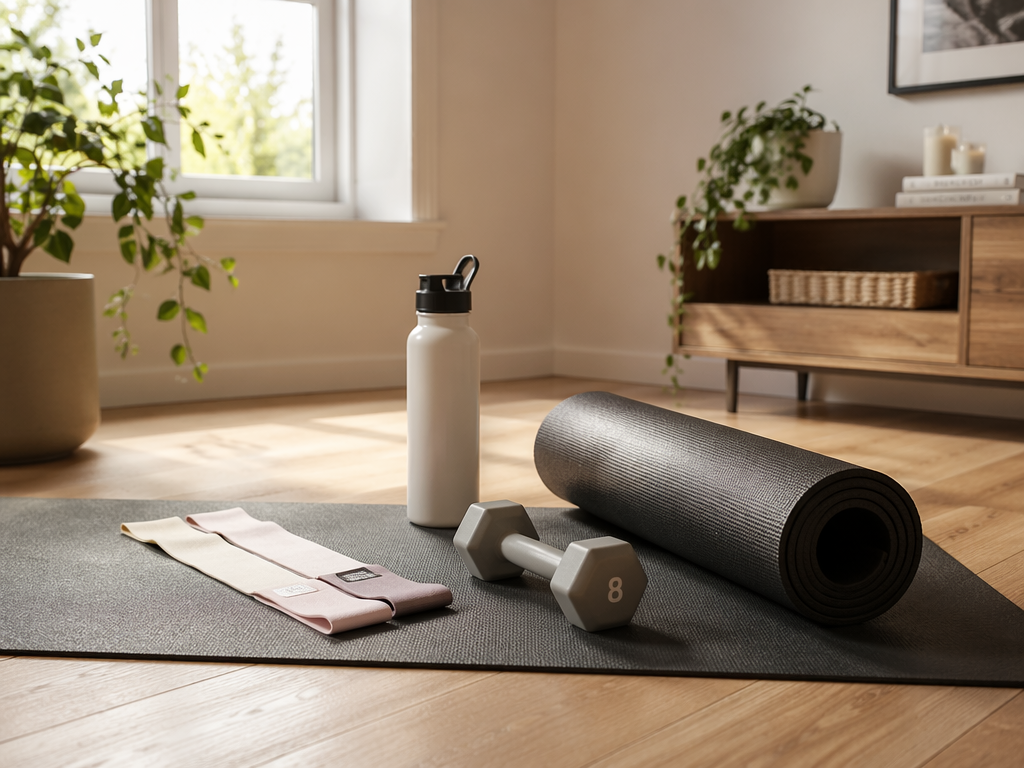
Exercise Notes That Matter More Than Perfect Form Videos
Squat
Use a chair if you are new, dizzy, or unsure of depth. Sit down lightly, stand up, and keep your feet fully planted. The chair is not cheating; it gives you a consistent target and lowers the chance that you turn the first week into a soreness project.
Push-Up
A wall push-up counts. A counter push-up counts. Choose the version that lets your body move as one piece without your neck reaching forward. When you can do 12 clean reps at one height, move your hands a little lower next time.
Band Row
Anchor the band safely around a sturdy object or hold it with both feet while seated. Pull your elbows back, pause for one second, and let the band return slowly. If the band snaps you forward, it is too heavy or you are too far from the anchor.
Glute Bridge
Lie on your back, bend your knees, and press through your heels to lift your hips. Keep the ribs from flaring up. This is one of the friendliest strength moves for low-energy days because it trains the hips without asking you to stand or balance.
Reverse Lunge or Split Squat
If lunges feel wobbly, hold a countertop or do a split squat with your feet already in position. If knees complain, shorten the range and keep the motion slow. This exercise is useful, but it is not the one to force on a rough medication day.
Plank, Calf Raise, and Superman
Treat these as finishing work. A plank should feel like a steady brace, not a breath-holding contest. Calf raises can be done at a wall. Supermans should be small and controlled; lifting higher is not automatically better.
Protein Belongs Next to the Workout, Not in a Separate Project
The usual working range for people trying to preserve muscle during GLP-1 weight loss is about 1.2–1.6 grams of protein per kilogram of body weight per day, which is roughly 90–120 grams for many adults.[7][8] That is general guidance, not a prescription. If you have kidney disease, liver disease, a history of disordered eating, or another medical constraint, set your target with your clinician or dietitian.
The practical problem is not that people have never heard of protein. It is that food can feel unappealing on GLP-1s, and a large plate may sit badly. Mayo Clinic Store and Ubie Health both point to liquid or small-volume protein options as useful because shakes, Greek yogurt, and similar foods can deliver protein without much bulk; Ubie describes 25–30 grams as a common small-volume protein dose.[7][8]
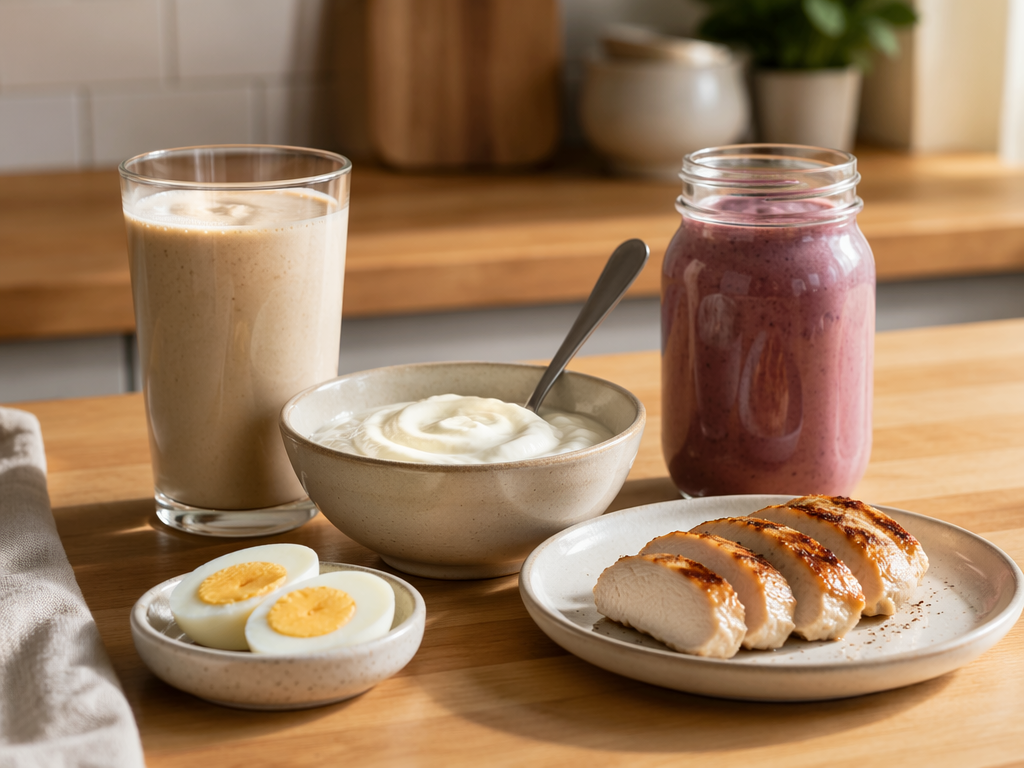
On training days, place protein where it is easiest to tolerate. That might mean Greek yogurt at breakfast, a shake after the session, a smoothie with protein earlier in the day, or smaller protein servings divided across meals. The exact foods matter less than the repeatable pattern.
Because GLP-1 medications slow gastric emptying, eating immediately before exercise can be a poor fit for some people. Expert guidance cited by CNN and Hinge Health suggests a meal or liquid-based option such as a smoothie about 1–2 hours before training may be better tolerated than eating right before movement.[3][4]
- If morning nausea is worst, train later and use breakfast as a protein anchor instead of forcing an early workout.
- If a full shake feels heavy, sip half before the session window and half afterward.
- If solid meals are easier than liquids, use the same timing idea with a small protein-forward meal.
- If you feel lightheaded, stop the session and address hydration, food intake, and medical guidance before pushing harder.
How to Adjust on Low-Energy Days Without Losing the Habit
Energy and recovery can be lower while taking GLP-1s, so sessions should start conservatively and change with the day you actually have, not the day you planned on paper.[6] The mistake is treating every low-energy day as a skipped day. Often the better move is to reduce the dose of training while keeping the appointment.
| How You Feel | What to Do |
|---|---|
| Normal energy | Do the full routine for 2–3 sets per exercise. |
| Low energy but no nausea or dizziness | Do one or two sets of the main five: squat, push-up, row, bridge, plank. |
| Mild nausea | Use slower movements, longer rests, and skip lunges if they make symptoms worse. |
| Very low intake that day | Do a short technique session or walk, then train harder after you have eaten better. |
| Dizziness, chest pain, faintness, or unusual symptoms | Stop and seek medical guidance rather than modifying through it. |
A reduced session still sends the useful signal: your legs stand, your arms press, your back pulls, your hips extend, and your trunk braces. That is very different from doing nothing for two weeks while waiting to feel perfect.
Progress Without Turning the Workout Into a Gym Program
Progressive overload is the reason a simple home routine keeps working. For beginners, that does not have to mean heavy weights. GLP-1 exercise guidance commonly points to more reps, shorter rests, harder variations, or stronger bands as ways to keep adapting.[3][4][5]
Use this order before adding complexity:
- First, make the movement cleaner: steadier squat depth, smoother rows, push-ups without sagging.
- Then add reps until you reach the top of the target range.
- Then add a set to the exercises that feel most stable.
- Then slow the lowering phase or add a one-second pause.
- Then choose a harder variation or stronger resistance band.
For example, a wall push-up can become a counter push-up, then a lower-counter push-up, then a floor push-up. A chair squat can become a free-standing squat, then a slower squat, then a squat holding a light dumbbell or backpack. A band row can progress by stepping farther from the anchor or using a thicker band, as long as the final reps still look controlled.
Progress every one to two weeks only if recovery is acceptable. If appetite has been poor, sleep has been rough, or your medication dose recently changed, hold the same version for another week. Repeating a good dose of training is not failure; it is often what keeps the routine alive.
A Four-Week Starter Schedule
Use this as a starting point, not a test. If two weekly sessions are all you can repeat right now, two is the plan. Add the third only when the first two are no longer draining you.
| Week | Frequency | Main Goal |
|---|---|---|
| Week 1 | 2 sessions | Learn the movements and stop before fatigue gets sloppy. |
| Week 2 | 2 sessions | Add a few reps where the first week felt easy. |
| Week 3 | 2–3 sessions | Add a third short session only if recovery and food intake are steady. |
| Week 4 | 2–3 sessions | Progress one or two exercises, not the entire routine at once. |
One clean progression is enough for a week. If you make the band row harder, leave the lunges alone. If you add a set of squats, keep push-ups at the same height. Beginners do not need every exercise to advance at the same speed.
When Your Situation Changes
This plan is for the active-treatment phase, when appetite, digestion, and weight loss may still be changing. If you are coming off GLP-1s, the training problem shifts toward maintenance after medication; use our guide to preserving muscle after GLP-1s for that next phase.
If your lower body needs more structure, continue with the beginner 8-week home leg workout plan. If you live above neighbors or need quieter sessions, use the small-space quiet strength plan. If you eventually want one piece of equipment beyond bands, a beginner kettlebell workout at home can be a simple upgrade. And if you want app-guided sessions, compare options by equipment and experience level before paying for more than you need.
The credible version of strength training on Ozempic is not dramatic. Train the major movement patterns two to three times per week, keep protein adequate within medically appropriate limits, and adjust sessions around appetite and energy instead of quitting on rough days. For a beginner at home, that is a real muscle-preservation strategy.
References
- Can Ozempic Cause You To Lose Muscle? Cleveland Clinic.
- Fitness for people taking GLP-1 agonists Mass General.
- GLP-1 muscle loss: How to eat and exercise while taking weight loss drugs CNN, 2025.
- Ozempic and Exercise: What You Need to Know Hinge Health.
- Maintaining Muscle Mass: Exercise & Ozempic Planet Fitness.
- Strength Training on Ozempic & Wegovy bStrong Personal Training.
- GLP-1 medications and muscle loss: What to know about nutrition and supplements Mayo Clinic Store.
- Muscle Loss and GLP-1s: A Doctor's Guide to Prevention Plans Ubie Health.
What a small equipment investment adds
We don't have a build tagged to this exact tier yet. Browse all builds.
How often should you repeat this?
How Whoop and Oura Ring track recovery for home workouts
For home exercisers deciding between WHOOP and Oura Ring, the better sleep and recovery tracker depends on training style: WHOOP's strength-aware tracking fits dumbbell and grip-heavy sessions, while Oura's sleep-first scoring suits yoga and indoor cycling. The verdict hinges on how each builds its daily recovery score, their home-workout tracking gaps, and who pays for hardware versus subscription.
Spot something off?
Tell us if a movement, tier assumption, or duration didn't match your experience.