
30-Minute Tour de France Cycling Workouts for Your Apartment
Turn the Tour de France's signature stage types into quiet 20-to-30-minute indoor cycling workouts designed for apartment living. This guide shows you how to train like a pro without disturbing your neighbors, including bike and mat recommendations to keep noise and floor damage to a minimum.
- Equipment tier required
- $0-100
- Duration
- 30 min
- Difficulty
- intermediate
- Target area
- legs
- Noise level
- Low
The apartment version of Tour de France-inspired home cycling training starts with a less glamorous question: can you surge, climb, and suffer a little without sending a dull thud through the floor? The answer is yes, if the workout is built around seated effort, smooth cadence changes, and a bike setup that treats vibration as part of the training plan.
These are not pro-stage simulations. They are 20-to-30-minute mini-stages you can do on a basic exercise bike using cadence, resistance, and RPE — rate of perceived exertion on a 1-to-10 scale. You do not need power numbers, a smart trainer, or a garage. You do need to keep the bike stable, keep most hard work in the saddle, and avoid the kind of stomping acceleration that makes a neighbor look up at the ceiling.
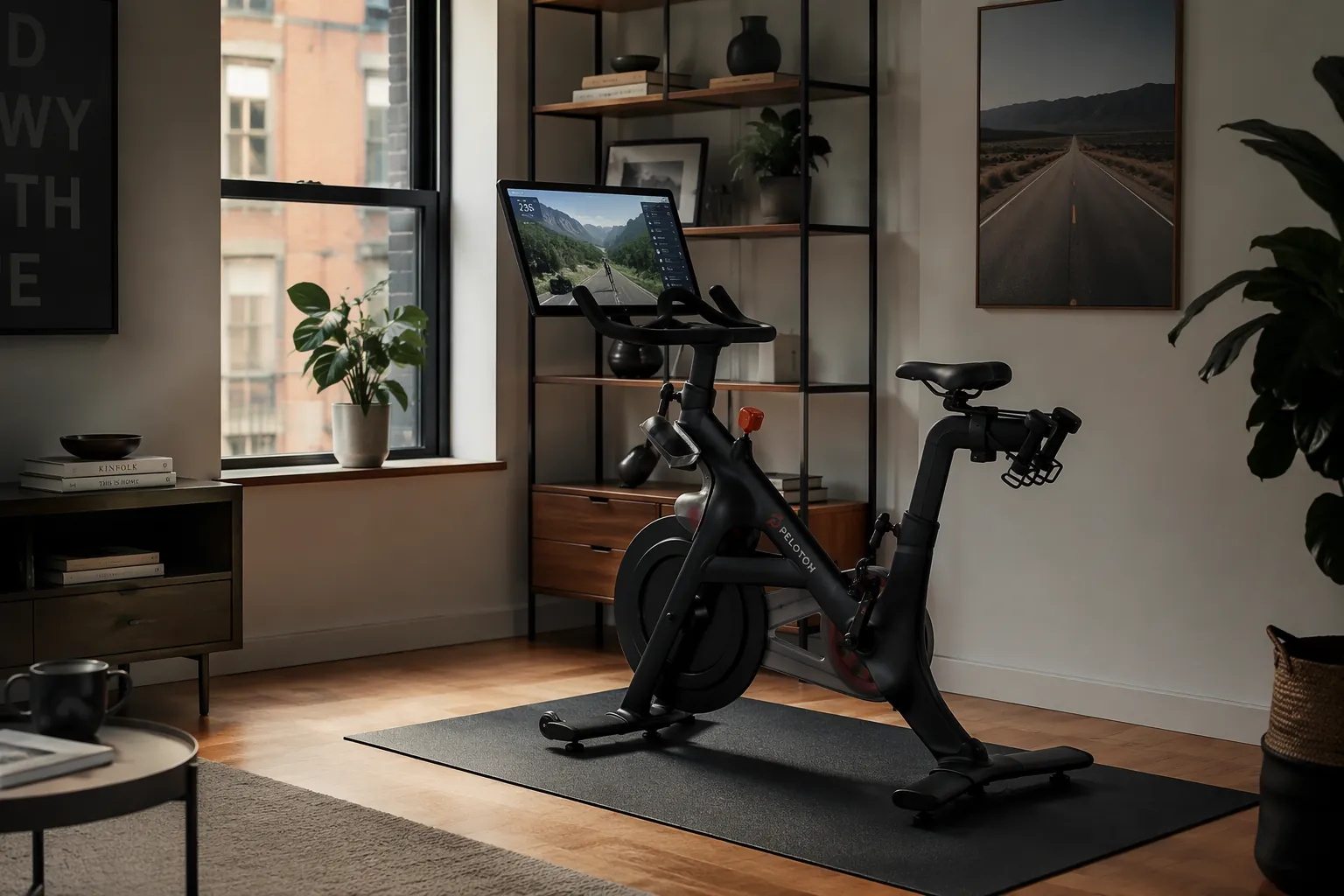
Set up the bike before you ask it to sprint
A quiet apartment ride is partly a workout choice and partly an equipment choice. If your bike rocks, rattles, or buzzes under load, the best interval plan in the world will still feel hostile to the room below you.
- Prefer belt-drive or magnetic-resistance bikes when you can. In everyday apartment use, they tend to feel smoother and quieter than chain-drive or fan-resistance setups. That is practical buying guidance, not a controlled acoustic measurement.
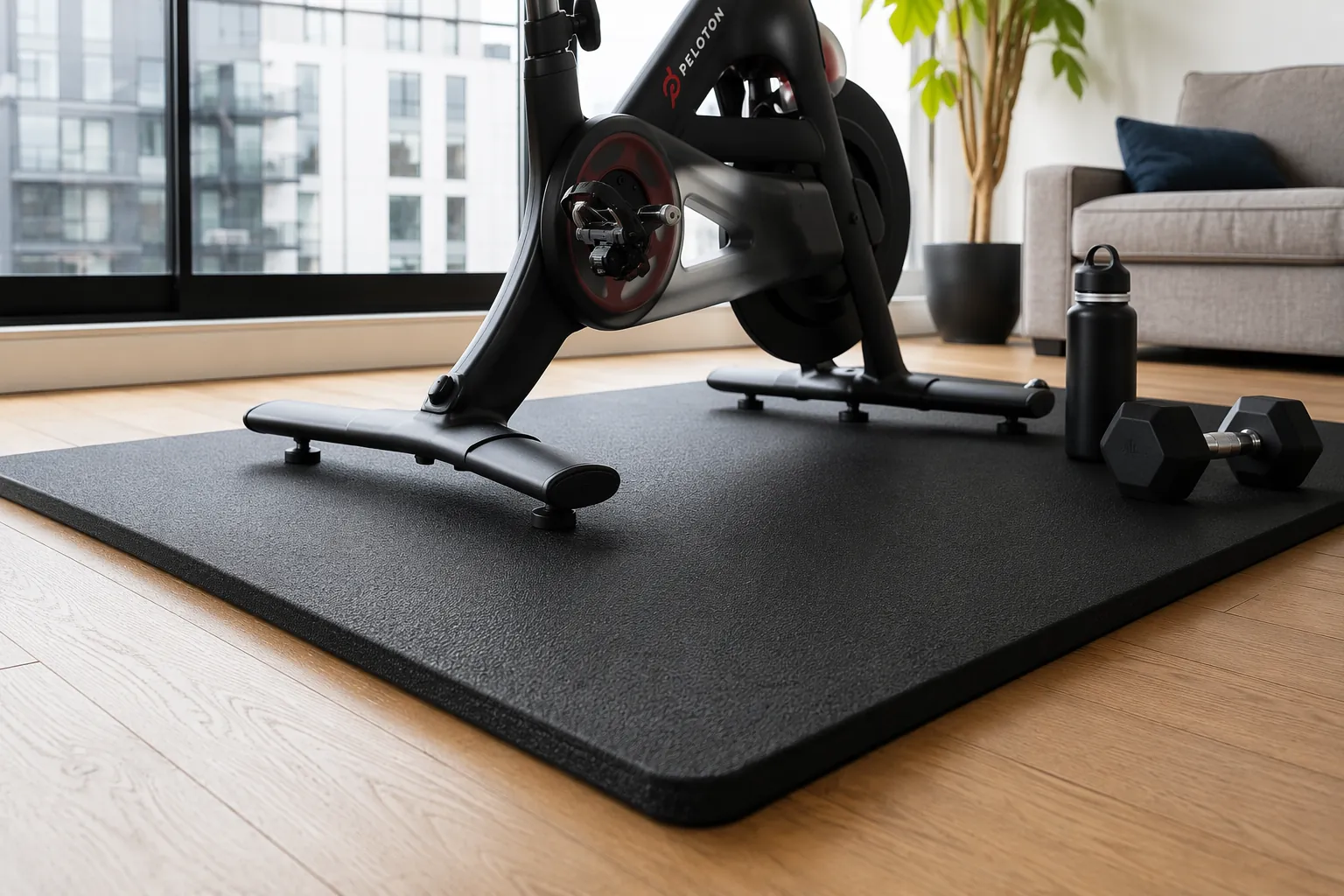
- Put the bike on a dense mat or interlocking gym tiles. The mat is not decoration; it helps reduce vibration transfer, protects hardwood or vinyl plank from sweat, and keeps the bike feet from scuffing the floor.
- Level the bike before riding. A tiny wobble at warm-up cadence becomes a knock during a sprint.
- Stay seated for hard climbs. Standing out of the saddle may feel more like a mountain stage, but it also adds body sway and downward force that small apartments do not need.
- Accelerate by turning the pedals faster, not by throwing your shoulders at the handlebars. If the bike starts walking across the mat, the interval is too aggressive for the room.
If this setup question is the bigger problem than the workout, start with how to choose a compact home gym around space, budget, and noise tolerance. An inexpensive bike can be perfectly useful, but a loud resistance system or unstable frame changes what you can do at home.
Translate the Tour into apartment rules
The Tour gives each ride a shape. A sprint finish has urgency. A climb has pressure. A time trial has restraint. For an apartment bike, the translation matters more than the fantasy.
| Tour stage idea | Apartment version | What you control |
|---|---|---|
| Sprint finish | Short seated 30-second surges with active recovery | Smooth acceleration, stable bike, cadence over stomping |
| Mountain climb | Long seated resistance blocks | Heavy but controlled pedaling, low body sway, steady breathing |
| Individual time trial | Even 30-minute effort at a hard-but-repeatable pace | Cadence discipline, no early heroics, quiet consistency |
Resistance scales vary wildly from bike to bike, so each workout below uses three controls: cadence, resistance feel, and RPE. If your bike does not show cadence, use a phone metronome, a watch, or the simplest count: pedal strokes for 15 seconds multiplied by four.
20-minute sprint stage: fast legs, quiet frame
This is the loudest workout if you do it badly and one of the most satisfying if you do it smoothly. The sprint format uses repeated 30-second hard efforts, adapted from Tour-themed indoor ride structures and stage-profile coaching formats, but the apartment rule is firm: every sprint stays seated and controlled [1][2].
| Time | Ride cue | Cadence | Resistance | RPE |
|---|---|---|---|---|
| 0:00–4:00 | Warm up. Start easy, then add a little resistance each minute. Check that the bike is not rocking. | 80–95 rpm | Light to moderate | 3–5 |
| 4:00–14:00 | 10 rounds: 30 seconds sprint, 30 seconds active recovery. Sprint by spinning up smoothly over the first 5 seconds, then hold fast legs. Keep hips heavy on the saddle. | 110+ rpm on sprint; 75–90 rpm recovery | Moderate for sprint; light for recovery | 9 on sprint; 3–4 recovery |
| 14:00–16:00 | Final lead-out. Settle into a strong seated push, like the last straight road before the line. No rocking. | 95–105 rpm | Moderate-heavy | 8 |
| 16:00–20:00 | Cool down. Drop resistance gradually and let breathing come down. | 70–90 rpm | Light | 2–3 |
The 30/30 block is hard enough that you should not need to mash the pedals. Think of the first half of each sprint as acceleration and the second half as holding form. If the handlebars sway, if the front foot of the bike taps the mat, or if you feel yourself punching down at the bottom of the pedal stroke, lower the resistance and keep the cadence fast.
The useful discomfort here comes from repeated high-intensity work and the recovery demand after it. You may see that post-workout oxygen cost described as EPOC. For apartment purposes, the practical point is simpler: keep the hard block short, make the recoveries honest, and stop before sloppy movement becomes the loudest part of the session.
25-minute seated climb: the apartment-friendly mountain stage
This is the best Tour adaptation for small apartments because the same choice solves several problems at once. Staying seated makes the ride quieter, makes the effort more controlled, and turns the climb into a muscular-endurance session instead of a furniture-shaking performance. The climb structure below is adapted from a Mont Ventoux-style home ride format, with the drama converted into resistance blocks rather than standing attacks [3].
| Time | Climb section | Cadence | Resistance | RPE |
|---|---|---|---|---|
| 0:00–5:00 | Valley roll-in. Easy seated pedaling, then a small resistance increase each minute. | 85–95 rpm | Low to moderate | 3–5 |
| 5:00–12:00 | Lower slopes. Stay seated and let the pedals feel heavier. Keep your upper body quiet enough that a glass on a nearby table would not complain. | 70–80 rpm | Moderate | 6 |
| 12:00–22:00 | The wall. Add resistance until each pedal stroke takes attention, but do not grind. Hands relaxed, hips planted, knees tracking smoothly. | 60–70 rpm | Heavy | 7–8 |
| 22:00–25:00 | Summit push. Increase cadence slightly without standing. This should feel urgent, not frantic. | 75–85 rpm | Heavy to very heavy | 8–9 |
If you have two or three extra minutes, spin very easy after the 25-minute mark. If you truly have to stop at 25, step off slowly and walk around the room until your breathing settles. The one thing not to do is finish the summit push and immediately fold yourself onto the couch.
For this ride, heavy resistance should not mean a square, grinding pedal stroke. If cadence falls below 60 rpm, back off slightly. The goal is a seated climb that loads the legs and lungs while keeping the bike planted. That is less cinematic than dancing on the pedals, but it is a better fit for a rental floor.
30-minute mini time trial: even pressure, no wasted motion
The time trial is the quietest of the three workouts because there is no sudden acceleration. It borrows the discipline of a solo race against the clock: pick a pace you can hold, resist the urge to surge early, and make the second half look like the first. Cycling Weekly describes the time-crunched rider’s “sweet spot” as 84–97% of FTP; without a power meter, use RPE 6–7 and the halting-conversation test instead [4].
| Time | Ride cue | Cadence | Resistance | RPE |
|---|---|---|---|---|
| 0:00–5:00 | Warm up into the position you can hold. Shoulders down, hands light, saddle pressure even. | 80–95 rpm | Light to moderate | 3–5 |
| 5:00–15:00 | Settle into your first split. You should be able to speak in short phrases, not full relaxed sentences. | 85–95 rpm | Moderate | 6 |
| 15:00–25:00 | Match or slightly improve the first split. Add only enough resistance to keep attention sharp. | 85–95 rpm | Moderate to moderately heavy | 6–7 |
| 25:00–28:00 | Controlled finish. Lift effort a notch without changing your posture or bouncing in the saddle. | 90–100 rpm | Moderate to moderately heavy | 7–8 |
| 28:00–30:00 | Cool down. Drop resistance and let the legs turn easily. | 70–90 rpm | Light | 2–3 |
A good apartment time trial looks almost boring from across the room. The effort rises inside the rider, not through the floor. If you finish feeling that you could have gone one minute longer but not ten, you aimed well.
How to rotate the mini-stages without turning every ride into a race
The Tour is exciting because racing happens constantly. Your apartment training should not copy that part. One EVOQ.BIKE analysis of Brandon McNulty reported 79% of ride time in Zone 2, which is a useful reminder to keep most riding easier even when the inspiration comes from elite racing [5]. That single example does not prove one perfect formula for everyone, but it points in the right direction: hard days need space around them.
| Day | Apartment cycling option | Intensity note |
|---|---|---|
| Monday | Easy spin or rest | 20–30 minutes at RPE 2–4, or take the day off |
| Tuesday | 20-minute sprint stage | Hard interval day |
| Wednesday | Rest, mobility, or easy walk | Let the legs absorb the work |
| Thursday | 30-minute mini time trial | Steady, controlled effort |
| Friday | Rest or easy spin | Keep it quiet and genuinely easy |
| Saturday | 25-minute seated climb | Strength-endurance focus |
| Sunday | Easy spin, walk, or no workout | Do not turn it into another race |
If three rides are too much, choose one hard day and one steady day. If your legs feel flat, keep the time trial easy and save the sprint stage for another week. The point of the rotation is not to complete a pretend Grand Tour; it is to give short rides enough structure that they stop feeling like random pedaling.
Small fixes that make the workouts more neighbor-proof
- Ride during reasonable hours. Even a quiet bike feels louder through a floor at night.
- Keep a towel over the frame and a second towel nearby. Sweat on a hard floor becomes a slip risk and a deposit problem.
- Tighten pedals, seat hardware, and bottle cages before interval days. A loose bolt can sound like a failing machine.
- Use the same mat footprint every time. Dragging bike feet across wood or vinyl is its own kind of workout noise.
- If the bike gets louder as resistance increases, cap your sprint resistance lower and use cadence for intensity.
For more quiet small-space training, the same principles show up in apartment boxing drills you can do without a bag and basketball shooting drills at home with no noise complaints. If heat is the reason you are moving workouts indoors, home workouts during extreme heat without AC may be the better companion guide.
And if these mini-stages make you want longer Tour-style sessions, use FitAtHome’s Tour de France indoor cycling guides as the next step. Just keep the apartment filter on: seated climbs first, smooth accelerations always, and a mat under the machine before the first imaginary flag drops.
References
- Tour de France and Tour de Femmes Indoor Rides — Bicycling.com
- How to Create and Lead a Tour de France Stage—Plus Six Pre-Made Tour Stage Profiles to Use — Indoor Cycling Association
- Ride the Stages: How to Recreate Tour de France Routes at Home — JLL Fitness
- Training zones: what are they and why do they matter? — Cycling Weekly
- Train Like A Pro — EVOQ.BIKE
What a small equipment investment adds
Cable Machine Alternatives That Save Space and Money
Compare the best cable machine alternatives for home gyms – from resistance bands and pulley systems to suspension trainers and compact digital units – and find the right option for your space and budget.
Small Treadmill Buying Guide: 7 Critical Specs to Check Before You Buy
A cross-category spec primer for apartment and small-space dwellers comparing walking pads, ultra-compact folding treadmills, and full-size folding treadmills. Learn the concrete thresholds for motor HP, deck length, noise, warranty, and subscription lock-in so you can compare apples to apples.
How to Practice Basketball at Home Without Noise Complaints
Learn how to run a full basketball workout in a small apartment without noise complaints. This guide covers no-dribble handling drills, wall form shooting, and silent ball options that let you train without disturbing neighbors.
How often should you repeat this?
See our recovery and rest reference for citation-anchored rest-interval guidance.
Spot something off?
Tell us if a movement, tier assumption, or duration didn't match your experience.