
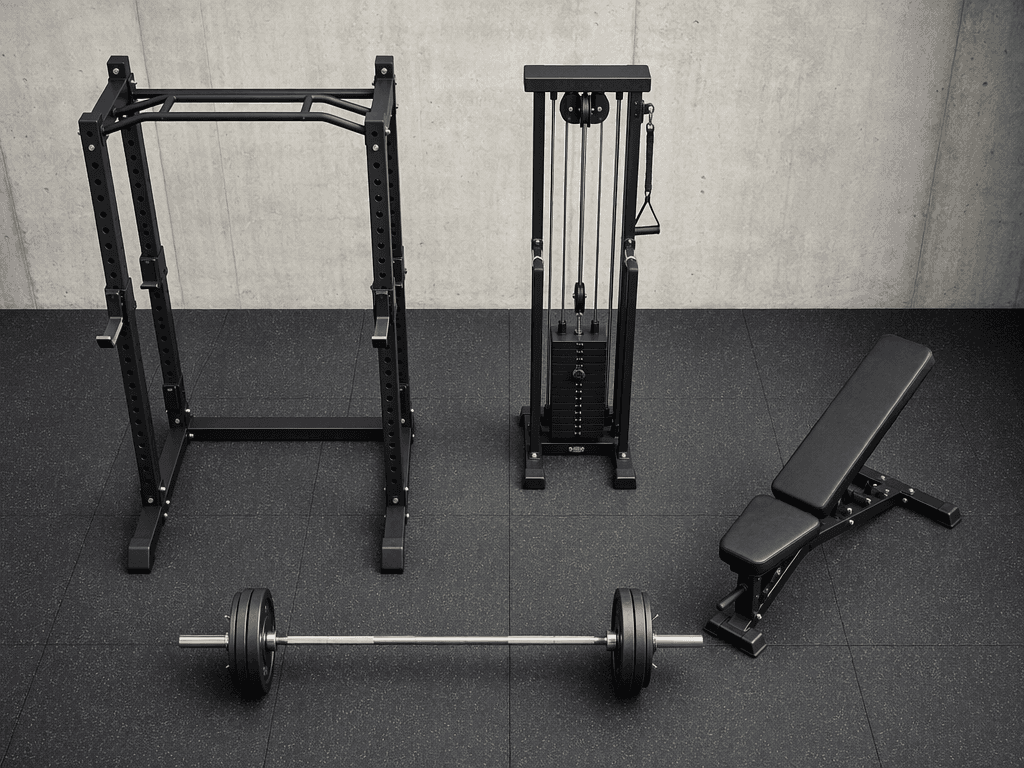
I have built both. The modular setup cost me roughly $1,435 on paper—a REP PR-1100 rack, a Bells of Steel Cable Tower, a Major Fitness bench, a barbell and plates. The all-in-one Major Fitness B17 runs $4,199.99. That $2,765 gap looks like a clear win for building your own. But that $1,435 figure does not include the weekend you spend assembling four different boxes. It does not include the adapter you need to make the cable trolley fit your rack uprights. And it most certainly does not include the second cable stack you will want once you realize a single tower does not let you do cable crossovers. The all-in-one arrives on one pallet, often with assembly service available. That is a real difference in procurement complexity—one that the modular enthusiast typically waves away as “just some assembly.”
What a Similar Price Point Actually Buys
The all-in-one machine gives you in one footprint: Smith machine, dual cable columns, pull-up bar, landmine, and often a leg hold-down. The Major Fitness B17 and Force USA C10 sit in the $4,000–$4,500 tier. The modular starter kit gives you a rack, a cable tower, a bench, and a barbell set—but no second cable column, no jammer arms, no landmine base, and no integrated plate storage. Here is what the numbers look like:
| Component | Price |
|---|---|
| All-in-one: Major Fitness B17 | $4,199.99 |
| All-in-one: Force USA C10 | $4,499 |
| All-in-one: Bells of Steel Basic | $1,299.99 |
| Modular: REP PR-1100 rack | $380 |
| Modular: Bells of Steel Cable Tower 210-lb stack | $434.99 |
| Modular: Major Fitness Adjustable Bench | $219.99 |
| Modular: Synergee Games Cerakote Barbell + plates (est.) | ~$400 |
| Modular total (starting point) | ~$1,435 |
The modular total is a starting point, not a lifetime cost. Add a second cable stack for dual-cable work and you are looking at another $500–$900. Add plate storage, a landmine attachment, and a better barbell, and the gap to the all-in-one shrinks by a couple thousand dollars. The point is not that modular is secretly expensive—it is that the headline savings are not the full picture.
Footprint Numbers That Don't Tell the Full Story
The B17's footprint is listed at 68.1" deep by 78.7" wide—about 37 square feet. The Bells of Steel all-in-one is even smaller at 54.6" by 59" (roughly 22 sq ft). Those numbers sound impressive until you realize they are machine base dimensions, not the usable space you actually need. An all-in-one with a Smith machine and cable columns needs clearance on multiple sides: enough room to lock the Smith bar at full range, enough space to stand at the edge for cable flyes, and room for the cables to travel unimpeded. You cannot push it flush against two walls.
Modular setups can be smarter with wall placement. A power rack only needs front access for most exercises—you can put it against one wall. Plate storage can go on a second wall. The cable tower can sit nearby. The net result: a modular setup often requires 50–70+ square feet of open floor, but that space is used more efficiently. The all-in-one's space advantage is real, especially in a garage with a single open bay, but the gap is smaller than the headline numbers suggest.
What Matters: Movement Patterns, Not Exercise Counts
Manufacturers love to boast about exercise counts. The Bowflex Xtreme 2 SE claims over 70 exercises. The Major Fitness B17 probably comes with a similar number. But those counts are padded. Different cable angles—30 degrees vs. 45 degrees—get listed as separate exercises when they are really the same movement pattern with slightly different resistance curves.
What matters for programming is the range of fundamental movement patterns: vertical pull (lat pulldown), vertical push (overhead press), horizontal pull (row), horizontal push (bench press), squat, hinge, and core. A quality all-in-one like the B17 covers most of these: cables for pulls and pushes, Smith machine for squats and overhead press, pull-up bar for vertical pull, landmine for rows. The main gap is free-weight barbell work—deadlifts and Olympic lifts—which require a clear floor path and a bar you can drop.
| Movement Pattern | All-in-One (B17) | Modular (rack + cable tower) |
|---|---|---|
| Vertical pull (lat pulldown) | Cables – yes | Cables – yes |
| Vertical push (overhead press) | Smith machine – fixed path | Free barbell – natural path |
| Horizontal pull (row) | Cables – yes | Cables or barbell row – yes |
| Horizontal push (bench press) | Smith machine – fixed path | Free barbell – natural path |
| Squat | Smith machine – fixed path | Free barbell – natural path |
| Hinge (deadlift) | Not ideal | Barbell deadlift – yes |
| Core / cables | Yes | Yes |
The decisive difference is the Smith machine. If you are comfortable with guided squatting and pressing—and many people are, especially for safety—the all-in-one covers nearly everything. If free-weight barbell work is non-negotiable, the modular setup wins on the squat and bench alone.
Where the Modular Setup Wins Decisively: Upgrade Path
This is the modular setup’s strongest argument, and I do not buy the counter that all-in-one machines are immune to it. With a modular rack, you can swap the barbell, add a leg press attachment, replace the bench, or upgrade the cable tower—each independently. If you want a higher-end barbell in a year, you buy just that. If you want a wider cable column, you replace just that component.
All-in-one machines lock you into a proprietary ecosystem. The Force USA 3x3 line uses 3"x3" uprights with 11-gauge steel and 1-inch holes on 2-inch spacing—that is not compatible with Rogue or REP attachments without adapters. The Major Fitness B17 uses a mix of 12- and 14-gauge steel, which is not standard rack gauge. If you want to add a different cable attachment, you are limited to what the manufacturer offers. Upgrading the weight stack means buying a whole new machine.
Resale value also favors modular. You can sell individual components—a rack, a barbell, a bench—on the used market easily. Selling a giant all-in-one machine is harder. Most buyers want something smaller or something different, and the all-in-one's size and proprietary attachments reduce its appeal. This is not a minor detail. It affects how much of your investment you can recover if your training goals change.
The Hidden Cost: Procurement Complexity
I said I built both. The all-in-one took an hour and a half to assemble, mostly tightening bolts. The modular setup took two Saturdays: one to assemble the rack and cable tower, another to realize the bench’s gap between the uprights was too narrow for the low-row footplate I had bought later. That second Saturday was not fun.
Procurement complexity is a real cost. The all-in-one arrives as one pallet, often with a delivery and assembly option. The modular setup requires four to six separate orders, coordinating shipping windows, and confirming compatibility across brands. Will this low-row footplate fit between my rack uprights? Will this cable tower’s height clear the ceiling where I plan to put it? These are not deal-breakers, but they are time spent that the all-in-one simply eliminates.
- All-in-one: 1 order, 1 delivery, 1–2 hours assembly (or pro assembly available)
- Modular: 4–6 orders, multiple shipping windows, 8–12 hours total assembly, plus compatibility checks
The modular advocate will say “just plan better.” And they are right—you can. But the time cost is real, and it is not factored into the $1,435 price tag.
The $2,000–$4,500 Buyer's Decision: How Certain Are Your Training Needs?
After all this, the question narrows to one thing: how certain are you that your training needs will stay the same for the next five years?
If you are a bodybuilder or general fitness enthusiast who wants variety, does not care about free-weight barbell work, and has a room that can fit the machine with clearance, an all-in-one is a rational choice. It delivers 80% of what a modular setup does in a smaller footprint with far less hassle. You get a Smith machine, dual cables, pull-up bar, and landmine in one tidy unit. The Major Fitness B17 or Force USA C10 are solid choices in the $4,000–$4,500 range.
If you are a powerlifter, want free-weight squatting and bench pressing above all, or expect your training focus to shift over the years, modular is worth the extra space and effort. You can start small and grow. You can swap out components as your priorities change. You can sell pieces and buy better ones. The investment is more flexible, and the ceiling is higher.
For family sharing—multiple people with different goals—the all-in-one’s variety of stations and exercises is hard to beat. Everyone can find something. For a single dedicated lifter, modular wins on long-term satisfaction.
| Scenario | Recommendation |
|---|---|
| General fitness, bodybuilding, variety | All-in-one |
| Powerlifting, Olympic lifting, free weight priority | Modular |
| Family or household sharing | All-in-one |
| Budget-constrained starter, willing to grow | Modular |
| Limited space, wants one-stop solution | All-in-one |
One more thing: if your budget is under $2,000, the sub-$2,000 all-in-one machines (like those using 14-gauge steel with 140–160 lb stacks) are a different tier. They compromise on build quality and weight capacity in ways that a modular setup at the same total spend does not. At that price point, modular is almost always the better bet. For the $2,000–$4,500 range, the all-in-one becomes a serious contender.
The thesis holds: for most buyers with moderate space and a $2,000–$4,500 budget, a quality all-in-one is a rational choice. But it comes with eyes wide open about the trade-off in upgrade path and attachment compatibility. If you are certain about your future training, buy the all-in-one. If you are not, take the modular route—and plan for those two Saturdays.
Comments
Join the discussion with an anonymous comment.