
The awkward part of buying a home smart gym is that the machines are not solving the same problem. One person wants coached strength training without driving to a gym. Another wants a compact cable system that folds away before dinner. Someone else wants Peloton-style classes, or a portable resistance tool that can travel, or a machine that avoids a monthly fee entirely.
That is why “best overall” is a dangerous shortcut here. A smart gym can be excellent and still be wrong for your room, your lease, your training level, or your tolerance for subscriptions. Before comparing model names, put yourself on four axes: resistance type, physical space, five-year cost, and training style.

| Decision axis | What you are really choosing | Examples to consider | Watch-out |
|---|---|---|---|
| Resistance type | Digital electromagnetic resistance, free weights with AI tracking, cardio resistance, mirrors, or portable cable-style resistance | Tonal 2, Speediance Gym Monster, AEKE K1, Tempo Move, Peloton, NordicTrack, Echelon Reflect, Alter, MaxPRO, Voltra | Digital strength systems often cap total resistance; Tonal 2 is listed at 250 lb and Speediance Gym Monster at 220 lb.[1][2] |
| Space | Wall-mounted, freestanding, foldable, cardio machine, mirror, or portable | Tonal, Speediance, AEKE K1, MaxPRO | Tonal requires wall studs 16–24 inches on center and a 7×7 ft workout area.[2] |
| Five-year cost | Hardware plus required or optional subscription fees | Tempo Move starter kit, Tonal 2, Speediance, NordicTrack iFIT, Alter | Published hardware ranges in 2026 comparisons run from a $504 Tempo Move starter kit to Tonal 2 at $4,295; subscriptions can add $0–$66/month depending on system.[1][2][3] |
| Training style | Class-led, AI-guided progression, self-directed lifting, cardio-first training, or hybrid use | Peloton, NordicTrack iFIT, Tonal, Speediance, Tempo Move, Voltra | A system with excellent coaching can still feel annoying if you prefer to lift without being led through a class. |
Start with the resistance you want to train against
Resistance type changes more than the spec sheet. It changes the feel of every rep, the kind of progression the machine can offer, how quickly you move between exercises, and whether the system still makes sense after your beginner phase is over.
Digital electromagnetic systems such as Tonal, Speediance, and AEKE use motorized resistance instead of plates or weight stacks. In practical terms, that lets the machine keep tension on the movement through the range of motion and offer modes that are awkward or impossible to reproduce cleanly with ordinary dumbbells alone, including eccentric overload, chains-style loading, and automatic drop sets. Product testing from Garage Gym Reviews and BarBend treats these dynamic modes as a major difference between digital resistance systems and conventional free-weight setups.[2][3]
That does not mean digital resistance is magically better for muscle growth in every situation. It means the machine can manipulate the resistance curve in ways free weights do not natively handle. If you like cable work, controlled tempo, guided progression, and fast exercise changes, digital resistance is the category that deserves your first serious look.
The ceiling matters. Tonal 2 is listed with up to 250 lb of resistance, while Speediance Gym Monster is listed at 220 lb.[1][2] For many beginners and general fitness users, that is plenty. For an intermediate or advanced lifter who already pulls heavy, presses heavy, or wants a long runway for lower-body strength, the cap is not a tiny footnote. It may decide whether the machine becomes your main gym or an accessory for unilateral work, tempo work, and higher-rep training.
Free-weight-based AI systems sit in a different lane. Tempo Move, for example, is built around using weights while the system adds form tracking and programming rather than replacing load with digital resistance. Its starter kit is listed at $504 in 2026 comparison data, which puts it far below the hardware price of premium wall-mounted smart strength machines.[1] The tradeoff is obvious but important: you still need the weights, the storage, and the willingness to handle equipment changes yourself.
Cardio-first smart machines deserve fair treatment because plenty of people are not trying to recreate a barbell room. Peloton and NordicTrack-style systems are built around classes, output tracking, and repeated cardio sessions. If the habit you will actually keep is cycling, running, rowing, or class-led conditioning, then a strength-first smart cable machine may be the wrong kind of impressive. The better machine is the one that gets used.
Fitness mirrors and screen-led systems such as Echelon Reflect or Alter are closer to guided training platforms than heavy resistance machines. They can be useful when your priority is instruction, movement variety, and a low-profile screen in a shared room. They are less compelling if your main requirement is progressive loaded strength training with a clear resistance pathway.
Portable resistance tools such as MaxPRO and Voltra are the category to consider when “home gym” really means “closet, suitcase, garage corner, and maybe a hotel room.” They will not feel like a mounted smart gym with arms and a display, but portability is not a consolation prize if your space or schedule makes a permanent machine unrealistic.
Measure the room before falling in love with the screen
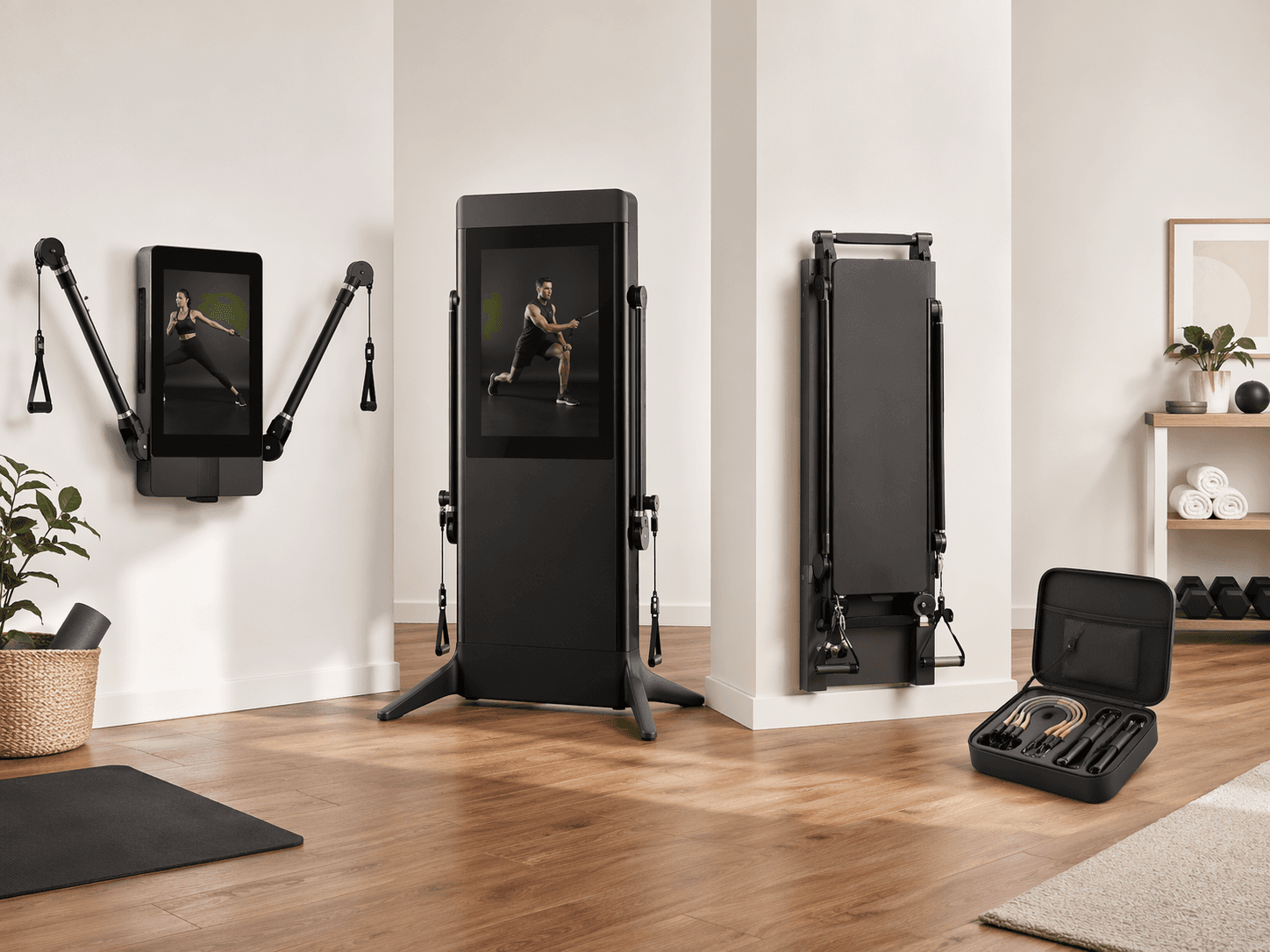
The screen is not the footprint. The machine may look slim in product photos, but your body, arms, handles, bench, mat, and exercise path all need space. This is where many smart gym purchases go from exciting to annoying.
Tonal is the clearest example because it is wall-mounted. The published installation requirement calls for studs 16–24 inches on center, and the recommended workout area is 7×7 ft.[2] That immediately rules out some renters, older buildings, masonry walls, oddly framed rooms, and spaces where a door swing or bed cuts into the working area. If drilling into studs is not allowed or not desirable, a wall-mounted system should not stay on the shortlist just because the workouts look good.
Freestanding systems such as Speediance avoid the wall-mount problem. That is a real advantage for renters and anyone who does not want installation day to involve stud finding, mounting brackets, and a permanent decision. The tradeoff is that freestanding equipment occupies its own physical zone. It may be easier to install, but it still has to live somewhere after the workout.
Foldable systems such as AEKE K1 aim at a different pain point: storage. The research materials describe AEKE K1 as storing in about 3.2 sq ft, which is the kind of number that matters in apartments and multipurpose rooms.[4] Because AEKE’s own blog is brand-affiliated, treat the claim as useful product information rather than independent proof that it will fit every room cleanly. A folded footprint still needs clearance, access, flooring that tolerates movement, and a place where the folded unit does not become an obstacle.
Portable tools such as MaxPRO change the question from “Where does the gym go?” to “Where do I anchor or set up the resistance?” That can be perfect for people who cannot surrender a room. It can also be less satisfying for someone who wants a dedicated training station that is always ready. The less setup a workout requires, the more often some people train; for others, portability is worth the setup ritual.
A quick space filter
- If you cannot drill or mount into studs, remove wall-mounted systems from the primary shortlist.
- If the room cannot provide a clear training area around the machine, do not rely on the product’s folded or wall profile alone.
- If the room has to become an office, bedroom, or living room immediately after training, prioritize foldable or portable systems.
- If you want the lowest-friction routine, favor a setup that can remain ready rather than one that must be assembled each time.
Price the machine over five years, not on checkout day
The hardware price is the number that gets attention. The subscription is the number that quietly decides whether the purchase still feels good in year four.
Current 2026 comparison data puts smart home gym hardware across a wide range, from the Tempo Move starter kit at $504 to Tonal 2 at $4,295.[1] Subscription pricing is just as uneven: Speediance basic mode is listed at $0/month, Speediance premium at $24.90/month, Tempo at $39/month, NordicTrack iFIT at $39/month, Tonal at $59.95/month with a 12-month minimum, and Alter at $66/month in the comparison data supplied by Garage Gym Reviews and BarBend.[2][3]
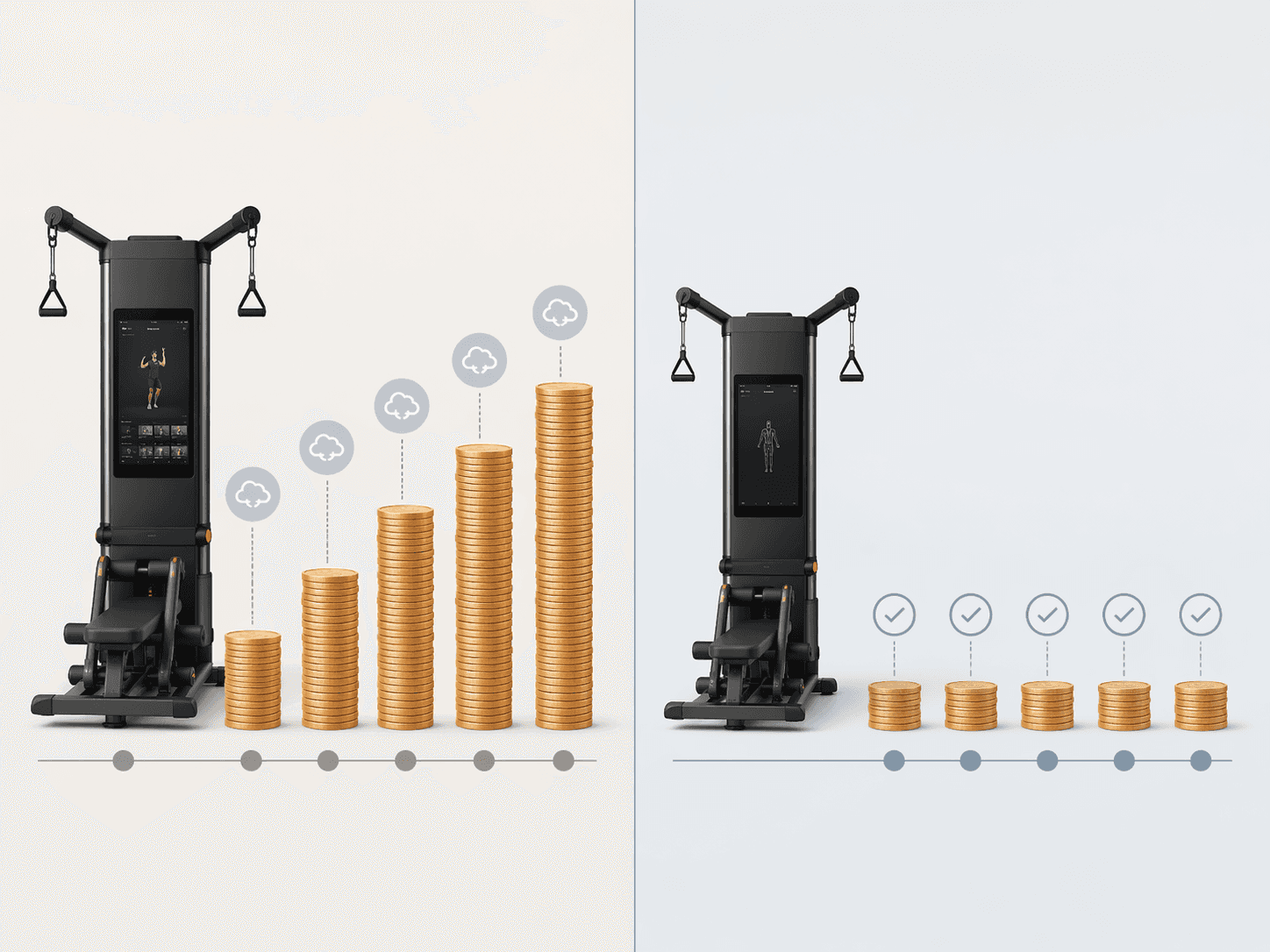
Here is the clean version: a $3,500 system with a required $50/month subscription becomes a $6,500 five-year decision before accessories, taxes, delivery, repairs, or financing. A $3,500 subscription-free system stays near $3,500 over the same period before those same add-ons. That is a $3,000 gap created by the monthly fee alone.
| Scenario | Hardware price | Monthly subscription | Subscription cost over 5 years | Approximate 5-year total before taxes/accessories |
|---|---|---|---|---|
| Subscription-required example | $3,500 | $50 | $3,000 | $6,500 |
| Subscription-free example | $3,500 | $0 | $0 | $3,500 |
| Tonal 2 listed hardware | $4,295 | $59.95 | $3,597 | $7,892 before other costs; subscription has a 12-month minimum in the cited comparison data.[1][2] |
| Tempo Move starter kit | $504 | $39 | $2,340 | $2,844 before other costs, assuming the subscription is kept for all five years.[1][2] |
| Speediance basic-mode case | Varies by configuration; Gym Monster cited around $3,199 in the research brief | $0 basic mode | $0 | Hardware-led cost if basic mode is sufficient; premium is listed at $24.90/month.[2] |
This is not an argument against subscriptions. A good subscription can be worth paying for if it supplies coaching, progression, classes, form feedback, and habit structure that you actually use. The mistake is treating the subscription as a small side fee when it can become one of the largest parts of ownership.
The comparison to a commercial gym can be useful, but only if you use it honestly. The Health & Fitness Association reported an average gym membership cost of $65/month in 2024.[5] Against that benchmark, a smart gym subscription plus hardware may still make sense for someone replacing a gym membership and training consistently at home. But if the machine becomes a coat rack after three months, the cost-per-workout gets ugly fast.
The subscription questions that matter
- Does the machine require the subscription for core functionality, or only for classes and advanced features?
- What happens if you cancel after the minimum term?
- Are multiple household profiles included, or does the plan become more expensive for shared use?
- Would you still want the hardware if the coaching library stopped being exciting?
- Are you comparing the five-year cost against a gym membership you will truly cancel, or against money you were not otherwise spending?
Match the coaching model to how you actually train
Training style is where buyers often lie to themselves politely. They imagine the version of themselves who loves polished classes, follows every program, and never skips leg day. The better test is less flattering: when you are tired on a Tuesday, what kind of system lowers the barrier enough that you still start?
Class-led systems are best for people who like being told what to do in real time. Peloton and NordicTrack iFIT belong here. The instructor, music, leaderboard, and session structure are the product. This works especially well for cardio-first users and people who want exercise to feel scheduled rather than self-designed.
AI-guided strength systems are more appealing if you want progression without building every workout yourself. Tonal and Speediance are examples in this lane. The machine can organize movements, adjust loading, and reduce the number of decisions between walking into the room and starting the first set. For beginners, that guidance may be the difference between training and browsing exercise videos for twenty minutes.
Self-directed users may not need that much hand-holding. If you already know your program, track your lifts, and prefer controlling rest times and exercise selection, a system that locks too much behind guided content can feel expensive and cramped. Tempo Move, Voltra, or a portable resistance setup may be a better fit than a premium guided platform, depending on how much tracking and coaching you want layered on top.
Household use complicates the answer. One person may want strength progression, another may want beginner yoga, and another may only care about cycling classes. A single-purpose machine can still be the right purchase if one person will use it constantly. But if the sales pitch is “everyone in the house will use it,” check whether the content library, profiles, and physical setup support that claim.
Do not compare discontinued machines as if they are active options
Smart gym research gets messy because older reviews often remain live after the product changes or disappears. Tempo Studio, NordicTrack Vault, and ProForm Vue have been discontinued since the 2024–2025 period covered in the research brief. They can be useful for understanding where the category has been, but they should not sit beside current systems as normal buying recommendations.
This matters more with smart equipment than with a plain bench or dumbbell rack. A connected machine depends on software, content, subscriptions, replacement parts, and company support. If a product is no longer actively sold, a cheap used price does not automatically make it a good value.
A conditional shortlist, not a universal winner
Once you sort yourself on the four axes, the shortlist gets smaller quickly.
- Choose a digital resistance system such as Tonal, Speediance, or AEKE if you want guided strength training, fast exercise changes, constant-tension cable-style work, and dynamic loading modes. Check the resistance ceiling before buying if you already train heavy.
- Choose a wall-mounted system only if your wall, lease, and workout area cooperate. Tonal’s stud and 7×7 ft workout-area requirements are not decorative details.[2]
- Choose a freestanding system if you want to avoid drilling and can give the machine a dedicated footprint.
- Choose a foldable or compact system if the room has to disappear back into normal life after the workout. Verify the stored footprint against your actual clearance, not just the product photo.
- Choose a portable system such as MaxPRO or Voltra if your real constraint is storage, travel, or flexible setup rather than a permanent training station.
- Choose a cardio-first smart machine if classes, metrics, and repeated cardio sessions are what you will actually do three or more times a week.
- Choose a lower-cost AI or app-supported setup such as Tempo Move if you want smart guidance around weights without paying premium mounted-system hardware prices.
- Choose a subscription-heavy platform only if the subscription is part of the value you want, not a fee you are hoping to ignore.
A home smart gym earns its space when it removes enough friction that training becomes easier to repeat. The right choice is the one whose resistance, footprint, five-year cost, and coaching style match the life it has to live inside.
References
- The Best Home Gym Equipment We've Tested for 2026 — PCMag
- Best Smart Home Gym Equipment (2026) — Garage Gym Reviews
- The 7 Best Smart Home Gyms of 2026, Tested By Fitness Experts — BarBend
- 7 Ways to Choose a Smart Home Gym in 2026 — AEKE
- Average gym membership cost — Health & Fitness Association, 2024
Comments
Join the discussion with an anonymous comment.