
The awkward truth about the best home gym cardio equipment is that the cheaper machine can become the expensive one after the monthly charge starts landing. A $990 rower with no required subscription is still roughly a $990 rower after three years. A connected bike or rower with a lower-looking entry point may carry another $1,400 to $1,800 in membership fees over the same period.
That does not make connected equipment a bad buy. It does mean the membership is part of the machine’s real price, not a footnote.
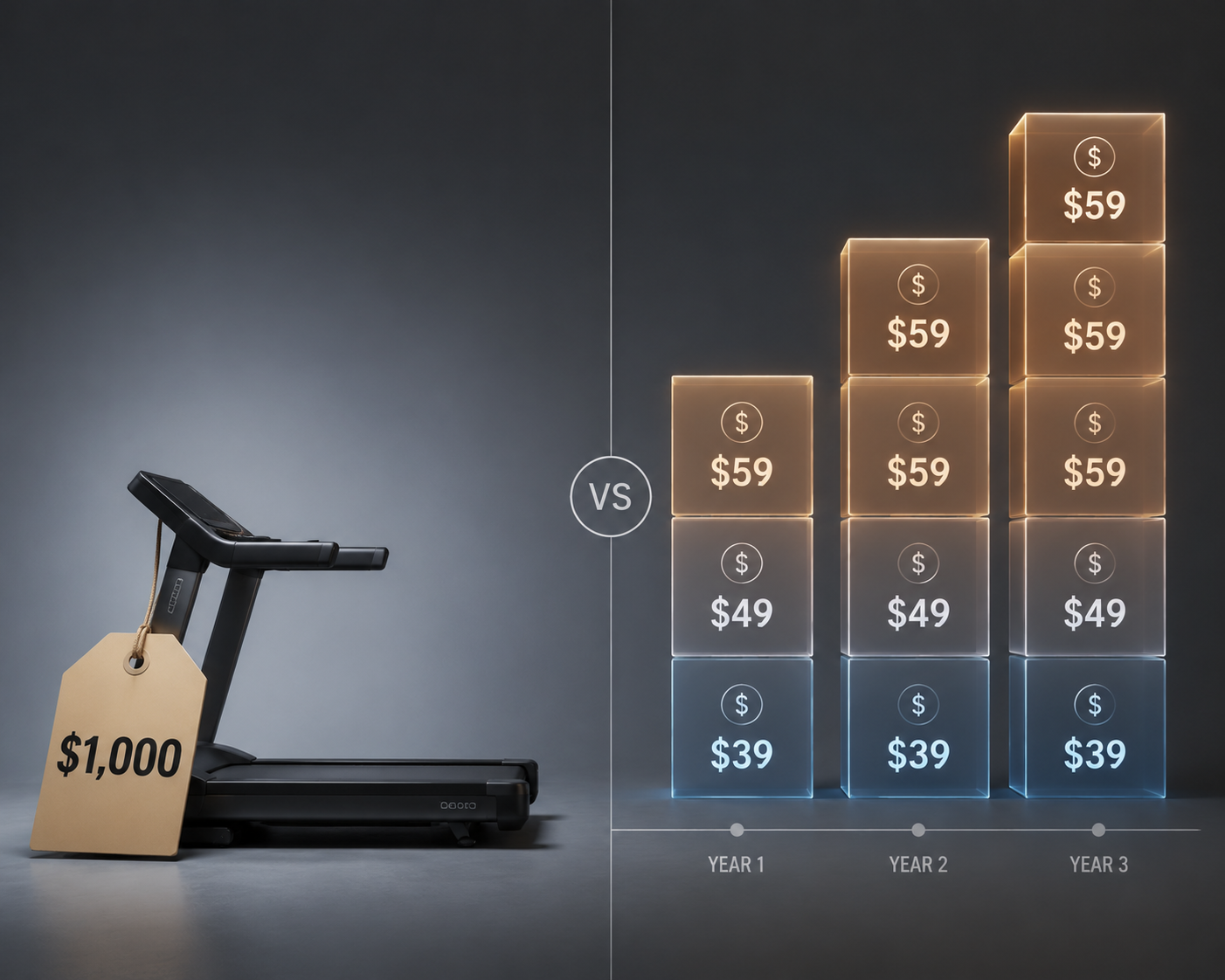
The Three-Year Cost Changes the Ranking
| Machine | Upfront price | Required monthly subscription | Three-year subscription total | Estimated hidden costs | Three-year equipment total | Vs. $65/month gym for three years |
|---|---|---|---|---|---|---|
| Peloton Bike+ | $2,695 | $49.99/month All-Access membership | About $1,800 | Delivery or assembly, mat, cycling shoes, heart rate monitor may add cost | $4,495 | $2,155 more than a $2,340 gym benchmark |
| NordicTrack Commercial 1750 | $2,499 | $39/month iFIT | $1,404 | Delivery or assembly, mat, heart rate monitor may add cost | $3,903 | $1,563 more than a $2,340 gym benchmark |
| Hydrow Wave | $1,995 | $44/month Hydrow membership | $1,584 | Delivery or assembly and floor protection may add cost | $3,579 | $1,239 more than a $2,340 gym benchmark |
| Concept2 RowErg | $990 | $0 | $0 | Mat is likely the main add-on; no required app fee | $990 | $1,350 less than a $2,340 gym benchmark |
| Bells of Steel Blitz Air Bike 2.0 | $964 | $0 | $0 | Mat is likely the main add-on; no required app fee | $964 | $1,376 less than a $2,340 gym benchmark |
| YOSUDA Indoor Cycling Bike | $260 | $0 | $0 | Mat and optional accessories may add cost | $260 | $2,080 less than a $2,340 gym benchmark |
The table is not saying the YOSUDA bike is better than the Peloton Bike+ in every meaningful way. It is saying the two purchases do not belong in the same mental bucket. One is a low-cost bike you can ride without a service relationship. The other is a bike plus a content membership, and the content membership is a major part of the ownership cost.
The same divide shows up with rowing. The Hydrow Wave’s upfront price is lower than many premium connected machines, but three years of membership moves the total to $3,579. The Concept2 RowErg starts at $990 and has no required subscription, which is why its three-year cost stays close to its purchase price. Garage Gym Reviews also notes the RowErg’s 5-year frame warranty and strong resale reputation, though broad resale values are not systematically tracked across every brand in the same way. [1]
That gap matters most for the buyer who has saved for one machine and one corner of a room. If the machine becomes a service bill, the budget needs to absorb the bill before the box arrives.
Why the Subscription Is the Real Price Lever
A $39 to $60 monthly fee does not look dramatic beside a four-figure machine. Over 36 months, it becomes the difference between a plain ownership curve and a rising one. NordicTrack’s $39/month iFIT cost adds $1,404 over three years. Hydrow’s $44/month membership adds $1,584. Peloton’s $49.99/month All-Access membership adds roughly $1,800. [1]
That money buys something real: coaching, classes, scenic rows or runs, workout tracking, leaderboards, and a screen that tells you what to do when motivation is thin. For some people, that is the difference between using the machine three times a week and avoiding it until it becomes furniture. A cheaper no-subscription machine only wins if the person using it can supply the plan, pacing, and repetition.
The accounting problem is that subscription equipment is often compared against non-subscription equipment at checkout, while the membership is treated like background noise. It is not background noise. It is a recurring condition of the experience the brand is selling.
There is also pricing volatility. Peloton, iFIT, and Hydrow have all adjusted pricing historically, so a three-year estimate is only as stable as the subscription price during that ownership window. Seasonal sales can also move the upfront number. That cuts both ways: a sale can make the machine cheaper, but it does not erase a monthly fee.
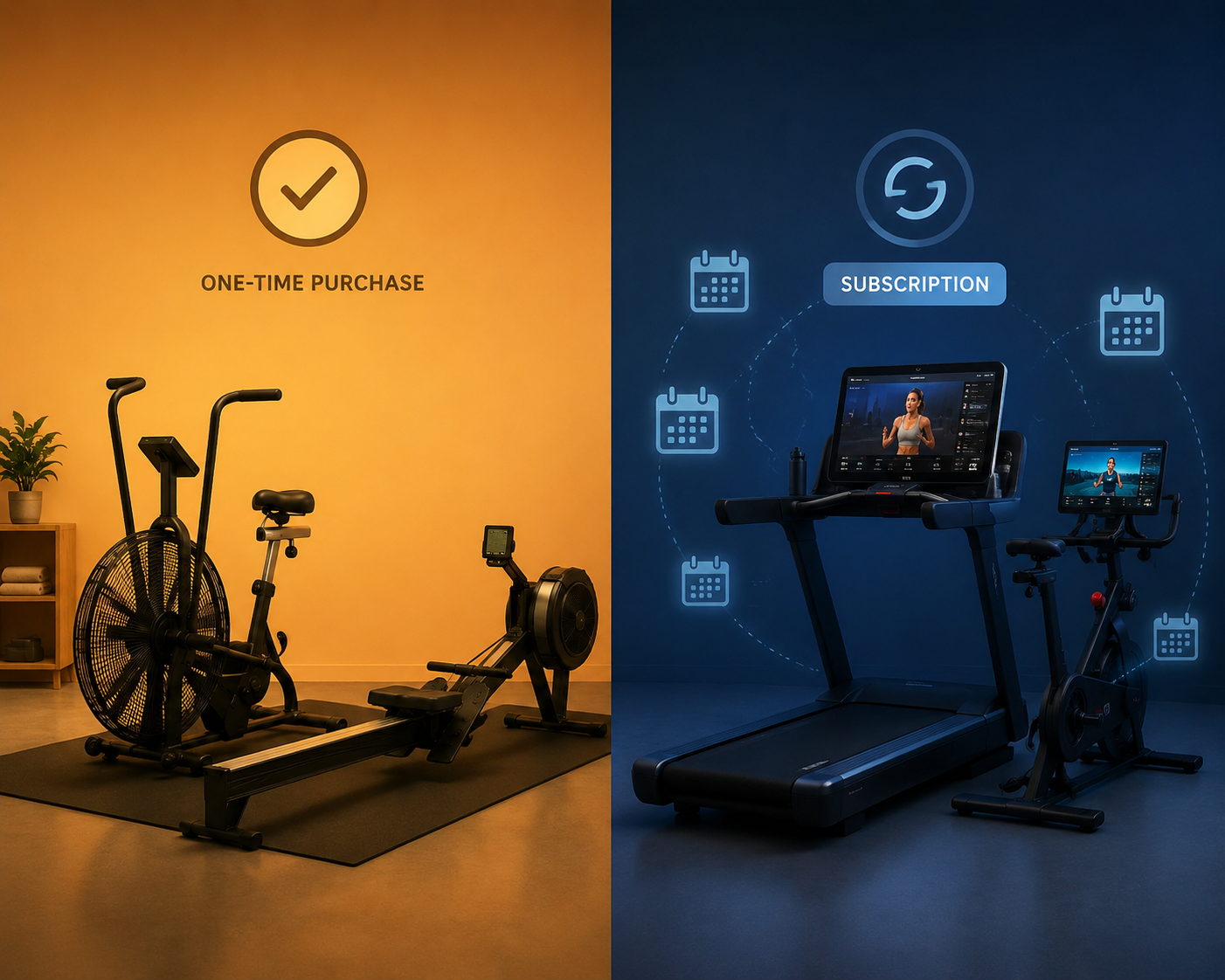
The Gym-Membership Comparison Only Works If It Is Your Gym
Garage Gym Reviews cites an average gym membership of about $65/month, or $780/year, and estimates that a $1,500 home gym breaks even in about 23 months against that benchmark. Its tested average home-gym cost range is $1,500 to $2,500, which it says can be recouped in under three years compared with a typical gym membership. [2]
That benchmark is useful, but it is not universal. Against a $65/month gym, a Concept2 RowErg or Bells of Steel air bike can look financially sensible very quickly. Against a $15/month budget gym, the math slows down. Against a $150/month boutique studio habit, even a connected machine with a subscription may reduce spending if it actually replaces the classes.
The cleanest break-even formula is simple:
Break-even months = upfront equipment cost ÷ monthly gym cost avoidedFor subscription machines, the formula needs one more line:
Monthly savings = monthly gym cost avoided - monthly equipment subscription
Break-even months = upfront equipment cost ÷ monthly savings
That second version is where many “home gym pays for itself” claims get too tidy. If someone cancels a $65/month gym and buys a machine with a $49.99/month subscription, the monthly savings before electricity, accessories, or maintenance is only about $15. A buyer canceling a $150/month studio routine is in a very different position.
Hidden Costs Can Decide a Close Call
Hidden costs are not usually big enough to overturn a $1,500 subscription gap, but they can matter when two options are close. Garage Gym Reviews lists delivery or assembly at $150 to $349, mats at $50 to $200, and add-ons such as heart rate monitors and cycling shoes as common extra costs. [2]
- Floor protection: a mat is cheap compared with a machine, but skipping it can be a bad trade in an apartment, basement, or spare room.
- Delivery and assembly: heavier treadmills and connected machines are more likely to turn “free space in the room” into a logistics cost.
- Cycling shoes and monitors: some bikes feel incomplete without accessories, even when the base machine is technically usable.
- Maintenance exposure: belts, screens, electronics, and moving parts do not all carry the same long-term risk.
If flooring is the main unknown, it is worth pricing that separately before committing to a machine. A buyer who is still deciding how much mat they actually need should handle that as its own purchase decision rather than casually adding the thickest option to the cart.
Three Buyers, Three Different Answers
The self-directed buyer
This is where no-subscription equipment has its clearest advantage. The Concept2 RowErg and Bells of Steel Blitz Air Bike 2.0 keep the ownership math plain: buy the machine, add a mat if needed, and train. The Concept2 also has the stronger evidence in the research brief for warranty and resale reputation, with a 5-year frame warranty and a 4.6/5 rating from Garage Gym Reviews. [1]
The risk is not financial complexity. The risk is whether the buyer will keep using a machine that does not coach them. If intervals, heart-rate zones, or steady-state sessions already make sense, that risk is lower.
The class-motivated buyer
For this person, the Peloton Bike+, NordicTrack Commercial 1750, or Hydrow Wave should be judged as a service-backed fitness system. The screen, instructors, tracking, and programming are not decorative. They are the reason the machine might get used.
The right comparison is not “Could I buy a cheaper machine?” It is “Would I use the cheaper machine enough for it to matter?” If the honest answer is no, then the subscription may be a behavior cost rather than wasted money. It still belongs in the budget for the full ownership period.
The gym-replacement buyer
This buyer should start with current monthly spending, not product rankings. Someone replacing a $65/month gym has $2,340 of avoided dues over three years. Someone replacing a $15/month gym has only $540. Someone replacing boutique classes has a much larger avoided cost, but only if the home machine truly replaces the habit rather than becoming an additional subscription.
If the cardio category itself is still unresolved—bike, rower, treadmill, elliptical, or air bike—that decision belongs before this cost comparison. A separate category-first guide, such as how to choose the best home cardio machine for your space, budget, and noise tolerance, is the better place to sort out footprint, noise, joint impact, and training style. This cost exercise is most useful once the category has narrowed.
So Which Equipment Is the Best Long-Term Value?
For most budget-conscious buyers who can train independently, the best long-term value is usually a no-subscription machine. The Concept2 RowErg and Bells of Steel Blitz Air Bike 2.0 keep the three-year cost close to the purchase price, and they avoid the problem of a machine becoming less useful because a membership changes.
For buyers who need instruction, accountability, and class structure, a connected machine can still be the better purchase. It just has to be judged with the subscription included from the first comparison, not discovered after the financing screen.
The decision boundary is practical: if you can supply your own programming, buy the durable machine with the clearest ownership cost. If guided programming is what keeps you exercising, price the connected machine as a three-year service commitment and compare that total against the gym or studio spending it will actually replace.
References
- Best Cardio Machines, Garage Gym Reviews
- How Much Does a Home Gym Cost?, Garage Gym Reviews
Comments
Join the discussion with an anonymous comment.