Good leg workout equipment for home does not start with the biggest machine you can fit through the door. It starts with a simpler question: can your setup train the four leg patterns you actually need—squat, hinge, knee extension, and knee flexion—without swallowing the room or forcing you to buy twice?
That matters because “complete” is where home gym purchases get messy. A leg press may be excellent for quad-dominant pressing, but it does not train a hip hinge. A leg curl machine solves knee flexion, but it does not give you loaded lunges, Romanian deadlifts, or squats. Dumbbells are flexible, but they do not automatically give you comfortable heavy loading forever. The best setup is usually a combination, not one impressive-looking machine.
The four-pattern test
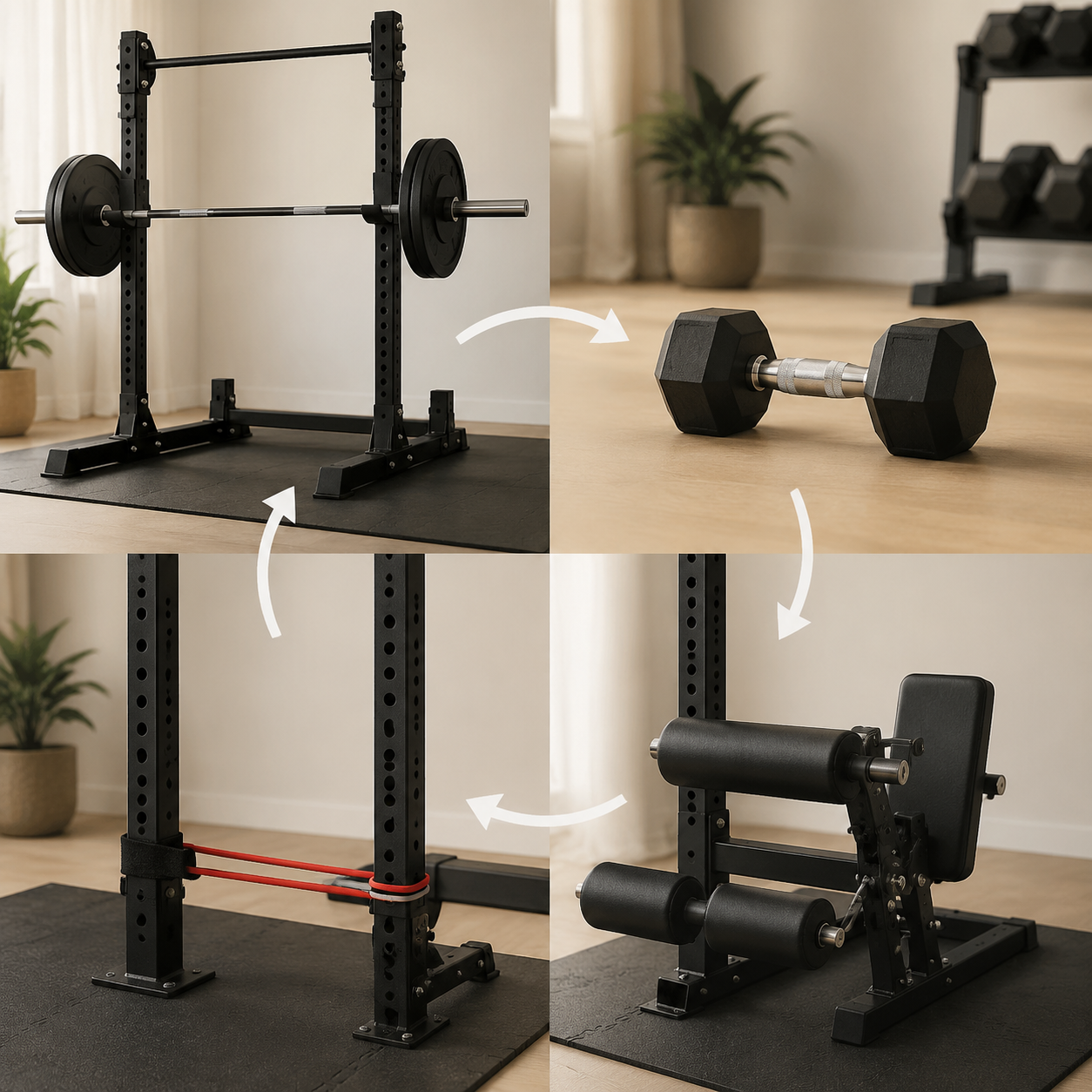
Before comparing racks, benches, dumbbells, bands, or machines, put every option through the same four-pattern test. This keeps the decision grounded in training coverage instead of product category.
| Pattern | What it covers | Home equipment that can cover it |
|---|---|---|
| Squat | Squats, split squats, lunges, step-ups, Bulgarian split squats | Rack, barbell, adjustable dumbbells, bench, plates |
| Hip hinge | Romanian deadlifts, good mornings, hip thrusts, loaded hinges | Barbell, dumbbells, bench, plates, bands |
| Knee extension | Leg extensions, sissy squat-style work, quad-focused pressing | Leg extension attachment, sissy squat setup, leg press, bands in limited cases |
| Knee flexion | Leg curls, Nordic curl variations, hamstring curl patterns | Bands, sliders, Nordic setup, leg curl attachment or machine |
A home setup that covers only squats and lunges can still build strong legs, but it is not a complete leg-day setup in equipment terms. It leaves hamstring flexion and direct knee extension under-served. That may be fine for a beginner, a small apartment, or a short budget phase. It is a problem only when the buyer mistakes a partial setup for a finished one.
This is also where the usual “best leg machine” framing starts to fall apart. Machines are not interchangeable. A vertical leg press, a 45-degree leg press, a leg extension/curl combo, and a hack squat all solve different problems. The useful question is not whether a machine is good. It is which movement-pattern gap it fills after the flexible basics are already considered.
If you want a broader way to sort home gym purchases by budget, room size, and training goal, the same constraint-first logic is laid out in The Home Gym Equipment Decision Framework. For legs, the framework becomes especially useful because lower-body training usually demands heavier loading, more floor protection, and more clearance than upper-body accessory work.
The baseline setup that earns its floor space
For most homes, the baseline decision set is not a dedicated leg machine. It is a squat rack or power cage, adjustable bench, barbell, plates, adjustable dumbbells or a small dumbbell run, and bands. That combination covers more patterns than a single-purpose machine and keeps expanding as the lifter gets stronger.
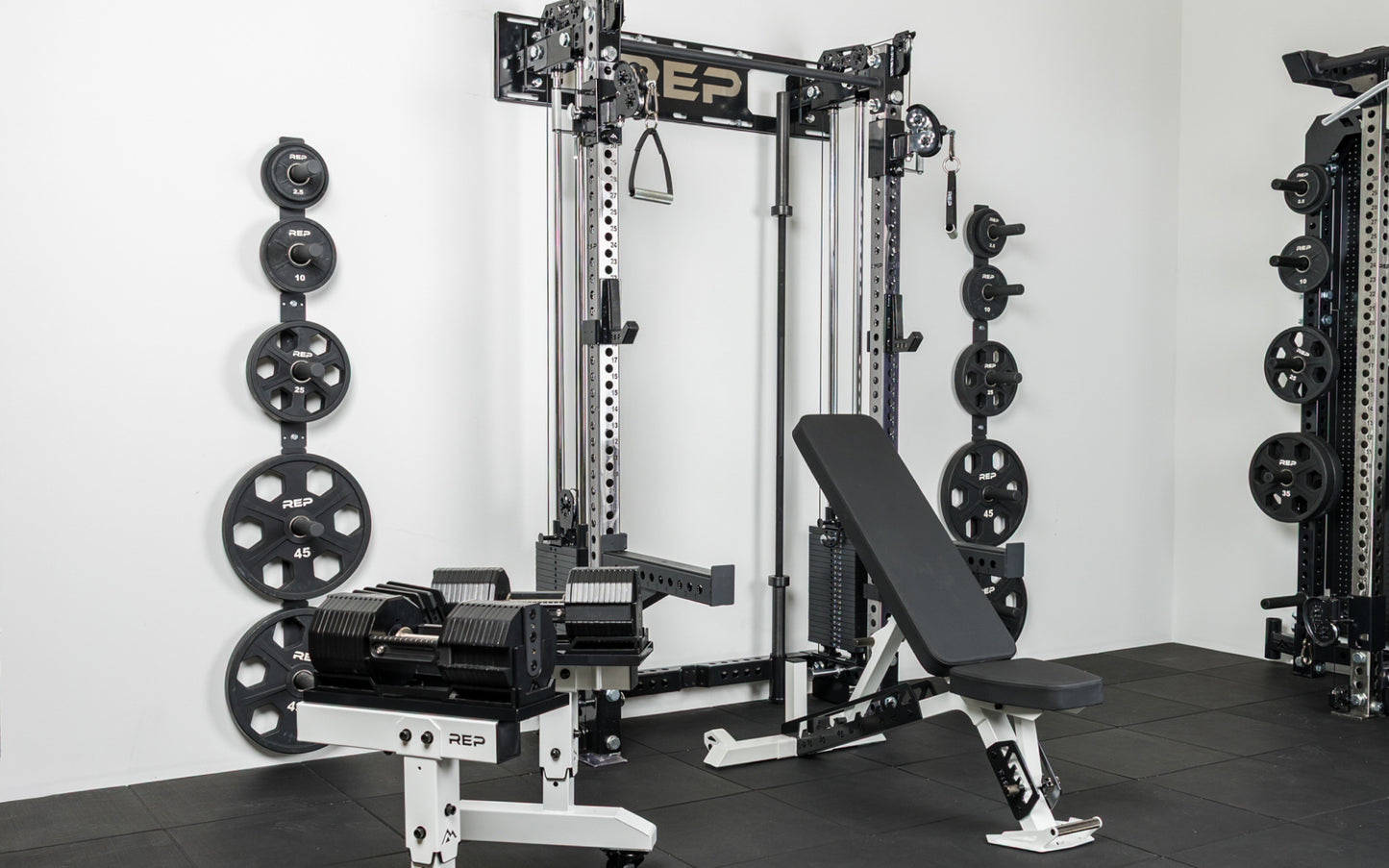
A rack and barbell handle squats, box squats, rack pulls, Romanian deadlifts, good mornings, calf raises, and loaded split squat variations. The bench matters because it turns the same corner of the room into a hip thrust station, Bulgarian split squat support, step-up surface, and general upper-body station. Dumbbells fill the single-leg gap when a barbell is too awkward. Bands add cheap knee flexion and lateral hip work.
Bands are not a consolation prize. Bands in the $15–$30 range can be used for glute bridges, leg curls, and lateral walks, and they are often the cheapest way to avoid buying a hip abductor/adductor machine or a dedicated hamstring curl station early on.[1] A 2019 systematic review and meta-analysis found that elastic resistance and conventional resistance produced comparable strength improvements, although the authors noted moderate evidence quality and high heterogeneity across studies.[2]
That evidence does not mean bands are identical to machines, or that every lifter will prefer them. It does support a narrower, practical conclusion: for many home users, bands are credible enough to cover several isolation and accessory jobs until the rest of the room is built.
What to buy first by budget
A smart purchase sequence protects both money and floor space. The first round should buy movement coverage. The second round should improve loading, comfort, or convenience. Dedicated machines belong later unless they solve a very specific constraint from day one.
Under $500: small, honest, and not finished
Under $500, the cleanest leg setup is usually adjustable or fixed dumbbells, bands, sliders, and a sturdy bench or step surface if you already have one. This covers goblet squats, split squats, lunges, step-ups, Romanian deadlifts, single-leg RDLs, band leg curls, glute bridges, and lateral band walks.
The tradeoff is loading. A beginner can get months of useful lower-body work from this setup, especially with single-leg variations. A stronger lifter will outgrow the dumbbell loading ceiling faster. That is not a reason to skip the budget setup if it matches the room and wallet; it is a reason to avoid pretending it replaces a rack-and-barbell setup forever.
June 2026 budget examples place CAP cast iron hex dumbbells at roughly $1 per pound, while adjustable dumbbells such as REP QuickDraws have appeared around $336–$576 depending on weight range and configuration.[3][4] Those are anchors, not guarantees. Sales, shipping, and inventory can change the real number quickly.
For readers trying to keep the entire starter gym under this ceiling, How to Build a Budget Home Gym Under $500 is the more natural companion piece because it has to balance legs against everything else.
$500 to $1,500: build the actual base
This is where most home leg gyms start to make sense. A budget rack, adjustable bench, barbell, starter plates, and bands create a setup that can progress for years. It gives you the heavy squat pattern, the heavy hinge pattern, and enough accessory coverage to train around weak points.
As of June 2026, examples in budget roundups include the REP PR-1100 power rack around $380, a Major Fitness adjustable bench around $219, and Fringe Sport bumper plates around $200 for starter plate packages or entry-level sets.[3] Exact totals depend heavily on barbell choice, plate weight, flooring, and shipping.
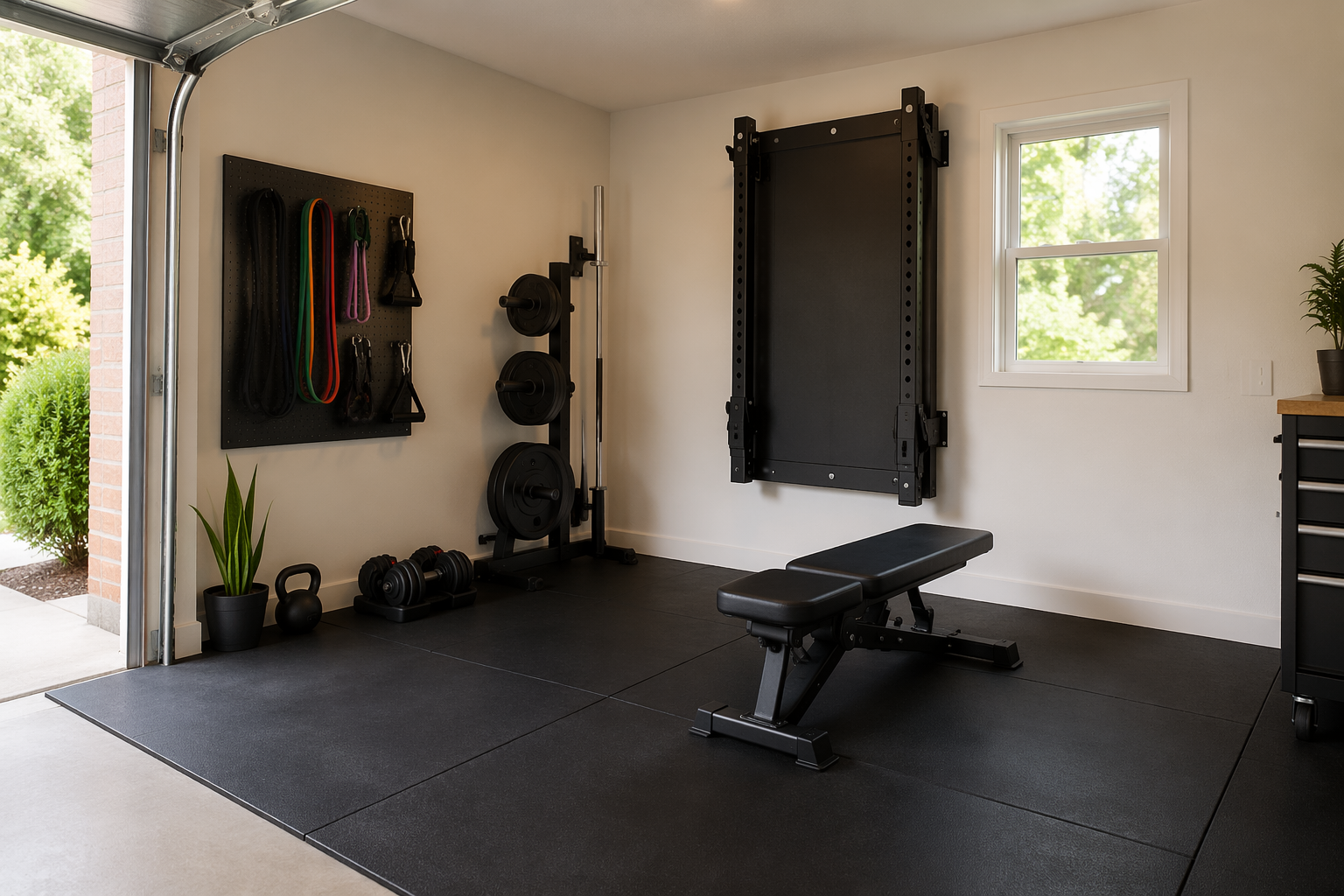
If there is one place not to get too cute, it is the rack footprint. Measure the room with the barbell loaded, not just the rack frame. You need space to walk plates to the sleeve, step around the bench, unrack safely, and store plates where they do not become ankle traps. A rack that technically fits but makes every set feel like furniture Tetris is not a good small-space solution.
For full starter-kit comparisons beyond leg day, see Complete Budget Home Gym Starter Kits. The important leg-day point is simple: this budget tier should usually buy the rack-and-free-weight base before it buys a dedicated leg machine.
$1,500 and up: add machines only after the gap is real
Once the base is covered, machines become much easier to judge. A leg extension/curl attachment makes sense if you want direct quad and hamstring isolation and already have the compound work handled. A vertical leg press makes sense if you want quad-dominant pressing without giving up a large rectangle of floor. A hack squat or 45-degree leg press makes sense only when the room, budget, and training priority all agree.
This is also the point where purchase order matters more than “best overall” lists. A machine that is excellent in a garage with open wall space can be an expensive mistake in a bedroom corner. A lifter with knee-extension limitations may value a leg extension attachment earlier than someone who mainly needs heavier hinges. A renter upstairs may need flooring and noise control before more iron.
For that kind of staged buying logic, Best Home Exercise Equipment: A Phased Purchase-Sequence Guide is more useful than another isolated machine ranking.
Vertical leg press versus 45-degree leg press
The leg press deserves attention because it is one of the few dedicated leg machines that can make sense in a home gym. The mistake is treating every leg press as the same kind of purchase.
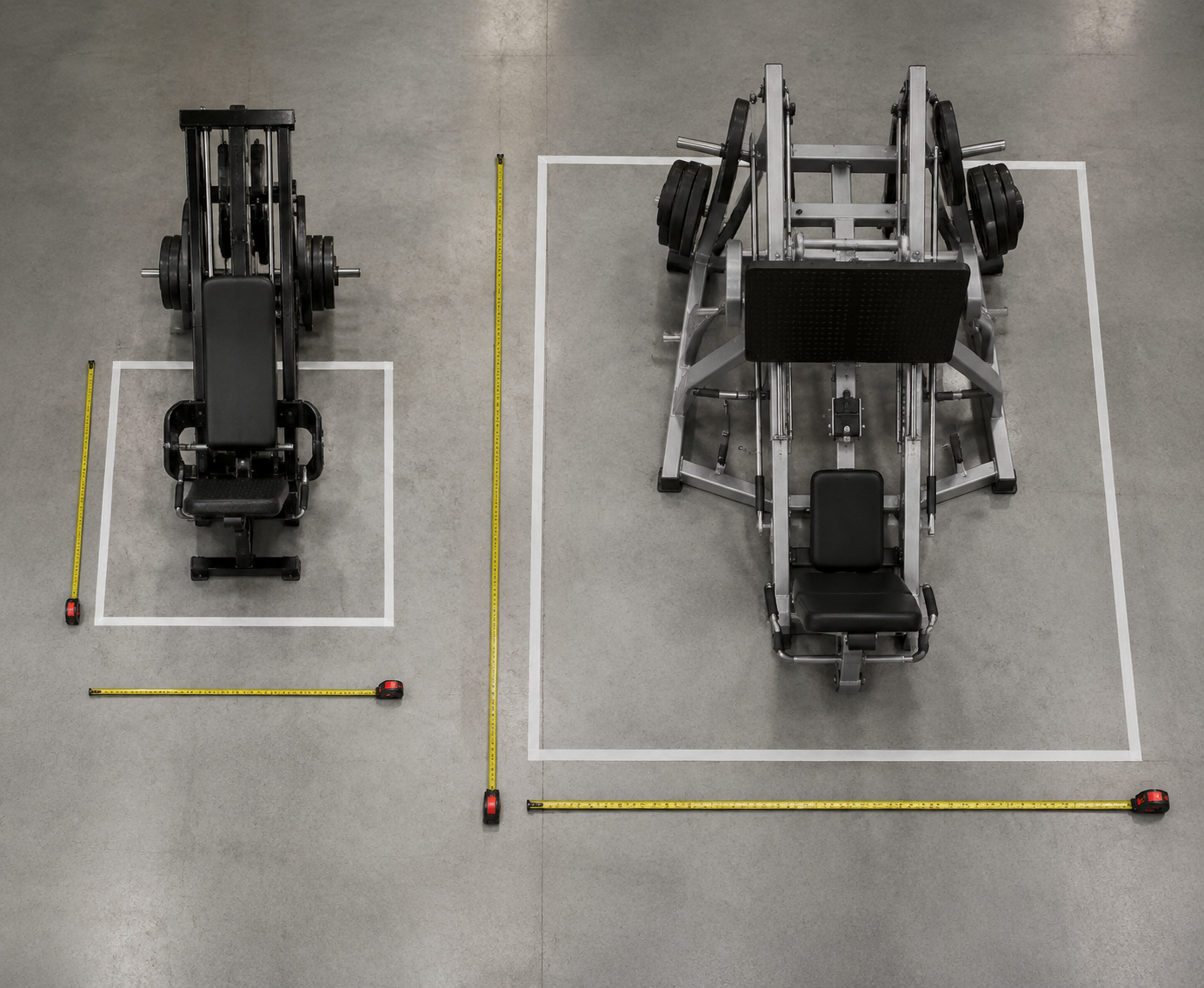
A vertical leg press can take roughly 8 square feet of floor space, while 45-degree leg presses often take more than 20 square feet.[5] In a commercial gym, that difference is barely interesting. In an apartment, spare bedroom, or basement corner, it can decide the purchase.
The compact footprint does not make the vertical leg press magically complete. It mainly gives you a space-efficient way to load a quad-dominant press pattern. You still need a hinge. You still need knee flexion if hamstring curls matter to your program. You still need to think about plate loading, storage, getting in and out of the machine, and what the machine blocks when it is not being used.
The muscle-activation evidence also argues against judging leg presses by size alone. A 2020 systematic review of leg press variants found that the vastus medialis and vastus lateralis showed the greatest activation among the quadriceps muscles studied, and that foot position influenced activation patterns.[6] The review’s underlying studies commonly had modest samples, so the finding is better used as directional guidance than as a reason to crown one home machine as universally superior.
For a tight home gym, the practical conclusion is restrained: a vertical leg press can be a good add-on when you want compact pressing and already know how the other three patterns will be covered. A 45-degree leg press asks for enough space that it should compete not with a vertical press, but with everything else that could occupy the same floor area.
Small-space leg training is mostly a clearance problem
Small-space equipment advice often stops at folded dimensions. Legs expose the flaw in that. You need working clearance: room for a bar path, room for dumbbells at your sides, room to step back from a rack, room for a bench to slide in and out, and room for plates to live somewhere other than the middle of the floor.
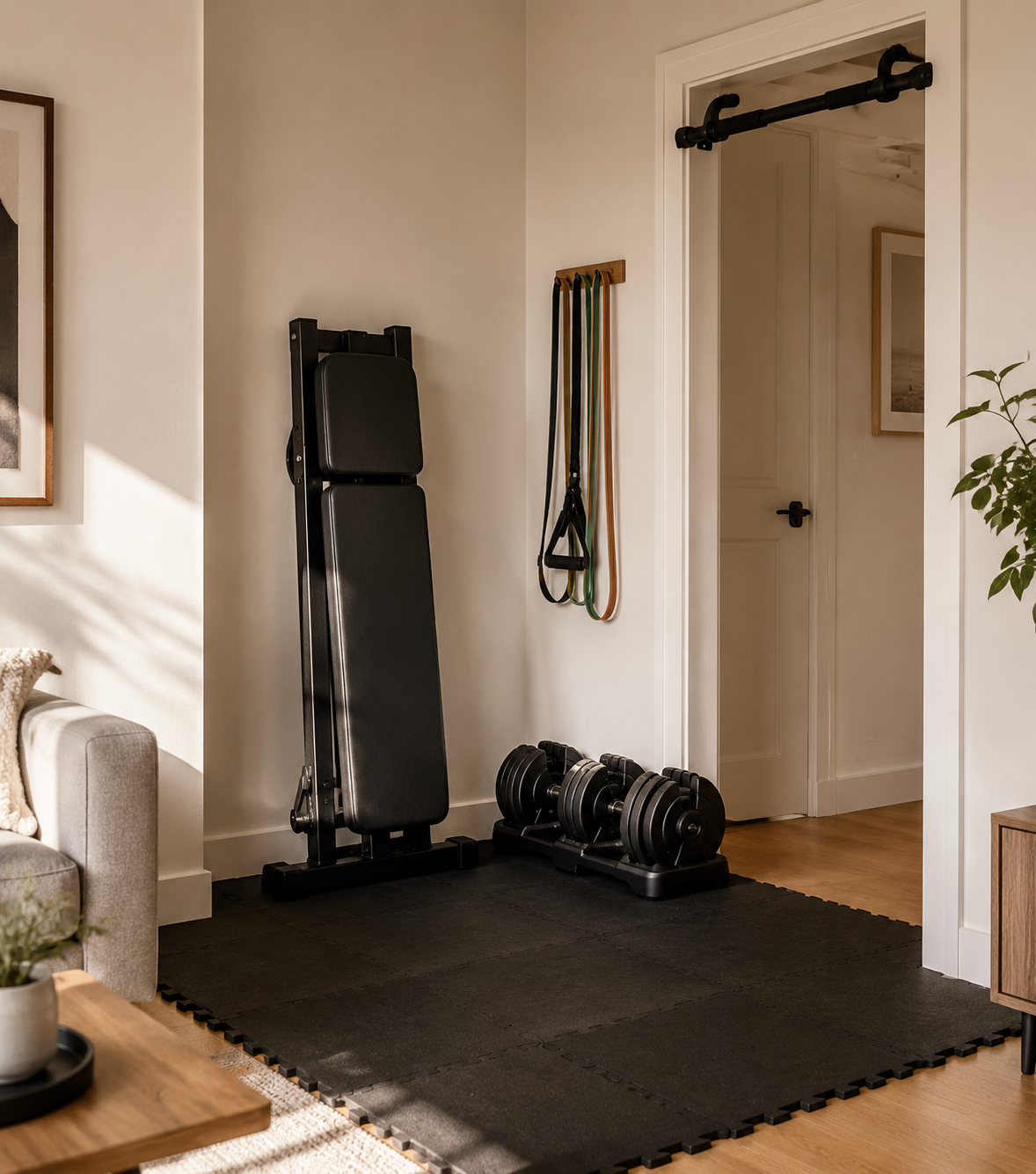
In an apartment or spare bedroom, the smallest effective combination is usually adjustable dumbbells, bands, a foldable or compact bench if it is genuinely stable, and possibly a compact rack only if ceiling height, barbell width, and floor protection are solved. Garage Gym Reviews’ compact-equipment testing is useful here because compactness is treated as a real constraint rather than a product adjective.[4]
Flooring is not decorative for leg day. Dropped dumbbells, loaded hinges, and plate changes are where renters start worrying about neighbors, subfloors, and security deposits. For apartment-specific matting and noise control, Home Gym Flooring for Apartments is worth reading before adding heavier equipment.
If the room is truly tight, Home Exercise Equipment for Small Spaces and Compact Home Gym Systems for Small Spaces are better next reads than a list of commercial-style leg machines. The question is not what looks like a gym. It is what can stay set up without making the room worse to live in.
Where each equipment type actually fits
A quick sorting pass can prevent most overbuying.
- Rack or power cage: best for heavy squat and hinge progression, but requires real clearance and plate storage.
- Adjustable bench: not leg-specific, but essential for Bulgarian split squats, hip thrusts, step-ups, and general training versatility.
- Barbell and plates: strongest long-term loading path for squats, RDLs, good mornings, and hip thrusts.
- Dumbbells: excellent for single-leg work and smaller rooms, with a loading ceiling that stronger lifters will eventually feel.
- Bands: cheap coverage for curls, glute bridges, lateral work, warmups, and travel-friendly accessories.
- Leg extension/curl machines or attachments: useful isolation tools after the main compound patterns are covered.
- Leg press or hack squat machines: worthwhile only when they solve a specific pressing need and the footprint is acceptable.
There is no need to force every home gym through the same final form. A beginner in a rented apartment may be right to stop at dumbbells, bands, and a bench for now. A garage lifter who squats heavy twice a week may need the rack and plates before anything else. Someone rehabbing around a movement limitation may reasonably prioritize a controlled machine earlier than a general buyer would.
A simple purchase path
Start by writing down how your current plan covers the four patterns. If squat and hinge are covered but knee flexion is missing, bands or sliders may solve the problem cheaply. If everything is light because your dumbbells top out too soon, the next purchase is probably heavier loading, not a machine. If direct quad work is the missing piece and space is tight, a compact extension option or vertical leg press deserves a look before a large 45-degree unit.
Then measure the room as it will be used. Include the loaded barbell, bench position, plate changes, walking paths, and storage. If a machine leaves no room to move plates safely or blocks the only open training lane, the footprint is larger than the product page says.
Finally, buy in a sequence that keeps options open: flexible free weights and bands first, rack-and-barbell loading when the room and budget support it, isolation attachments or dedicated machines only when they solve a remaining gap. That is how a complete home leg day usually gets built—not as one dramatic purchase, but as a setup that covers the work without wasting the room.
References
- Exercise Equipment for Legs: The Ultimate Collection — Powertec
- Effects of Training with Elastic Resistance Versus Conventional Resistance on Muscular Strength: A Systematic Review and Meta-Analysis — PMC / Lopes et al., 2019
- The Best Budget Home Gym Equipment of 2026 — Garage Gym Reviews
- Expert-Tested: The Best Compact Exercise Equipment (2026) — Garage Gym Reviews
- The 10 Best Leg Machines for Leg Day — Garage Gym Reviews
- Evaluation of the Lower Limb Muscles Electromyographic Activity During the Leg Press Exercise and Its Variants: A Systematic Review — PubMed / Martín-Fuentes et al., 2020
Comments
Join the discussion with an anonymous comment.