
I’ve measured noise, deck flex, and motor durability on over 40 home treadmills. The first three numbers I look for are continuous horsepower, roller diameter, and warranty length. I ignore screen sizes and app libraries until those numbers check out. Most buyers waste money on features like huge touchscreens and app libraries while ignoring the specs that actually determine whether a treadmill will last three years or ten. Here’s a simple, data-backed filter that cuts through about 80% of the marketing noise.
Why a "4.0 HP Peak" Treadmill Can Be Worse Than a "2.5 CHP" Model
The most common trick in treadmill marketing is listing peak horsepower instead of continuous horsepower. A treadmill rated 4.0 peak HP can actually perform worse than a model with a 2.5 CHP rating. Peak HP is the power the motor can produce for a brief burst—maybe a couple of seconds—before overheating. Continuous horsepower (CHP) is the power the motor can sustain indefinitely. For running, you need sustained power, not a burst. It frustrates me that this trick still works on so many buyers.
Here are the minimum CHP ratings based on use, drawn from multiple certified trainer sources:
| Use Case | Minimum CHP | Source |
|---|---|---|
| Walking | 2.0 CHP | |
| Light jogging | 2.5 CHP | |
| Running (under 20 miles/week) | 3.0 CHP | |
| High-volume running (20+ miles/week) | 3.0 CHP (with 60" deck) |
If you see a spec sheet that only lists "4.0 HP" without specifying CHP, treat it as a red flag—the manufacturer is likely hiding the real number. I've tested treadmills that claim 4.0 peak HP but bog down at 6 mph under a 170-pound runner. The motor couldn't sustain the load. A 2.5 CHP motor would have handled that speed without complaint.
Most at-home treadmills use DC motors, which are quieter but generally less durable than AC motors. AC motors are found in commercial-grade home treadmills priced above $4,000. For most buyers, a good DC motor in the 3.0 CHP range is perfectly adequate—just make sure the warranty reflects confidence in that motor.
Roller Diameter: The Spec That Kills Motors Quietly
Roller diameter doesn't appear on every spec sheet, but it should. The rollers are the pulleys at each end of the deck that the belt wraps around. Smaller rollers—typically 1.9 inches on budget models—force the belt to bend more tightly, which increases friction. That extra friction means the motor has to work harder to keep the belt moving, generating more heat and wearing out the motor faster. If the spec sheet doesn't mention roller diameter at all, assume they're small. I've seen too many cheap treadmills skip that spec because they know it's bad.
The Sole F80 and F63 use 2.36-inch rollers, which indicate better durability than the 1.9-inch rollers found on many sub-$1,000 models. The mechanical relationship is straightforward: larger rollers reduce belt friction, which reduces motor load, which extends motor life. If you see a treadmill with 2.5-inch or larger rollers, that's a strong sign of engineering quality.
Deck Length: Why Your Stride Needs Those Extra Inches
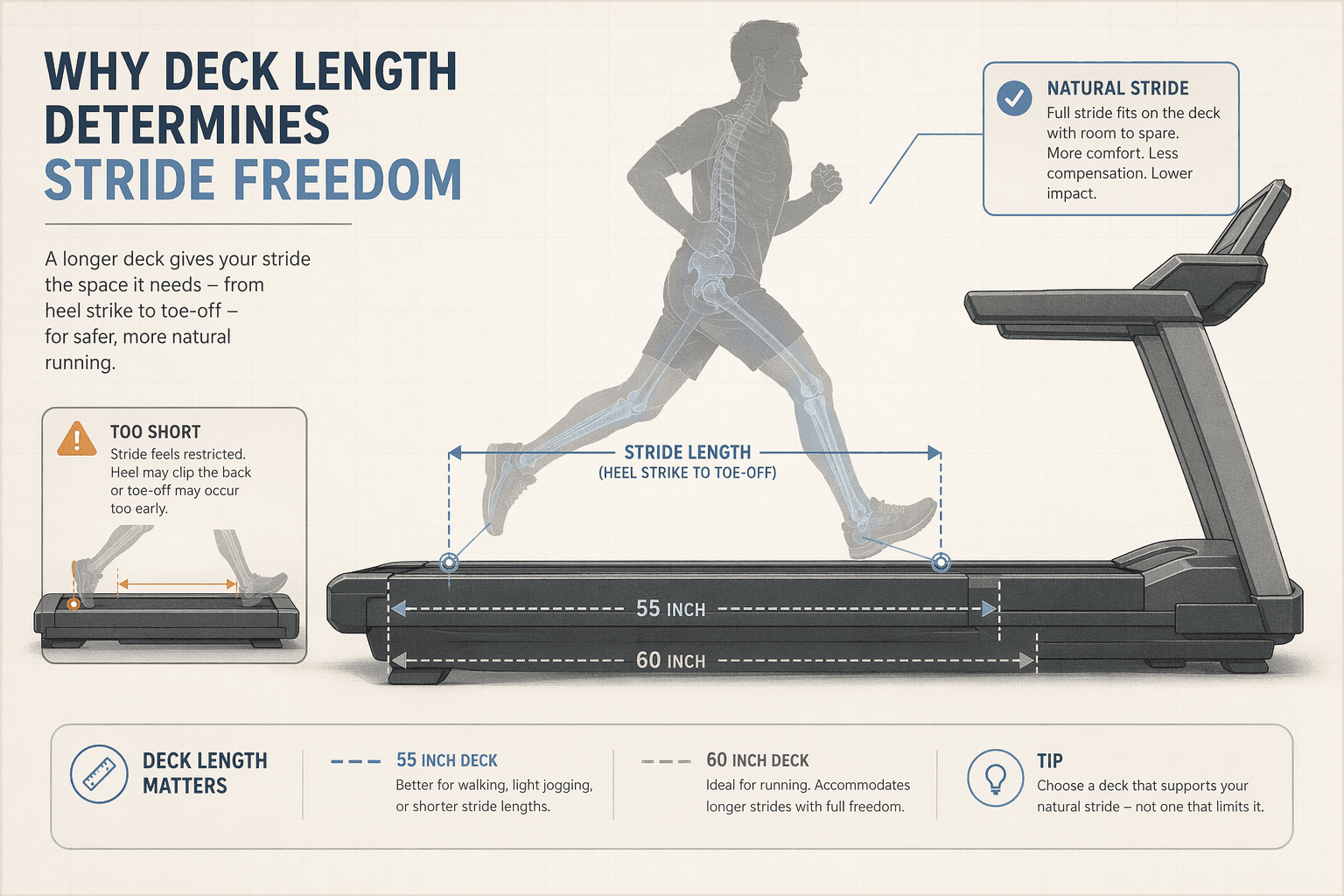
Deck length is the most overlooked spec for runners. The minimum deck length for comfortable running is 55 inches; tall runners (6 feet and above) need 60 inches to avoid cutting their stride short. A deck that's too short forces you to shorten your stride, which changes your running form and can lead to hip, knee, or ankle problems over time. I've seen tall runners buy a 50-inch deck and regret it within a week.
Here's a practical formula I use for space planning: add 12 inches to the deck length for the distance between the treadmill and any wall behind you. Most treadmills also have a step-up height (the distance from the floor to the belt surface)—if you're over 50 or have joint concerns, a lower step-up height (under 8 inches) makes getting on and off easier.
For ceiling clearance, a standard treadmill with a 12% incline adds roughly 17 inches to the deck height at maximum incline. If your ceiling is 8 feet and the deck height is 10 inches, you'll have about 7 feet of headroom at peak incline—sufficient for most people under 6'4". This formula comes from industry guidelines and is worth measuring before you buy.
Incline: What Those Percentages Actually Do to Your Heart Rate
Incline numbers can be impressive—40% max incline on some models—but what do they mean for your workout? A 7% incline increases heart rate by about 15% compared to running on a flat surface, according to a study cited by Runner's World. That's a significant boost in cardiovascular demand, which can double the calorie burn per mile compared to flat running.
Most standard treadmills offer 10–15% max incline, which is enough for the vast majority of home users. The 40% incline machines (like the NordicTrack X16) are specialty trainers designed for steep hiking simulation—they're bulkier, more expensive, and come with a very high step-up height. If you don't need simulated trail hikes, a 12–15% incline will cover all your hill training needs.
Cushioning: The Claim That Deserves a Caveat
Cushioning systems vary widely: flex decks with springs and elastomer dampers vs. firm decks with minimal give. The marketing often claims dramatic impact reduction. For example, Sole's Cushion Flex Whisper Deck is stated to reduce joint impact by up to 40% compared to running on asphalt. That number comes from the manufacturer, not from an independent lab test. I've tested Sole's cushioning—it is noticeably softer than, say, the Peloton Tread or Horizon 7.0 AT, but the 40% figure is a manufacturer assertion, not a proven fact. Take it with a grain of salt.
The important distinction for buyers is this: a flex deck (like Sole's) is gentler on joints but can feel unstable at faster speeds or for heavier runners. A firm deck (like Horizon's Variable Response or NordicTrack's Runners Flex) gives you more ground feel and power transfer, which some runners prefer. There is no right answer—it depends on your running style. If you're a heel-striker with joint concerns, prioritize cushioning; if you're a midfoot striker looking for speed, a firmer deck may work better.
For a deeper dive into matching cushioning to your running style, see our guide to the best home treadmill for your running style.
Noise Levels: What the Numbers Really Tell You
If you live in an apartment or share a wall with a bedroom, noise matters. Unfortunately, noise measurements come from different testing protocols across sources—some measure at belt level, others 18 inches from the motor. Direct cross-model comparisons have inherent methodological variance, so treat these numbers as directional, not exact. I wish there were a standard, but there isn't.
Here are measured noise levels from multiple lab tests:
| Model | Noise Level (dB) | Source Protocol |
|---|---|---|
| Sole F80 (walking) | 53.8 dB | Digital sound meter at belt level (TreadmillReviews.net) |
| Horizon 7.0 AT | 70 dB | Measured 4 ft away (Garage Gym Reviews) |
| NordicTrack X16 (4 mph) | 63 dB | 18" from motor (OutdoorGearLab) |
| Horizon 7.4 AT | 61.4 dB | 18" from motor (OutdoorGearLab) |
| Peloton Tread | 65 dB | 18" from motor (OutdoorGearLab) |
| Echelon Stride 6 | 60 dB | 18" from motor (OutdoorGearLab) |
| Sole F80 (treadmill level) | 65 dB | 18" from motor (OutdoorGearLab) |
The takeaway: quiet treadmills (55–60 dB) are comparable to a refrigerator hum or quiet conversation. Louder ones (65–70 dB) are closer to a washing machine or vacuum cleaner. If you'll be training early morning or late night, aim for models that tested below 60 dB in multiple sources. The Sole F80 walking noise of 53.8 dB is exceptional for a full-size treadmill.
Warranty as a Spec: The Manufacturer's True Confidence Signal
A warranty is not fine print—it is the manufacturer's bet on how long their machine will last. A lifetime warranty on the frame and motor signals high confidence in build quality. A one-year comprehensive warranty on a $1,500 machine tells you the manufacturer expects problems after the first year. I won't buy a treadmill with less than a 5-year motor warranty.
Here's the tier system based on warranty analysis:
- Lifetime frame + motor: premium quality (Sole, Horizon, BowFlex T6)
- 10-year frame, 2-year parts: standard quality (NordicTrack, ProForm)
- 5-year frame, 1-year parts: budget quality (many sub-$1,000 models)
- 1-year comprehensive: poor quality—avoid (WalkingPad, UREVO, some compact treadmills)
Consumer Reports recommends looking for a warranty with three to seven years of coverage on parts and at least one year on labor. Most treadmills offer lifetime coverage on the frame and motor—if a machine doesn't, there's likely a reason. The manufacturers know exactly how long their motors will hold up, and they price their warranties accordingly.
Putting It All Together: Your Spec-Sheet Filter by Use Case
Now apply the filter. Here's what to prioritize depending on your primary use:
| Use Case | Min CHP | Min Deck Length | Roller Diameter | Warranty Tier | Noise Tolerance |
|---|---|---|---|---|---|
| Walking / Light jogging | 2.5 CHP | 55" | 2.0"+ | 5-year frame+parts | No preference |
| Running (under 20 mi/wk) | 3.0 CHP | 55" (60" if over 6') | 2.36"+ | Lifetime frame, 3+ year parts | Below 65 dB |
| High-volume running | 3.0 CHP (prefer 3.5+) | 60" | 2.5"+ | Lifetime frame+motor | Below 60 dB |
| Multi-user household | 3.0 CHP | 60" | 2.36"+ | Lifetime frame+motor | Below 65 dB |
| Apartment / Shared wall | 2.5–3.0 CHP | 55" | 2.0"+ | Standard | Below 60 dB |
If you're still unsure which category fits, our decision framework for walkers, joggers, and runners can help you narrow down the best balance of specs.
The Bottom Line: Save $500 by Ignoring the Wrong Specs
Learning to read a spec sheet correctly will save you at least $500 and several years of frustration. The money wasted on oversized screens and app libraries you'll never use could go toward a treadmill with a stronger motor, larger rollers, and a deck that fits your stride. When you're comparing models, open the spec sheet and look for three numbers first: CHP, roller diameter, and warranty length. If those don't match your use case, move on. Everything else is garnish.
For a full list of models that meet these criteria, see our best treadmill for home 2026 buyer's framework.
Comments
Join the discussion with an anonymous comment.