
The Resurgence of Manual Treadmills in Home Gyms
Walk into a CrossFit box or a pro sports training facility, and you will likely see a curved, motorless treadmill sitting in the corner. These machines — led by brands like TrueForm and Assault Fitness — have moved from a niche gym curiosity to a serious consideration for home runners who prioritize running mechanics over passive entertainment. The question for the home buyer is no longer just "which motorized treadmill should I buy?" but "should I buy a motorized treadmill at all?"
The appeal is real. A curved manual treadmill like the TrueForm Trainer costs $3,999 — roughly $1,500 more than a premium motorized model like the NordicTrack 1750 ($2,499). Yet buyers are paying that premium for a machine that offers no preset workouts, no touchscreen, and no incline. The value proposition is entirely about the running experience itself: a more natural stride, greater muscle activation, and a workout that demands more from you with every step.
This guide breaks down the manual vs. motorized decision for home runners. We will look at the biomechanics, the costs, the space requirements, and — most importantly — who actually benefits from owning a non-motorized treadmill and who should stick with a traditional powered machine.
How Curved Manual Treadmills Work (And Why They Feel Different)
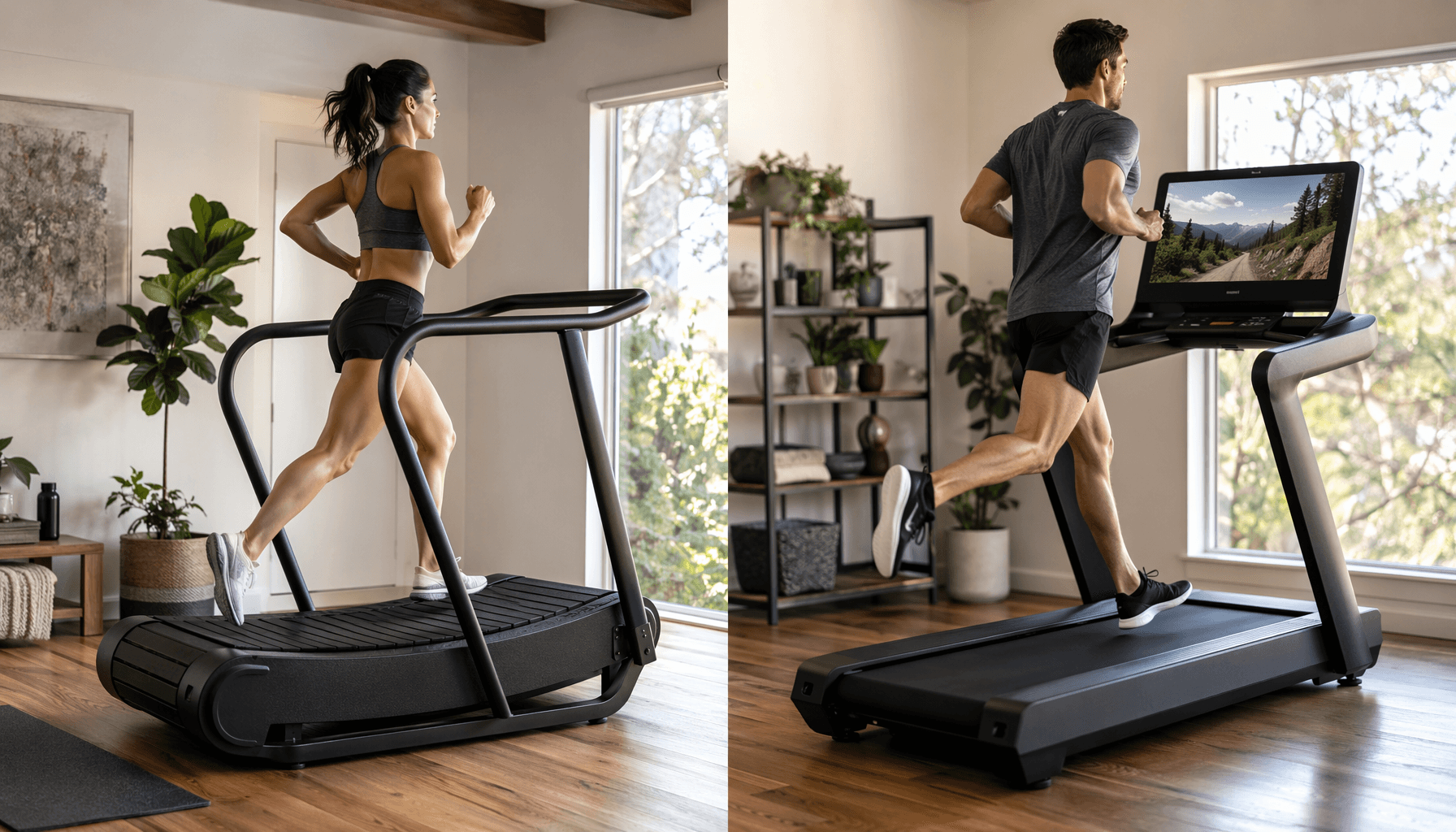
A curved manual treadmill has no motor. The running surface is a slatted, curved belt that you power entirely with your own stride. When you run, the belt rotates under your feet. When you stop, the belt stops. There is no "start" button, no speed setting, and no coasting.
This design changes the running experience in three fundamental ways:
- You control the pace entirely. There is no motor to set a constant speed. If you slow down, the belt slows down. If you accelerate, the belt accelerates. This makes pacing more active and less passive.
- The curved shape creates a natural incline. The belt dips in the center and rises at the front and back. This slight curve encourages a mid-foot strike and a forward lean, which is closer to outdoor running than the flat, motor-driven belt of a traditional treadmill.
- There is no electricity required. You can place a manual treadmill anywhere — a garage without power, a patio, or a room far from an outlet. The TrueForm Trainer weighs 270 lbs and has transport wheels, making it more portable than most motorized treadmills.
The trade-off is effort. Because you are generating all the power, running on a curved manual treadmill feels harder than running on a motorized belt at the same perceived speed. This is not a flaw — it is the point. But it means that a 30-minute run on a manual treadmill is a more demanding workout than the same duration on a motorized model.
The Form Benefits: Why Sprinters and Technique-Focused Runners Love Them
The most compelling argument for a curved manual treadmill is the running form it encourages. On a motorized treadmill, the belt pulls your foot backward, which can promote a longer stride and a heel-strike pattern. On a curved manual treadmill, you must actively push the belt backward with each step.
"Since the belt moves itself, we don't use our backside mechanics to push ourselves forward as we do on flat ground. There's still a demand for front-side mechanics, like lifting the knees and stepping forward, but there's an imbalance between the front and back."
That observation comes from Jacob Penner, a personal trainer and former competitive track athlete, quoted in the Garage Gym Reviews treadmill buying guide. Penner's point is that the curved manual treadmill forces a more balanced muscle recruitment pattern. You cannot rely on the motor to do the work of pulling your leg through the stride. Instead, you must engage your hamstrings and glutes more actively to drive the belt.
The specific form benefits include:
- Mid-foot strike promotion. The curved surface discourages heel-striking, which reduces braking forces and may lower impact on joints.
- Greater hamstring and glute activation. Because you must actively push the belt, your posterior chain works harder than on a motorized treadmill.
- Improved cadence. The self-powered belt naturally encourages a quicker turnover, which is a common goal in form-focused training.
- No "belt pull." On a motorized treadmill, the belt can pull your foot backward, potentially over-striding. On a manual treadmill, your stride length is entirely self-determined.
These benefits make curved manual treadmills particularly popular among sprinters, track athletes, and runners who are actively working on form correction. The GGR review notes that the TrueForm Trainer scored 4.25 out of 5 for ergonomics, reflecting the quality of the running surface and the natural feel of the stride.
Who Should Buy a Manual Treadmill (And Who Should Skip It)
The decision to buy a curved manual treadmill comes down to your training goals and your tolerance for a harder workout. The machine is not a one-size-fits-all replacement for a motorized treadmill. It is a specialized tool for specific types of runners.
The Ideal Manual Treadmill Buyer
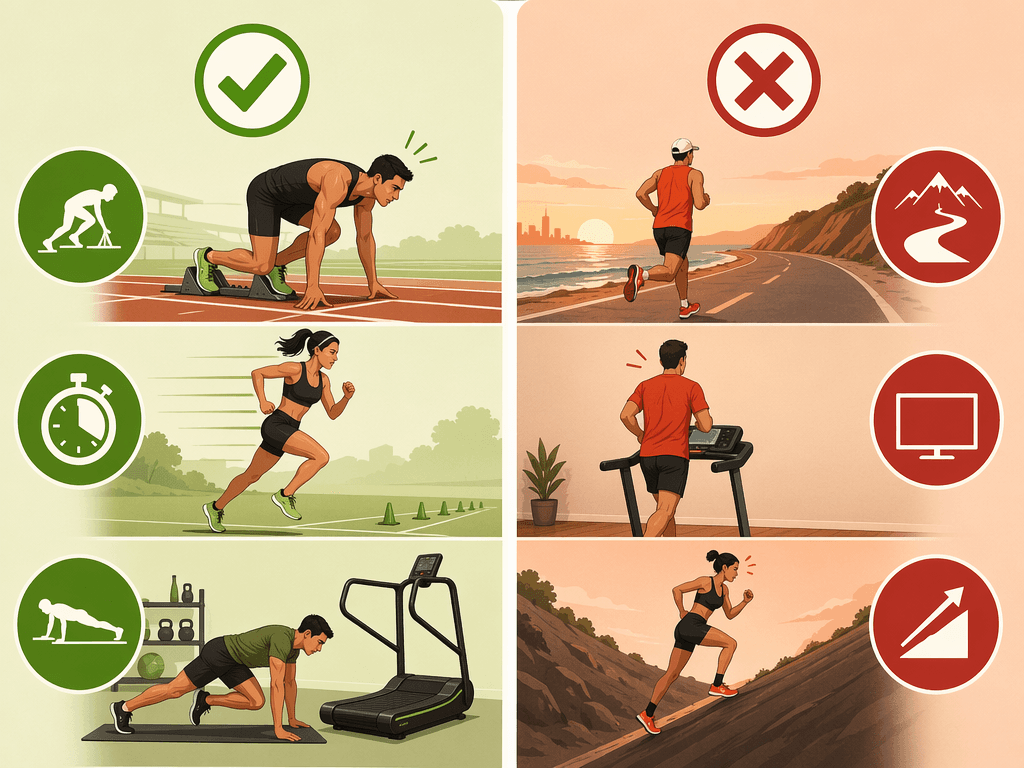
- Sprinters and speed-focused runners. If your primary training is intervals, strides, and short-distance work, the manual treadmill's instant speed response and natural resistance are ideal.
- Form-focused runners. If you are actively working on mid-foot striking, cadence, or posterior chain engagement, the manual treadmill provides real-time feedback that a motorized belt cannot.
- Hybrid and CrossFit athletes. The manual treadmill is a staple in functional fitness gyms because it demands more from the runner and integrates well into circuit-style training.
- Runners who want a secondary machine. If you already have a motorized treadmill for long runs and want a dedicated tool for form work and intervals, a manual treadmill makes sense as a supplement.
Who Should Stick with a Motorized Treadmill
- High-mileage runners. If you are logging 30+ miles per week on the treadmill, the extra effort required by a manual treadmill will limit your volume. A motorized treadmill allows you to maintain a steady pace for longer durations with less fatigue.
- Runners who need incline training. Curved manual treadmills do not offer adjustable incline. The curve provides a slight natural grade, but you cannot simulate a 6% hill climb. Motorized treadmills like the NordicTrack 1750 offer -3% to 15% incline/decline, which is essential for hill training.
- Runners who rely on entertainment. The TrueForm Trainer scored only 2 out of 5 for dynamic programming in GGR testing, reflecting the absence of preset workouts, screens, or app integration. If you need Netflix, Zwift, or guided runs to stay motivated, a motorized treadmill with a touchscreen is the better choice.
- Runners on a budget. At $3,999, the TrueForm Trainer is more expensive than many excellent motorized treadmills. The NordicTrack 1750 at $2,499, for example, offers a 4.25 CHP motor, a 22" x 60" deck, and a 16-inch HD touchscreen — features that a manual treadmill simply cannot match.
Cost Comparison: TrueForm Trainer vs. Premium Motorized Treadmill Over 5 Years
The upfront price difference between a manual and motorized treadmill is only part of the story. To understand the real cost, you need to look at total ownership over a realistic timeframe. Below is a five-year cost comparison between the TrueForm Trainer ($3,999) and the NordicTrack Commercial 1750 ($2,499), a popular premium motorized model.
| Cost Factor | TrueForm Trainer (Manual) | NordicTrack 1750 (Motorized) |
|---|---|---|
| Upfront price | $3,999 | $2,499 |
| Electricity cost (5 years) | $0 | $150–$300 (estimated) |
| Subscription cost (5 years) | $0 | $2,340 ($39/mo iFIT) |
| Warranty coverage | 20-year frame, 2-year parts | Lifetime motor, 2-year parts |
| Estimated 5-year total | $3,999 | $4,989–$5,139 (with subscription) |
| 5-year total (no subscription) | $3,999 | $2,649–$2,799 |
Comments
Join the discussion with an anonymous comment.