
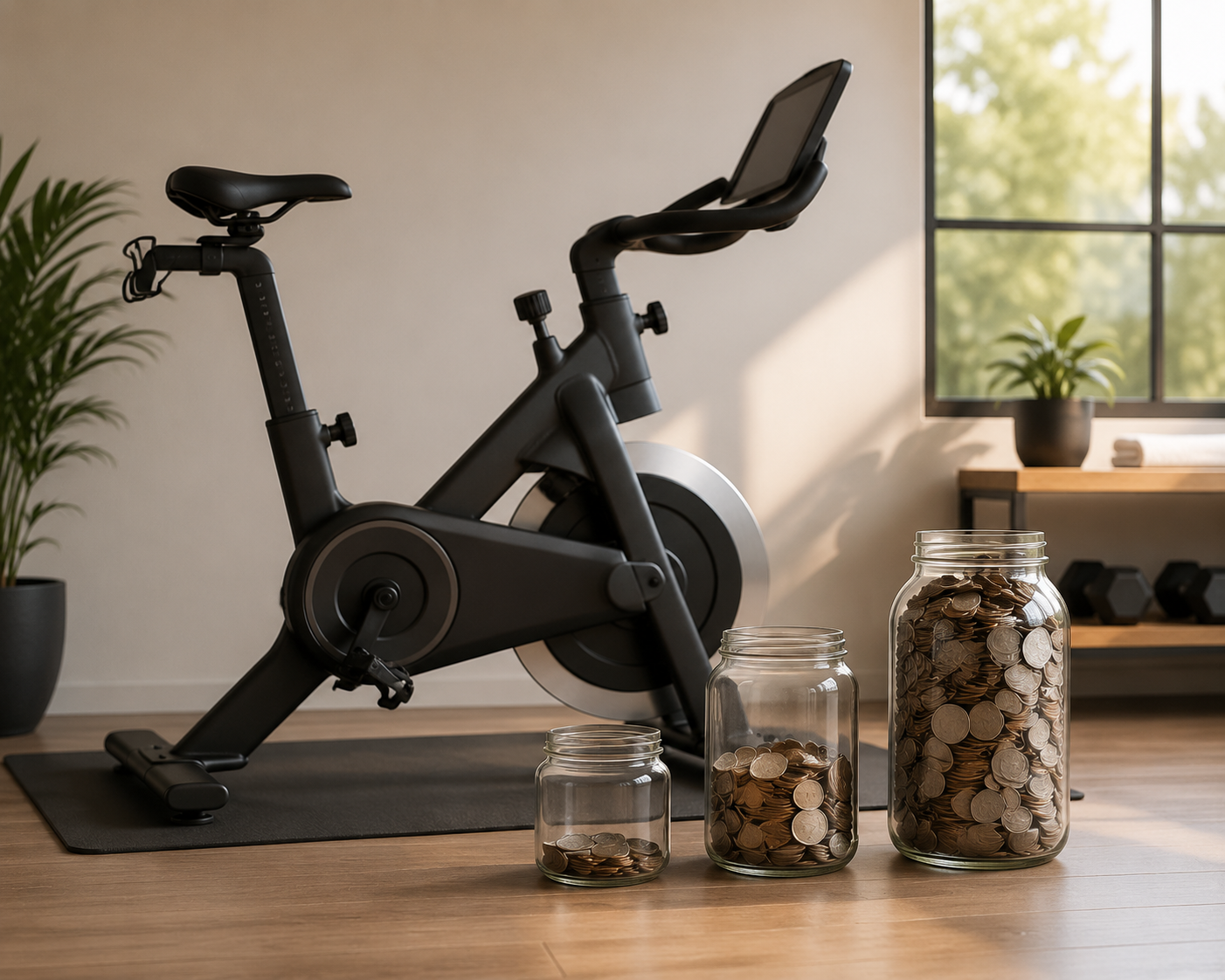
The awkward part of shopping for the best home exercise bike is that the bike you pay for at checkout is not always the bike you end up paying for. A $1,000-ish bike can stay a $1,000-ish bike. A $2,000-plus connected bike can quietly become a $3,000 or $4,000-plus commitment once the class membership is counted. That matters because this is already a serious purchase: Garage Gym Reviews’ testing of more than 25 exercise bikes found an average bike price of $1,409.[1]
For this comparison, the useful question is not which bike has the nicest screen in the product photo. It is what the bike costs over three years, including the subscription a buyer is likely to keep. Subscription prices below use mid-2026 figures and should be verified before purchase, especially for Peloton, iFIT, and Echelon memberships.[1][2]
The 3-Year Cost Comparison
| Subscription category | Bike | Purchase price | Required or optional subscription | Monthly fee used here | 3-year subscription cost | 3-year total |
|---|---|---|---|---|---|---|
| No subscription | Sunny SF-B1002 | $267 | None | $0 | $0 | $267 [3] |
| No subscription | Yosuda budget magnetic bike | $340 | None | $0 | $0 | $340 [3] |
| No subscription | Rogue Echo Bike | $945 | None | $0 | $0 | $945 [1] |
| No subscription | Concept2 BikeErg | $1,100 | None | $0 | $0 | $1,100 [1] |
| Compact no subscription | DeskCycle 2 | $150 | None | $0 | $0 | $150 [1] |
| Folding no subscription | Marcy Foldable | $162 | None | $0 | $0 | $162 [4] |
| App-optional | Schwinn IC4 | $899 | Optional app connection | $0 | $0 | $899 [1] |
| App-optional | Schwinn IC4 + Peloton App | $899 | Optional app connection | $12.99 | About $468 | About $1,367 [1][2] |
| App-optional | Horizon 7.0 IC | $999 | Optional app connection | $0 | $0 | $999 [1] |
| Subscription-required for full experience | Echelon EX-5s | $1,499 | Echelon membership | $40 | $1,440 | $2,939 [2] |
| Subscription-required for full experience | NordicTrack X24 | $2,299 | iFIT membership | $39 | $1,404 | $3,703 [2] |
| Subscription-required for full experience | Recertified Peloton Bike | About $1,445 | Peloton membership | $50 | $1,800 | About $3,245 [2] |
| Subscription-required for full experience | Peloton Bike+ | About $2,695 | Peloton membership | $50 | $1,800 | About $4,495 [2] |
The table makes one thing hard to ignore: monthly fees of $20 to $50 are not small add-ons when they run for years. They become the deciding line between bikes that stay near their sticker price and bikes whose ownership cost keeps climbing.
The cleanest example is the Schwinn IC4. Bought on its own, it lands at $899 over three years. Paired with the Peloton App at $12.99 per month, it lands at roughly $1,367 over the same period. That is still less than many connected bikes cost before their subscriptions begin.[1][2]
That does not automatically make the Schwinn the best bike for every rider. It does mean a buyer should not compare it against a Peloton Bike+, NordicTrack X24, or Echelon EX-5s by sticker price alone. The real comparison is hardware plus the membership model attached to it.
Where the Money Actually Goes
No-subscription bikes are the easiest to understand. The Sunny SF-B1002 at $267, the Rogue Echo Bike at $945, and the Concept2 BikeErg at $1,100 do not need a paid content library to remain usable, so their three-year total is simply the purchase price.[1][3]
That simplicity is valuable if the buyer already knows how they like to train. Someone who wants intervals, steady Zone 2 rides, warmups before lifting, or a rugged air-bike option may not need a screen telling them what to do. The trade-off is that the motivation has to come from somewhere else: a written workout, a separate app, a coach, a watch, or plain habit.
App-optional bikes sit in the middle. The Schwinn IC4 and Horizon 7.0 IC can be used without paying for a proprietary class library, but they can also pair with outside apps. This is the part of the market I tend to trust most for households that are still figuring out their routine. If the class habit sticks, keep the app. If it does not, the bike does not become a large screen waiting for a login.
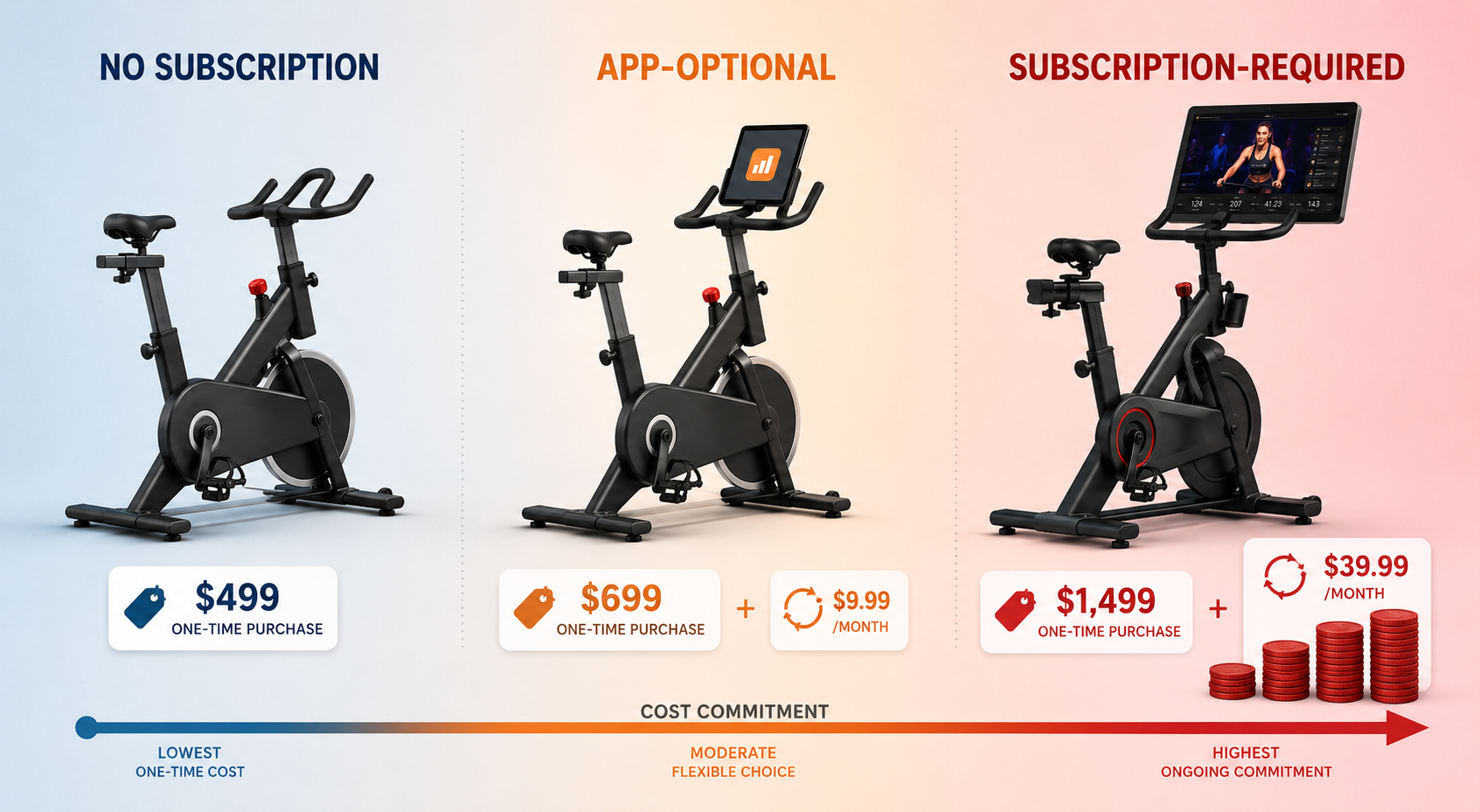
Screen-centered bikes are different. Their strongest selling point is the integrated experience: classes on the built-in display, metrics in the same interface, leaderboards, scenic rides, structured plans, and fewer loose devices on the handlebars. That polish can be the reason someone rides three times a week instead of letting the bike become furniture. But if the paid service is cancelled, the value of that screen can drop sharply, especially on bikes built around a proprietary platform. For a deeper cancellation-focused breakdown, see Exercise Bike Subscription Lock-In: What Really Happens When You Cancel.
The Schwinn IC4 Case Is Why Total Cost Matters
The Schwinn IC4 plus Peloton App comparison is counterintuitive in the way home fitness shopping often is. The setup does not give you a Peloton Bike+. It gives you a separate bike and a separate app. You may use your own tablet, and the experience will not feel as seamless as a fully integrated studio bike.
But the cost gap is too large to treat as a minor compromise. The IC4 at $899 plus three years of the Peloton App at $12.99 per month comes to about $1,367. A Peloton Bike+ at about $2,695 plus a $50 monthly membership comes to about $4,495 over three years. A recertified Peloton Bike at about $1,445 still reaches about $3,245 once the same membership is included.[1][2]
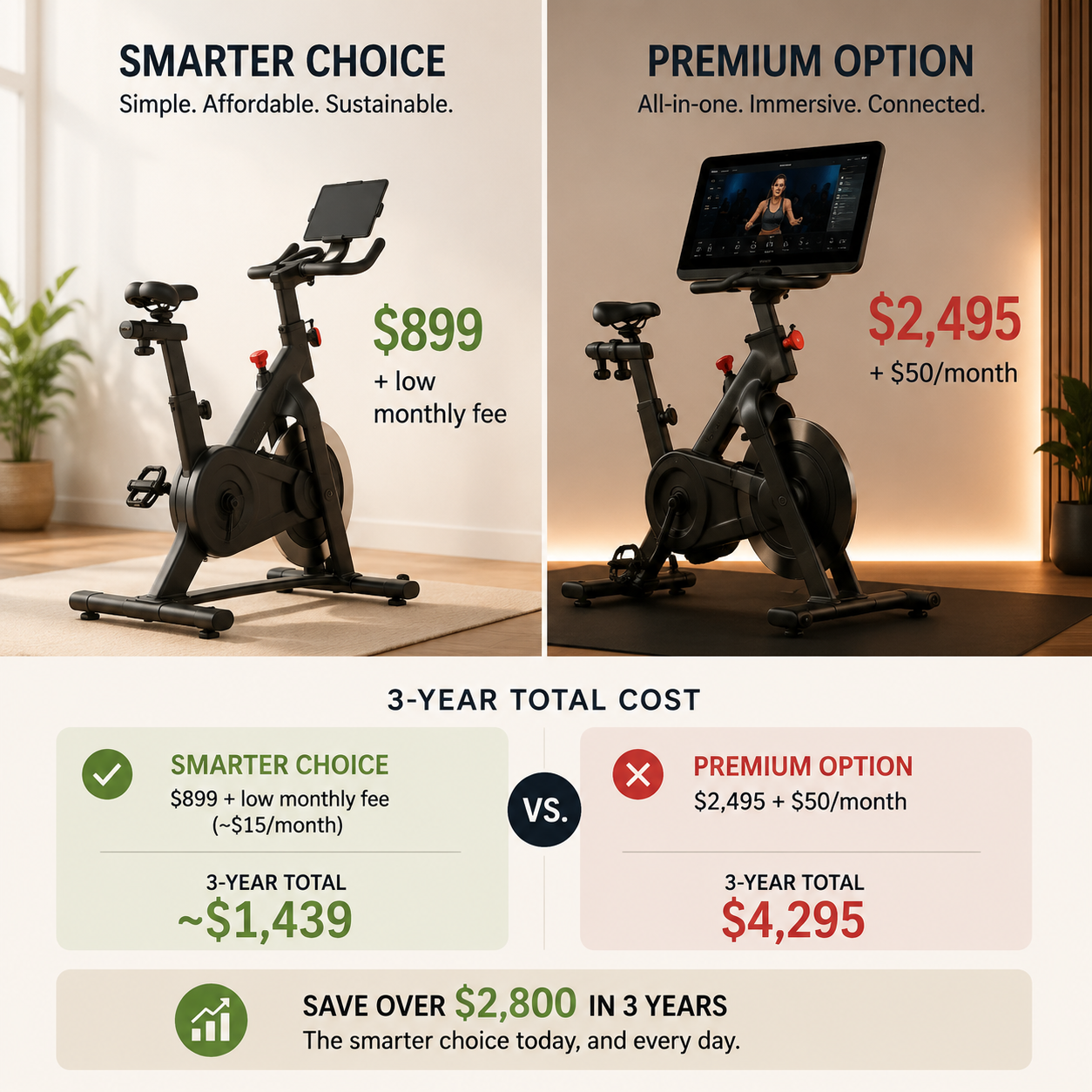
That is the kind of reversal that gets missed in normal “best bike” lists. The buyer sees a premium screen, a clean frame, and a monthly price that sounds manageable in isolation. Three years later, the subscription alone has added $1,800 to the bike.
The fair comparison is not “cheap bike versus nice bike.” It is “flexible hardware plus optional content” versus “integrated hardware plus a required content ecosystem.” Those are different purchases.
When Paying More Still Makes Sense
A subscription bike can be worth the higher total if the rider will actually use what the subscription provides. The person who needs coaching, music, programming, metrics, and a visible instructor may get more value from an integrated class bike than from a cheaper frame that technically saves money but never gets ridden.
Households also change the math. A $50 monthly membership feels different if two or three people use it regularly. The bike is still expensive, but the fee is buying shared access to a training library rather than sitting on one person’s credit card while everyone else walks past it.
The real mistake is buying the premium bike while mentally treating the subscription as optional spending. For Peloton, iFIT, and Echelon-style bikes, the subscription is part of the product experience as sold. If the classes, guided programming, and screen integration are the reason you want the bike, then the three-year subscription cost belongs in the purchase budget from day one.
The Zero-Fee Bikes Are Not All the Same
The cheapest three-year total is not automatically the best ride. Folding and under-desk bikes can be useful for small spaces, rehab-style movement, light pedaling, or keeping a routine visible during the day. The Marcy Foldable at $162 and DeskCycle 2 at $150 keep costs low because there is no subscription layer.[1][4]
Their limits are practical. Folding bikes and under-desk options commonly use smaller frames and simpler resistance systems; some compact models offer eight resistance levels compared with 100 on premium spin bikes. That does not make them bad. It means they should not be expected to feel like a studio bike built for hard standing climbs.
Air bikes deserve their own quick note. The Rogue Echo Bike and Concept2 BikeErg have no subscription cost, but they are not trying to be quiet living-room spin-class machines. They make more sense for riders who want conditioning, intervals, CrossFit-style work, or simple durable equipment than for someone who wants an instructor-led class on a screen.[1]
A Narrower Way to Choose
If the only goal is the lowest three-year cost, choose a no-subscription bike that fits your space and training style. That may be a budget magnetic bike, a folding model, an under-desk option, or a tougher air bike. The purchase price is the ownership cost.
If you want guided classes without being locked into one hardware ecosystem, favor app-optional bikes. The Schwinn IC4 is the clearest example in this comparison, because it can remain a normal exercise bike without a subscription and can still carry a low-cost app setup if classes help you ride.
If you want the most integrated studio experience, buy the connected bike only after adding the membership to the real price. A Peloton Bike+, NordicTrack X24, or Echelon EX-5s may be the right choice for a committed rider, but it should be judged as a multi-year equipment-and-service purchase, not as a one-time bike purchase with a small monthly extra.
Readers who want to weigh cost alongside space, resistance type, noise, and rider goals may be better served by a broader framework such as Best Home Exercise Bike: A Decision-Matrix Guide by Budget, Space, Resistance, and Subscription or Exercise Bike Buying Guide: 7 Specs That Matter Most for Home Use. This article is deliberately narrower: it is the cost check that should happen before anyone calls a bike a deal.
References
- Best Exercise Bikes (2026) - Personally Tested, Garage Gym Reviews
- The 6 Best Exercise Bikes of 2026 | Reviews by Wirecutter, Wirecutter
- The 7 Best Exercise Bikes Under $1,000 of 2026, Tested and Reviewed, BarBend
- The Best Folding Exercise Bikes (2026), Garage Gym Reviews

Comments
Join the discussion with an anonymous comment.