
The best home treadmill for running, if you are already doing real mileage, is not the one with the loudest screen. It is the one that still behaves like a treadmill after you decline the membership prompt. For runners who want to train 15, 20, or 30-plus miles a week without a mandatory fee, the short list starts with the Sole F80, Horizon 7.8 AT, and Horizon 7.0 AT.
That distinction matters because the purchase price is only the first bill. OutdoorGearLab’s 2026 treadmill testing put the Sole F80 at about $32 per month over five years and the Horizon 7.4 AT at about $40 per month when the machine price is amortized and no subscription is required. The NordicTrack Commercial 1750 rose to about $75 per month once a $39 monthly iFit subscription was included, while the Peloton Tread reached about $94 per month with a $44 monthly Peloton membership included.[1]
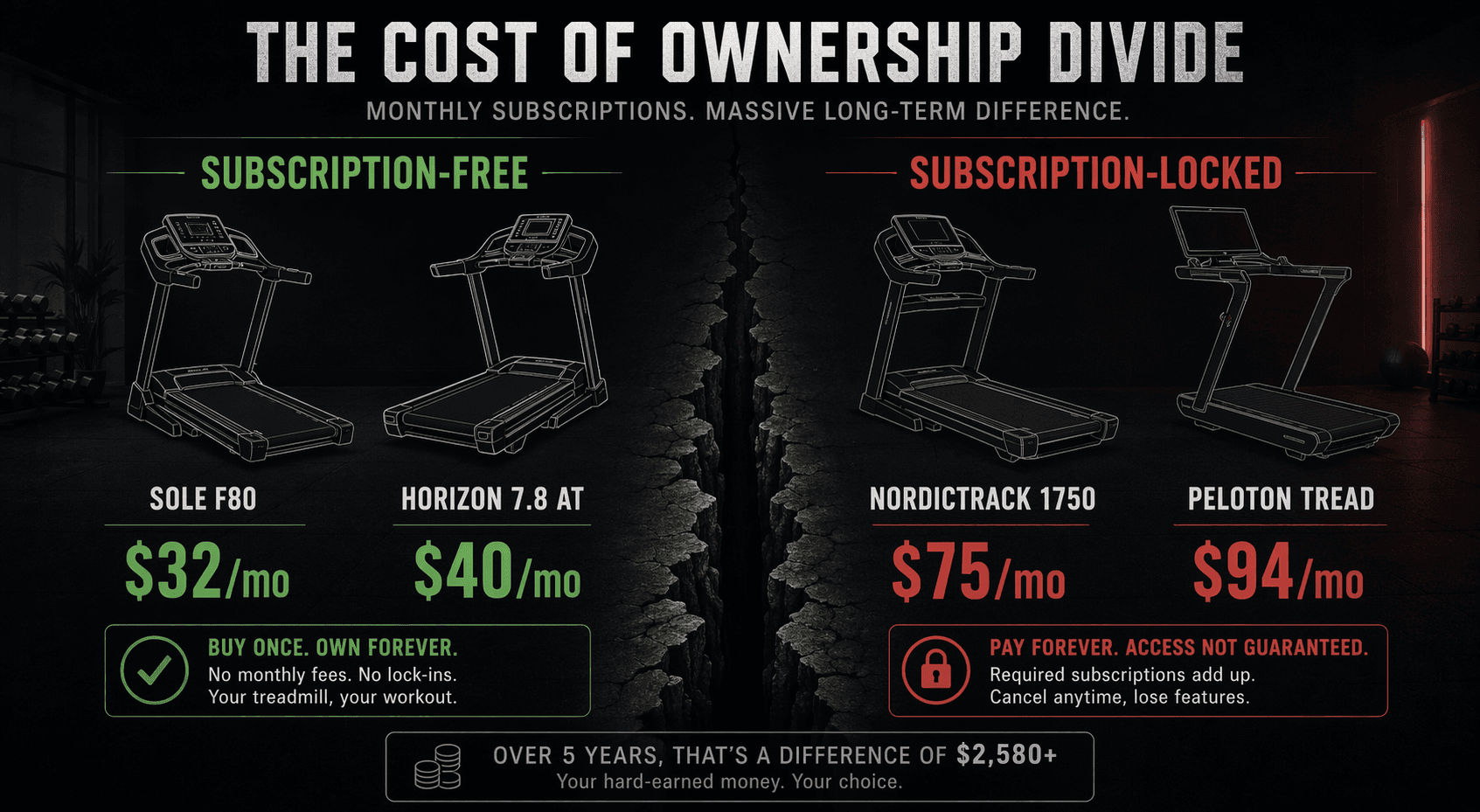
Those figures do not include electricity, maintenance, or repairs; they are sticker price plus subscription only.[1] Even with that caveat, they expose the part of treadmill shopping that gets softened by glossy product pages. A required $39–$44 monthly fee is not a small add-on over five years. It changes what the machine costs to own.
Here, “subscription-free” does not mean “never use an app.” It means no required monthly fee to use the treadmill’s core training functions: manual speed control, incline, basic workout operation, and the ability to run without asking a brand’s content platform for permission. If you choose to use Zwift, Peloton Digital, or another app, that is different. Paying for content by choice is not the same as paying so the treadmill feels complete.
The ownership line: open, optional, or locked
Before comparing decks and motors, sort the machines by what happens when you do not subscribe.
| Ownership model | What it means for a runner | Examples |
|---|---|---|
| No required fee for core treadmill use | Manual running, speed, incline, and ordinary training remain usable without a paid membership. | Sole F80; Horizon 7.8 AT; Horizon 7.0 AT |
| Optional app use | The treadmill can pair with outside apps, but the subscription is your choice rather than the treadmill’s requirement. | Horizon FTMS support with apps such as Peloton Digital or Zwift |
| Closed or degraded without membership | High-profile features disappear, or the machine becomes much less useful, when the subscription stops. | NordicTrack/iFit; Peloton; Echelon models reported by OutdoorGearLab |
Bluetooth FTMS deserves plain English because it is one of the few connected features worth caring about. FTMS lets a treadmill and a training app communicate in both directions, so the app can read workout data and, where supported, interact with the machine. Horizon’s 7.8 AT and 7.0 AT are useful here because they can connect to outside apps without requiring a Horizon-specific subscription.[1][2]
That still does not make the apps free. Runner’s World highlighted the Horizon 7.0 AT as “Best Subscription-Free” partly because it can run Peloton classes through the Peloton app route rather than requiring the full Peloton hardware membership; the research brief notes that Peloton Digital is roughly $13 per month versus the $44 monthly Peloton Tread membership.[2] Zwift, noted in the same app-compatibility context, is also an optional cost, not a Horizon toll booth.
If you want a deeper framework for this split, the supporting guide on closed vs. open treadmill ecosystems is the right companion piece. The useful question is not whether a treadmill has an app. It is who controls the machine after the app is gone.
Best overall subscription-free running treadmill: Sole F80
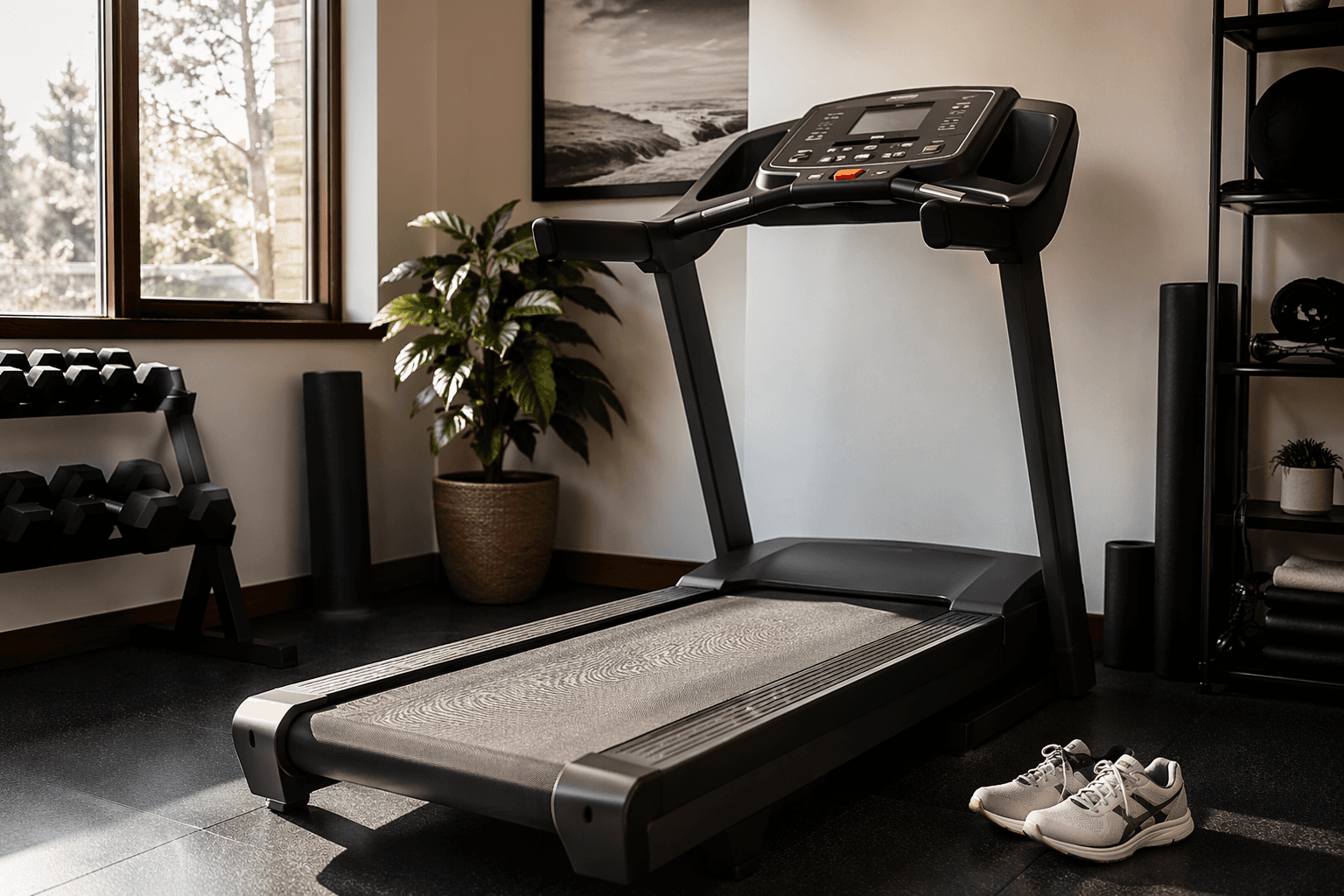
The Sole F80 is the cleanest answer for the runner who wants a serious traditional treadmill and would rather put money into the deck, motor, and warranty than into a locked class screen. Its listed package is unusually runner-friendly for this price band: a 3.5 CHP motor, a 22-by-60-inch running surface, a $1,899 price in the cited 2026 review context, the free Sole+ app, and a lifetime warranty on the frame, motor, and deck.[3]
That warranty is not a decorative spec. For a runner, the deck and motor are not background parts; they are the machine. A walker can forgive a lot of flex, heat, and belt hesitation. Interval work and steady 60-minute runs are less forgiving. If a treadmill is going to live under a runner several days a week, long coverage on the frame, motor, and deck matters more than whether the console looks like a mounted TV.
Sole also promotes its Cushion Flex Whisper Deck as reducing impact by up to 40 percent, a claim repeated in review coverage of cushioned treadmills.[4] Treat that as a manufacturer claim, not an independent guarantee that every runner at every pace will feel exactly that reduction. Still, the broader point is relevant: the F80 is built around being a treadmill first, not a content terminal that happens to have a belt.
The F80’s tradeoff is that it is less of an open connected playground than Horizon’s FTMS models. If your idea of a good winter block is manual progression runs, hill repeats, and the occasional free Sole+ session, that is not a problem. If you want Zwift and other apps to talk more actively with the treadmill, Horizon has the edge.
| Sole F80 detail | Why it matters |
|---|---|
| 3.5 CHP motor | A stronger motor claim than many budget folding treadmills, suitable for regular running use within the limits of manufacturer-stated ratings. |
| 22" x 60" deck | A wider-than-basic running surface with the 60-inch length most runners should expect for stride room. |
| Lifetime frame/motor/deck warranty | The coverage aligns with the parts a higher-mileage runner is most likely to care about. |
| Free Sole+ app | Connected content exists, but the treadmill does not depend on a paid monthly plan for core function. |
For more on why warranty language can change the real cost of ownership, the separate guide to treadmill warranties and repair exposure is worth reading before assuming two similarly priced machines carry the same risk.
Best open-connected treadmill without a brand subscription: Horizon 7.8 AT
The Horizon 7.8 AT is the pick for runners who want a strong home treadmill and still want modern app freedom. OutdoorGearLab’s testing singled out Horizon’s connected approach because the 7.8 AT can use Bluetooth FTMS with apps such as Peloton and Zwift without forcing a Horizon subscription.[1]
The motor story needs a little restraint. Reviews commonly cite the Horizon 7.8 AT at 4 CHP, but Horizon does not consistently publish exact CHP figures in every product context, so it is best treated as a review-derived or review-reported rating rather than a universally visible manufacturer spec.[1] Either way, the 7.8 AT sits in the heavier-duty part of Horizon’s home lineup, and that is the right neighborhood for runners who actually run rather than occasionally jog between strength workouts.
The controls are part of the appeal. Horizon’s better AT models are known for quick-adjust dials, which matter during intervals because a speed change that arrives late can wreck the rep. This is one of those treadmill details that looks minor in a showroom and becomes obvious the first time you try to move from recovery pace to 5K effort without punching a touchscreen five times.
At about $1,999 in the cited 2026 pricing context, the 7.8 AT is not the budget pick.[1] It is the open-connected pick: a machine for runners who want to bring their own training environment, not rent the manufacturer’s.
- Choose it over the Sole F80 if third-party app communication is central to how you train.
- Choose the Sole F80 instead if warranty coverage and a more traditional treadmill-first setup matter more.
- Skip both subscription ecosystems if what you really want is manual running with occasional optional app use.
Best lower-cost serious pick: Horizon 7.0 AT
The Horizon 7.0 AT is the compromise that makes sense when the budget is real but the running still matters. Runner’s World named it “Best Subscription-Free” in its 2026 treadmill roundup, citing its Bluetooth FTMS capability and its ability to work with Peloton classes through the app route rather than through a required Horizon fee.[2]
The key specs are enough to keep it in the running category rather than the casual walking category: roughly $935 on sale in the cited 2026 context, a 3.0 CHP motor, a 60-inch deck, Bluetooth FTMS, and no required subscription.[2] That combination is why the 7.0 AT keeps showing up in conversations among runners who want to avoid monthly fees without dropping into flimsy equipment.
The compromise is that it is not the 7.8 AT. Heavier runners, faster interval work, and households with multiple runners may have good reason to move up. But for one runner trying to keep the total home gym budget under control, the 7.0 AT is the least expensive model in this group that still answers the important question correctly: yes, you can use the treadmill properly without paying the manufacturer every month.
For broader budget planning, pair this comparison with a home gym cost breakdown or a dedicated treadmill total cost of ownership comparison. The machine price is only one part of the decision, but it is the part easiest to see before the recurring charges start.
Why NordicTrack, Peloton, and Echelon are not the main picks here
NordicTrack and Peloton can make sense for people who genuinely want instructor-led ecosystems. That is a different purchase. In OutdoorGearLab’s five-year comparison, the NordicTrack Commercial 1750 moved to about $75 per month once the $39 monthly iFit subscription was counted, and the Peloton Tread moved to about $94 per month once the $44 monthly Peloton membership was counted.[1]
The issue is not that classes exist. The issue is that the most advertised features often depend on staying subscribed. For NordicTrack, the iFit ecosystem is tied to features such as terrain-based auto-adjustment. For Peloton, the point of the hardware is tightly bound to instructor-led classes. If that is exactly what gets you running, fine. If you already know your workout and just want the belt to respond, it is an expensive way to rent motivation.
NordicTrack also carries an ownership caveat that matters for many home gym buyers: its warranties are voided if the treadmill is stored in a garage. That is a serious contrast if your only practical training space is a garage gym.
Echelon is the sharper warning. OutdoorGearLab reported that Echelon models offer no useful functionality beyond manual mode, if that, without an active membership.[1] That crosses a line. A paid content library is one thing. A treadmill that loses meaningful usefulness without a membership is an ownership model, not a feature set.
How to choose among the three
The right pick depends on which kind of freedom you value most.
| Rank | Treadmill | Best for | Why it wins that use case |
|---|---|---|---|
| 1 | Sole F80 | Runners who want the strongest traditional no-fee treadmill value | Lifetime frame/motor/deck warranty, 3.5 CHP motor claim, 22" x 60" deck, free Sole+ app, and no required membership. |
| 2 | Horizon 7.8 AT | Runners who want the best open-connected setup | Bluetooth FTMS support, app flexibility with Peloton/Zwift-style training, quick controls, and no Horizon subscription requirement. |
| 3 | Horizon 7.0 AT | Budget-focused runners who still need a real running deck | Roughly $935 sale pricing in the cited 2026 context, 3.0 CHP, 60" deck, FTMS support, and Runner’s World’s “Best Subscription-Free” designation. |
There are a few caveats to keep taped to the console. Prices here reflect early-to-mid 2026 sale and review contexts and will move. CHP ratings are manufacturer-claimed or, in the Horizon 7.8 AT’s case, commonly review-reported where exact publication by the brand is inconsistent. OutdoorGearLab’s five-year monthly figures exclude electricity, maintenance, and repairs.[1] Sole’s 40 percent cushioning figure is a manufacturer claim, not an across-the-board lab result for every runner.[4]
If the goal is the best home treadmill for running without a monthly fee, the Sole F80 is the safest overall choice, the Horizon 7.8 AT is the better open-connected choice, and the Horizon 7.0 AT is the budget choice that still respects runners. After that, the decision is less about features and more about who gets to decide when your treadmill is fully usable: you, or the subscription screen.
References
- The Best Treadmills of 2026 | Lab Tested & Ranked — OutdoorGearLab
- The 8 Best Treadmills in 2026 — Runner’s World
- Best Home Treadmills for 2026 — TreadmillReviews.net
- Best Cushioned Treadmill — Garage Gym Reviews
Comments
Join the discussion with an anonymous comment.