
Under $1,000 Home Gym: Where to Spend and Where to Save
A practical guide to building an effective home gym for under $1,000, with tiered build paths, spend-vs-save principles, and cost-benefit analysis showing how the setup pays for itself in about 14 months versus a typical gym membership.
Yes, you can build a genuinely useful home gym for under $1,000. The part that matters is not finding the cheapest version of every item. It is spending on the equipment that determines exercise choice, load progression, and safety, while refusing to pay early for accessories that mostly add comfort or variety.
For most people, the practical center of a budget home gym is simple: adjustable dumbbells or cast-iron dumbbells, resistance bands, a bench, a barbell with plates if space allows, and eventually a basic rack. That combination covers squats or squat variations, presses, rows, hinges, carries, curls, triceps work, core training, and enough conditioning to replace many commercial-gym routines. It will not replicate every machine in a full facility, and it does not need to.
The financial case is also more concrete than it first appears. One cited benchmark puts a foundational home gym build at about $2,530, while a minimal dumbbell-and-pull-up-bar setup can come in under $400. The same source cites an average gym membership cost of $69 per month, or $828 per year, which means a $1,000 home gym pays back in roughly 14 to 15 months only if it replaces a membership you would otherwise keep paying for.[1]
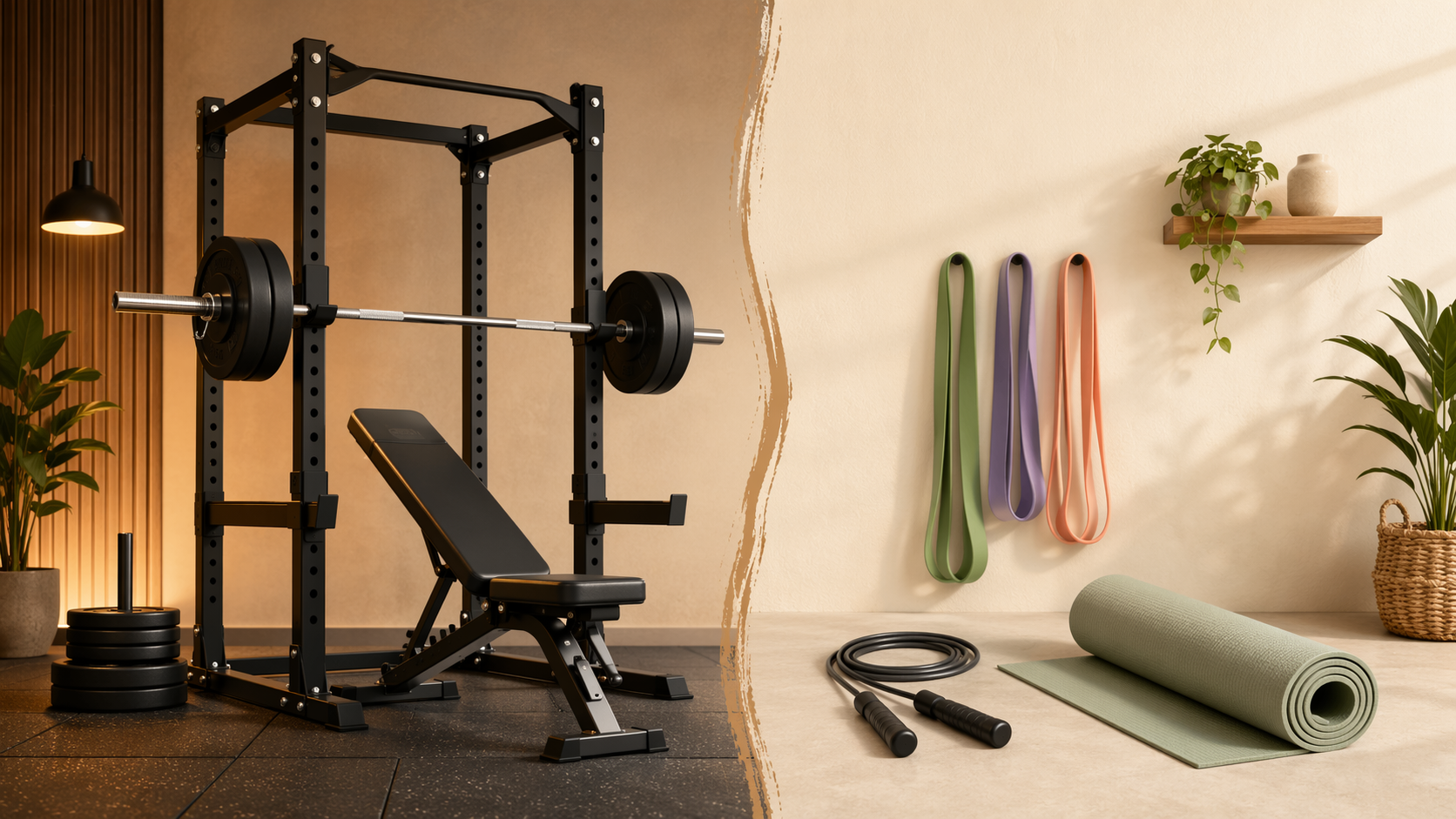
The first $400 should buy training range, not a miniature gym
The worst way to start a budget home gym is to buy one large, narrow-use item because it looks like a gym. A cheap treadmill, a single fixed-weight machine, or a bulky cable station can consume the budget before the room can support a complete week of training.
At $200 to $400, the useful build is modest: dumbbells, resistance bands, a jump rope, and a mat. This is enough for full-body beginner and intermediate training if the programming is sensible. It is not enough for heavy barbell work, and it will eventually become limiting for lifters who need large jumps in load.
| Budget | What to buy | What it lets you do | What is still missing |
|---|---|---|---|
| $200–$400 | Dumbbells, resistance bands, jump rope, mat | Full-body strength basics, mobility work, simple conditioning | Heavy barbell lifts, safe max-effort squatting or benching, broad load progression |
| $500–$800 | Add an adjustable bench, barbell, and plates | Presses, rows, hinges, floor or bench work, more progressive loading | A rack for safer squats and bench press setup |
| $800–$1,000 | Add a budget power rack if space and ceiling height allow | More complete strength training, safer unracking, pull-up options if included | Commercial-machine variety and premium cable work |
This is why the first purchase does not have to be glamorous. Resistance bands, in particular, are often treated as temporary substitutes, but the evidence is stronger than that. A 2019 systematic review and meta-analysis in SAGE Open Medicine found that elastic resistance training produced strength gains similar to conventional resistance training across the studies reviewed.[2]
That does not mean bands are identical to free weights. They feel different, load the body differently through the range of motion, and become awkward when the goal is very heavy lower-body training. But for rows, presses, lateral raises, face pulls, triceps work, curls, assisted pull-up work, warmups, and travel-friendly training, they are real equipment rather than filler.
Where the money should go
If the budget stretches beyond the starter tier, spend first on the equipment that changes what exercises you can perform safely and progressively. That usually means the barbell, plates, rack, and bench. These pieces carry load, affect setup safety, and determine whether your training can progress for years rather than weeks.
A budget rack is one of the clearest examples. Garage Gym Reviews lists the REP PR-1100 at $380 with a 700-pound capacity, compared with an average squat rack price of $708 in its budget-equipment pricing context.[3] That is not an argument that every buyer needs that exact rack. It does show that a basic rack does not have to consume the entire $1,000.
The same logic applies to dumbbells. CAP Cast Iron Hex Dumbbells are cited at about $1 per pound, against an average of $3.23 per pound in the same product-pricing research.[3] For a first home gym, paying for sturdy iron or rubber hex dumbbells generally matters more than paying for a polished storage system, a premium handle shape, or matching pairs all the way up the rack.
The bench deserves more caution than the jump rope and less romance than the rack. A bench should feel stable, support your body under load, and fit your space. It does not need to be commercial-grade to be useful at home, but it should not wobble, flex, or force awkward pressing angles. A cheap bench that makes you hesitate before unracking weight is not a bargain.
Where to save without weakening the gym
Save on the items that do not decide the training outcome. A jump rope is the cleanest example: the WOD Nation Speed Jump Rope is listed under $20 in the cited budget-equipment research.[3] For conditioning, footwork, warmups, and short intervals, that is enough for many people. The extra money is better kept for loadable strength equipment.
Flooring is another place to be deliberate. Good flooring protects the room and reduces noise, but premium flooring is not the first priority if the choice is between nicer mats and enough plates to train properly. A small lifting area can be built before the whole room looks finished.
Cable work can also wait. Garage Gym Reviews identifies the Bells of Steel Cable Tower at $434.99 as the lowest-priced tested cable machine in its budget context.[3] That is a meaningful price for a useful piece of equipment, but it is still almost half of a $1,000 ceiling. For many first builds, cables belong after the rack, barbell, bench, plates, dumbbells, and bands are already solving the main training problem.
Dumbbell cradles, wall storage, premium collars, specialty bars, landmine attachments, and machine-style accessories can all be useful later. They are poor early purchases when they reduce the amount of weight, bench quality, or rack safety you can afford.
A phased buying plan that depends on use, not optimism
A month-by-month plan is helpful only if it includes a condition for moving forward. The point is not to buy more equipment because a calendar page changed. The point is to let consistent training prove which bottleneck is real.
| Phase | Buy | Move on when |
|---|---|---|
| Start | Dumbbells or adjustable dumbbells, resistance bands, jump rope, mat | You have trained consistently and know which movements feel limited by load or setup |
| Next | Barbell and plates | You are ready to progress hinges, presses, rows, and lower-body work beyond the dumbbell range you own |
| Then | Power rack | You need safer setup for squats, rack pulls, presses, or pull-up work and have confirmed the space works |
| After that | Adjustable bench or bench upgrade, if not already purchased | Pressing, rows, step-ups, or seated work are frequent enough that floor-only training is holding you back |
| Later | Cable tower, storage, specialty attachments, expanded flooring | The core setup is being used and variety, organization, or accessory work has become the actual constraint |
For renters, the rack step needs one extra filter: ceiling height, floor tolerance, noise, and the likelihood of moving. A barbell-and-rack setup can still make sense, but only if it will be used rather than resented. In a small apartment, heavier adjustable dumbbells, bands, a foldable bench, and a jump rope used outside may be the more honest version of a home gym.
What a sub-$1,000 gym can and cannot replace
A carefully built $400 to $1,000 home gym can replace a commercial gym for general strength, muscle-building, basic conditioning, and habit consistency. It is especially strong for people who train with dumbbells, barbells, bodyweight movements, bands, and simple intervals.
It is weaker for people who rely on a wide machine circuit, need very heavy calibrated equipment, want multiple cardio machines, or train in a sport that requires specialized implements. It also does not solve the social or coaching side of a gym. If the membership is mainly buying instruction, community, childcare, a pool, or a reason to leave the house, the payback calculation becomes less direct.
The payback only works if it replaces a real expense
The commonly cited $69 monthly membership average makes the math attractive: $1,000 divided by $69 is about 14 to 15 months, and the annual comparison is $1,000 in equipment versus $828 in membership fees.[1] But this is not a universal saving. It applies to someone who would otherwise keep paying for a gym and who will actually train at home.
For that person, the best under-$1,000 build is not a compromise version of a commercial facility. It is a smaller, more disciplined gym: enough weight to progress, enough setup to train safely, enough conditioning to keep the heart rate honest, and few enough extras that the budget still serves the training.
References
- How Many People Have a Home Gym? (2026 Statistics), Fitness Avenue.
- Effects of training with elastic resistance versus conventional resistance on muscular strength: A systematic review and meta-analysis, SAGE Open Medicine, 2019.
- Budget home gym equipment pricing and specifications, Garage Gym Reviews.
This result comes from one real apartment under the stated conditions — it is a strong signal, not a guarantee your space will measure identically.
Builds this evidence supports
Cable Machine Alternatives That Save Space and Money
Compare the best cable machine alternatives for home gyms – from resistance bands and pulley systems to suspension trainers and compact digital units – and find the right option for your space and budget.
How to Choose a Compact Home Gym That Works for Your Space, Budget, and Noise Tolerance
This article provides a structured decision framework for apartment dwellers and small-space residents to match their specific floor footprint, noise sensitivity, and budget to the most suitable compact home gym strategy — whether that's an all-in-one machine, modular build, smart digital system, or band/bodyweight setup.
The Garage Gym Reality Check: What Equipment Actually Fits in a Single-Car Garage
Most garage gym guides assume a two-car space. This article uses real dimensions, real equipment footprints, and three layout templates to show what fits—and what doesn't—in a single-car garage (10x20 to 12x20 ft).
Spot something off?
If this result didn't match your own space, let us know — floor-damage and noise claims carry real deposit-risk consequences if we get them wrong.