If you are searching for free fitness apps with workout plans, the useful question is not whether an app has a free download button. It is what you can do after the download, before a subscription, trial timer, ad wall, or locked feature interrupts the routine you were trying to start.
A fair free tier should be clear about five things: whether complete workout plans are open, what training styles are included, whether ads get in the way, how much logging or progression is available, and where the paid ask begins. That standard makes Nike Training Club the cleanest benchmark: Forbes Health named it the “Best Free Fitness App,” and Nike’s own app page presents the app as free access to workouts, programs, wellness content, and trainer-led guidance rather than as a limited trial.[1][2]
The $0 Reality Check
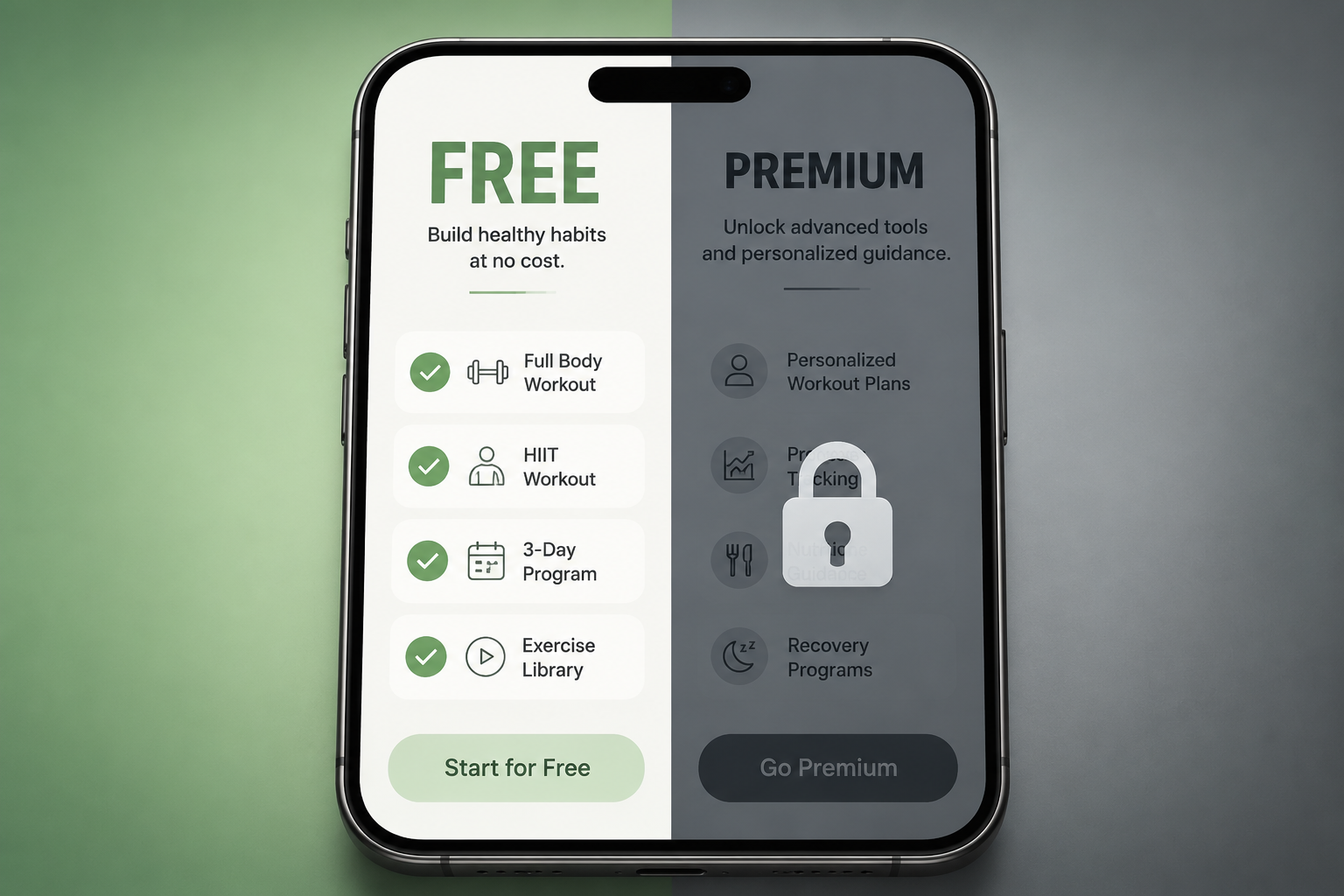
This is the short version before the app-by-app notes. The comparison leans on official app descriptions where available and on third-party testing from Garage Gym Reviews, which says its 2026 free workout app guide tested more than 50 apps.[3] Pricing and free-tier boundaries can change, so the point is not to freeze these apps forever; it is to show what deserves a check before you build a routine around one.
| App | What $0 Actually Gets You | Workout Plans / Programming | Ads | Logging And Progression | Where The Paywall Starts |
|---|---|---|---|---|---|
| Nike Training Club | Fully free guided workouts, programs, and wellness content | 185+ guided workouts and multi-week programs reported by Forbes Health; Nike describes free access to workouts and programs [1][2] | No ads or subscription model cited in the reviewed sources [1] | Good guided workout experience; not primarily a deep lifting log | No standard subscription paywall in the cited sources [1][2] |
| Caliber | Ad-free training app with algorithm-generated custom workouts | Custom strength programs built from a 500+ exercise library [3][4] | No ads in the free tier according to Garage Gym Reviews [3][4] | Strong for structured strength training and progression | 1-on-1 coaching at $200/month; group coaching at $19/month [4] |
| Boostcamp | Large free program library and workout tracking | 11,000+ programs free; Pro adds 20+ exclusive coach programs [3][5] | No ad issue highlighted in the cited source | Full workout tracking free; Pro adds advanced analytics [3][5] | Pro at $14.99/month or $79.99/year [3][5] |
| Hevy | Generous workout logging, graphs, and social feed | Useful if you already know or choose your plan; less about guided video classes | No major ad limitation highlighted in the cited source [3] | Unlimited logging, progress graphs, and social feed free [3] | Pro at $2.99/month adds advanced analytics and Hevy Trainer AI [3] |
| FitOn | All workout videos free | Broad video library across fitness styles; good for guided sessions [3] | Pro is described as adding an ad-free experience [3] | More video-class oriented than lifting-log oriented | Pro unlocks offline downloads and personalized meal plans; reported prices conflict across sources [3][6] |
| JEFIT | Exercise library and workout logging with ads | 1,400+ exercise library and workout logging free [3] | Ad-supported free tier [3] | Solid gym-style logging; advanced analytics require Elite [3] | Elite at $69.99/year removes ads and unlocks video demos and advanced analytics [3] |
| StrongLifts 5x5 | The full 5x5 strength program with auto-progression | One simple barbell strength program rather than a broad library [3] | No ad issue highlighted in the cited source | Auto-progression for the 5x5 program is free [3] | Premium at $4.99/month adds tools such as warm-up and plate calculators [3] |
The table also shows why “best free” lists can feel slippery. One app may be generous because it gives away hundreds of guided sessions. Another may be generous because it lets you log indefinitely. A third may give away one complete program and almost nothing else. Those are not the same product, even when all three can truthfully call themselves free.
For a broader taxonomy of the traps behind free labels, see The Four Flavors of Free Fitness Apps. This article stays narrower: workout plans, logging, ads, and paywall triggers.
Nike Training Club Sets The Clean Free Benchmark
Nike Training Club is the app to measure the others against because its free claim does not depend on a fragile interpretation. Forbes Health lists Nike Training Club as the best free fitness app and describes it as offering 185+ workouts, expert guidance, and no cost to use.[1] Nike’s official page also frames the app around free workouts, programs, and wellness content, with training options for strength, mobility, yoga, cardio, and recovery.[2]
That matters for beginners because guided workouts solve a different problem than a blank exercise logger. If you open an app with no plan, you still have to decide what to train, how hard to go, how to sequence sessions, and what to do next week. Nike’s advantage is that a user can start with a trainer-led session or a multi-week program without first becoming their own coach.
The tradeoff is that Nike is not trying to be the deepest strength-tracking notebook. If your idea of progress is a clean history of sets, reps, estimated maxes, and volume trends, Hevy, JEFIT, Caliber, Boostcamp, or StrongLifts may feel more natural. But for someone who wants structured guided training without subscription friction, Nike is unusually straightforward.
The Strong Free Tiers That Still Have A Business Model
Caliber is a good example of a free tier that can be genuinely useful without pretending the whole company is free. Garage Gym Reviews names Caliber its best free workout app overall and describes the free version as ad-free, with algorithm-generated custom workouts built from a 500+ exercise library.[3] Its separate Caliber review says the paid tiers are where human coaching begins: group coaching at $19 per month and 1-on-1 coaching at $200 per month.[4]
That is a clean boundary. You can use the free tier for structured strength programming; you pay when you want a coach involved. For a home trainee who wants progression but does not need messages from a human coach, this is a reasonable free model rather than a disguised demo.
Boostcamp works differently. Its free claim is built around program volume: Garage Gym Reviews and Boostcamp’s own materials describe 11,000+ free programs and free workout tracking, while Pro adds 20+ exclusive coach programs and advanced analytics.[3][5] That makes it attractive if you like following named programs or browsing plans from coaches and communities, especially for strength training.
The caution with Boostcamp is not that the free tier is thin; it is that abundance has its own cost. A beginner who needs fewer decisions may prefer Nike’s guided environment or Caliber’s generated plan. Someone who already knows they want a particular strength block may get more from Boostcamp’s library than from another app’s polished videos.
StrongLifts 5x5 is the narrowest useful free model in this group. Garage Gym Reviews describes the full 5x5 program with auto-progression as free, with premium features such as a warm-up calculator and plate calculator at $4.99 per month.[3] It is not a general fitness library. It is a simple barbell strength routine. That limitation is also the point: if you want that program, the core routine is not held hostage.
When Logging Matters More Than Video
Hevy and JEFIT are easier to appreciate if you care about the record of training as much as the workout itself. A video app helps you decide what to do today. A good logger helps you see whether today was heavier, higher-volume, or more consistent than last month.
Hevy’s free tier is unusually generous for that purpose. Garage Gym Reviews says it includes unlimited logging, progress graphs, and a social feed, while Pro at $2.99 per month adds advanced analytics and Hevy Trainer AI.[3] That is the kind of paywall that feels tolerable: the core act of recording workouts is not capped so aggressively that the app becomes useless right when consistency begins.
JEFIT is more conditional. Its free tier includes a 1,400+ exercise library and workout logging, but it is ad-supported; Elite at $69.99 per year removes ads and unlocks video demos and advanced analytics.[3] If ads make you abandon apps, that matters more than the size of the exercise library. If you are comfortable with an ad-supported interface and want a gym-style database, the free tier may still be enough.
For strength-focused readers comparing these options more deeply, Strength Training Apps Compared by Budget, Equipment, and Experience Level is the more specific next stop.
FitOn Is Free In A Different Way
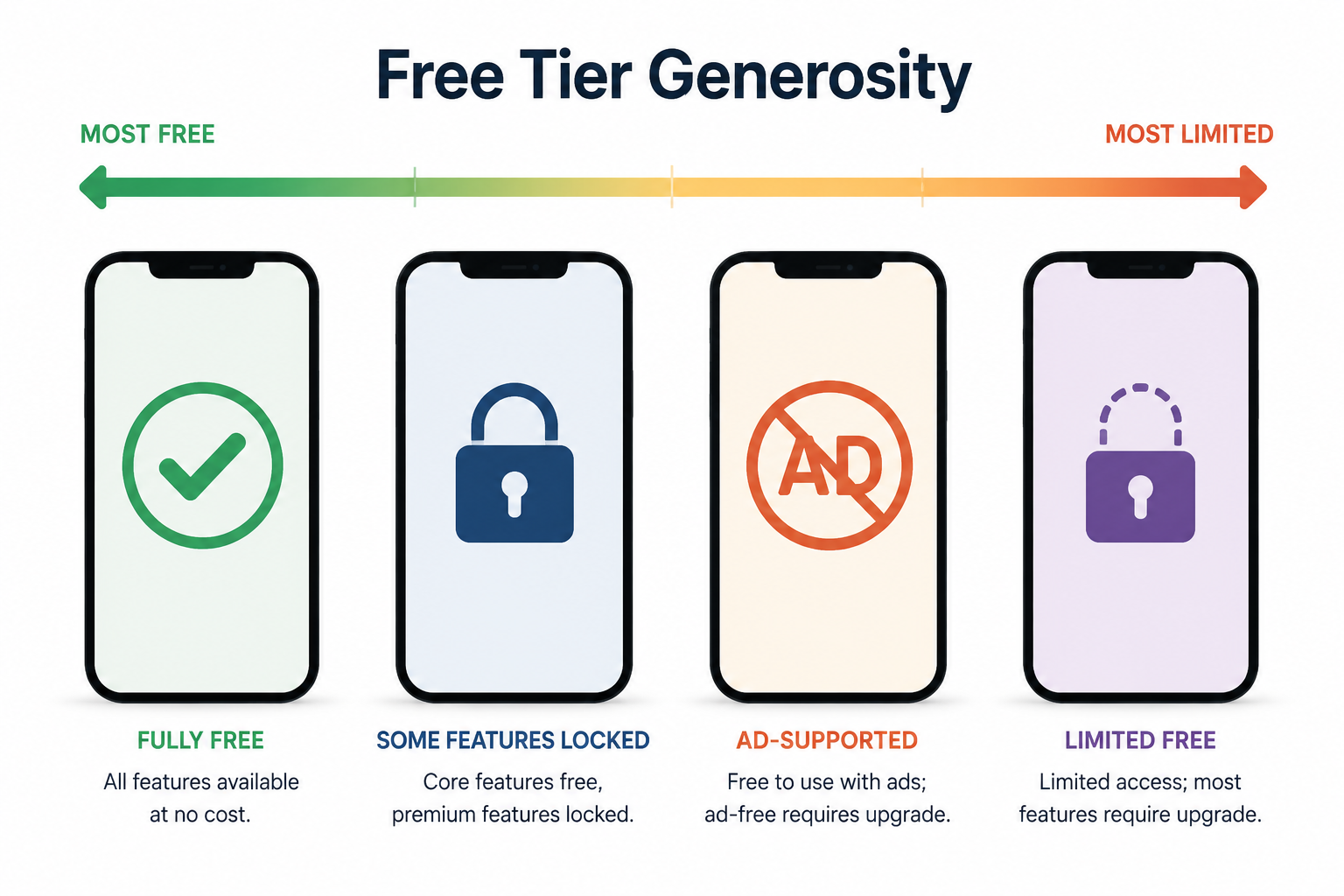
FitOn deserves separate treatment because its free value is not primarily in lifting analytics or progressive strength plans. Garage Gym Reviews describes all workout videos as free, with Pro unlocking offline downloads, personalized meal plans, and an ad-free experience.[3] That is a strong offer if your main barrier is finding guided classes you actually want to follow at home.
The pricing around FitOn Pro is messier than the feature boundary. Garage Gym Reviews reports Pro at $30 per year, while CNET reports $25 for six months; the research set also notes other reported prices from Forbes that differ from both.[3][6] FitOn’s official site should be checked before upgrading, especially because app-store pricing, promotions, and plan names can shift.[7]
That discrepancy should not erase the main free-tier point: a person who wants video variety can get real use from FitOn without first paying. It does mean FitOn is a poor place to rely on a third-party price quote if the decision is specifically about upgrading.
How To Match The Free Model To Your Actual Routine
The best free choice depends less on which app has the longest feature list and more on what failure point you are trying to avoid. If you usually quit because you do not know what workout to do next, guided programming matters. If you quit because logging becomes annoying, tracking depth matters. If you quit because every session starts with an upgrade prompt, the cleanest free tier matters.
| If You Want | Start With | Why |
|---|---|---|
| Guided workouts and multi-week programs with the least subscription friction | Nike Training Club | It is the clearest fully free benchmark in the cited sources, with broad guided training and no standard subscription paywall [1][2] |
| Structured strength programming without paying for coaching | Caliber | The free tier includes ad-free algorithm-generated workouts; coaching is the paid line [3][4] |
| A large library of strength programs and free tracking | Boostcamp | It offers 11,000+ free programs and tracking, with Pro focused on exclusive coach programs and analytics [3][5] |
| A workout log that will not feel cramped immediately | Hevy | Unlimited logging and progress graphs are free; advanced analytics and AI are paid [3] |
| A gym-style exercise database with logging, and you can tolerate ads | JEFIT | The free tier includes a 1,400+ exercise library and workout logging, but ads remain [3] |
| Video class variety at home | FitOn | All workout videos are free; Pro is mainly about offline use, meal plans, and ad-free viewing [3] |
| One simple barbell program | StrongLifts 5x5 | The full 5x5 program and auto-progression are free; calculators sit behind premium [3] |
There is also no rule that one app has to do everything. A perfectly reasonable free setup might use Nike or FitOn for guided sessions and Hevy for lifting logs. If that sounds more practical than chasing one all-in-one app, pairing two specialized trackers may be a better framework.
A Note On “Best Free” Awards
Different publications can name different “best free” apps without truly disagreeing, because they are often defining the category differently. Forbes Health names Nike Training Club the best free fitness app in its broader workout-app list.[1] Fortune’s 2026 workout app coverage names WalkFit as a best free workout app, but that is a walking-focused pick rather than a full substitute for a guided strength, cardio, yoga, and mobility app.[8]
That category distinction is important. If your goal is walking consistency, a walking-first app can be exactly right. If your search is specifically for free fitness apps with workout plans across training styles, it should not be compared as though it solves the same problem as Nike, Caliber, Boostcamp, FitOn, or StrongLifts.
Gymshark Training and Alo Wellness Club are also worth watching because both have been described as moving toward fully free access in the 2025–2026 window, but they are less documented in the cited testing set than the apps above. That makes them interesting candidates, not stronger evidence than the more thoroughly tested options.
What To Check Before You Commit
Before you spend a Sunday setting up profiles, choosing goals, saving workouts, and mentally committing to a plan, open the app-store page or official site and check the current free boundary. Look for the exact plan you want to follow, not just the word “workouts.” Try to start a second or third week of training. Open the logging screen. Tap the analytics tab. See whether the ad experience is tolerable before you depend on it.
- Choose Nike Training Club if you want guided workouts and programs with the fewest subscription complications.
- Choose Caliber if you want structured strength programming and are comfortable paying only if you later want coaching.
- Choose Boostcamp if program depth matters and you like browsing established plans.
- Choose Hevy or JEFIT if logging matters more than video instruction, with Hevy cleaner for free tracking and JEFIT broader but ad-supported.
- Choose FitOn if free video variety is the draw, and verify Pro pricing before treating any quoted upgrade price as current.
- Choose StrongLifts if you want one simple 5x5 strength program rather than a general fitness library.
For readers deciding whether an upgrade is worth it after testing the free tier, How Much Should You Pay for a Fitness App? is the more useful question than whether a premium badge looks impressive.
The honest final check is simple: free tiers change. Re-check the paywall before you build momentum around any app, because the worst free fitness app is not the one with fewer features; it is the one that lets you build a routine around a feature it never meant to keep free.
References
- The 10 Best Workout And Fitness Apps Of 2026, Forbes Health.
- Nike Training Club official page, Nike.
- The 12 Best Free Workout Apps Tested by Experts (2026), Garage Gym Reviews.
- Caliber App Review After 21 Days of Testing (2026), Garage Gym Reviews.
- Boostcamp official page, Boostcamp.
- 7 Fitness Apps You'll Want to Try During Your Next Workout (2026), CNET.
- FitOn official page, FitOn.
- Best Workout Apps (2026): Fitness Expert Approved, Fortune.
Comments
Join the discussion with an anonymous comment.