If you are looking at the Samsung Galaxy Watch 8 as a fitness tracker, the useful answer is not “accurate” or “inaccurate.” It is accurate enough for daily activity, walking, sleep trends, and steady cardio. It is more questionable when you ask it to follow fast heart-rate changes during intervals, and Samsung still does not give you the obvious escape hatch: pairing a third-party chest strap for workouts.
That makes the Galaxy Watch 8 accuracy story better than many older Galaxy Watch conversations, but not as clean as the dashboard makes it feel. GPS distance is one of the stronger parts of the watch. Step count is good enough for daily movement trends. Sleep tracking is useful as a habit signal, with some caveats. Heart rate is the metric that deserves the closest look, because it is the one most likely to change how hard you train.
| Metric | How much to trust it | Best use | Where to be careful |
|---|---|---|---|
| Heart rate | Moderate | Steady runs, walks, general workout intensity | Intervals, rapid ramps, athlete-grade zone work |
| GPS distance | High | Outdoor runs and walks, route distance, pace context | Small overestimates can still happen |
| Steps | High for trends | Daily movement goals, walking consistency | Exact counts can shift with pace and arm swing |
| Sleep | Moderate | Bedtime consistency, general sleep pattern tracking | Exact sleep/wake times and single-night judgments |

Heart Rate: Good Enough Until the Effort Changes Fast
Heart rate is where wrist wearables most often overpromise. A clean zone chart after a workout can make the measurement feel settled, even when the sensor was late to the party during the hardest minute of the session.
In CNET’s 30-mile multi-watch test, the Galaxy Watch 8 had a 6.6% heart-rate error compared with a Polar H10 chest strap. In the same test, the Apple Watch was under 1% error and the Garmin Venu 4 was at 3.89%. CNET also found the Galaxy Watch 8’s error was highest during the rapid heart-rate ramp at the start of runs, which is exactly the place where a wrist sensor’s delay becomes most noticeable.[1]
A 6.6% average error is not a disaster for normal training. If you are jogging at a steady pace, warming up on an exercise bike, or checking whether a walk counted as light cardio, the number can still be useful. The problem is that averages flatten the part many runners and gym users care about: how quickly the watch notices that effort has changed.
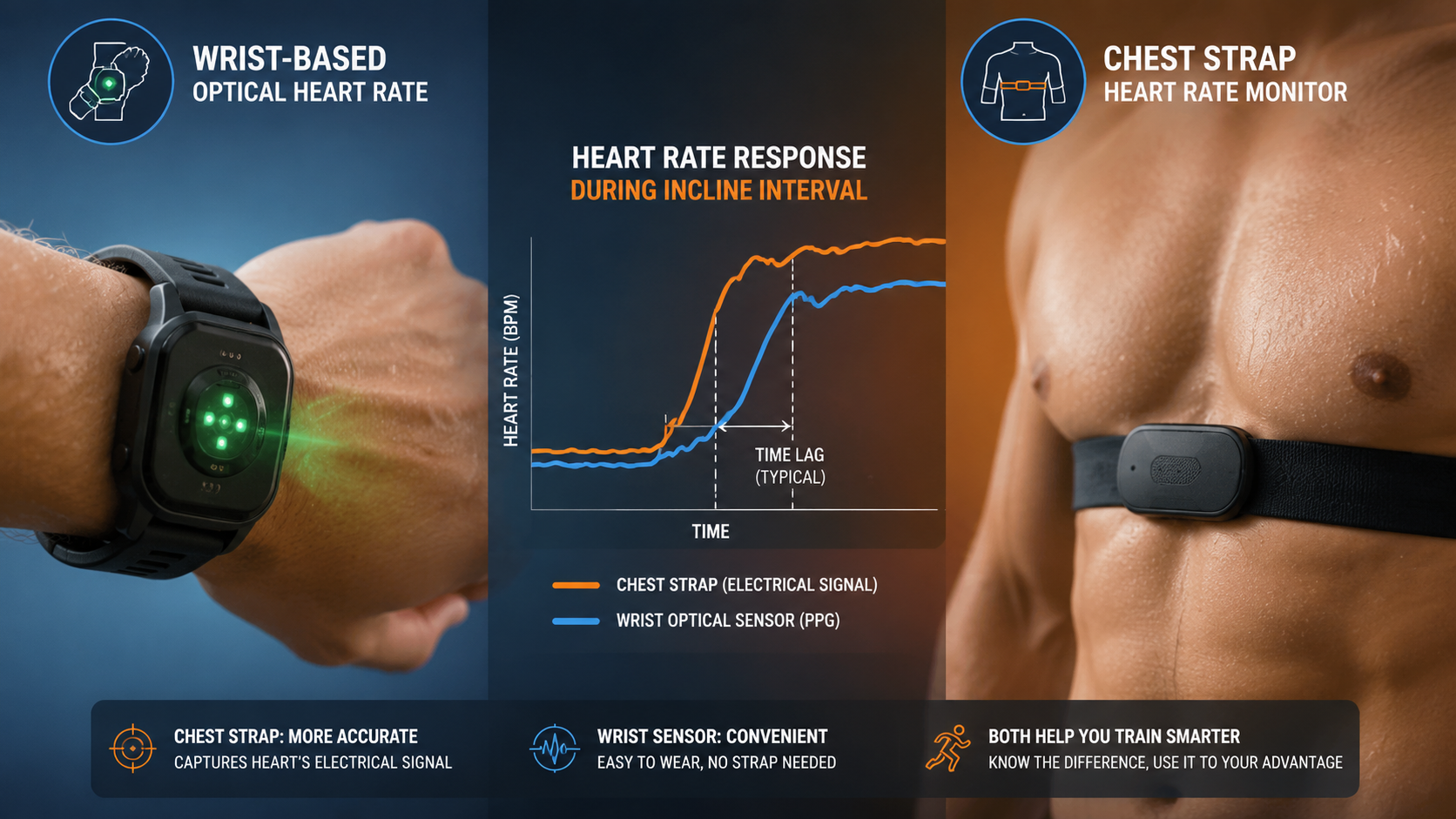
That matters during interval work. If you run a hard repeat, recover briefly, and then go again, a lagging wrist sensor can under-read the beginning of the hard effort and overhang into the recovery. The completed workout may still look reasonable, but the second-by-second guidance is less dependable. For zone-based intervals, that is not a small distinction.
Other field comparisons look more forgiving. PCMag found the Galaxy Watch 8 stayed within 5 beats per minute of an Apple Watch Ultra 2 during workouts.[2] The Telegraph’s half-marathon test reported a 106 bpm average on the Galaxy Watch 8 versus 105 bpm from a Garmin HRM 600 chest strap.[3] Those are useful results, especially because they come from real workouts rather than a feature demo.
They also do not erase the CNET result. A workout average can be very close while the sensor still misses fast transitions. For steady mileage, that is usually acceptable. For intervals, hill repeats, or short strength circuits where effort rises and falls quickly, it is the transition that carries the training value.
There is some broader Samsung context here, but it needs to be handled carefully. An academic study of a Samsung Gear Sport found excellent heart-rate agreement during sleep, with r=0.941 versus ECG and a mean absolute error of 1.06 bpm, while awake activity correlation dropped to r=0.675.[4] That study was not performed on the Galaxy Watch 8, so it should not be treated as a direct score for this watch. It does, however, fit the familiar pattern: optical wrist heart rate tends to look cleaner when the body is still and less clean when movement and intensity changes enter the picture.
The bigger frustration is not that the Galaxy Watch 8 fails to behave like a chest strap. Wrist sensors sit on a moving joint, read blood-flow changes optically, and have to survive sweat, grip changes, tattoos, skin contact issues, and cold-weather circulation. The frustration is that Samsung does not let a user who likes the watch pair a third-party chest strap and keep the rest of the Galaxy Watch experience. If you outgrow wrist heart rate for serious sessions, the watch does not give you a clean upgrade path.
For a deeper explanation of why wrist readings can drift during exercise, see our guide to fitness tracker heart-rate accuracy. The short version for the Galaxy Watch 8 is simple enough: trust it more for steady efforts than for fast changes.
GPS Distance: The Strongest Part of the Watch 8’s Fitness Case
GPS distance is where the Galaxy Watch 8 looks much easier to recommend. On a half-marathon, The Telegraph recorded 13.2 miles from the Galaxy Watch 8 versus 13.13 miles from a Garmin Forerunner 970, a difference of 0.07 miles.[3] CNET found the watch within 0.05 miles of a measured track.[1]
Those differences are small enough that most runners would not change a training decision because of them. A 0.05- to 0.07-mile gap can slightly move average pace on the workout summary, but it is not the kind of miss that turns a normal run into bad data. For everyday outdoor running, walking, and route logging, the Galaxy Watch 8’s dual-band GPS performance is one of its clearest strengths.
There is still a caution: Wareable noted slight distance overestimation in its review.[5] That does not contradict the stronger test results as much as it reminds us that GPS accuracy is route-dependent. Tall buildings, tree cover, tight turns, and watch fit can all make a run less tidy than a measured track.
For most buyers, though, GPS is not the reason to hesitate. If the question is whether the Galaxy Watch 8 can produce credible run and walk distances without carrying a phone, the evidence says yes. If you want the broader brand-by-brand picture, our Fitness Tracker Accuracy Report 2026 puts GPS and heart-rate performance in a wider context.
Step Count: Reliable for Daily Movement, Less Sacred as an Exact Count
Step counting is lower-stakes than heart rate, but it is the number many people see most often. Here the Galaxy Watch 8 performs well, especially if you treat steps as a trend rather than a laboratory count of every footfall.
CNET found the Galaxy Watch 8 was within 11 steps in a 2,500-step controlled test.[1] Tom’s Guide saw more variation: the watch counted 223 extra steps over a 5,000-step manual walk and 44 extra steps over a 4,000-step walk, with error ranging from about 0.5% to 5% depending on walking context.[6]
That spread is believable. Step algorithms have to infer walking from wrist motion, and wrist motion changes with pace, terrain, phone carrying, stroller pushing, handrails, grocery bags, and how much your arms swing. A controlled walk with clean arm movement is not the same job as a distracted walk through a neighborhood.
The practical takeaway is favorable: the Galaxy Watch 8 is reliable for daily movement goals, streaks, and comparing one week with another. It is not a gait lab. If your watch says you walked more this week than last week, that signal is probably useful. If you are arguing over a few dozen steps at the end of the day, the watch was never the right instrument for that level of certainty.
Sleep: Useful Trends, but Do Not Overread a Single Night
Sleep tracking is where wearable data can be most seductive and most fragile. A watch can tell you something helpful about bedtime consistency and overnight patterns. It cannot see sleep the way a clinical sleep study can, and it often has to infer sleep stages from movement and heart-rate signals.
PCMag reported no sleep data gaps with the Galaxy Watch 8, which is a basic but important pass.[2] Missing chunks of the night are more damaging than a slightly debatable score, because they make the whole summary hard to use. The Telegraph, though, found the watch was sometimes off by up to an hour versus its reference.[3]
The older Gear Sport academic study also helps explain why sleep can look better than workouts for Samsung optical heart-rate data: during sleep, the study found r=0.941 correlation with ECG and a 1.06 bpm mean absolute error.[4] Again, that is not direct Galaxy Watch 8 validation. It is directional support for the idea that Samsung’s wrist heart-rate measurements can be much more stable when the wearer is still.
So the Watch 8 is reasonable for sleep habits: whether you went to bed later, whether your schedule is consistent, whether a rough night looks different from your normal pattern. Be careful with exact sleep onset, exact wake time, and fine-grained sleep-stage claims, especially from one night. Those numbers are better treated as clues than verdicts.
The Coaching Layer Is Less Convincing Than the Sensors
Sensor accuracy and coaching quality are not the same thing. A watch can measure a run reasonably well and still make odd training judgments afterward.
That is worth noting with Samsung’s Running Coach. CNET’s half-marathon runner was assigned “level 2” and a beginner plan, while Engadget’s reviewer scored “level 3” despite never being coached.[1][7] Those are only a few reviewer experiences, and software coaching can change. Still, it is a reminder not to treat the Galaxy Watch 8’s training labels as more authoritative than the underlying workout data.
For buyers comparing smartwatch convenience against more fitness-first devices, our fitness tracker decision framework is the better place to weigh ecosystem, battery life, coaching depth, and training features. For this watch specifically, the coaching layer should not be the reason you trust the data more.
Who Can Trust the Galaxy Watch 8?
The Galaxy Watch 8 is credible for Samsung phone owners who want one watch for notifications, health tracking, walking, gym sessions, steady runs, and general sleep trends. Its GPS distance results are strong. Its step counting is more than good enough for daily activity tracking. Its heart-rate data is usable when effort is stable and you are not asking the watch to make second-by-second training decisions.
It is less reassuring for runners who structure workouts around intervals, athletes who depend on accurate zone changes during short efforts, and anyone who already knows they prefer a chest strap for hard sessions. The 6.6% heart-rate error in CNET’s testing is not a reason to dismiss the watch outright, but the gap versus Apple and Garmin matters if heart-rate precision is central to your training.[1]
Samsung has likely made its most accurate Galaxy Watch yet. The Watch 8 is a strong daily fitness tracker for Android users, and it is credible for ordinary home fitness routines, walks, steady cardio, and route tracking. The boundary is heart-rate-dependent training. If your workout depends on catching rapid spikes and recoveries accurately, or if you want to pair a chest strap when wrist optical data is not enough, this is where the Galaxy Watch 8’s accuracy story stops being fully reassuring.
References
- I Ran 30 Miles With 5 Smartwatches, CNET
- Samsung Galaxy Watch 8 Review, PCMag
- Samsung Galaxy Watch 8 review: I ran and hiked 100 miles, The Telegraph
- A comprehensive accuracy assessment of Samsung smartwatch heart rate and heart rate variability, PMC
- Samsung Galaxy Watch 8 review, Wareable
- Samsung Galaxy Watch 8 review, Tom's Guide
- Galaxy Watch 8 review: Samsung's best smartwatch in years, Engadget
Comments
Join the discussion with an anonymous comment.