
The awkward thing about shopping for a screenless fitness tracker in 2026 is that the price tag often answers the wrong question. A $99 band, a $349 ring, and a $199-per-year strap can sit next to each other in a buyer’s guide as if they are competing on the same terms. They are not. One is a purchase. One is hardware plus a paid interpretation layer. One is closer to rented access to a fitness service.
That difference matters more than the shape of the device. Engadget put the subscription problem bluntly in its no-subscription tracker guide: “A $399 Oura Ring 4 is not really a $399 purchase,” because the useful long-term experience depends on a recurring membership, bringing two-year ownership to about $550 and five-year ownership to about $750 in its example.[1] The same math is even sharper with WHOOP, where the device is bundled into a membership and the buyer does not build resale value in the hardware.
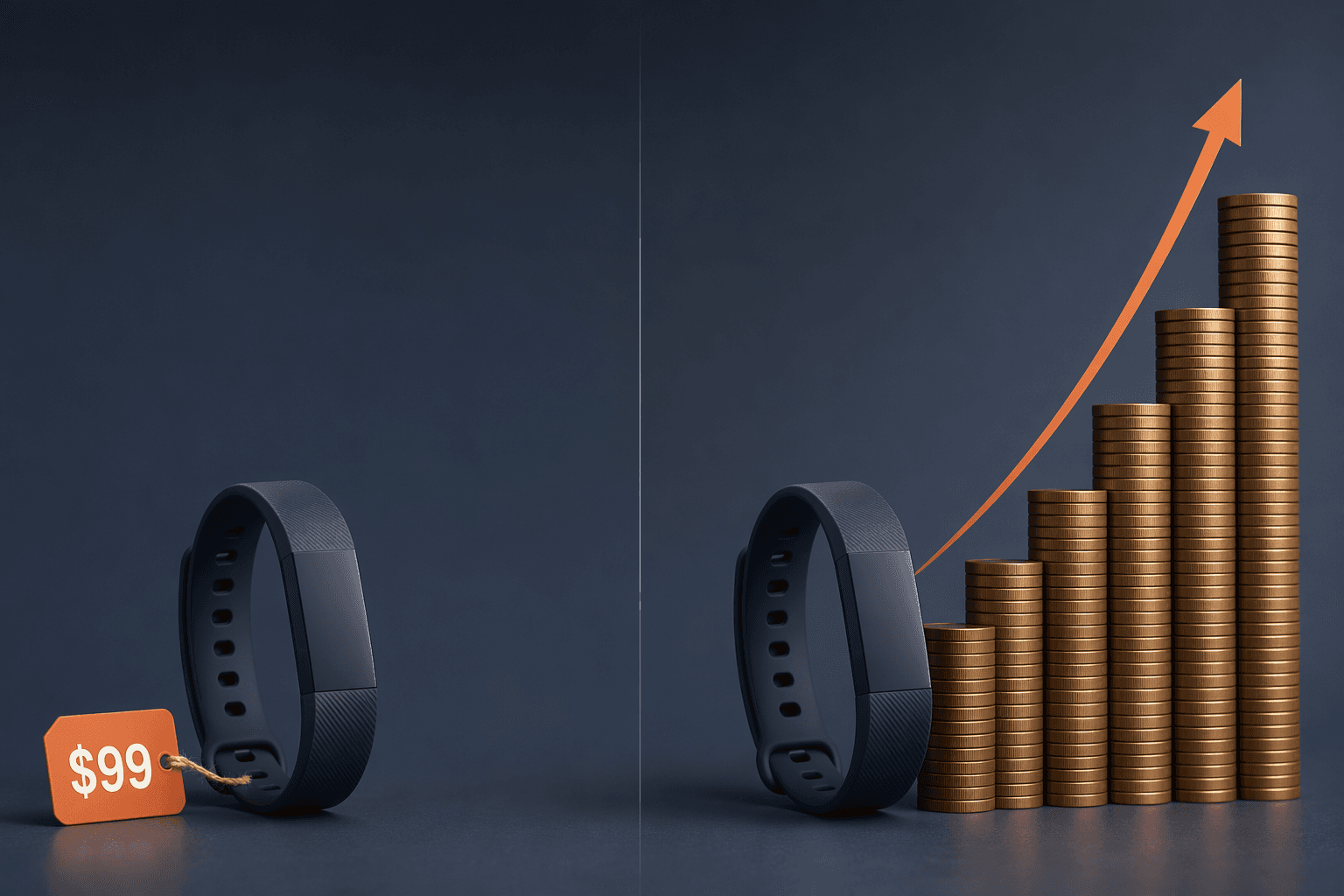
The Ownership Cost Is the Comparison
For a buyer trying to build a home fitness habit without another monthly charge, the cleanest first filter is not recovery score polish or app design. It is whether the tracker still does the job after the original payment. The table below uses U.S. mid-2026 pricing from the research materials and keeps each device in its actual ownership model: mandatory subscription, optional subscription, or no subscription.
| Device | Pricing model | 1-year cost | 2-year cost | 3-year cost | 5-year cost | What the price means |
|---|---|---|---|---|---|---|
| WHOOP 5.0 Basic | Mandatory membership | $199 | $398 | $597 | $995 | Annual access model; hardware is not owned in the normal purchase-and-resell sense.[2] |
| WHOOP MG / Life tier | Mandatory membership | $359 | $718 | $1,077 | $1,795 | Highest-cost WHOOP tier; Blood Pressure Insights marketing drew an FDA warning letter in July 2025.[2] |
| Oura Ring 4 | Hardware plus paid membership | $418.99–$420.88 | $488.98–$492.76 | $558.97–$564.64 | $698.95–$708.40 | $349 ring plus $69.99/year or $5.99/month membership for readiness scores, trends, and detailed insights.[3][1] |
| Fitbit Air | Core tracking free; optional AI coaching | $99.95–$199.95 | $99.95–$299.95 | $99.95–$399.95 | $99.95–$599.95 | Heart rate, sleep, and activity are free; Google Health Premium coaching adds about $10/month or $100/year.[4] |
| Amazfit Helio Strap | No subscription | $99 | $99 | $99 | $99 | BioCharge, VO2 max, recovery time, heart-rate tracking, and sleep data are included with the device.[2] |
| RingConn Gen 2 | No subscription | $250–$300 | $250–$300 | $250–$300 | $250–$300 | No recurring fee; positioned as a lower-cost smart-ring alternative with about 12-day battery life.[5] |
| Ultrahuman Ring Air | No subscription | $349 | $349 | $349 | $349 | No recurring fee, but shorter battery life of about five days and no blood oxygen in the research brief.[5] |
| Xiaomi Smart Band 10 | No subscription | About $50 | About $50 | About $50 | About $50 | Lowest-cost anchor; covers basics but lacks ECG, blood pressure, skin temperature, barometer, and HRV sensors.[1][5] |
| Polar Loop | No subscription | $199.99 | $199.99 | $199.99 | $199.99 | Polar ecosystem and recovery tracking without a membership fee.[2] |
The table makes the category less mysterious. Over three years, WHOOP Basic reaches $597 and WHOOP MG reaches $1,077. Oura lands around $559 to $565, depending on whether the buyer pays annually or monthly. Fitbit Air stays at $99.95 if the buyer ignores AI coaching, and Amazfit Helio Strap stays at $99 while still offering recovery and heart-rate tracking.
That does not make every no-subscription tracker better. It does make the burden of proof different. Once a device asks for recurring payment, the question becomes whether the paid layer changes behavior enough to justify the cost every year the buyer owns it.
What the Subscription Actually Buys
WHOOP is the cleanest example of a membership product disguised, in casual comparison, as hardware. The band has no screen and the appeal is not a cheap sensor bundle. It is the continuous loop of strain, recovery, sleep coaching, and app interpretation. Wareable describes WHOOP’s model as a membership structure where the device is included, with tiers including annual pricing such as $149 for a refurbished 4.0 plan, $239 for Peak with WHOOP 5.0, and $359 for Life.[2]
For a highly engaged user, that can be rational. If someone opens the app daily, changes training based on recovery, and wants a coach-like service without a watch face, they are buying the service more than the strap. The problem is the shopper who thinks they are buying a $199 tracker. After three years, the Basic path is roughly six times that first-year number, and the hardware itself does not become an owned asset with a normal resale market.
The MG or Life tier needs an extra note because the cost is not the only issue. Wareable reports that WHOOP received an FDA warning letter in July 2025 regarding Blood Pressure Insights marketing claims.[2] That does not mean every WHOOP metric is suspect, and it does not make the band useless. It does mean buyers should treat the most expensive tier’s health-claim layer with more caution than ordinary activity tracking.
Oura is a different kind of cost trap. The ring is purchased hardware, and the form factor has real value for people who dislike bands. But Wirecutter and Engadget both note that the subscription unlocks the readiness scores, trends, and detailed insights that make Oura feel like Oura; without it, the ring becomes much closer to a basic step and sleep logger.[3][1]
That distinction is important. Oura is not charging merely for a decorative app. It is charging for interpretation. If readiness scoring, longitudinal trend views, and a ring that disappears under normal clothing are the reasons someone is shopping in this category, the subscription may be part of the product they actually want. If the goal is simply to track sleep duration, heart rate, activity, and broad recovery patterns, the paid wall becomes harder to defend.
Fitbit Air and Amazfit Change the Baseline
Fitbit Air is the awkward comparison for subscription-first products because its core tracking is not paywalled. PCMag lists the device at $99.95, with heart-rate, sleep, and activity tracking available without the optional Google Health Premium plan; the paid layer is for Gemini AI coaching and guided workouts, at about $10 per month or $100 per year.[4] Tom’s Guide also treated the device as a budget screen-free tracker that can stand on its own without forcing the buyer into a coaching plan.[6]
That model is easier to evaluate. A buyer can start at $99.95, use the basic health and activity data, and only add coaching if it proves useful. If the habit fades after two months, the damage is contained. If the buyer later wants more guided workouts or AI interpretation, the subscription is an add-on rather than a condition for making the device meaningful.
Amazfit Helio Strap pushes the same point harder. At $99 with no subscription, it includes BioCharge, VO2 max, recovery time, heart-rate tracking, and sleep data. Wareable’s testing found its arm-worn heart-rate accuracy within 1–2 BPM of a Garmin chest strap, which is the kind of third-party result that matters more than a long feature checklist.[2]
The Helio Strap is not automatically a better product than WHOOP for every athlete. WHOOP’s app, coaching rhythm, and membership ecosystem are the reason loyal users stay. But the Amazfit comparison clarifies what a shopper is paying for. The recurring fee is not required for the existence of recovery metrics, heart-rate tracking, or sleep tracking. It is paying for a specific interpretation system and a more polished behavior loop.
Readers who already know they want to avoid recurring fees can narrow the field further with a dedicated no-subscription comparison of screenless fitness trackers without a subscription. For the more common cross-shop, the sharper question is whether Fitbit Air’s low-cost optional model is enough, or whether WHOOP’s paid membership experience is worth committing to from day one.
Core Tracking Versus Premium Interpretation
Most buyers say they want “health insights,” but the bill depends on what that phrase means. Core tracking usually means heart rate, sleep, activity, and sometimes HRV or recovery trends. Premium interpretation means readiness scores, coaching prompts, long-term trend analysis, and app feedback that tells the user what to do next.
| Need | Lower-cost devices can cover it? | Where subscriptions may add value |
|---|---|---|
| Basic activity and heart-rate tracking | Yes. Fitbit Air, Amazfit Helio Strap, Xiaomi Smart Band 10, Polar Loop, RingConn, and Ultrahuman all sit in the no-mandatory-subscription camp. | Usually limited value unless coaching or training plans are used consistently. |
| Sleep tracking | Yes, though comfort and form factor matter. Rings may be easier to wear overnight than straps for some users. | Trend interpretation, readiness scoring, and more polished sleep coaching. |
| Recovery or HRV-style guidance | Often yes, depending on device. Amazfit includes BioCharge and recovery time; RingConn is positioned around sleep and HRV-style tracking.[2][5] | Better app narrative, habit prompts, and longitudinal coaching. |
| Medical-style claims | Treat cautiously across the category. | Higher-priced tiers do not remove the need to separate wellness guidance from regulated health claims. |
Recovery guidance is where many buyers overspend. A recovery score can feel more useful than raw heart-rate variability because it reduces the decision to one number. That convenience has value. It is also the easiest place for a recurring fee to feel harmless until the tracker sits in a drawer and the payment keeps going.
Accuracy should also be handled with restraint. PCMag and TechRadar both confirmed Fitbit Air’s tracking accuracy in their coverage, while Wareable’s Helio Strap testing produced a strong heart-rate comparison against a chest strap.[4][7][2] Those are useful signals, not a guarantee that every metric on every wrist, finger, or upper arm is equally precise in every workout.
The Other No-Subscription Anchors
RingConn Gen 2 and Ultrahuman Ring Air matter because they weaken the idea that Oura’s subscription is simply the cost of wearing a smart ring. Vora’s 2026 screenless tracker guide places RingConn Gen 2 around $250 to $300 with no subscription and about 12 days of battery life, compared with Oura’s roughly eight days.[5] That does not mean RingConn has the same app polish or interpretation quality. It means the ring form factor itself no longer requires a monthly fee.
Ultrahuman Ring Air is closer to Oura’s upfront price at $349 and also avoids a subscription. The tradeoff in the research brief is shorter battery life, around five days, and no blood oxygen. For a buyer choosing a ring mainly because it is comfortable and unobtrusive, that may be acceptable. For someone who wants the most complete overnight health dashboard, the missing sensor and shorter battery become harder to ignore.
Xiaomi Smart Band 10 is the budget floor, not a direct WHOOP replacement. At about $50, it covers basic tracking and offers the longest battery claim in the group at 21 days, but the research brief notes that it lacks ECG, blood pressure, skin temperature, barometer, and HRV sensors. It can work as a clip-on, but advanced metrics are lost when it is not in skin contact.[1][5] That is a fair trade for someone who wants steps, basic workouts, and low cost. It is not the same purchase as a recovery-first wearable.
Polar Loop sits in a quieter position: $199.99, no subscription, and access to Polar’s ecosystem and recovery tracking. It is not the cheapest device in the table, but it gives buyers another way to get serious training context without turning the tracker into a yearly bill.[2]
Battery Claims Need Testing, Not Faith
Battery life is one of the cleaner-looking specs in fitness tracker marketing, and one of the easiest to overread. Wirecutter found the Fitbit Inspire 3 lasted 8.5 days in testing against a 10-day advertised figure, and the research brief notes Amazfit Helio Strap testing at eight days against a 10-day advertised figure.[3] The lesson is not that these batteries are bad. It is that buyers should treat advertised battery life as a ceiling, then ask whether the real charging rhythm fits their sleep and workout routine.
That is especially relevant for screenless trackers because they are easy to forget until they are dead. A smartwatch reminds the user with a visible battery meter. A ring or strap depends more heavily on app notifications and habit. Longer battery life lowers friction, but it does not rescue a device whose core data or pricing model is wrong for the buyer.
Match the Device to the Ownership Period
For one year, the choice can still be emotional. A buyer curious about WHOOP might treat $199 as a trial of the membership experience. Someone who wants a ring and values Oura’s readiness system might accept a first-year cost just over $418 with annual membership. The mistake is pretending that first-year curiosity is the same as a long-term purchase.
At two to three years, the shape of the decision changes. WHOOP Basic moves from $398 to $597. Oura moves from about $489 to about $559 with annual membership. Fitbit Air without coaching remains $99.95. Amazfit Helio Strap remains $99. The buyer now has to believe that the paid interpretation layer is worth several replacement devices.
At five years, mandatory subscriptions dominate the bill. WHOOP Basic reaches $995, and the WHOOP MG or Life tier reaches $1,795. Oura with annual membership reaches about $699. Fitbit Air without optional coaching, Amazfit Helio Strap, RingConn Gen 2, Ultrahuman Ring Air, Xiaomi Smart Band 10, and Polar Loop do not compound in the same way.
A simple buying frame is enough:
- Choose a no-subscription tracker if the goal is heart rate, sleep, activity, basic recovery trends, and low long-term cost.
- Consider Fitbit Air if the buyer wants a low upfront price with the option to add coaching later, rather than a required membership from the start.
- Consider Amazfit Helio Strap if recovery metrics and arm-worn heart-rate tracking matter more than a premium coaching ecosystem.
- Consider Oura if the ring form factor and readiness insights are the main reasons for buying, and the membership cost is acceptable over several years.
- Consider WHOOP only when the membership experience itself is the product the buyer expects to keep using.
The deeper head-to-head between the two most commonly compared bands belongs in a separate Fitbit Air vs. WHOOP 5.0 comparison. The broader point is already visible from the cost table: for budget-conscious shoppers, the best screenless fitness tracker is usually the one that still delivers useful core data after the first payment is over. Subscriptions can be worth paying for, but only when the coaching loop is something the buyer uses, not something they meant to cancel.
References
- 5 Fitness Trackers That Don't Lock Core Features Behind A Monthly Subscription — Engadget
- Best discreet, non-watch fitness trackers without a screen — Wareable
- The 3 Best Fitness Trackers of 2026 — Wirecutter
- The Best Fitness Trackers We've Tested for 2026 — PCMag
- Best Screenless Fitness Trackers in 2026 — Vora Blog
- I thought screen-free wearables were a gimmick... — Tom's Guide
- As a fitness tracker reviewer... 3 discreet screenless fitness trackers — TechRadar
Comments
Join the discussion with an anonymous comment.