
The badges are gone. So are the monthly sleep animals, the community feed, the stress check graphs, and the Estimated Oxygen Variation data. On May 19, 2026, the Fitbit app became the Google Health app, and a lot of the gamification and detail that made Fitbit feel distinct disappeared with the rebrand. The question is not whether Google Health Premium costs $9.99 a month. The question is whether it adds anything back that actually changes how you train. For most people, the answer depends entirely on which device you own. So let me state it plainly: if you own an Inspire 3, skip the subscription. If you own a Charge 6, use the free trial and decide later. If you own the new Fitbit Air, the Premium subscription may be worth it—but only if the AI Coach genuinely changes your routine, and only after you have tested it during the three-month trial.
I have been through the Google Health Help Center, the Wirecutter update, the Men's Health review, and the Tech Advisor comparison. The pricing is inconsistent across sources—Wirecutter says $80/yr for existing subscribers, $100/yr for new; Men's Health says $99.99/yr; Tech Advisor says $79.99/yr. Google is still sorting out regional and promotional pricing. Check the official Google Store before you buy.
What the Transition Took Away
The feature-removal list matters more than the feature-add list for existing Fitbit owners. According to the Google Health Help Center, these are gone regardless of subscription:
- Sleep Profile and monthly sleep animals (removed entirely; you can ask the AI Coach about your sleep type if you subscribe)
- Estimated Oxygen Variation (EOV) – removed; SpO2 trends remain
- Stress check graphs – removed (Scan Quick Reset still works on Charge 5/6 and Sense)
- Skin temperature minute-by-minute data – removed; daily and weekly trends remain
- Badges – removed; historic badges will be deleted
- Community Feed and direct messaging – removed
- Recipes – removed for Premium users
- Groups – removed
If you relied on the social motivation of badges or the detail of EOV trends, you are losing those regardless of whether you pay. That shifts the value calculation for long-time users: the subscription now feels like a way to get back some of what was taken, not a net gain.
The free tier still gives you step count, heart rate, sleep score, SpO2 trends, Active Zone Minutes, basic workout tracking, and period tracking. There is a dispute about the Daily Readiness Score: Business Insider lists it as free, but the Help Center does not include it in the free tier, and Men's Health implies it is part of Premium. I am leaning toward the Help Center as authoritative—so Readiness Score probably requires Premium for most users. But even if it's free, it does not change my device-by-device advice.
Device by Device: Is Premium Worth It?
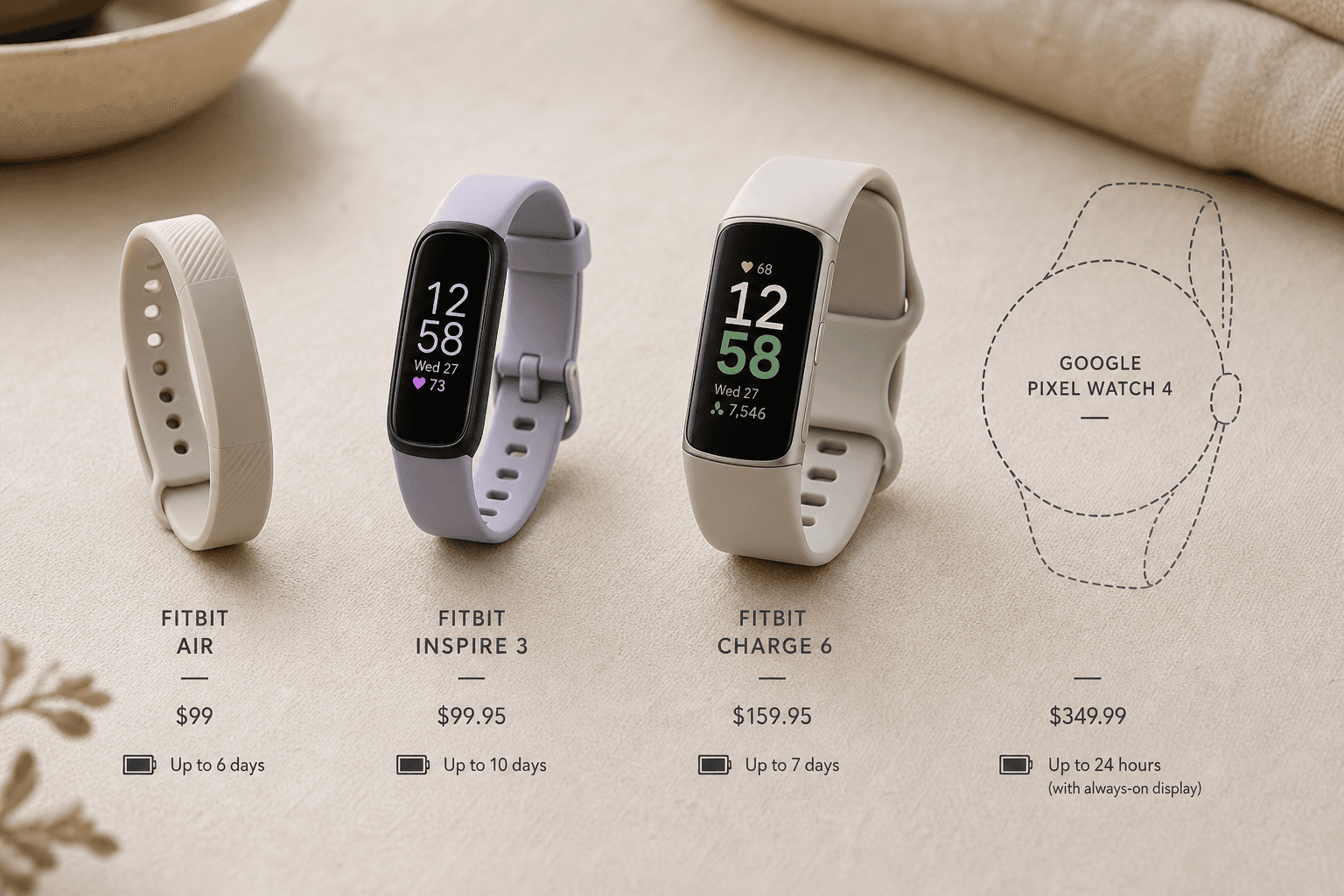
Fitbit Inspire 3 — Skip It
If you own an Inspire 3, do not pay for Premium. The free tier already covers everything you bought the device for: steps, heart rate, sleep score, SpO2 trends, basic workout tracking, and Active Zone Minutes. There is no Premium-only feature that changes how an Inspire 3 user trains. The AI Coach might give you a workout suggestion, but you can get free workout videos anywhere. Adding a subscription turns a $99 tracker into a $179+ proposition for something that does not improve your routine. Spend that money on something that actually changes your habits.
Fitbit Charge 6 — Optional, Not Transformative
The Charge 6 already has ECG and built-in GPS, both free. Its heart rate and sleep tracking are solid without Premium. What Premium adds is the Daily Readiness Score (if it is indeed Premium-only), the AI Coach, and adaptive fitness plans. For someone who is already training daily and wants guidance on when to push and when to rest, the readiness score can be useful. But it is not transformative. I would recommend using the three-month free trial that comes with the device. If after three months you find yourself ignoring its suggestions, cancel. You lose nothing. The Charge 6 at $149 with the free tier is a strong package; adding $80–100 per year only makes sense if the coach actually changes your decisions.
Fitbit Air — Near-Essential, but Only After a Trial
The Fitbit Air is a screenless tracker that costs $99. Without a subscription, it tracks steps, heart rate, sleep, and basic metrics—Men's Health puts it bluntly: "The Fitbit Air without the Premium subscription does not stand out from the crowd." The AI Coach is the main differentiator. It can generate workout plans, analyze your sleep patterns, and provide nutrition guidance based on conversation history with Gemini. That is genuinely new for Fitbit. But the AI Coach is still in preview; its real-world value is partly speculative. My advice: buy the Air, use the 90-day free trial, and only subscribe if the coach actually improves your routine. If you cancel after the trial, you still have a capable basic tracker—unlike Whoop, which requires a subscription to function at all.
A quick cost comparison puts it in perspective:
| Option | Device cost | Yearly subscription | Total first year |
|---|---|---|---|
| Fitbit Air + Premium | $99 | $80–100 | $179–199 |
| Charge 6 + free tier | $149 | $0 | $149 |
| Inspire 3 + free tier | $99 | $0 | $99 |
| Whoop (any tier) | Included | $199–$359 | $199–$359 |
| Oura Ring 4 + Membership | $349–$499 | $69.99 | $419–$569 |
For basic tracking, a $99 Fitbit Air without subscription beats Whoop's total cost of ownership. For anyone who wants the AI Coach, the Air plus Premium at $179–199 is still cheaper than Whoop's cheapest tier. But that only matters if the coach actually delivers. I am not convinced yet. The three-month trial is your safety net.
Here is the bottom line: The transition to Google Health removed several genuinely useful features from the free tier. That loss colors the subscription proposition for everyone. But if you are buying a new tracker, the device itself should drive your budget, not the subscription. Get the Inspire 3 or Charge 6 and stay free. If you want the Air's AI Coach, try it free first. Most Fitbit buyers should stick with free tracking and spend their money on something that actually changes their routine.
Comments
Join the discussion with an anonymous comment.