
A subscription-free fitness tracker should not make you pay again to see the basics: heart rate, sleep, activity, workouts, and useful trends over time. That sounds obvious until you shop the 2026 wearable aisle, where “free app,” “optional membership,” and “required subscription” can mean three very different bills.
The short version: Xiaomi has the cheapest capable band, Fitbit Air is the most interesting new screenless option, Garmin remains the safest watch-style no-subscription pick, and Samsung’s Galaxy Ring is the cleanest mainstream ring alternative if you already live on Android. Oura and Whoop can still make sense for people who want guided recovery and are willing to rent the software experience, but they are the comparison baseline here, not the default recommendation.
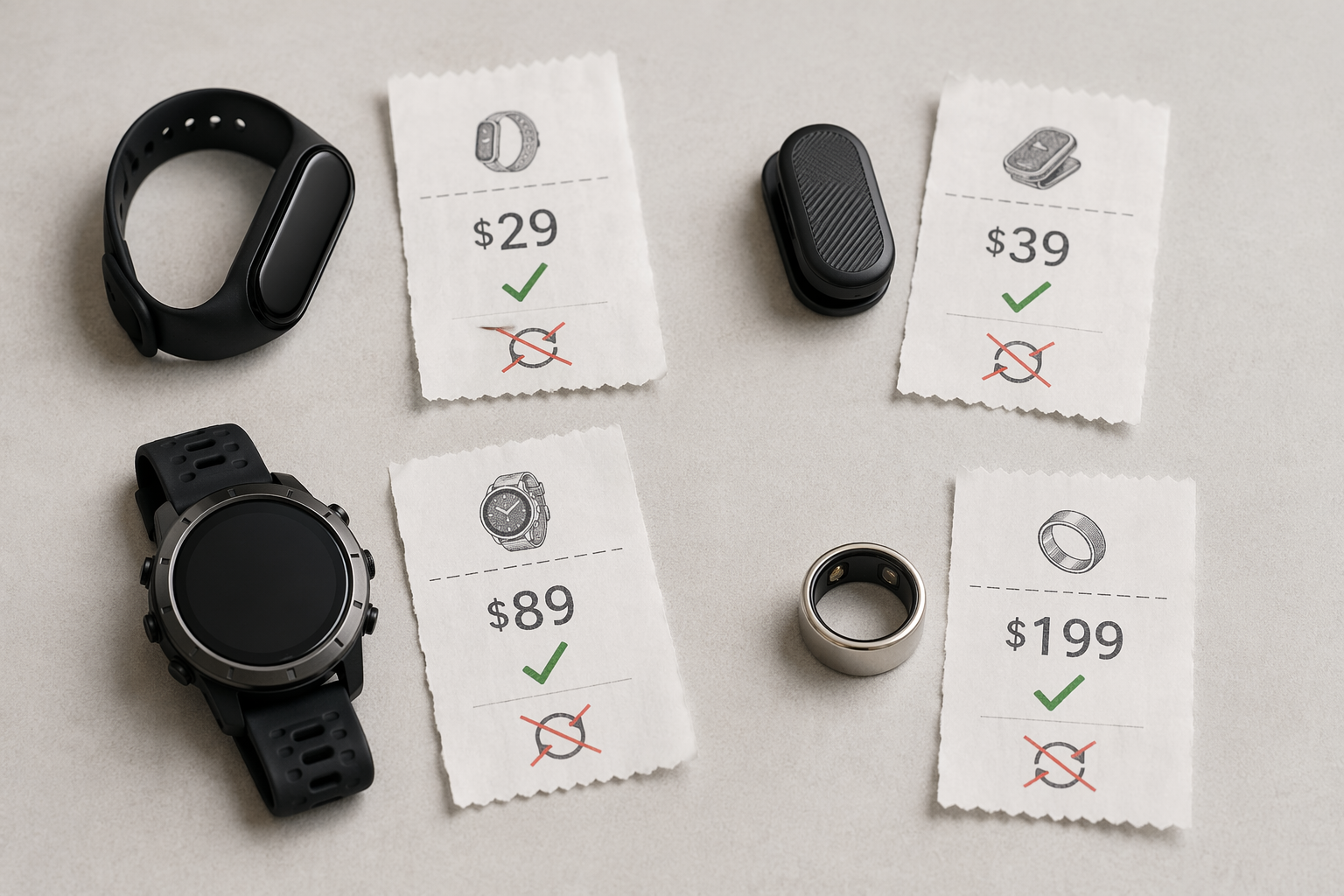
What Counts as Subscription-Free Here
For this guide, a tracker counts as subscription-free only if the core experience works after the one-time purchase. That means you can use heart-rate tracking, sleep tracking, activity tracking, workout logging, and meaningful history without a monthly or annual fee.
A paid tier does not automatically disqualify a device. Fitbit Air, for example, keeps its core features free while putting AI Coach behind Fitbit Premium. Garmin’s Connect+ has paid extras, but Garmin’s core metrics remain free on most models. The line is crossed when the device depends on a membership to remain useful, as with Whoop’s annual plan or Oura’s membership model.
If you are still deciding whether you want a band, watch, ring, or screenless tracker, start with our fitness tracker decision framework or the form-factor guide to rings vs. smartwatches vs. fitness bands. This article is for the next question: which of those choices lets you stop paying after checkout?
2026 Subscription-Free Fitness Tracker Comparison
| Device | Form factor | Approx. price | Battery | What stays free | Main catch |
|---|---|---|---|---|---|
| Xiaomi Smart Band 10 | Budget fitness band | About $50 | Up to 21 days | Heart rate, sleep, activity, workout tracking, app data without subscription [1][2] | US availability and Mi Fitness app experience may differ by market [1][2] |
| Fitbit Air | Screenless tracker | $99 | 8.5 days | Core heart-rate, sleep, activity, and workout features; PCMag rated it 4.5/5 and noted highly accurate heart-rate and sleep tracking [1][3] | AI Coach requires Fitbit Premium at $100 per year [3] |
| Polar Loop | Screenless tracker | $169.99 | 8 days | Sleep stages, Nightly Recharge, 24/7 heart rate, automatic activity detection [4] | More expensive than Fitbit Air and Xiaomi; less smartwatch-like utility |
| Amazfit Helio Strap | Screenless tracker | $99.99 | Check current specs | Readiness tracking through the Zepp app without subscription positioning [3] | Independent long-term validation is thinner than Garmin, Fitbit, or Apple |
| Garmin vívosmart 5 | Fitness band | $150 | Check current specs | Garmin’s core fitness and health features remain free on most models [5] | Garmin Connect+ created backlash because users expected Garmin to stay fully no-subscription [5] |
| Apple Watch Series 11 | Smartwatch | $400 | Check current specs | Apple’s core health, activity, and workout features do not require a fitness-tracker subscription [6] | Higher upfront cost; best for iPhone users |
| Samsung Galaxy Ring | Smart ring | $400 | Check current specs | Mainstream no-subscription ring option [7] | Best fit for Samsung/Android users; expensive upfront |
| RingConn Gen 2 Air | Smart ring | $199 | Check current specs | No-subscription smart-ring tracking positioned below Oura’s long-term cost [7] | Less established than Oura or Samsung |
| Circular Ring 2 | Smart ring | $349 | Check current specs | No-subscription ring model; ECG positioning comes from Circular’s own materials [7] | Medical-adjacent claims should be checked against independent review or clearance documentation before purchase |
| Oura Ring 4 | Smart ring | $349 plus $70/year | Check current specs | Useful only as a subscription baseline in this guide | Membership raises cost to about $489 after 2 years and $699 after 5 years [8] |
| Whoop ONE | Screenless recovery tracker | $199/year | Check current specs | Useful only as a subscription baseline in this guide | Annual pricing totals $398 after 2 years and $995 after 5 years on the referenced tier [8][3] |
Prices in this guide come from May–July 2026 reporting and product pages, so check the current retailer page before buying. The relative pattern matters more than a sale price: a $50 band, $99 screenless tracker, or $150 Garmin can stay close to its checkout price, while subscription-based devices keep adding cost every year.
Best No-Subscription Picks by Buyer Type
Fitbit Air: the screenless tracker that changes the middle of the market
Fitbit Air is the device that makes the 2026 subscription-free category feel different. At $99, it lands in the same psychological price zone as many impulse-buy bands, but it behaves more like a serious everyday tracker. PCMag named it an Editors’ Choice, rated it 4.5 out of 5, and called out highly accurate heart-rate and sleep tracking, with 8.5-day battery life [1].
The important part is what you get without paying again. Fitbit Air’s core heart-rate, sleep, activity, and workout tracking are free. That makes it a cleaner answer for people who want Whoop-like screenless wear without accepting Whoop-style annual pricing. The catch is not hidden, but it matters: Fitbit’s AI Coach sits behind Fitbit Premium, listed at $100 per year in the cited comparison [3].
That leaves Fitbit Air in a useful middle position. If you want passive tracking, good sleep and heart-rate data, and a device you can wear without a watch face, it is one of the strongest no-subscription choices in this list. If you specifically want coaching prompts, interpretation, and AI-guided next steps, you need to decide whether that paid layer is part of the product you thought you were buying.
For a deeper screenless-only comparison, use our complete 2026 guide to screenless fitness trackers without subscriptions.
Xiaomi Smart Band 10: the cheapest capable exit from subscriptions
The Xiaomi Smart Band 10 is the budget pick that makes the “just buy something cheap” advice less risky. At about $50, with up to 21-day battery life and no subscription requirement, it gives shoppers a real low-cost way to track sleep, heart rate, activity, and workouts without buying into a membership ecosystem [1][2].
This is the model I would look at first for a beginner who wants to learn their patterns, not optimize every recovery score. A long battery reduces one of the classic beginner failures: the tracker dies, sits on a charger, and never returns to the wrist. The price also leaves room for normal human indecision. If someone uses it for three months and decides they want a larger watch or a ring, they have not spent smartwatch money just to learn their own habits.
The caveat is real for US shoppers. The Mi Fitness app experience and availability can differ between US, European, and Asian markets [1][2]. That does not erase the value, but it does mean the Smart Band 10 is not as frictionless a recommendation as it looks on price alone. If easy returns, local warranty support, and app polish matter more than the lowest possible cost, Fitbit or Garmin may be worth the extra money.
If you are comparing the lower end of the market, our affordable fitness tracker feature guide is the better place to sort out what $30, $50, $80, and $100 actually buy.
Garmin vívosmart 5 and Garmin watches: the safe no-subscription habit
Garmin still deserves its reputation as the practical no-subscription brand. Its core fitness and health features remain free on most models, which is why Garmin has long been the easy recommendation for people who hate paying rent on their own activity data [5].
That reputation is also why Garmin Connect+ caused such an emotional reaction. TechRadar described user backlash after Garmin’s 2025 paid tier, precisely because the brand had trained customers to expect a complete app experience without a membership [5]. The detail that matters for buyers is narrower: Connect+ does not make Garmin’s core tracking subscription-only on most models, but it does weaken the old emotional promise that Garmin would never put meaningful software behind a new toll gate.
For a no-subscription fitness band, the Garmin vívosmart 5 at about $150 is a sensible middle pick. For runners, cyclists, and people who want buttons, GPS-oriented sport features, or a more watch-like training tool, Garmin’s broader watch line is usually a better fit than a slim band. The reason to buy Garmin is not glamour; it is the confidence that the basic training log, health metrics, and long-term activity history are not treated as a recurring upsell.
Apple Watch Series 11 and Samsung watches: subscription-free, but not budget devices
Apple and Samsung sit in a slightly different lane. Their watches are not cheap fitness trackers, but their core health, activity, and workout features do not require a dedicated fitness-tracker subscription. The Apple Watch Series 11 appears here at $400, which makes it expensive next to a Xiaomi band or Fitbit Air, but straightforward if you already want an iPhone-connected smartwatch [6].
This is where form factor matters more than spec-sheet perfection. If you want notifications, apps, safety features, and a bright screen on your wrist, a smartwatch can be worth the upfront cost. If you only want sleep, resting heart rate, workouts, and steps, paying $400 for a watch because it has no fitness subscription may still be overbuying.
Polar Loop and Amazfit Helio Strap: screenless alternatives with different comfort zones
Polar Loop is the more traditional, training-brand version of the screenless idea. At $169.99, it is not the cheapest option, but Polar’s product page lists sleep stages, Nightly Recharge recovery, 24/7 heart-rate tracking, automatic activity detection, and 8-day battery life without a subscription [4]. For someone who likes Polar’s training language and wants a screenless device that feels less like a startup experiment, that matters.
Amazfit Helio Strap is closer to Fitbit Air on price at $99.99 and is positioned around readiness tracking in the Zepp app without subscription hassle [3]. It belongs on the shortlist if you want a low-cost screenless device and already like Amazfit’s app ecosystem. I would still give Fitbit Air the advantage for a first-time buyer unless Amazfit’s app, companion devices, or pricing are specifically appealing.
No-subscription smart rings: RingConn, Samsung, and Circular
Smart rings are where subscription-free shopping gets most tempting, because Oura made the category feel premium and also made the membership bill feel normal. The no-subscription alternatives covered here are RingConn Gen 2 Air at $199, Circular Ring 2 at $349, and Samsung Galaxy Ring at $400 [7].
RingConn Gen 2 Air is the value play: a lower upfront price than Oura Ring 4 and no annual membership in the cited comparison. Samsung Galaxy Ring is the safer mainstream choice for Android users who want a polished ecosystem and are already comfortable with Samsung Health. Circular Ring 2 is more complicated. Circular’s own 2026 article positions it as a no-subscription ring and highlights ECG-related features, but those claims should be checked against independent reviews or regulatory documentation before you treat them as medical decision-making tools [7].
That caution is not anti-ring. Rings are excellent for people who hate sleeping in watches and want passive recovery and sleep tracking. The practical issue is that a ring has to fit correctly, survive daily wear, and produce useful trends in the app you will actually open. Do not let one medical-adjacent feature claim override those basics.
The Ownership Math: One-Time Tracker vs. Subscription Device
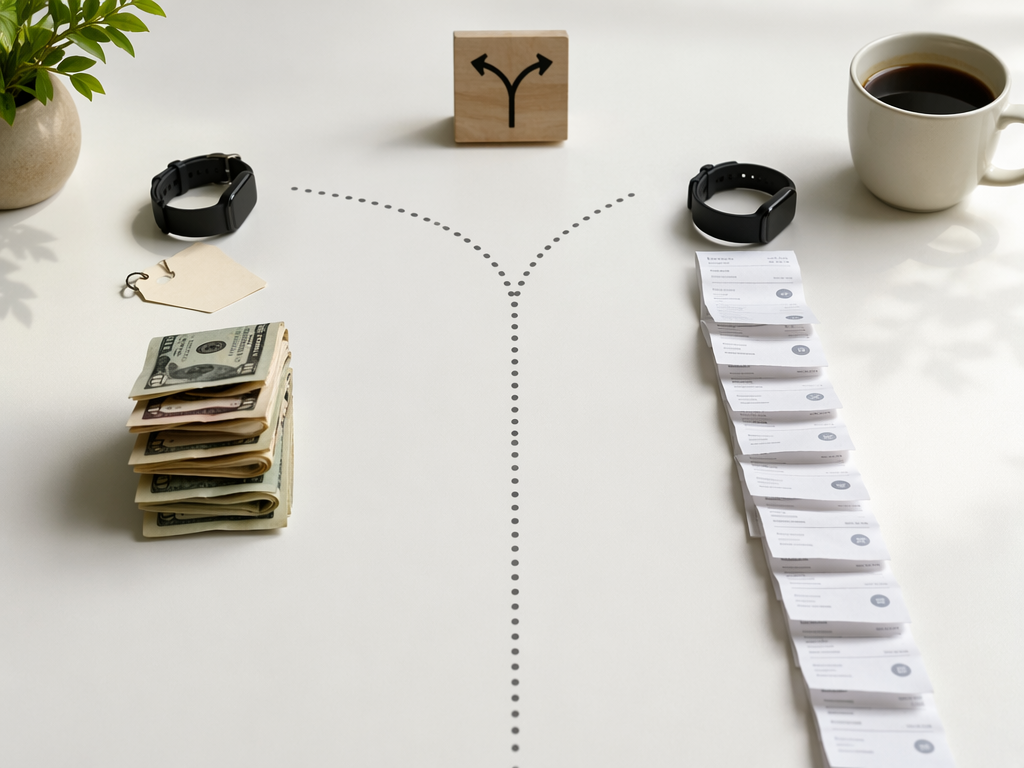
The reason subscription-free trackers deserve their own list is not moral purity. It is arithmetic. A device that looks cheaper at checkout can become the expensive option once the app bill is part of the product.
| Device or model | Upfront or annual price in cited sources | Approx. 2-year cost | Approx. 5-year cost | What the number shows |
|---|---|---|---|---|
| Xiaomi Smart Band 10 | About $50 | About $50 before replacement or accessories | About $50 before replacement or accessories | Lowest-cost capable no-subscription option [1][2] |
| Fitbit Air | $99 | About $99 if you skip Premium | About $99 if you skip Premium | Core tracking stays free; AI Coach is optional at $100/year [1][3] |
| Garmin vívosmart 5 | $150 | About $150 | About $150 | Core Garmin experience remains free on most models [5] |
| Oura Ring 4 | $349 plus $70/year membership | About $489 | About $699 | The membership roughly doubles the long-term gap versus many no-subscription trackers [8] |
| Whoop ONE | $199/year | $398 | $995 | The referenced annual tier behaves like a service, not a one-time device purchase [8][3] |
There are people who should pay for interpretation. A recovery-focused athlete may value Whoop’s coaching enough to treat the subscription like a training expense. An Oura user may like the ring, the app language, and the way the membership turns raw signals into daily guidance. That is a reasonable choice when it is made on purpose.
What is not reasonable is discovering after checkout that the trend, score, or guidance you expected lives behind a second price. If you want the longer version of the math, compare ownership periods in fitness tracker subscription costs over 1, 3, and 5 years or the broader guide to the true cost of a workout tracker. For the subscription side specifically, our Whoop 5.0 review is the more direct question: is that service worth it for home fitness?
Which One Should You Buy?
- Buy Xiaomi Smart Band 10 if you want the lowest-cost capable tracker and can tolerate possible US availability or app differences.
- Buy Fitbit Air if you want a $99 screenless tracker with strong heart-rate and sleep marks, and you are comfortable skipping the paid AI Coach.
- Buy Garmin if you want the safest long-term no-subscription training ecosystem, especially for sport tracking.
- Buy Apple Watch or Samsung watch if you want smartwatch features first and fitness tracking second.
- Buy Samsung Galaxy Ring or RingConn Gen 2 Air if you want a ring without Oura’s annual membership.
- Consider Oura or Whoop only if the paid interpretation, coaching, or recovery ecosystem is the thing you are intentionally buying.
In 2026, avoiding fitness-tracker subscriptions no longer means settling for a toy. The good options now span $50 bands, $99 screenless trackers, established Garmin devices, full smartwatches, and smart rings. The buying skill is more specific: separate free core tracking from optional paid coaching, and separate a device’s checkout price from what it costs to keep using it.
References
- The Best Fitness Trackers We’ve Tested for 2026, PCMag.
- Wareable fitness tracker roundups, Wareable.
- Fitbit Air vs. WHOOP vs. Oura Ring, Droid Life.
- Polar Loop product page, Polar USA.
- Have your say — one year after Garmin’s divisive Connect+ launch, TechRadar.
- No-subscription alternatives article, TechRadar.
- Best Smart Rings Without Subscription in 2026, Circular.xyz.
- 5 Fitness Trackers That Don’t Lock Core Features Behind A Monthly Subscription, Engadget.
Comments
Join the discussion with an anonymous comment.