
A “free” Whoop 5.0 is not free if you keep it for the length of a normal device cycle. At the Basic membership tier, it costs $597 over three years; at the Life tier, it costs $1,077. An Oura Ring 4 at $349 becomes $559 after three years of membership. A Garmin Forerunner 265 that looks expensive on the shelf at $450 stays $450 because the core features are included. A Xiaomi Smart Band 10, at roughly $53, sits in another universe entirely if its simpler feature set is enough for your workouts.[1][2][3]
That is the part most “best workout tracker” comparisons make too easy to miss. Purchase price is only the first line of the receipt. The real question is what the tracker asks from you every year after the box is open.
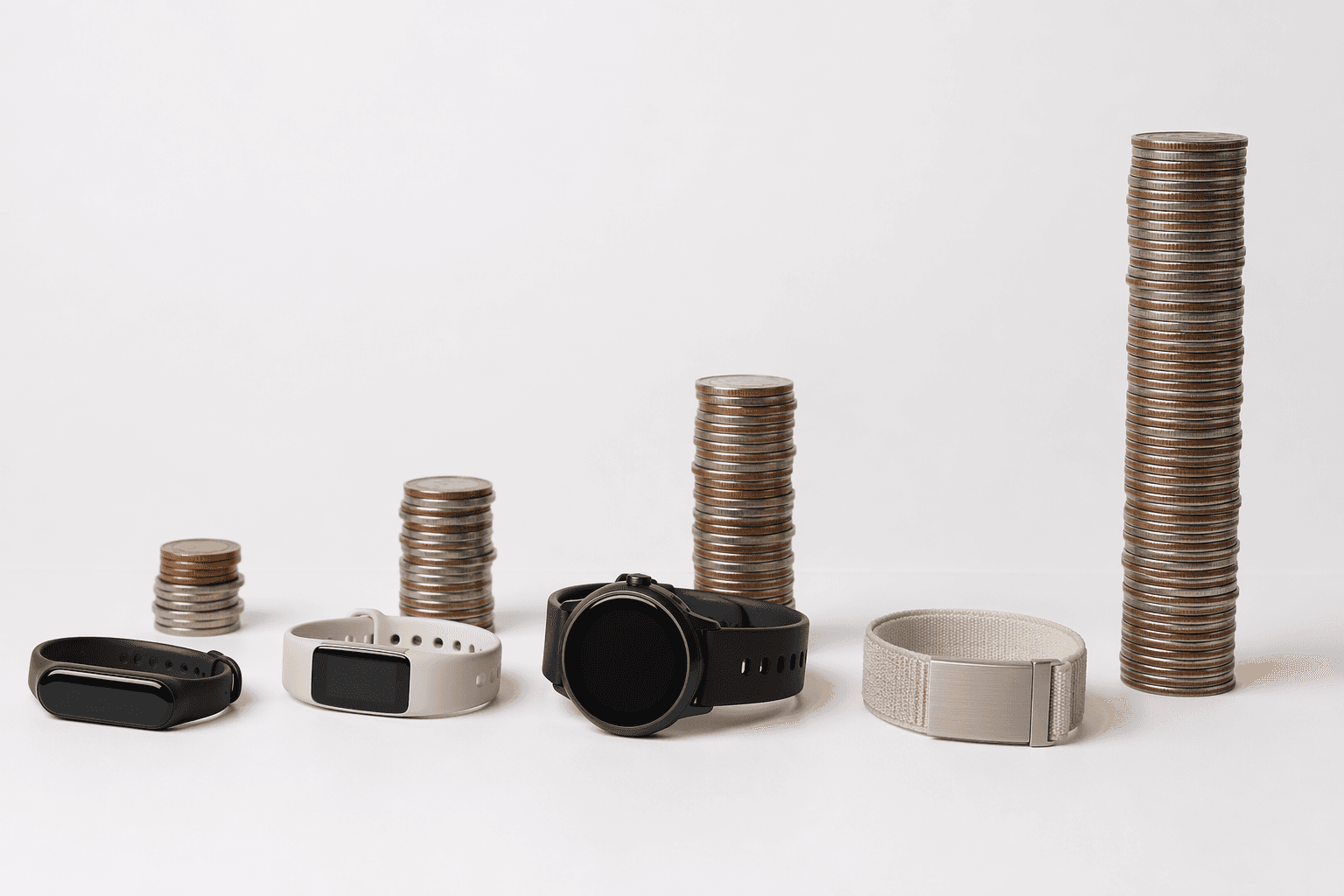
The three-year price is the price that matters
For a home fitness buyer, three years is a reasonable ownership window: long enough for a watch, band, or ring to become part of a routine, and long enough for subscription costs to stop looking small. The calculator is simple:
Device price + three years of required or heavily pushed subscription cost = actual comparison price.
Using June 2026 US pricing, the spread is not a rounding error. It is the difference between a one-time budget band and a four-figure training service.[1][2][3]
| Tracker | Upfront device price | Subscription model | Three-year cost |
|---|---|---|---|
| Whoop 5.0 Basic | $0 | $199/year required membership | $597 |
| Whoop 5.0 Life | $0 | $359/year required membership | $1,077 |
| Oura Ring 4 | $349 | $70/year for membership | $559 |
| Garmin Forerunner 265 | $450 | No required subscription for core features | $450 |
| Garmin Vivoactive 6 | $250–$300 | No required subscription for core features | $250–$300 |
| Xiaomi Smart Band 10 | About $53 | No subscription | About $53 |
This is where the shelf-price instinct breaks. The Garmin Forerunner 265 is a $450 watch, so it can feel like the premium purchase. But over three years, it costs less than the “free” Whoop 5.0 on the Basic membership tier. The difference is not subtle: $450 versus $597, before considering the higher Whoop tiers.[1][2]
The Xiaomi comparison should be used carefully. A roughly $53 band that covers a large share of basic tracking needs is not the same product as a recovery-focused wearable with coaching, long-term trend analysis, and a polished app experience. It may also be weaker for home gym integrations such as Apple Health, Google Fit, Peloton, or other connected-training workflows. But for step counting, workout logging, basic heart-rate tracking, sleep estimates, and general activity awareness, the cost gap is too large to ignore. It is under 5% of the three-year cost of the most expensive Whoop tier.[1][2]
If you are still choosing between a band, smartwatch, ring, or app before comparing ownership cost, the broader Best Workout Tracker 2026 form-factor guide is the better first stop. Once the form factor is settled, the subscription math should move to the top of the decision.
What the subscription actually controls
A subscription is not automatically a trap. If it changes how you train, recover, sleep, or avoid overreaching, it may be worth paying for. The problem is comparison shopping that treats the subscription as optional when the product experience has been designed around it.
Fitbit: affordable hardware, meaningful premium layers
Fitbit is the classic low-upfront-cost example. A buyer sees an approachable device price and assumes the decision is mostly finished. The catch is that Fitbit Premium, listed at $80 per year, and Google Health Premium, listed at $100 per year, put several valuable features behind a paid layer, including Daily Readiness Score, detailed sleep breakdowns, and a workout library.[1][4]
That does not make every Fitbit a bad buy. Wirecutter’s 2026 fitness tracker coverage includes Fitbit models in its testing context, and Fitbit can still make sense for someone who wants a familiar app, a slim band, and basic activity tracking.[4] The buyer just needs to know whether the features being advertised in reviews and screenshots are included with the device or living behind the recurring bill.
Oura: hardware purchase plus a sleep-and-recovery subscription
Oura is different from Fitbit because the product’s appeal is heavily tied to sleep, recovery, and longitudinal health trends. The Oura Ring 4 starts with a $349 hardware purchase, then adds a $70-per-year membership for advanced insights, resilience score, and long-term trends. Over three years, that brings the total to $559.[1][2]
For the right person, that may be a rational purchase. A ring can be more comfortable than a watch during sleep, and recovery-focused users may value the interpretation layer more than another workout screen. But it should be compared as a $559 three-year product, not as a $349 ring. Readers mainly shopping for HRV, sleep, readiness, and recovery interpretation should also compare it against the options in the recovery tracker guide before deciding whether the subscription is doing enough work to earn its place.
Whoop: membership first, device second
Whoop deserves its own category because there is no meaningful device-purchase alternative in this comparison. The device price can be $0, but the product is the membership. With the 5.0 model, the Basic tier is listed at $199 per year and the Life tier at $359 per year, creating a three-year range from $597 to $1,077.[1][2]
That makes Whoop one of the clearest examples of why “starts at” pricing can mislead a home fitness buyer. If someone wants recovery coaching, strain guidance, and a screen-free wearable built around daily interpretation, Whoop may belong on the shortlist. If the buyer mainly wants workout tracking for a garage gym, treadmill, bike, rowing machine, or strength routine, the membership model needs to justify itself against watches and bands that keep working without a bill.
Garmin, Withings, Xiaomi, Amazfit, and Coros: cleaner cost structures
Garmin, Withings, Xiaomi, Amazfit, and Coros are not automatically better devices for every buyer. They are cleaner devices to price. In the research set used here, their core feature access does not require a subscription. Garmin stands out because models from the $250–$300 Vivoactive 6 range up to the $450 Forerunner 265 include the main tracking and training features with the device purchase.[1][2][3]
That matters for anyone building a home routine on a fixed budget. A device that costs more today but stops charging tomorrow can be easier to plan around than a cheaper device that quietly becomes part of the monthly household stack.

Accuracy still matters, but it does not erase the cost problem
A cheap tracker that gives you unusable data is not a bargain. Heart-rate accuracy during intervals, sleep-stage estimates, GPS behavior, and strength-training recognition can all affect whether a device helps or annoys you. Roundups from PCMag, Wirecutter, Wareable, and Garage Gym Reviews are useful because they test and compare devices beyond the price tag.[1][2][3][4]
The caution is that accuracy claims are rarely one clean leaderboard. Kygo’s wearable accuracy analysis covers 17 studies across 6 devices and flags funding sources, including both independently funded and manufacturer-funded research.[5] That kind of mixed evidence is useful, but it should not be stretched into a universal claim that one brand is always accurate and another is always wrong.
For home fitness buying, the practical standard is narrower: do not pay a subscription for an accuracy promise unless the specific data you care about is both measured well enough and presented in a way that changes your training. If you lift at home, indoor-cycle, row, walk, or follow app-based classes, compatibility can matter as much as sensor reputation. The home gym tracker compatibility guide is a better place to check ecosystem fit before paying for a platform you may not use fully.
How the buying decision changes once subscriptions are included
Once the three-year cost is visible, the categories get simpler. The question is no longer which device has the lowest advertised price. It is which cost structure matches the job you need the tracker to do.
| Buyer priority | Most sensible direction | Reason |
|---|---|---|
| Lowest total cost | Xiaomi Smart Band 10 or another no-subscription budget band | The roughly $53 ownership cost is difficult to beat if basic tracking is enough. |
| Best no-subscription training value | Garmin Vivoactive 6 or Forerunner 265 | Higher upfront price, but no required subscription for the main feature set. |
| Recovery-focused tracking | Oura or Whoop, compared carefully by three-year cost | The subscription may be worthwhile if sleep, readiness, HRV, and coaching change behavior. |
| Low upfront price with premium app features | Fitbit, with Premium cost included before buying | The device can be affordable, but readiness, detailed sleep, and other features may require payment. |
| Home gym ecosystem fit | Check compatibility before choosing | A cheap tracker is less useful if it does not connect cleanly to the apps or equipment you use. |
For many buyers, the Garmin value cliff is the most important lesson. A $450 Forerunner 265 can be the cheaper long-term purchase than a $0 Whoop because the Garmin stops asking for money. That does not make Garmin the best workout tracker for every wrist or every training style, but it does make the one-time price easier to understand.
For the strict budget buyer, Xiaomi’s role is different. It is the reminder that basic tracking does not have to become a service relationship. The trade-off is that the experience may be less polished, integrations may be thinner, and advanced coaching may be limited. That is a fair compromise for some people and a bad one for others.
For shoppers also filtering by fit, wrist size, cycle tracking needs, or smaller watch cases, the fitness tracker guide for women adds another layer to the cost question. A tracker that is financially sensible still has to be comfortable enough to wear consistently.
A quick calculator to use before buying
Before comparing two trackers, write down four numbers:
- The device price you will actually pay today, after any sale or bundle discount.
- The annual subscription price for the features you expect to use.
- The number of years you realistically keep wearables before replacing them.
- Any accessories, replacement bands, charging cables, or required app costs that affect your real setup.
Then compare like this:
Total ownership cost = device price + (annual subscription cost × years owned)A hypothetical $99 tracker with a $100 annual premium plan is not a $99 purchase if the features you want require that plan. Over three years, it is a $399 purchase. A hypothetical $300 tracker with no subscription is cheaper over the same period, even though it looks three times more expensive at checkout.
This is also where app-only alternatives can be worth considering for some budget readers. Zapier’s 2026 fitness app roundup is useful context if your main need is logging workouts, building habits, or tracking routines rather than wearing a sensor all day.[6] An app will not replace wrist-based heart-rate data or sleep tracking, but it can avoid buying hardware for a problem that is really about planning and consistency.
The standard to use
Do not compare workout trackers by purchase price until you have priced the subscription years you are likely to own the device. A subscription can be worth it, especially for recovery coaching or sleep insight that changes behavior. But it should win honestly, as part of the total cost, not hide behind a low device price.
References
- The Best Fitness Trackers We've Tested for 2026, PCMag
- Best fitness tracker 2026, Wareable
- The 13 Best Fitness Trackers, Tested by Trainers (2026), Garage Gym Reviews
- The 3 Best Fitness Trackers of 2026, Wirecutter
- Wearable Accuracy Ranked: 17 Studies, 6 Devices (2026), Kygo
- The 9 best fitness apps in 2026, Zapier
Comments
Join the discussion with an anonymous comment.