
Is the Oura Ring Worth It for Home Gym Users? A Practical Guide for Lifters, Runners, and Hybrid Athletes
Thinking about adding an Oura Ring to your home gym setup? This practical guide evaluates the ring's real-world value for strength training, running, and hybrid workouts — covering recovery insights, grip interference, the two-wearable solution, and total cost compared to alternatives like Whoop and Fitbit.
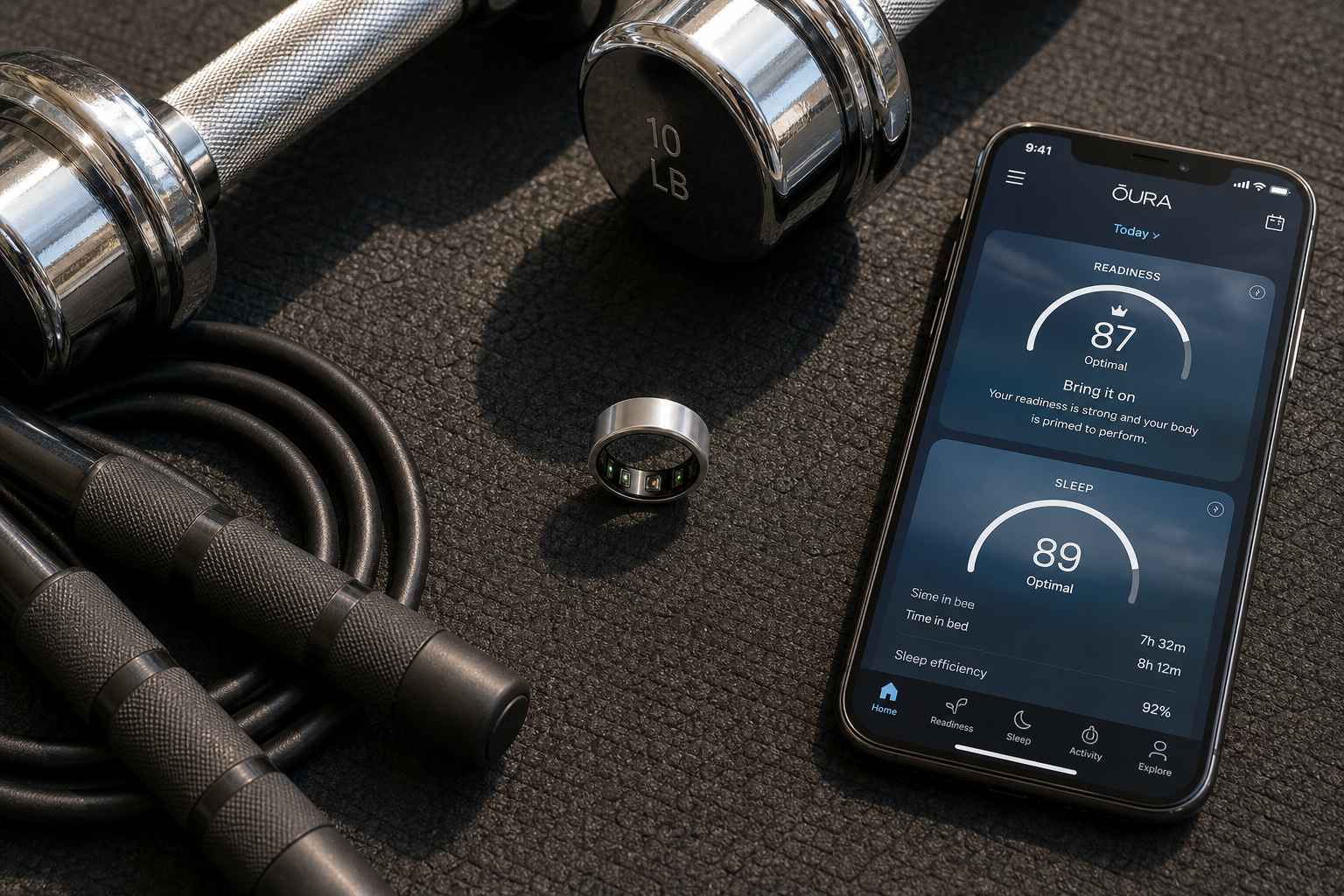
The Home Gym Tracking Gap: Why Most Self-Trained Athletes Miss Recovery Signals
If you train at home — whether you're grinding through a 5x5 squat program, chasing a half-marathon PR on the treadmill, or mixing both in a hybrid block — you've probably noticed something missing: structured feedback on whether your body is actually ready to perform. In a commercial gym with a coach, you'd get cues on bar speed, rep quality, and programmed deloads. At home, you get a logbook and your own subjective feel.
That's the gap the Oura Ring aims to fill. It's not a fitness tracker in the traditional sense — it won't count your reps, log your sets, or tell you if your deadlift form is breaking down. But it will synthesize over 20 biometric signals into a single Readiness Score that tells you whether to push hard, back off, or take a rest day. For the self-coached home gym athlete, that kind of feedback can be the difference between productive training and digging a recovery hole.
The question is whether the ring's unique value — data-driven recovery awareness — outweighs its well-documented limitations for strength training, grip interference, and the ongoing subscription cost. This guide evaluates the Oura Ring specifically through the lens of home gym training decisions, not as a general wellness gadget.
What the Oura Ring Actually Does Well for Home Gym Training
Before we get into the limitations, it's worth understanding what the ring does that your phone or a basic fitness band cannot. The Oura Ring's core value proposition for home gym users rests on three capabilities:
- Readiness Score: Oura's proprietary algorithm pulls data from heart rate, heart rate variability (HRV), body temperature, respiratory rate, and overnight activity to produce a single score each morning. Business Insider's reviewer described it as an indicator of whether to "push or rest." For a home gym lifter who doesn't have a coach adjusting their program daily, this is the closest thing to an objective training readiness signal.
- HRV Trend Tracking: Heart rate variability is a well-established marker of autonomic nervous system recovery. A downward trend over several days can flag early overtraining before you feel it subjectively. The ring captures HRV during sleep, giving you a consistent daily reading without needing to sit still for a morning measurement.
- Sleep Quality Scores: A study published in JMIR Mhealth Uhealth (2020) found the Oura Ring on par with medical-grade actigraphy for tracking total sleep time and sleep efficiency. For home gym athletes, sleep is the single most important recovery variable — knowing you got only 5.8 hours of restorative sleep is actionable data that can justify a lighter training session.
Real-World Home Gym Use Cases: From Readiness to Training Decisions
Data is only useful if it changes behavior. Here are three concrete scenarios where Oura data can directly influence a home gym training session:
- Low Readiness Score → Swap Heavy Squats for Mobility Work: You wake up with a Readiness Score of 62. Your program calls for heavy back squats at RPE 8. Instead of grinding through a session that leaves you drained for the rest of the week, you pivot to a 30-minute mobility circuit and a light 20-minute zone 2 bike ride. You lose nothing in the long run — you preserved recovery and avoided accumulating fatigue.
- HRV Downward Trend → Schedule a Deload Week: Your 7-day HRV average has dropped 12% from your baseline. You feel fine — maybe a little tired, but nothing unusual. The trend data suggests your nervous system is accumulating strain. You decide to start your deload week three days early, cutting volume by 40% and keeping intensity moderate. By the end of the week, your HRV is back to baseline.
- Poor Sleep Score → Adjust Training Split Timing: You got 5 hours of sleep with low restorative time. Your morning readiness is poor. Instead of forcing a morning session, you shift your workout to the evening after a nap and a proper meal. The session goes well — you hit your numbers — because you gave your body time to recover before demanding performance.
These scenarios are not hypothetical. They represent the core value of the ring for home gym athletes: replacing guesswork with data-driven decisions about training intensity and recovery. The key is that the ring doesn't tell you what to do — it gives you information, and you apply it within your existing training framework.
Where the Oura Ring Falls Short: Grip Interference, No Rep Tracking, and Scratching
The Oura Ring's limitations for home gym training are not minor inconveniences — they are fundamental design constraints that anyone considering the ring needs to understand before purchasing.
Grip Interference During Barbell and Dumbbell Work
The most frequently cited issue from strength-training reviewers is that the ring physically interferes with gripping a barbell, dumbbell, or pull-up bar. This is not a theoretical concern — it comes from experienced lifters who tested the ring in real training environments.
Olympian Caine Wilkes used the Oura Ring for 10 months leading up to the Tokyo Olympics and recommended against wearing it for barbell work — snatches and cleans — because it felt 'in the way' for grip.
Similarly, Coop Mitchell, founder of Garage Gym Reviews, tested the ring and stated it is "uncomfortable when used in [resistance training] environment" and wears an Apple Watch during workouts instead. The Sleep Foundation reviewer also found the ring uncomfortable for workouts involving gripping — weightlifting and rowing — and recommended removing it during such exercises.
No Rep Counting, Set Logging, or Strength Training Tracking
The Oura Ring does not track strength training. It does not count reps, log sets, or recognize exercises. According to Garage Gym Reviews, the ring only tracks walking, running, and cycling. If your primary training modality is barbell strength work, the ring will provide almost no useful workout data. You will need to log your sets and reps manually in a separate app or notebook.
Scratching and Durability
Multiple reviewers — including Forbes and Business Insider — noted that the ring scratches easily, especially during weightlifting. The titanium and ceramic finishes are durable for daily wear, but contact with knurled barbells, dumbbell handles, and kettlebells will mark the surface. If you care about the ring's appearance, you will need to remove it before every strength session.
The Two-Wearable Solution: Pairing Oura with a Chest Strap or Smartwatch
Given the ring's limitations for real-time workout tracking, many home gym users adopt a two-device strategy: wear the Oura Ring 24/7 for sleep, recovery, and readiness data, and use a separate device — a chest strap or a smartwatch — for workout tracking.
This approach acknowledges that no single wearable does everything well. The Oura Ring excels at passive, continuous monitoring of recovery metrics. A chest strap (like a Polar H10) provides accurate real-time heart rate data during exercise. A smartwatch (like an Apple Watch or Garmin) adds GPS for outdoor runs, rep counting for strength training, and on-wrist feedback during workouts.
The trade-off is cost and complexity. You are now managing two devices, two charging schedules, and potentially two subscriptions. But for home gym athletes who want both deep recovery insights and accurate workout tracking, this is currently the most practical solution.
Cost-Benefit Analysis: Oura Ring vs. Whoop vs. Fitbit for Home Gym Users
To evaluate whether the Oura Ring is worth it, you need to compare its total cost of ownership against alternatives that serve similar recovery and training needs. The table below focuses on home gym training utility — not general features — so you can compare what each device actually delivers for your specific training context.
| Dimension | Oura Ring 4 | Whoop 4.0 | Fitbit Charge 6 |
|---|---|---|---|
| Upfront cost | $349 – $499 | $0 (no hardware cost) | $139.95 |
| Subscription cost | $69.99/year ($5.99/mo) | $30/month ($360/year) | $0 (optional Premium at $9.99/mo) |
| Year 1 total cost | $419 – $569 | $360 | $139.95 (or $260 with Premium) |
| Year 2+ annual cost | $69.99 | $360 | $0 (or $120 with Premium) |
| Recovery / readiness tracking | Excellent — Readiness Score from 20+ signals | Excellent — Strain/Recovery model | Good — Daily Readiness Score (with Premium) |
| Strength training tracking | None — no rep/set logging | Manual strain input only | Auto-detect exercise, no rep counting |
| Grip interference | Yes — uncomfortable for barbell work | No — worn on wrist | No — worn on wrist |
| Battery life | 5–8 days (varies by ring size) | 4–5 days | 7 days |
| Best for home gym use | Recovery-focused athletes willing to pair with another device | Athletes who want a subscription-based all-in-one recovery and strain model | Budget-conscious users who want basic readiness and activity tracking |
A few important caveats on the data above. The Oura Ring's battery life varies significantly by ring size — CNET's size 6 ring got approximately 6 days versus the claimed 8 days. The Whoop subscription is all-inclusive (no hardware purchase), but the $360/year cost adds up quickly — after three years, you've spent $1,080 with no hardware to show for it. The Fitbit Charge 6 offers the lowest total cost of ownership, but its readiness features require the optional Premium subscription.
Recommendations by Workout Type: Strength, Cardio, and Hybrid Athletes
The Oura Ring's value varies dramatically depending on your primary training modality. Here is a breakdown by workout type:
- Strength-Focused Lifters: If your training revolves around barbell squats, deadlifts, bench press, rows, and pull-ups, the Oura Ring is difficult to recommend as a standalone device. The grip interference during heavy sets is a real problem, and the ring provides zero workout tracking for strength training. You would need to pair it with another device for workout data, which adds cost and complexity. Consider the Oura Ring only if you are deeply committed to data-driven recovery and willing to manage a two-device setup. Otherwise, a wrist-based tracker like a Garmin or Apple Watch will serve you better.
- Cardio-Focused Runners and Cyclists: For runners and cyclists training at home (treadmill, indoor bike, outdoor runs), the Oura Ring is a stronger option. The ring tracks running and cycling automatically, and CNET's testing showed heart rate accuracy within approximately 10 bpm of a Polar chest strap during running. The ring's recovery insights are directly applicable to endurance training, where managing training load is critical. You may still want a chest strap for precise heart rate data during interval sessions, but the ring can serve as a primary device for steady-state cardio.
- Hybrid Athletes: If you mix strength training with cardio (e.g., a 5/3/1 program with running on off days, or a CrossFit-style approach), the Oura Ring's value depends on how much you prioritize recovery data. The two-wearable approach is most practical here: use the ring for sleep and readiness, and a smartwatch or chest strap for workout tracking. This gives you the best of both worlds — deep recovery insights and accurate workout data — but at the highest cost and complexity.
Verdict: Decision Criteria for Home Gym Owners
After evaluating the Oura Ring's strengths, limitations, costs, and alternatives, here is a clear decision framework for home gym owners:
- The Oura Ring is worth it if: (1) You value data-driven recovery insights and are willing to adjust your training based on Readiness Scores and HRV trends. (2) You are willing to pair the ring with another device (chest strap or smartwatch) for workout tracking. (3) You accept the total cost of $419–$569 in year one and $69.99/year thereafter. (4) Your primary training is cardio-based, or you are a hybrid athlete who can tolerate a two-device setup.
- The Oura Ring is not worth it if: (1) You primarily do barbell strength training and want a single device for everything. (2) You are unwilling to pay a subscription for full functionality. (3) You need real-time heart rate data during workouts and don't want to wear a second device. (4) You are concerned about scratching a $349–$499 ring during weightlifting sessions.
The Oura Ring is not a magic bullet for home gym training. It will not make you stronger, faster, or more consistent. But for the self-coached athlete who wants to replace guesswork with data, it can be a valuable tool — provided you understand its limitations and are willing to work around them.
This result comes from one real apartment under the stated conditions — it is a strong signal, not a guarantee your space will measure identically.
Builds this evidence supports
Where to Spend vs. Save on Affordable Home Gym Equipment: A Quality Tradeoff Guide
A practical guide for budget-conscious buyers (under $1,000) that reveals which equipment categories demand a higher investment for safety and durability, and where cutting costs is a smart move.
Spot something off?
If this result didn't match your own space, let us know — floor-damage and noise claims carry real deposit-risk consequences if we get them wrong.